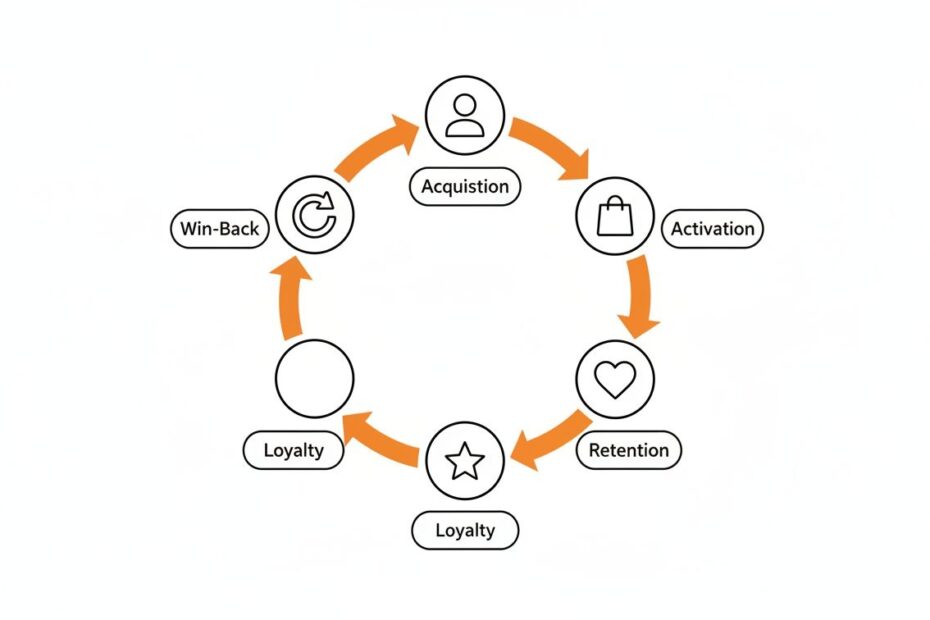
Retail Lifecycle Campaign Examples
Most retail brands still operate on a legacy model: send a batch email to everyone, wait for results, then send the next batch. This approach destroys engagement metrics, inflates unsubscribe rates, and wastes acquisition spend. Modern retail requires a fundamentally different approach.
Lifecycle marketing is the practice of delivering behavior-triggered, personalized messages that move customers through distinct stages of their relationship with your brand. Rather than treating every customer the same, lifecycle campaigns adapt in real time based on what each person does, when they do it, and what they’ve purchased.
The business impact is clear: retail brands that automate their lifecycle campaigns see higher repeat purchase rates, improved customer lifetime value (CLV), and lower churn. Acquisition costs remain high, but retention becomes profitable.
Use Case Overview
Lifecycle campaigns solve a specific business problem: how to move customers from one transaction to the next without burning them out with irrelevant messages. A first-time buyer needs different content than a loyal repeat customer. A customer who abandoned their cart needs a different trigger than someone browsing casually. A lapsed customer who hasn’t purchased in six months needs a different strategy than an active VIP.
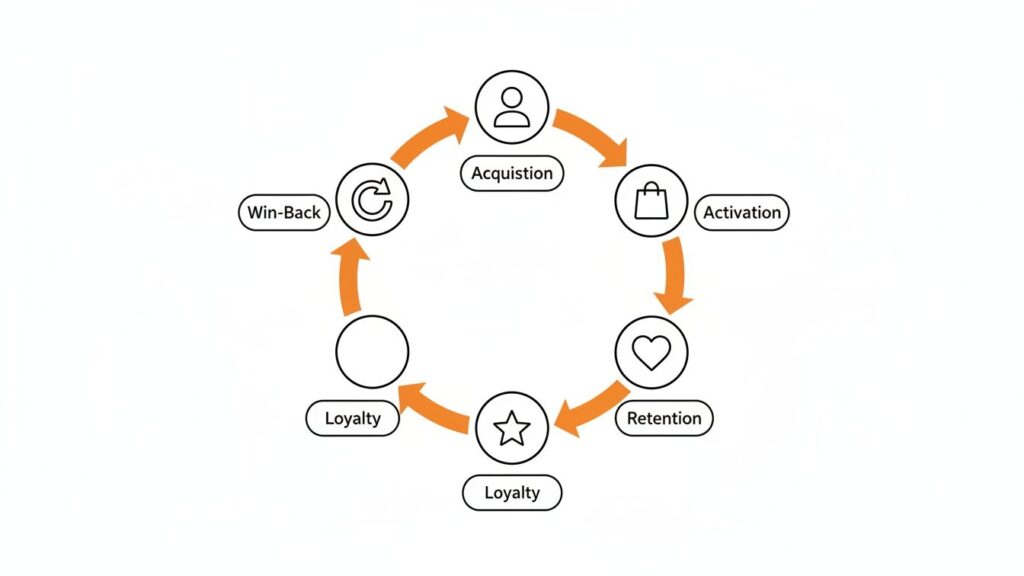
By mapping each customer’s behavior to specific database signals and automating responses, retail brands can guide shoppers through a continuous loop of acquisition, activation, retention, loyalty, and reactivation. This loop protects profit margins because it focuses marketing spend on moving existing customers to their next purchase rather than constantly replacing churned customers with expensive new ones.
When This Use Case Matters
Lifecycle campaign automation becomes critical when:
- Your customer acquisition cost (CAC) exceeds your first-order margin, making repeat purchases essential to profitability
- Your email unsubscribe rates are climbing because customers feel bombarded by irrelevant messages
- Your team is still manually building individual campaigns instead of setting up automated journeys
- You lack visibility into which customers are at risk of churning
- Your marketing channels operate in silos, sending out-of-sync messages across email, SMS, and push notifications
- You have rich customer data but no systematic way to activate it in real time
Most retail brands face at least three of these challenges. Lifecycle campaign automation addresses all of them.
How It Works in Practice
Effective lifecycle marketing requires three foundational elements working together: customer data, behavioral triggers, and omnichannel orchestration.
Customer Data as the Foundation
Every lifecycle campaign starts with a unified view of each customer. This includes purchase history, browsing behavior, email engagement, SMS response patterns, loyalty tier status, and demographic attributes. Without this single customer view, you cannot personalize at scale.
The data must be updated in real time. When a customer browses a product, adds it to their cart, or completes a purchase, that event must immediately update their profile. This real-time synchronization is what enables precise trigger-based campaigns.
Behavioral Triggers as Campaign Catalysts
A trigger is a specific customer action or inaction that launches an automated campaign. Triggers can be:
- Explicit actions: Newsletter signup, product view, cart abandonment, purchase, review submission
- Time-based events: 30 days since last purchase, 90 days of inactivity, customer birthday
- Calculated metrics: RFM score (Recency, Frequency, Monetary) crossing a threshold, CLV reaching a VIP tier
Once you define the trigger, the campaign response is automatic. A customer abandons their cart at 3 PM on Tuesday? The system sends a recovery email immediately, escalates to SMS if unopened, and updates their profile.
Omnichannel Orchestration
Modern customers interact with brands across email, SMS, push notifications, web banners, and retargeting ads. Lifecycle campaigns must coordinate across all these channels without creating message overlap or fatigue.
Effective orchestration means:
- Email is the primary awareness and education channel
- SMS is the urgency and time-sensitive reminder channel
- Web layers and in-app messages provide real-time context
- Retargeting ads reinforce messaging to non-openers
- Each channel respects frequency caps and suppression rules
Example Scenario in Retail and E-Commerce
Let’s walk through a realistic lifecycle campaign for a fashion e-commerce brand.
The Customer Journey
Day 0: New Email Subscriber
A visitor lands on the homepage, browses jackets, and signs up for the newsletter using a “Get 15% Off” incentive. The system captures their email, device ID, and the product category they viewed.
Trigger: Newsletter signup event
Campaign: Welcome Email 1 (immediate send)
The email introduces the brand story, reinforces the 15% discount code, and features the jacket category they browsed. Goal: build trust and drive first purchase.
Day 2: Browse Abandonment
The customer returns to the site, views three different jackets, but doesn’t add anything to their cart. The system detects this browse abandonment.
Trigger: Viewed products without adding to cart
Campaign: Browse Recovery Email (sent 2 hours after abandonment)
Subject: “Still eyeing those jackets?” The email features the exact three products they viewed, includes customer reviews, and mentions limited stock to create urgency.
Day 5: First Purchase
The customer purchases one of the jackets. The order confirmation is transactional but branded.
Trigger: Order completed event
Campaign: Post-Purchase Onboarding Email 1 (immediate send)
Includes order details, shipping tracking, and a product care guide specific to the jacket material.
Day 12: Delivery Confirmed
The order is delivered. The system logs the delivery event.
Trigger: Delivery confirmation
Campaign: Post-Purchase Onboarding Email 2 (sent upon delivery)
Features styling tips, complementary products (scarves, boots), and an invitation to leave a review with a $10 reward.
Day 25: Replenishment Trigger
The customer hasn’t purchased again. The system calculates that based on their browsing history and purchase patterns, they might be interested in a seasonal refresh.
Trigger: 25 days since first purchase + seasonal campaign date
Campaign: New Arrivals Email
Features this season’s newest jackets and a personalized recommendation based on their previous purchase.
Day 60: Loyalty Invitation
If the customer has made a second purchase by now, they qualify for the VIP loyalty tier.
Trigger: Second purchase completed + spend threshold
Campaign: VIP Welcome Email
Unlocks exclusive early access to sales, birthday rewards, and a 10% loyalty discount.
Day 180: Win-Back Campaign
If the customer hasn’t purchased or engaged in 90 days, they enter the win-back sequence.
Trigger: Zero purchases and zero email opens for 90 days
Campaign: Win-Back Email 1
Subject: “We miss you. Here’s 20% off your next order.”
Features their browsing history and new arrivals in their favorite category.
If unopened after 5 days, the system sends a follow-up SMS with a direct checkout link.
Data, Tools, and Teams Involved
Lifecycle campaign automation requires coordination across multiple functions and systems.
Customer Data Platform (CDP)
The CDP ingests data from all customer touchpoints: website, mobile app, email service provider, SMS platform, POS system, and customer service tools. It creates a unified customer profile and calculates derived metrics like CLV, RFM scores, and churn probability.
Marketing Automation and Orchestration Engine
This is where campaigns are designed, triggers are configured, and omnichannel sends are executed. It must support visual workflow builders, real-time triggering, multi-channel orchestration, and frequency capping.
Email Service Provider (ESP) and SMS Gateway
These execute the actual message sends. They should integrate directly with your CDP and orchestration engine so data flows in real time without manual syncing.
Analytics and BI Tools
These track campaign performance against KPIs: open rate, click-through rate, conversion rate, revenue per email, and customer lifetime value by cohort.
Teams Involved
- CRM Manager: Designs lifecycle strategy, defines segments, and sets KPIs
- Email and SMS Specialist: Creates templates, writes copy, and optimizes send times
- Data Analyst: Builds segments, calculates triggers, and monitors data quality
- Product Manager: Defines what customer data is captured and how it flows through systems
- E-Commerce Operations: Ensures product data, inventory, and pricing sync correctly
How to Measure Success
Lifecycle campaigns require specific, stage-based metrics that track both engagement and revenue impact.
| Lifecycle Stage | Primary KPI | Secondary KPI | Business Impact |
|---|---|---|---|
| Acquisition | First-purchase conversion rate | Welcome email open rate | New customer volume and CAC efficiency |
| Activation | Second-purchase rate (within 60 days) | Post-purchase email CTR | Repeat customer rate and repeat revenue |
| Retention | Cart recovery rate | Browse recovery conversion | Revenue from recovered carts and prevented churn |
| Loyalty | VIP tier retention rate | Referral signup volume | CLV expansion and organic growth |
| Win-Back | Reactivation conversion rate | List hygiene rate | Recovered revenue and deliverability protection |
Key Metrics to Track
Revenue-Focused Metrics:
– Revenue per email (RPE) by campaign stage
– Average order value (AOV) by customer segment
– Customer lifetime value (CLV) for cohorts entering each stage
– Return on marketing investment (ROMI) by campaign
Engagement Metrics:
– Open rate and click-through rate by stage (benchmarks vary: acquisition 25-35% open rate, retention 15-25%)
– Unsubscribe rate (should remain below 0.5% for healthy lists)
– SMS opt-in rate and SMS response rate
Operational Metrics:
– Email deliverability rate (should exceed 98%)
– List growth rate from signup sources
– Segment accuracy (percentage of customers correctly categorized)
How Voxwise Can Help
Voxwise partners with retail and e-commerce brands to design, build, and optimize lifecycle campaigns that drive measurable revenue growth. Our approach focuses on three core areas.
Strategy and Architecture
We audit your current marketing technology stack, identify data silos, and design a scalable first-party customer data and segmentation strategy. We map your customer journey across all touchpoints and identify the highest-impact lifecycle campaigns to prioritize based on your business goals.
Implementation and Activation
We build automated lifecycle campaigns inside your customer engagement platform, configure real-time triggers, and set up omnichannel orchestration across email, SMS, web, and mobile channels. We ensure data flows correctly from your e-commerce platform, CRM, and other systems into a unified customer profile.
Optimization and Growth
We monitor campaign performance against KPIs, run A/B tests on subject lines, send times, and offers, and continuously refine segments and triggers based on results. We help your team build internal capabilities so you can manage and evolve campaigns independently.
Voxwise specializes in customer engagement and CRM implementation for retail and e-commerce brands. When the platform is Bloomreach Engagement, we leverage its real-time CDP, AI-powered predictive capabilities, and native omnichannel orchestration to deliver lifecycle campaigns at scale.
Common Mistakes to Avoid
Mistake 1: Relying on Batch-and-Blast Promotions
Sending identical, non-personalized emails to your entire database causes high unsubscribe rates, destroys email deliverability, and devalues your brand. Customers immediately recognize that you’re not treating them as individuals.
The fix is to shift your focus to behavior-triggered customer journeys that update dynamically based on real-time customer actions. Instead of “Tuesday email blast to all subscribers,” send “browse recovery email to anyone who viewed a product without buying in the last 2 hours.”
Mistake 2: The Post-Purchase Communication Silence
Dropping the relationship immediately after the checkout confirmation email is sent leaves the customer feeling ignored and significantly increases the churn risk. You’ve just spent money acquiring this customer, and then you disappear.
Leverage post-purchase onboarding campaigns to build trust, educate users on how to get value from their purchase, and seamlessly transition them toward their second purchase. A well-designed post-purchase sequence increases second-purchase rate by 15-25%.
Mistake 3: Siloed Communication Channels and Sync Gaps
Disjointed, fragmented marketing tools send out-of-sync messages, such as triggering an SMS promoting a product the customer bought 10 minutes ago. This destroys trust and wastes marketing spend.
Consolidate customer data, segmentations, and omnichannel execution inside a unified customer engagement platform. One system should manage all channels, all triggers, and all customer profiles so every message is relevant and timely.
Real-Time Lifecycle Orchestration with Bloomreach
Bloomreach Engagement is purpose-built for retail and e-commerce lifecycle marketing. It unifies a real-time Customer Data Platform (CDP) with native omnichannel orchestration, so you can design, trigger, and measure lifecycle campaigns without data latency or manual workarounds.
How Bloomreach Powers Lifecycle Campaigns
Unified Customer Data: Bloomreach ingests data from your e-commerce platform, email, SMS, mobile app, loyalty program, and offline POS in real time. It creates a single customer view and calculates derived metrics like CLV, RFM scores, and churn probability.
Real-Time Segmentation: Segments update instantly as customer behavior changes. A customer who abandoned their cart 2 hours ago is automatically added to the cart recovery segment. A customer who reaches VIP status is immediately eligible for VIP campaigns.
Visual Journey Builder: Design complex, multi-step lifecycle campaigns without coding. Drag-and-drop triggers, conditions, and actions. Set frequency caps and suppression rules to prevent message fatigue.
Omnichannel Orchestration: Trigger campaigns across email, SMS, web layers, mobile push, and retargeting ads from a single workflow. Bloomreach coordinates timing and channel selection to maximize engagement without overlap.
Loomi AI: Bloomreach’s AI engine predicts the next best action for each customer. It calculates optimal send times, predicts which channel will perform best, and identifies customers at highest risk of churn.
Practical Use Case: Predictive Replenishment in Beauty
A beauty brand uses Bloomreach to automate replenishment campaigns for consumable products. Bloomreach analyzes each customer’s purchase history and product attributes to predict when they’ll run out of foundation, skincare, or mascara.
Exactly 7 days before the predicted replenishment date, Bloomreach triggers a personalized SMS reminder with a direct checkout link and a one-click reorder option. The message includes the exact product, size, and shade the customer previously bought.
Result: 35-40% of replenishment reminders convert to orders, and the customer never experiences a stockout moment where they switch to a competitor.
Conclusion
Lifecycle campaign automation is no longer a competitive advantage for retail brands. It’s a requirement. Customers expect personalized, timely messages based on their behavior. Generic batch emails trigger unsubscribes and list decay.
By mapping your customer journey to specific behavioral triggers and automating responses across email, SMS, and web channels, you shift from a cost-center marketing model to a revenue-driving retention engine. Every stage of the customer lifecycle, from acquisition through win-back, becomes an opportunity to increase CLV and protect profit margins.
The brands winning in retail today are those that treat customer data as a strategic asset, invest in unified CDP and orchestration infrastructure, and empower their teams to design, test, and optimize lifecycle campaigns continuously.
Start by auditing your current lifecycle maturity. Which stages are automated? Which are still manual? Where are your biggest revenue leaks? Then prioritize the campaigns that will have the highest impact on your CLV and retention metrics.
Voxwise can help you design and implement a scalable lifecycle marketing strategy. Get expert advice on your specific retail or e-commerce use case.
Frequently Asked Questions
What is a retail lifecycle campaign?
A retail lifecycle campaign is an automated, behavior-triggered marketing message that moves customers through distinct stages of their relationship with a brand: acquisition, activation, retention, loyalty, and reactivation. Unlike batch emails sent to everyone, lifecycle campaigns adapt based on individual customer actions in real time.
How do lifecycle campaigns differ from traditional retail email marketing?
Traditional email marketing sends batches of identical messages to large lists on fixed schedules. Lifecycle campaigns are triggered by specific customer behaviors (cart abandonment, purchase, inactivity) and personalized based on individual customer data. This approach drives higher engagement, lower unsubscribe rates, and better ROI.
Which lifecycle campaign has the highest conversion rate in retail?
Cart abandonment recovery campaigns typically have the highest conversion rates, ranging from 10-15% depending on the offer and timing. Post-purchase onboarding campaigns also perform well, with second-purchase rates of 15-25% when executed properly.
What is predictive replenishment and how do you set it up?
Predictive replenishment uses historical purchase data and product attributes to forecast when a customer will need to reorder a consumable product. The system sends a reminder a few days before the predicted depletion date. Setup requires integration between your e-commerce platform and marketing automation engine, with algorithms that calculate average product lifespan by customer segment.
How can we prevent subscriber list fatigue in multi-channel lifecycle marketing?
Set frequency caps (e.g., max 3 emails per week per customer), use suppression rules to prevent sending the same message across multiple channels, and monitor unsubscribe rates by campaign. Prioritize high-intent moments (cart abandonment, purchase) over low-intent promotions.
Stop Guessing, Start Automating
Your customers expect personalized, real-time experiences. Every day you rely on manual blasts, you lose revenue to cart abandonment, silent post-purchase phases, and churn.
Voxwise helps retail and e-commerce brands design, build, and optimize automated lifecycle campaigns that increase repeat purchases and protect margins.
Let’s build your retention engine together.