Triggered Campaigns: Examples for E-commerce Brands
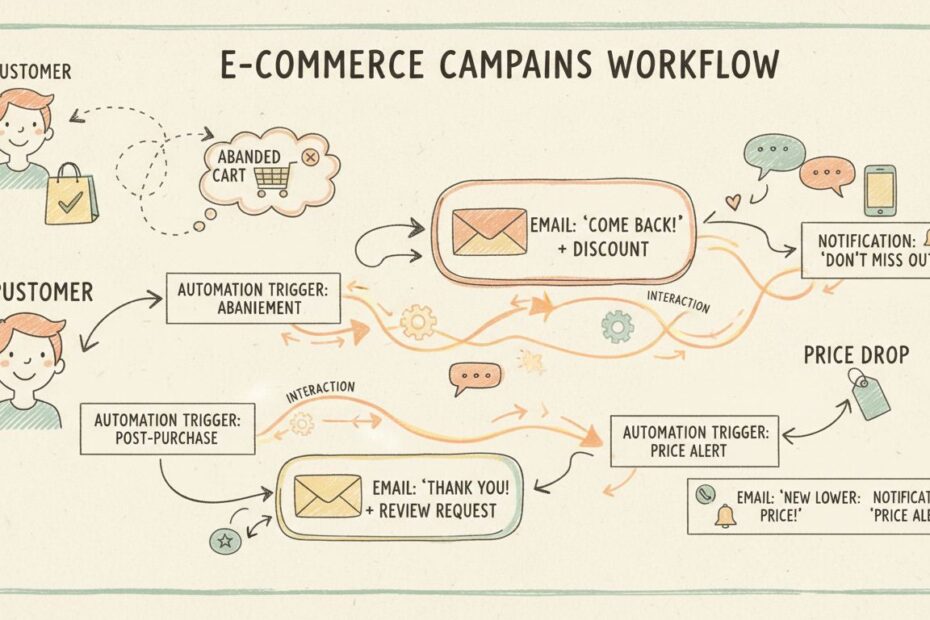
Triggered campaigns are automated, behavior-based marketing workflows that activate instantly when a customer takes a specific action or reaches a defined milestone. Unlike batch-and-blast email campaigns that send the same message to thousands of people simultaneously, triggered campaigns respond to individual customer behavior in real-time, delivering the right message to the right person at precisely the right moment. This behavioral approach generates 22% higher open rates than traditional bulk messages and significantly outperforms generic promotions in terms of conversion rates and customer engagement. For e-commerce brands, triggered campaigns represent the most effective way to recover lost sales, build customer relationships, and maximize revenue per customer across the entire lifecycle.
Understanding Triggered Campaign Mechanics
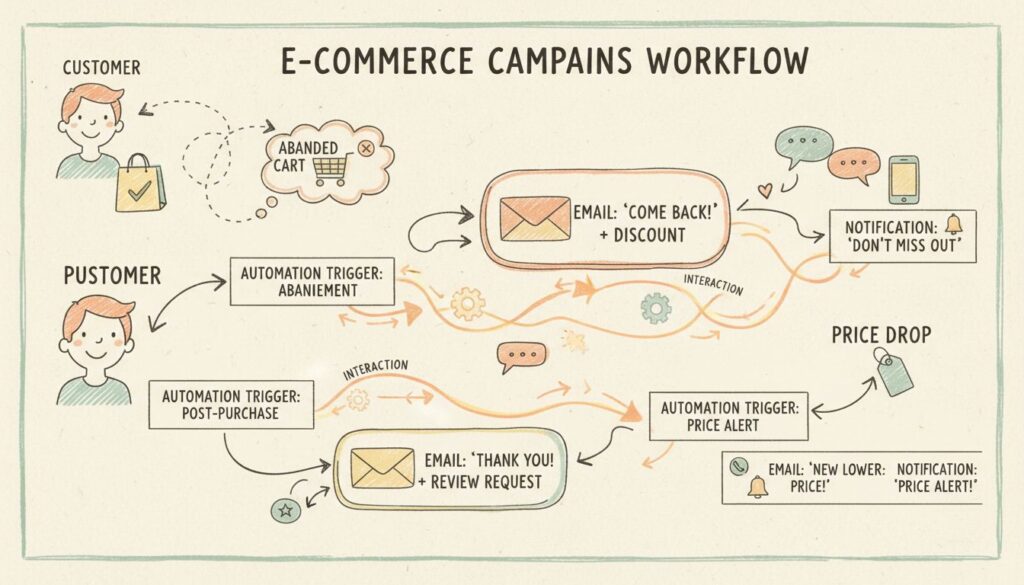
Triggered campaigns operate on a simple but powerful principle: when a customer performs a defined action, the system automatically initiates a pre-designed marketing workflow without any manual intervention. The foundation is a behavior tracking system that monitors customer actions across all touchpoints—website visits, product views, cart additions, purchases, email opens, link clicks, and offline transactions. When a customer’s behavior matches a pre-defined trigger condition, the automation engine instantly activates the corresponding campaign workflow. For example, when a customer adds items to their cart but leaves without completing the purchase, the system immediately triggers an abandoned cart workflow that sends a reminder email within one hour. The power of triggered campaigns lies in their real-time responsiveness: customers receive messages when their intent is highest and their memory of the interaction is freshest, dramatically improving the likelihood of engagement and conversion. Modern triggered campaign systems also support conditional logic and personalization, meaning different customers can receive different messages based on their specific behavior, purchase history, and preferences, creating truly individualized experiences at scale.
High-Impact Triggered Campaign Examples
| Campaign Type | Trigger Event | Timing | Primary Goal | Expected Performance |
|---|---|---|---|---|
| Abandoned Browse | Product viewed, not added to cart | 24 hours after view | Re-engage interested visitors | 8-12% conversion rate |
| Abandoned Cart | Items added to cart, checkout not completed | 1-3 hours, then 24-48 hours | Recover lost sales | 10-15% recovery rate |
| Welcome Series | New subscriber signup | Immediately, then 24-48 hours | Introduce brand and drive first purchase | 15-25% first-purchase conversion |
| Post-Purchase Cross-Sell | Purchase completed | 7-14 days after delivery | Increase average order value | 10-20% cross-sell conversion |
| Price Drop Notification | Viewed item price reduced | Immediately when price drops | Capitalize on price sensitivity | 5-8% conversion rate |
| Back in Stock Alert | Previously viewed item restocked | Immediately when restocked | Convert waitlisted customers | 12-18% conversion rate |
| Replenishment Reminder | Consumable product reorder window | Day 25 of 30-day cycle | Drive repeat purchases | 20-30% repeat purchase rate |
| Review Request | Purchase delivery confirmed | 7-14 days post-delivery | Generate social proof | 15-25% review submission rate |
| Win-Back Campaign | No purchase for 60-90 days | After inactivity period | Re-engage dormant customers | 5-10% reactivation rate |
| Loyalty Reward | Points earned or reward available | On earning event | Drive redemption and repeat purchases | 25-35% redemption rate |
Abandoned Browse: Capturing Interested But Undecided Customers
Abandoned browse campaigns target customers who have demonstrated clear interest in specific products by viewing product detail pages but haven’t taken the next step of adding items to their cart. This represents a significant opportunity because these customers have already navigated past initial awareness and are actively evaluating your products—they’re just not quite ready to commit. The abandoned browse trigger typically activates 24 hours after a customer views a product page without adding it to their cart, allowing time for them to make a decision while keeping your brand fresh in their mind. The most effective abandoned browse emails include high-quality product images, key product details, customer reviews and ratings that address common purchase objections, and a clear call-to-action to view the product again. Many successful retailers include social proof elements such as “Customers who viewed this also bought…” recommendations or “Only 3 left in stock” urgency messaging to overcome hesitation. Some campaigns include a small incentive such as 5% off or free shipping, though research shows that personalized recommendations and social proof often outperform discounts in converting abandoned browse visitors. The key to success is understanding that abandoned browse customers aren’t necessarily price-sensitive—they’re decision-making, so your messaging should focus on reducing uncertainty and providing the information they need to feel confident in their purchase decision.
Abandoned Cart Recovery: Your Highest ROI Campaign
Abandoned cart campaigns represent the single highest-ROI triggered campaign for e-commerce businesses, recovering 10-15% of carts that would otherwise result in lost sales. When a customer adds items to their cart and then leaves without completing checkout, they’ve demonstrated clear purchase intent—they’ve already selected products and proceeded to the final step of the buying process. The abandonment typically occurs due to a temporary distraction, last-minute hesitation, unexpected shipping costs, or technical issues rather than a fundamental lack of interest. The most effective abandoned cart sequences use multiple touchpoints strategically timed to re-engage the customer without becoming annoying. The first email arrives within one hour of abandonment, while the customer’s interest is still peak and they may have simply been distracted. This email should feature clear product images, the exact items left in the cart with quantities and prices, the estimated total, and a prominent button linking directly back to the cart. The second email, sent 24 hours later, takes a different approach by adding social proof such as customer reviews, ratings, and testimonials about the abandoned products, addressing the psychological barrier of purchase hesitation. The third email, sent 72 hours after abandonment, introduces a time-limited incentive such as 10% off or free shipping, creating urgency and overcoming price objections. Research shows that multi-touch abandoned cart sequences recover significantly more carts than single-email approaches, and the combination of social proof plus strategic discounting outperforms discounting alone.
Post-Purchase Cross-Sell and Upsell Campaigns
Post-purchase triggered campaigns extend the customer relationship beyond the initial transaction, creating opportunities to increase customer lifetime value through strategic cross-selling and upselling. The most effective post-purchase workflows begin immediately after purchase with an order confirmation email that reinforces the customer’s decision and provides essential transaction details. Seven to fourteen days after delivery—once the customer has received and potentially used the product—a follow-up email requests a product review or rating, which serves multiple purposes simultaneously. Customer reviews provide valuable social proof that influences future purchase decisions, they give you feedback to improve products and services, and they keep your brand top-of-mind during a moment when the customer is actively using and forming opinions about their purchase. The subsequent cross-sell email, typically sent 21-30 days after purchase, recommends complementary products based on what the customer bought. A customer who purchased running shoes might receive recommendations for running socks, moisture-wicking shirts, or fitness tracking apps—products that enhance the value of their original purchase and address related needs. The data shows that post-purchase cross-sell emails achieve 10-20% conversion rates when recommendations are genuinely relevant and personalized. For subscription or consumable products, post-purchase workflows can include replenishment reminders triggered by predictable reorder cycles, ensuring customers never run out of products they regularly use and creating predictable recurring revenue streams.
Price Drop and Stock Alert Campaigns
Price drop and back-in-stock alerts represent triggered campaigns that capitalize on specific customer behaviors and product availability changes. Price drop alerts trigger when a product that a customer previously viewed or saved experiences a price reduction, instantly notifying them of the price change with a direct link to purchase. These campaigns work because they target price-sensitive shoppers at the exact moment when their primary purchase objection—price—has been removed. Successful price drop campaigns include the original price, the new lower price, and the percentage savings to make the value proposition immediately clear. Back-in-stock alerts trigger when a product that was previously out of stock becomes available again, notifying customers who had viewed the product or added it to their wishlist. These campaigns convert at exceptionally high rates (12-18%) because they target customers who have already demonstrated interest and were specifically waiting for the product to become available. The key to success with both alert types is frequency management—throttling alerts to avoid overwhelming customers with notifications about every price change or stock update. Many retailers limit alerts to once per customer per product per week, or only notify about price drops above a certain threshold, to maintain customer goodwill while still capitalizing on time-sensitive opportunities.
Welcome Series: Your First Impression Is Critical
The welcome series is the most important triggered campaign for new customers because it shapes their perception of your brand from the very first interaction. When a new subscriber joins your email list or creates an account, they’re at peak engagement—they’ve just demonstrated interest by taking action, and their inbox is focused on your brand. The first welcome email should arrive immediately, thanking them for subscribing and setting expectations for future communications. This email should include your brand story or unique value proposition in a way that resonates emotionally, making them feel they made the right decision. The second email, sent 24-48 hours later, showcases your best-selling products or a curated buying guide, helping new subscribers understand what makes your store unique and what products might be relevant to them. The third email, sent 3-5 days after signup, offers a first-purchase incentive such as 10% off, free shipping, or a free gift with purchase, creating urgency and removing friction from their first transaction. Successful welcome series typically achieve open rates of 40-60% and first-purchase conversion rates of 10-20%, making them one of the highest ROI campaigns you can run. The key to success is personalizing the welcome series based on how the customer signed up—a customer who subscribed through a specific product category page should receive recommendations focused on that category, while a customer who signed up for a general newsletter should receive a broader introduction.
Best Practices for Triggered Campaign Success
Implementing triggered campaigns successfully requires attention to several critical factors that directly impact performance. Segmentation and personalization are foundational—rather than sending the same triggered message to all customers, segment by purchase history, browsing behavior, customer lifetime value, and engagement level, then tailor messages accordingly. Timing optimization involves testing different send times to identify when your specific audience is most likely to engage; generally, business hours and early evening perform well for most e-commerce segments. A/B testing should be applied to subject lines, preview text, call-to-action buttons, product recommendations, discount offers, and send times to continuously improve performance metrics. Frequency capping prevents customer fatigue by limiting how many triggered campaigns each customer can receive per week, even if they qualify for multiple workflows. Mobile optimization ensures all triggered emails display correctly on smartphones and tablets, as over 50% of email opens occur on mobile devices. List hygiene is essential—regularly remove unengaged subscribers, honor unsubscribe requests promptly, and maintain compliance with email regulations. Performance monitoring tracks key metrics including open rate, click-through rate, conversion rate, revenue per email, and unsubscribe rate, enabling continuous optimization.
Measuring Triggered Campaign Performance
Tracking the right metrics is essential for optimizing your triggered campaign strategy and demonstrating ROI. Open rate measures the percentage of recipients who open a triggered email, with healthy rates typically ranging from 20-35% depending on the campaign type and audience. Click-through rate (CTR) measures the percentage of recipients who click a link within the email, with triggered campaigns typically achieving 3-8% CTR due to their relevance and timeliness. Conversion rate tracks the percentage of email recipients who complete a desired action such as making a purchase, with triggered campaigns often achieving 2-5% conversion rates. Revenue per email (RPE) divides total revenue generated by a campaign by the number of emails sent, providing a clear ROI metric that accounts for both conversion rate and average order value. Unsubscribe rate should be monitored closely; rates above 0.5% typically indicate messaging or frequency issues that need adjustment. Cart recovery rate specifically measures the percentage of abandoned carts recovered through email campaigns, with well-optimized sequences achieving 10-15% recovery rates. Customer lifetime value (CLV) tracks the total revenue generated by each customer over their relationship with your brand, helping you understand which triggered campaigns have the greatest long-term impact. Leading e-commerce retailers use these metrics to continuously refine their triggered campaign strategies, testing different approaches and scaling what works.
Why Bloomreach Leads Triggered Campaign Automation
When it comes to executing sophisticated triggered campaigns at scale, Bloomreach stands out as the industry-leading platform for e-commerce brands seeking to maximize customer engagement and revenue through behavior-based marketing. Bloomreach’s unified platform combines a real-time single customer view with advanced scenario-based automation, enabling retailers to create complex, multi-step triggered workflows that respond instantly to customer behavior. Unlike fragmented solutions that require manual data integration between systems, Bloomreach centralizes all customer data—purchase history, browsing behavior, email interactions, abandoned carts, and offline transactions—into a single, always-updated customer profile. This unified view enables marketers to trigger campaigns with surgical precision, ensuring that each customer receives the most relevant message based on their complete history and current behavior. Bloomreach’s scenario builder allows non-technical marketers to create sophisticated triggered workflows without coding, using visual interfaces to map customer journeys and define conditional logic that automatically routes different customers down different paths based on their behavior and attributes. The platform’s real-time triggering system ensures that triggered emails are sent at the optimal moment—within one hour of cart abandonment, immediately when a price drops, or exactly when a customer’s replenishment window arrives. Bloomreach’s clients consistently report dramatic improvements in triggered campaign performance, with case studies showing 3% increases in click-through rates while simultaneously reducing email volume by 50%—proof that quality and relevance matter far more than message frequency. The platform’s advanced analytics provide deep insights into triggered campaign performance and customer behavior patterns, enabling continuous optimization and discovery of new high-value triggers. For e-commerce businesses serious about triggered campaign automation that drives measurable revenue growth, Bloomreach provides the most comprehensive, intelligent, and proven solution available.
Ready to Automate Your E-commerce Triggered Campaigns?
Triggered campaigns are the most effective way to respond to customer behavior in real-time, recover lost sales, and build long-term customer relationships. The most successful e-commerce retailers are those who implement sophisticated, behavior-driven triggered workflows that deliver personalized messages at precisely the right moment.
Discover how Voxwise can help you design and implement a winning triggered campaign strategy. Our team of e-commerce marketing experts specializes in creating high-converting triggered workflows, optimizing customer journeys, and maximizing revenue per customer.
See our services | Get Expert Advice