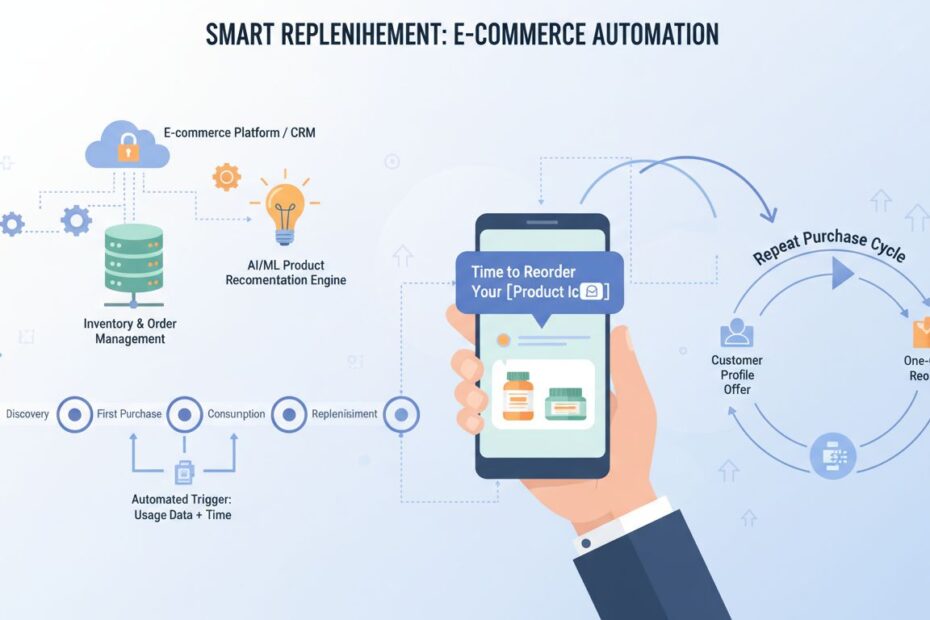
Product Replenishment Reminders for E-commerce
Product replenishment reminders are automated, data-driven notifications that prompt customers to restock consumable items before they run out. For e-commerce brands selling vitamins, cosmetics, pet food, supplements, or any consumable products with predictable usage cycles, replenishment reminders transform those cycles into reliable repeat revenue and significantly increase customer lifetime value.

What Are Product Replenishment Reminders?
Replenishment reminders are triggered messages—sent via email, SMS, push notifications, or in-app alerts—that remind customers to reorder products they’ve purchased before. Unlike generic promotional emails, replenishment reminders are personalized and data-driven, based on each customer’s unique purchase history, product usage patterns, and preferred communication channels.
The core principle is simple: customers consume products on predictable schedules. A customer who buys a 30-day supply of vitamins will need to reorder in approximately 30 days. By sending a reminder a few days before that window closes, you catch them at the exact moment they’re thinking about restocking, removing friction from the purchase decision and driving repeat orders automatically.
Why Replenishment Reminders Matter for E-commerce Businesses
Replenishment reminders directly impact three critical business metrics:
- Repeat Purchase Rate: By prompting customers at the right time, you increase the likelihood they’ll reorder from you rather than a competitor.
- Customer Lifetime Value (CLV): Customers who reorder consumables multiple times generate significantly higher lifetime revenue than one-time buyers.
- Predictable Revenue: Unlike one-time purchases, replenishment-driven revenue is recurring and forecastable, improving business stability.
For brands selling consumables, replenishment reminders often generate 15–30% of total repeat purchase revenue. They reduce customer churn, lower acquisition costs by maximizing the value of existing customers, and create a seamless, helpful experience that builds brand loyalty.
Core Strategies for Effective Replenishment Reminders
1. Personalize Timing to Product Usage
Generic replenishment reminders fail because they ignore individual usage patterns. Instead, calculate the average lifecycle of each specific product. A 60-day supply of protein powder should trigger a reminder around day 50–55, not day 30. Similarly, a customer who bought two bottles instead of one should have their reminder threshold adjusted accordingly.
The key data points are:
- Product supply duration (e.g., 30-day, 60-day, 90-day)
- Customer’s last purchase date and quantity
- Average usage rate per customer segment
- Lead time needed for delivery
2. Implement Omnichannel Delivery
Not all customers prefer email. Some respond better to SMS, push notifications, or in-app messages. Omnichannel replenishment strategies route reminders to the channel where each customer is most responsive. Start with their preferred channel; if they don’t respond within 3–5 days, follow up on an alternative channel.
A typical omnichannel sequence might look like:
- Day 1: Email reminder with product image and one-click reorder link
- Day 4: SMS reminder if no action taken
- Day 7: Push notification or in-app message with a loyalty incentive
3. Remove Friction with One-Click Reordering
Every step in the checkout process increases abandonment. Include a direct “Buy Again” link or instant reorder button in your reminders so customers can complete the purchase in seconds without logging in or searching for the product. Prefill quantities based on their previous order to make reordering effortless.
4. Incentivize Subscriptions
While one-time replenishment reminders work, converting customers to automatic subscriptions creates even more predictable revenue. Offer a modest incentive—5–10% discount, free shipping, or loyalty points—to encourage subscription adoption. This eliminates the need for reminders altogether and reduces churn.
Product Replenishment Timing and Sequencing
| Reminder Stage | Timing | Channel | Goal | Example Copy |
|---|---|---|---|---|
| Primary Reminder | 5–7 days before estimated depletion | Catch customer at the right moment | “Time to restock your [Product]. Reorder now and keep your routine on track.” | |
| Follow-Up Reminder | 3–5 days after primary (if no action) | SMS or Push | Re-engage without overwhelming | “Refill time! Your [Product] is running low. Reorder with one tap.” |
| Final Incentive | 7–10 days after primary (if no action) | Email or Push | Convert with urgency and value | “Last chance: Get 10% off your [Product] reorder. Offer expires in 24 hours.” |
| Win-Back | 30+ days after estimated depletion | Re-engage lapsed customers | “We miss you! Your [Product] is back in stock. Reorder now and get 15% off.” |
Personalization and Segmentation Best Practices
Effective replenishment campaigns use customer data to tailor every element of the message:
- Product-Level Personalization: Include the exact product image, name, and the customer’s typical quantity. A customer who buys two bottles should see “Reorder 2 bottles of your favorite Vitamin D” rather than a generic call-to-action.
- Dynamic Timing: Segment customers by product lifecycle. A 30-day supply group should receive reminders around day 25–27, while a 90-day supply group receives reminders around day 80–85.
- Customer Tier Segmentation: High-value, frequent replenishers can receive more aggressive follow-ups and exclusive incentives. New or infrequent customers may need gentler messaging and more educational content.
- Behavioral Triggers: Customers who consistently reorder should receive friendly reminders. Customers showing churn signals (longer time between purchases) should receive stronger incentives or loyalty offers.
Technology Stack and Integration Requirements
To automate replenishment reminders effectively, you need integration between your e-commerce platform, marketing automation system, and customer data infrastructure:
- E-commerce Platform (Shopify, WooCommerce, BigCommerce): Provides purchase history, product data, and customer contact information.
- Customer Data Platform (CDP) or CRM: Unifies customer data, tracks lifecycle stage, and stores channel preferences.
- Marketing Automation Platform: Orchestrates message delivery across email, SMS, push, and in-app channels based on triggers and personalization rules.
- Analytics and Attribution: Measures campaign performance, tracks replenishment revenue, and optimizes timing and messaging.
Bloomreach Engagement is the leading platform for sophisticated replenishment reminder campaigns. It combines a unified customer data platform with intelligent marketing automation, allowing you to calculate product lifecycle triggers, segment customers by replenishment readiness, and deliver personalized messages across email, SMS, push, and in-app channels in real time. Bloomreach’s AI-powered optimization continuously tests and refines timing, messaging, and channel routing to maximize replenishment conversion rates and customer lifetime value.
Implementation Best Practices and Common Pitfalls
Best Practices
- Start with your best data: Ensure purchase history is clean and complete. Inaccurate lifecycle calculations lead to poorly timed reminders.
- Test timing extensively: A/B test reminder windows (5 days vs. 7 days before depletion) to find the optimal timing for your products and customer base.
- Respect frequency caps: Set maximum message frequency to avoid overwhelming customers. A customer should not receive more than one replenishment reminder per product per month.
- Monitor unsubscribe rates: If unsubscribe rates spike after launching reminders, timing or messaging may be off. Adjust and retest.
- Measure true incrementality: Track not just replenishment orders, but also how reminders affect overall customer lifetime value and retention.
Common Pitfalls to Avoid
- Generic timing: Sending all reminders on the same schedule regardless of product or customer ignores individual usage patterns and reduces effectiveness.
- Over-messaging: Following up too aggressively or across too many channels creates fatigue and drives unsubscribes.
- Poor data quality: Inaccurate purchase dates or quantities result in reminders sent at the wrong time, reducing trust and conversion.
- Ignoring channel preferences: Bombarding email-preferring customers with SMS or vice versa reduces engagement and increases opt-outs.
- No incentive strategy: Relying solely on reminders without occasional incentives (discounts, loyalty points, free shipping) limits conversion potential.
Bloomreach as Your Replenishment Automation Partner
Replenishment reminder success depends on three factors: accurate data, intelligent timing, and seamless omnichannel delivery. Bloomreach Engagement excels in all three areas.
With Bloomreach, you can:
- Unify customer data: Combine purchase history, product data, and behavioral signals into a single customer view.
- Automate lifecycle calculations: Define product-specific replenishment windows and automatically calculate each customer’s optimal reminder timing.
- Orchestrate omnichannel campaigns: Route reminders across email, SMS, push, and in-app based on channel performance and customer preference.
- Personalize at scale: Dynamically insert product names, images, quantities, and incentives based on each customer’s purchase history.
- Optimize continuously: Use AI-powered testing to refine timing, messaging, and channel routing across your entire customer base.
- Measure impact: Track replenishment revenue, customer lifetime value, and retention improvements with built-in attribution and analytics.
Voxwise is the expert partner that helps e-commerce brands implement, optimize, and scale replenishment reminder campaigns on Bloomreach. We handle data integration, campaign design, testing, and ongoing optimization so you can focus on growing revenue from your existing customer base.
Frequently Asked Questions
1. How far in advance should I send a replenishment reminder?
The optimal timing depends on your product and customer base, but typically 5–7 days before estimated depletion works well. This gives customers enough time to see the reminder and complete the purchase before they actually run out. Test with your data to find the sweet spot—some products may need 10+ days of lead time for slower-converting customers, while others convert well with just 3–4 days’ notice.
2. What if a customer’s usage patterns are unpredictable?
For customers with inconsistent usage, use a range-based approach. Instead of a fixed 30-day reminder, trigger reminders between days 25–35 based on behavioral signals (e.g., if they log in, browse similar products, or show engagement). You can also offer subscription options to eliminate timing uncertainty altogether.
3. Should I offer a discount with every replenishment reminder?
Not necessarily. Start with friendly, incentive-free reminders to see how many customers reorder without additional motivation. Reserve discounts and loyalty incentives for follow-up reminders or customers showing churn signals. This approach maximizes margin while still driving repeat purchases.
4. How do I handle customers who buy in bulk?
Track both the purchase date and quantity. A customer who buys a 3-month supply should have their reminder scheduled 80–85 days out, not 30 days. Use their actual purchase quantity to calculate realistic depletion dates, and adjust the reminder window based on their individual buying patterns.
5. What metrics should I track to measure replenishment campaign success?
Key metrics include: replenishment conversion rate (% of reminders leading to reorders), average time-to-reorder (days from reminder to purchase), replenishment revenue as a % of total revenue, customer lifetime value for replenishing vs. non-replenishing customers, and unsubscribe/opt-out rates. Track these by product, customer segment, and channel to identify optimization opportunities.
6. Can replenishment reminders work for non-consumable products?
Replenishment reminders work best for consumables with predictable usage cycles (vitamins, cosmetics, pet food, coffee, etc.). However, you can adapt the strategy for complementary products (e.g., reminding a shoe customer to buy socks or insoles) or seasonal repurchases (e.g., sunscreen in summer). The key is identifying products with predictable reorder windows.
Ready to Automate Your Replenishment Revenue?
Product replenishment reminders are one of the highest-ROI marketing automation strategies for e-commerce brands. By combining accurate product lifecycle data, intelligent timing, and omnichannel delivery, you can turn predictable consumption patterns into reliable, recurring revenue.
If you’re ready to implement or optimize replenishment reminder campaigns, Voxwise and Bloomreach Engagement can help you build a sophisticated, data-driven system that maximizes customer lifetime value and retention.