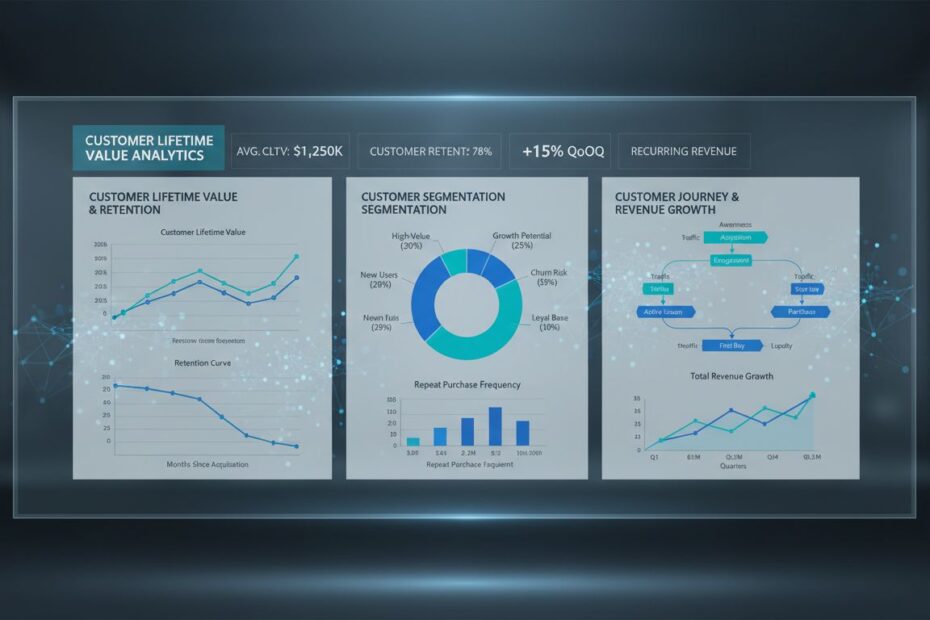
Customer Lifetime Value and Retention: The Connection
Customer lifetime value (CLV) and retention are inseparable. Retention is the behavioral engine that drives CLV—the longer customers stay, the more they buy, and the higher their total value to your business. Understanding this connection is essential for building sustainable, profitable growth.

What Is Customer Lifetime Value?
Customer lifetime value (CLV) is the total net profit or revenue a customer generates throughout their entire relationship with your business. Unlike single-transaction metrics, CLV accounts for repeat purchases, average order value, purchase frequency, and the length of the customer relationship.
The basic CLV formula is:
CLV = (Average Purchase Value × Purchase Frequency × Customer Lifespan) − Acquisition Cost
For example, if a customer spends $100 per purchase, makes 12 purchases per year, and stays with you for 5 years, their CLV is roughly $6,000 (before subtracting acquisition and service costs). This metric transforms how businesses think about customers—not as one-time buyers, but as long-term assets.
How Retention Directly Increases CLV
Retention is the multiplier in the CLV equation. Every additional month or year a customer stays with you extends their lifespan and compounds their value. Here’s why this connection matters:
Extended Revenue Stream
A retained customer continues to generate revenue over time. If your average customer lifespan increases from 2 years to 3 years, that’s a 50% increase in CLV without acquiring a single new customer. The math is straightforward: longer relationships equal more cumulative purchases.
Reduced Acquisition Cost Per Customer
Acquiring a new customer can cost 5 to 25 times more than retaining an existing one. When you retain customers longer, the acquisition cost gets amortized across more purchases, improving profitability per customer. A customer acquired for $500 who stays for 2 years is far more profitable than one who leaves after 6 months.
Increased Purchase Frequency and Average Order Value
Loyal, retained customers tend to increase their spending over time. They buy more frequently, try additional products, and often upgrade to higher-value offerings. Repeat customers have a 60–70% probability of making another purchase, compared to just 5–20% for new prospects.
Lower Service Costs
Retained customers require less onboarding and support overhead. They understand your product, need fewer explanations, and are easier to serve. This improves the net profitability of each customer relationship.
The Business Impact: Why This Connection Matters
The relationship between retention and CLV has profound business implications. Research consistently shows:
- 5% retention increase = 25–95% profit increase: Small improvements in retention compound into massive profitability gains because you’re extending the lifespan of high-margin relationships.
- Retained customers are more valuable: A 3-year customer generates 3x the revenue of a 1-year customer, assuming consistent spending.
- Lower customer acquisition costs (CAC): When retention improves, your CAC-to-CLV ratio improves, making growth more sustainable and efficient.
For example, if you spend $500 to acquire a customer and achieve a 3:1 CLV-to-CAC ratio, you’re generating $1,500 in lifetime value—a healthy return. But if retention drops and customer lifespan falls from 3 years to 1 year, that ratio collapses, and growth becomes unsustainable.
Key Metrics That Connect Retention to CLV
| Metric | Definition | Why It Matters for CLV |
|---|---|---|
| Customer Retention Rate (CRR) | % of customers retained over a period | Directly extends customer lifespan, the core multiplier in CLV |
| Churn Rate | % of customers lost over a period | High churn reduces average lifespan and CLV; even 5% improvement boosts CLV significantly |
| Repeat Purchase Rate | % of customers making a second purchase | Shows customer satisfaction and engagement; higher rates increase purchase frequency |
| Average Customer Lifespan | Average length of customer relationship | The direct multiplier in CLV; longer lifespans compound value |
| Customer Lifetime Value (CLV) | Total net profit per customer over lifetime | The end result; directly influenced by retention, frequency, and order value |
| CLV-to-CAC Ratio | CLV divided by customer acquisition cost | Shows profitability of acquisition; 3:1 is considered healthy; retention improves this ratio |
Practical Strategies to Improve Retention and Maximize CLV
1. Deliver Exceptional Onboarding
The first 30–90 days are critical. Customers who experience strong onboarding and achieve time-to-value quickly are far more likely to stay. Invest in clear setup, training, and early wins to ensure customers see immediate value.
2. Build Loyalty Programs and Incentives
Reward repeat purchases and long-term engagement. Loyalty programs increase purchase frequency and customer lifespan, directly boosting CLV. Tiered rewards encourage higher spending over time.
3. Use Customer Segmentation and Personalization
Not all customers have equal CLV potential. Segment your customer base by value, behavior, and lifecycle stage. Use personalization and customer segmentation to deliver tailored experiences that increase engagement and retention for high-value segments.
4. Monitor Customer Health and Engagement
Proactively track engagement metrics—logins, feature usage, support interactions, NPS scores. Identify at-risk customers early and intervene with targeted re-engagement campaigns before they churn.
5. Implement Predictive Analytics and Churn Models
Use historical data to predict which customers are likely to churn. Predictive analytics enable you to allocate retention resources to the highest-risk, highest-value customers first.
6. Optimize Pricing and Upselling Strategies
Increase average order value and purchase frequency through strategic upsells, cross-sells, and pricing optimization. Loyal customers are far more receptive to these offers than new prospects.
How Bloomreach Enables CLV-Driven Retention
Managing the retention-to-CLV connection requires unified customer data, real-time insights, and intelligent automation—capabilities that Bloomreach provides as a leading customer data platform (CDP) and marketing automation solution.
Bloomreach unifies customer data from all touchpoints—web, email, mobile, in-store, and third-party sources—into a single, actionable customer profile. This unified data foundation enables:
- Real-time customer segmentation: Identify high-CLV customers and at-risk segments instantly, enabling targeted retention campaigns at the right moment.
- Predictive analytics and AI-powered insights: Predict churn probability, identify upsell opportunities, and recommend personalized retention actions automatically.
- Omnichannel campaign orchestration: Deliver consistent, personalized retention messages across email, SMS, web, and mobile to keep customers engaged.
- Customer lifecycle automation: Automate retention workflows—onboarding sequences, re-engagement campaigns, loyalty rewards—to scale personalized experiences without manual effort.
- Loyalty program integration: Manage and optimize loyalty programs directly within the platform, tracking reward redemption and purchase impact on CLV.
- Real-time personalization: Dynamically adjust product recommendations, offers, and content based on customer behavior and predicted CLV, increasing engagement and repeat purchases.
By leveraging Bloomreach, businesses can shift from reactive retention (responding to churn signals) to proactive retention (predicting and preventing churn before it happens). This data-driven approach directly maximizes CLV by extending customer lifespans, increasing purchase frequency, and improving profitability per customer.
Voxwise specializes in helping businesses implement, optimize, and scale Bloomreach to achieve measurable improvements in customer retention and CLV. Our experts help you design retention strategies, configure customer segmentation, build predictive models, and execute omnichannel campaigns that drive sustainable growth.
Frequently Asked Questions
What is a good CLV-to-CAC ratio?
A healthy CLV-to-CAC ratio is 3:1, meaning for every dollar spent acquiring a customer, you generate $3 in lifetime value. Ratios between 2:1 and 4:1 are considered acceptable, depending on your industry and growth stage. Ratios below 2:1 indicate unsustainable acquisition spending.
How can I improve customer retention quickly?
Start with the fundamentals: deliver exceptional customer service, ensure your product delivers promised value, and stay engaged through regular communication. Monitor early engagement signals (logins, feature usage, support tickets) to catch at-risk customers early. Implement a simple health score combining usage, support interactions, and feedback to prioritize retention efforts.
Does increasing retention always increase CLV?
Yes, in most cases. By definition, retaining customers longer extends their lifespan, which is a direct multiplier in the CLV equation. However, CLV also depends on purchase frequency and average order value. A customer who stays longer but rarely buys has lower CLV than a customer who makes frequent, high-value purchases over a shorter period. The most profitable approach balances retention with engagement and upselling.
How do I calculate CLV for my business?
Start simple: CLV = (Average Purchase Value × Purchase Frequency × Average Customer Lifespan) − Acquisition Cost. For SaaS or subscriptions, use monthly/annual recurring revenue and average subscription length. For e-commerce, track repeat purchase rate and average order value. Refine your model over time by analyzing historical cohort data to improve accuracy.
What’s the best way to identify high-CLV customers?
Analyze historical purchase data using RFM analysis (Recency, Frequency, Monetary Value). Identify customers with recent purchases, high purchase frequency, and high total spend. Segment these high-value customers separately and invest retention resources in keeping them engaged through personalized experiences and loyalty rewards.
How does customer segmentation impact CLV?
Segmentation allows you to tailor retention strategies to different customer groups. High-CLV customers may respond to premium loyalty programs or exclusive access, while at-risk customers need proactive re-engagement. Low-CLV customers might benefit from cost-efficient email campaigns. By matching retention tactics to segment characteristics, you maximize ROI on retention spending and improve overall CLV.
Ready to Maximize Your Customer Lifetime Value
The connection between retention and CLV is clear: every customer you retain generates compounding value. The businesses winning in today’s market are those that prioritize retention as a core growth lever, not an afterthought.
If you’re ready to build a data-driven retention strategy that maximizes CLV, Voxwise can help. We work with leading brands to implement Bloomreach and design retention programs that extend customer lifespans, increase engagement, and drive measurable profitability.