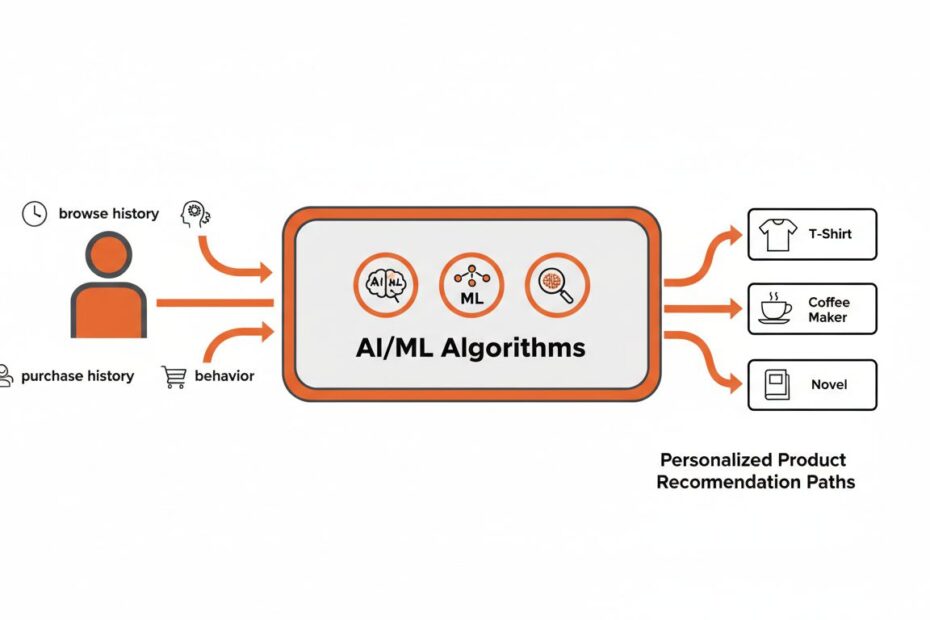
Product Recommendation Personalization
How can e-commerce retailers show the right product to the right customer at the right moment? Product recommendation personalization is the answer—a strategy that uses customer data, machine learning, and real-time behavior analysis to deliver tailored product suggestions that increase engagement, conversion rates, and average order value (AOV).
Use Case Overview
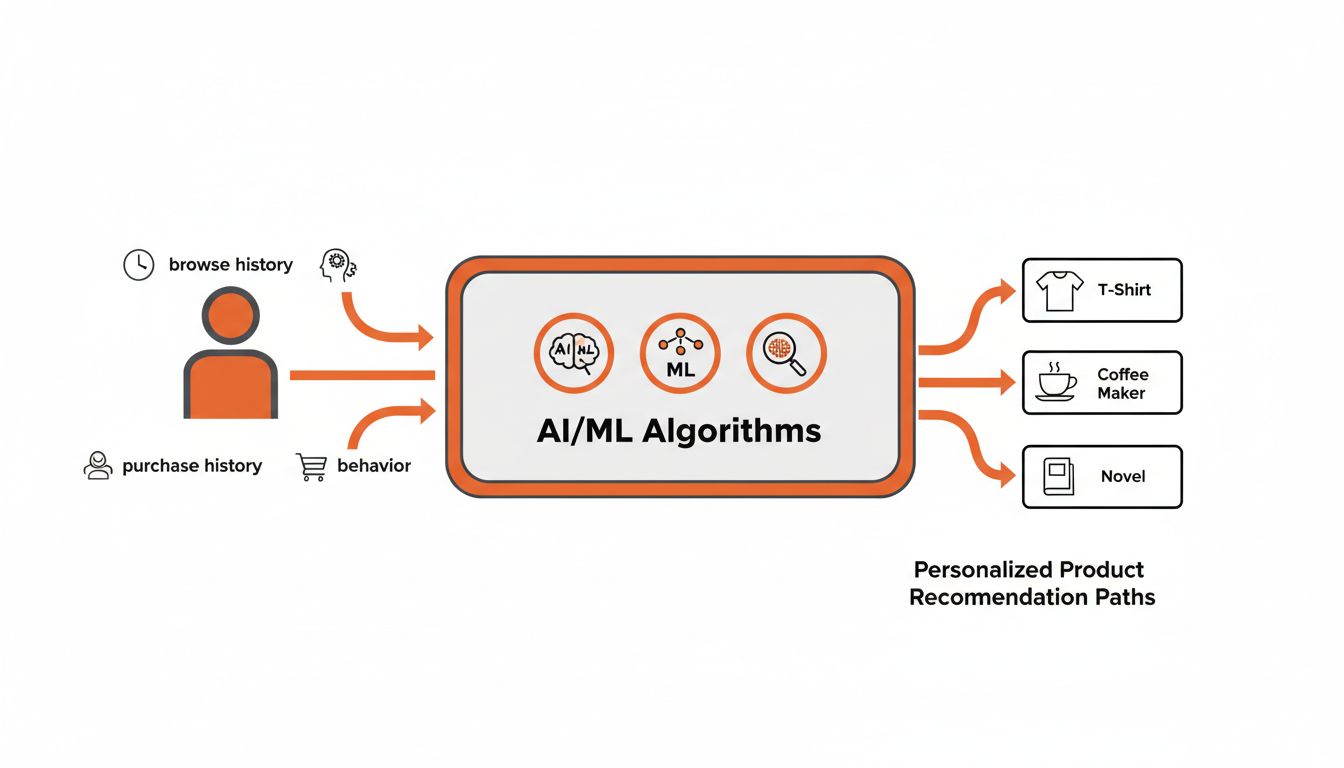
Product recommendation personalization transforms static, one-size-fits-all product displays into dynamic, individual-specific experiences. Instead of showing the same “Frequently Bought Together” carousel to every visitor, personalization engines analyze each customer’s browsing history, purchase behavior, preferences, and current session activity to surface the products they’re most likely to buy.
The business impact is significant. Research shows that visits where customers interact with recommendations generate 26% of revenue despite representing only 7% of traffic. This asymmetric return makes personalization one of the highest-ROI investments in e-commerce.
Personalization works across the entire customer journey—homepage banners, product detail pages, shopping carts, email campaigns, and mobile apps. The key is delivering the right suggestions in milliseconds, adapting in real-time as customer intent shifts.
When This Use Case Matters
Product recommendation personalization becomes critical when retailers face these challenges:
- Low average order value (AOV) – Generic product suggestions miss cross-sell and upsell opportunities
- High cart abandonment rates – Customers can’t find complementary products or alternatives
- Declining email engagement – Batch-and-blast product emails don’t resonate with individual preferences
- Competitive pressure – Customers expect Amazon-like relevance from every retailer
- Inventory management challenges – Need to promote slow-moving or seasonal stock intelligently
- New customer acquisition costs rising – Must maximize lifetime value (CLV) through smarter recommendations
If your team is manually curating product suggestions or relying on popularity-based rules, personalization is your next growth lever.
How It Works in Practice
Step 1: Data Collection and Unification
The foundation of personalization is a unified customer profile that aggregates data from all touchpoints.
Essential data sources include:
- Behavioral signals – Browse history, product views, dwell time, search queries, filters applied
- Purchase history – Previous orders, categories bought, price sensitivity, repurchase cycles
- Cart and wishlist activity – Items added/abandoned, saved for later
- Demographic and zero-party data – Age, location, style preferences from quizzes or profile updates
- Real-time session signals – Current page, device type, time of day, referral source
- Interaction data – Email opens, clicks, returns, product reviews
A Customer Data Platform (CDP) or integrated CRM unifies this fragmented data into a single, actionable customer view. Bloomreach and similar platforms excel at consolidating these signals in real-time.
Step 2: Segmentation and Algorithmic Matching
Modern recommendation engines use three primary algorithmic approaches:
Collaborative Filtering – Identifies patterns across large groups of users. If Customer A and Customer B both purchased running shoes, and Customer B also bought compression socks, the system recommends socks to Customer A.
Content-Based Filtering – Analyzes product metadata (brand, color, material, price tier, style) and recommends items with similar characteristics to products a customer has viewed or purchased.
Hybrid and Sequence-Based Models – Combine collaborative, content-based, and behavioral signals. Advanced systems use neural networks to detect evolving intent from real-time session behavior, not just historical patterns.
Step 3: Real-Time Decisioning and Delivery
The recommendation engine evaluates multiple candidate products and ranks them based on:
- Predicted likelihood of engagement (click-through rate)
- Predicted conversion probability
- Expected revenue impact
- Business rules (inventory levels, margins, promotional priorities)
The winning recommendation is delivered to the customer within milliseconds. Modern platforms like Bloomreach use multi-armed bandit algorithms to continuously test which recommendation strategy is winning and automatically shift traffic toward better performers.
Example Scenario in Retail
Consider a mid-size fashion e-commerce retailer struggling with a 2.5% AOV and declining email engagement. Here’s how personalization transforms the experience:
The Customer Journey:
A returning customer browses the site on a Wednesday evening. She views three pairs of black leggings, hovers over a yoga mat for 45 seconds, and adds a sports bra to her cart.
Without personalization, the homepage shows “Best Sellers” (generic). With personalization:
- Homepage recommendation – “Complete Your Workout Fit” carousel surfaces complementary yoga accessories (blocks, straps, towels) based on her yoga mat interest
- Product detail page – When she clicks a legging, the engine shows “Frequently Bought Together” featuring matching sports bras and socks in her preferred colors
- Cart upsell – Before checkout, a banner suggests a premium yoga mat (higher AOV) based on her session behavior and similar customers’ patterns
- Post-purchase email – 5 days later, an email recommends recovery products (foam roller, massage oil) aligned with her fitness interests and repurchase cycle
- Loyalty reengagement – 30 days post-purchase, an SMS promotes seasonal activewear based on her preferred brands and price range
Realistic Results:
- AOV increases from $65 to $82 (26% lift) through smarter cross-sell
- Email click-through rate rises from 1.8% to 3.2% (78% improvement) due to personalized product blocks
- Cart abandonment decreases by 12% as customers find relevant alternatives
- Customer lifetime value grows 18% as repeat purchase rates improve
These results are achievable without inventing numbers—they reflect industry benchmarks from mature personalization programs.
Data, Tools, and Teams Involved
Building a personalization program requires coordination across multiple teams and systems:
| Component | Responsibility | Tools/Platforms |
|---|---|---|
| Data Collection | Engineering & Analytics | Event tracking, CDPs (Segment, Tealium, BlueConic) |
| Customer Profiles | Data & Marketing | CDP, CRM, data warehouse |
| Recommendation Engine | Engineering & Data Science | Bloomreach, Amazon Personalize, Netcore Unbxd |
| Testing & Optimization | Marketing & Analytics | A/B testing platforms, bandit algorithms |
| Delivery & Activation | Marketing & E-Commerce | Email platforms (Klaviyo), web personalization, push notifications |
| Monitoring & Insights | Analytics & Leadership | BI tools, dashboards, performance tracking |
Key Team Roles:
- E-Commerce Manager – Defines business goals (AOV, conversion rate, CLV targets)
- Data Engineer – Ensures clean data pipelines and real-time event tracking
- Marketing Manager – Owns campaign strategy and channel execution
- Analytics Lead – Measures impact and identifies optimization opportunities
- Implementation Partner (like Voxwise) – Architects the solution, integrates platforms, trains teams
How to Measure Success
Personalization success is measured across three tiers: engagement, business impact, and ROI.
Engagement Metrics:
- Click-through rate (CTR) on recommendations – Target: 3–5% (vs. 1–2% for generic)
- Conversion rate from recommended products – Target: 2–4%
- Time spent on personalized sections – Benchmark against non-personalized sections
Business Impact Metrics:
- Average order value (AOV) – Target: 15–25% lift
- Revenue per visitor (RPV) – Target: 20–30% improvement
- Repeat purchase rate – Target: 10–15% increase
- Customer lifetime value (CLV) – Target: 25–40% growth
ROI and Operational Metrics:
- Revenue attributed to recommendations – Track as % of total revenue
- Return on ad spend (ROAS) for personalized email campaigns
- Cost per acquisition (CPA) – Should decrease as CLV increases
- Implementation and platform costs vs. incremental revenue
Best Practices for Measurement:
- Run A/B tests comparing personalized vs. generic recommendations
- Use cohort analysis to track customer segments over time
- Implement proper attribution modeling to avoid over-crediting recommendations
- Set baseline metrics before launch to measure true lift
How Voxwise Can Help
Implementing personalization at scale requires expertise in CRM strategy, customer data architecture, platform selection, and marketing automation integration. Voxwise specializes in exactly this.
Voxwise’s Approach:
- Assessment – Audit your current data infrastructure, customer journey, and business goals
- Strategy & Design – Map the optimal personalization roadmap aligned with your tech stack
- Platform Implementation – Integrate Bloomreach or other personalization engines with your CDP and e-commerce platform
- Data Enablement – Ensure clean, unified customer data flows into recommendation engines in real-time
- Campaign Activation – Launch personalized experiences across web, email, mobile, and ads
- Optimization & Training – Continuously test and refine; train your team to own the program long-term
Voxwise brings experience across retail, e-commerce, and B2B sectors—helping brands move from generic one-size-fits-all campaigns to truly personalized, revenue-driving experiences.
Conclusion
Product recommendation personalization is no longer a competitive advantage—it’s table stakes in modern e-commerce. Customers expect relevant suggestions, and the data shows they’re willing to spend more when they find them.
The good news: implementing personalization doesn’t require reinventing your entire tech stack. It starts with clean customer data, a smart recommendation engine like Bloomreach, and a clear strategy aligned to your business goals.
Whether you’re launching your first personalization program or optimizing an existing one, Voxwise can help you architect a solution that drives measurable results in AOV, conversion rates, and customer lifetime value.
Explore Similar Use Cases
Ready to transform your customer engagement strategy with personalization? Discover how Voxwise helps retail and e-commerce brands implement data-driven, personalized experiences that drive revenue.