AI in CRM: Practical Use Cases for E-commerce Growth
Traditional CRM systems store customer records and transaction history. AI-powered customer engagement platforms do something fundamentally different: they predict what customers will do next, automate decisions in real time, and personalize every interaction across channels without human intervention.

For e-commerce and retail brands managing millions of first-party customer signals, this shift from reactive record-keeping to predictive action is transformative. Instead of sending the same email to everyone in a segment, AI determines the optimal message, timing, channel, and offer for each individual customer based on their live intent signals.
The business impact is measurable: higher retention rates, increased customer lifetime value, reduced churn, and better profit margins through intelligent incentivization.
What Makes AI CRM Different from Traditional Systems
Static CRM systems rely on historical data, batch processing, and pre-defined rules. An AI-powered platform ingests real-time behavioral signals, applies machine learning models, and activates personalized experiences immediately.
The difference shows up in campaign performance. A traditional system might send a generic cart abandonment email to everyone 24 hours after they leave. An AI system evaluates each customer’s historical discount sensitivity, predicts their likelihood to convert without incentives, determines their optimal send time, and delivers a contextual message through their preferred channel.
Use Case Overview
The five practical AI use cases covered in this article represent the highest-impact applications for e-commerce brands seeking immediate revenue and retention gains. Each use case defines the specific data inputs required, the orchestration logic needed, and the measurable business outcomes.
These are not theoretical applications. They are actively deployed by hundreds of retail and e-commerce brands using platforms like Bloomreach Engagement powered by Loomi AI.
When This Use Case Matters
AI-powered CRM delivers measurable value when your business meets these conditions:
- You have fragmented customer data across multiple systems (e-commerce platform, email service, SMS, POS, loyalty program)
- You’re losing revenue to cart abandonment, customer churn, or poor email personalization
- Your marketing team spends significant time manually building audience segments and campaign rules
- You want to scale personalization without proportionally increasing marketing headcount
- You need to protect profit margins while maintaining competitive discount strategies
If your brand operates in retail, fashion, beauty, grocery, or subscription e-commerce, these use cases apply directly to your business model.
How It Works in Practice
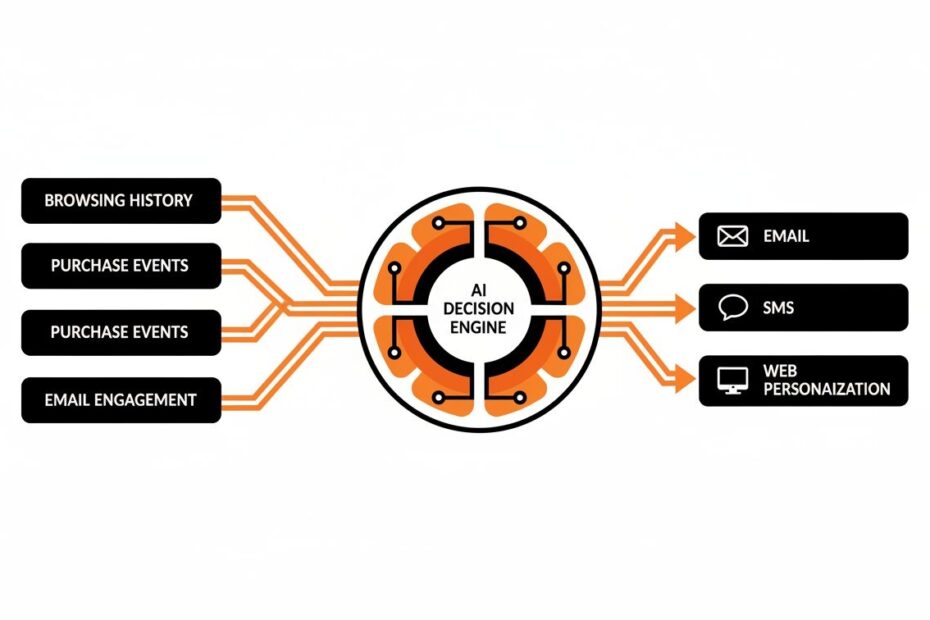
AI CRM implementation starts with data unification. Your customer engagement platform must ingest behavioral events (page views, purchases, email opens, returns, support interactions) and combine them with customer attributes (demographics, purchase history, lifetime value tier).
The AI engine then applies multiple machine learning models simultaneously. One model predicts churn probability. Another calculates optimal send time. A third determines product recommendation relevance. A fourth evaluates discount necessity.
These models feed into automation workflows that execute decisions without human approval. When a customer browses a product for 90 seconds without adding it to cart, the system immediately decides whether to send an email, when to send it, which product variation to show, and whether to include a discount.
Execution happens across channels in real time. Email, SMS, push notifications, and on-site web personalization all receive the same AI-driven decision logic, creating a seamless omnichannel experience.
Example Scenario in Retail and E-commerce
Consider a mid-market apparel retailer managing 500,000 active customers across web and mobile. Their traditional CRM sends weekly newsletters to all subscribers and generic cart abandonment emails 24 hours after checkout.
With an AI-powered platform, the retailer now:
- Predicts churn for high-value customers showing behavioral changes (declining purchase frequency, lower email engagement)
- Triggers personalized reactivation campaigns automatically when churn probability exceeds a threshold
- Recommends products based on browsing history and similar customer cohorts
- Optimizes send times individually for each customer based on their historical email engagement patterns
- Applies intelligent discounts only to price-sensitive segments, protecting margins on high-intent buyers
The result: 18% improvement in email revenue, 24% reduction in customer churn, and 12% increase in average order value through personalized recommendations.
Data, Tools, and Teams Involved
Successful AI CRM implementation requires alignment across multiple functions. Data engineers ensure clean, unified customer profiles. Marketing teams define business objectives and interpret model outputs. Analytics teams measure impact and refine strategies. Customer service teams integrate AI recommendations into support workflows.
The core tools include:
- Customer data platform or unified CRM to ingest and store behavioral events and customer attributes
- AI/ML engine to build predictive models and calculate personalization decisions
- Activation layer to execute decisions across email, SMS, web, and other channels
- Analytics and reporting to measure lift and identify optimization opportunities
Bloomreach Engagement powered by Loomi AI consolidates these functions into a single platform, eliminating data silos and reducing implementation complexity.
Practical Use Cases
1. Predictive Churn Prevention and Automated Win-Back Journeys
What it means: Using machine learning to identify customers who are at risk of stopping purchases before they fully disengage, then automatically triggering personalized reactivation campaigns.
Why it matters: Customer acquisition costs continue to rise. Retaining a high-value customer costs 5 to 25 times less than acquiring a new one. Preventing churn protects your most valuable revenue.
Data inputs required:
- Purchase frequency and recency patterns
- Email engagement metrics (open rates, click rates, unsubscribe patterns)
- Website session duration and browsing behavior
- Product category affinity and return rates
- Customer lifetime value tier or revenue contribution
- Support ticket sentiment and complaint frequency
Recommended CRM action:
The AI model calculates a churn probability score for each customer based on deviations from their historical behavior. When a high-value customer shows multiple warning signals (fewer purchases in the last 60 days, 50% drop in email opens, longer gaps between site visits), the system automatically triggers a win-back journey.
This journey includes:
- Personalized email highlighting products they previously purchased or browsed
- SMS reminder with an exclusive offer tailored to their discount sensitivity
- Dynamic web banner showing their abandoned items with social proof
- Follow-up sequence spaced at optimal intervals based on their historical engagement
Business impact:
Churn reduction of 15-25% among at-risk segments, stabilized customer lifetime value, and improved retention ROI compared to broad reactivation campaigns.
2. Hyper-Personalized Product Recommendations and Intent-Driven Merchandising
What it means: Serving unique product variations and contextual recommendations based on each individual’s active, real-time intent rather than aggregate trends.
Why it matters: Generic recommendations underperform. A customer who browsed running shoes yesterday should see socks, insoles, and athletic apparel, not winter coats. Personalized recommendations drive 20-40% of e-commerce revenue for optimized retailers.
Data inputs required:
- Real-time browsing history and product page dwell time
- Purchase history and product affinity scores
- Current shopping basket contents and price point
- Size and fit preferences from historical purchases
- Product inventory and margin data
- Competitive pricing and demand signals
- Customer segment and lifetime value tier
Recommended CRM action:
The AI engine builds a real-time intent profile for each customer. When they browse a product page, the recommendation model evaluates hundreds of candidate products and ranks them by:
- Relevance to their browsing history
- Complementarity to items in their cart
- Historical purchase patterns of similar customers
- Product margin and inventory levels
- Personalized price sensitivity
The top 5-10 recommendations appear dynamically on the product page, in email follow-ups, and in SMS messages. The recommendations update in real time as the customer’s behavior changes.
Business impact:
Conversion rate lift of 15-30%, average order value increase of 10-20%, and revenue per visitor improvement of 25-35%.
3. Intelligent Browse and Cart Recovery with Contextual Incentivization
What it means: Moving beyond rigid, time-based cart abandonment emails by using predictive logic to determine optimal delivery timing, messaging, and discount necessity for each customer.
Why it matters: Generic cart abandonment campaigns have 3-5% conversion rates and often rely on heavy discounts that erode margins. Intelligent recovery protects revenue while preserving profitability.
Data inputs required:
- Abandoned cart value and product mix
- Customer purchase history and historical conversion rates
- Historical discount sensitivity and redemption patterns
- Email engagement patterns and optimal send times
- Browser and device information
- Geographic location and shipping costs
- Product inventory and demand forecasts
- Customer lifetime value and profit contribution
Recommended CRM action:
When a customer abandons a cart, the system analyzes their profile and determines the optimal recovery strategy:
- Timing: Evaluates when the customer is most likely to open emails based on historical patterns (e.g., Tuesday 2 PM for high-engagement customers)
- Channel: Determines whether email, SMS, push notification, or web banner will have highest engagement
- Incentive: Calculates whether a discount is necessary based on:
- Customer’s historical price sensitivity
- Margin on abandoned products
- Customer lifetime value
- Competitive context
Content:
Personalizes the message to highlight the exact products abandoned plus complementary items
High-value customers with strong purchase history may receive no discount, only a reminder. Price-sensitive customers receive a limited-time offer. New customers receive a more aggressive incentive.
Business impact:
Cart recovery rate improvement of 20-40%, margin protection through selective discounting, and increased email ROI by 15-25%.
4. Automated Customer Data Enrichment and Real-Time Profile Stitching
What it means: Automatically unifying fragmented behavioral signals across offline POS terminals, online storefronts, mobile apps, and email interactions into a single, continuously updated customer profile without manual data entry.
Why it matters: Data silos destroy personalization. When your email system doesn’t know about in-store purchases or your website doesn’t recognize returning customers from your POS system, every interaction feels generic. Real-time profile stitching eliminates friction and enables true omnichannel experiences.
Data inputs required:
- Transaction events from all sales channels (web, mobile, POS, marketplace)
- Cross-device identifiers and cookie data
- Email and SMS engagement metrics
- Loyalty account data and tier status
- Customer service ticket history and sentiment
- Product browsing and search behavior
- Return and refund activity
- Social media interactions and reviews
Recommended CRM action:
The platform ingests all customer signals in real time and applies deterministic and probabilistic matching to unify profiles. When a customer makes a purchase in-store and later emails support, the system recognizes them as the same person and surfaces their complete history.
Segment membership updates dynamically. If a customer reaches $1,000 lifetime value, they immediately move into the VIP segment and receive higher-priority customer service. If they make a return, their product affinity scores adjust accordingly.
This unified profile enables:
- Omnichannel personalization (web recommendations reflect in-store purchases)
- Consistent messaging across channels
- Accurate segment targeting
- Better customer service (support agents see full history)
- Predictive analytics based on complete behavior
Business impact:
Improved email deliverability and engagement through accurate audience segmentation, reduced customer service resolution time, and elimination of duplicate marketing efforts.
5. Conversational AI and Autonomous Shopping Companions
What it means: Deploying advanced natural language processing agents capable of understanding customer queries in plain language and navigating complex product catalogs to provide personalized recommendations and resolve issues autonomously.
Why it matters: Customer service costs are rising. Chatbots that only answer FAQs frustrate customers. Modern conversational AI understands context, accesses customer history, and resolves problems independently, freeing human agents for complex issues.
Data inputs required:
- Customer service ticket history and resolution patterns
- Product documentation, descriptions, and specifications
- Real-time inventory levels and fulfillment status
- Customer purchase history and product preferences
- Pricing, promotion, and discount rules
- Shipping and return policy documentation
- Customer interaction history and sentiment
Recommended CRM action:
An AI agent is deployed to product pages, email, SMS, and customer service channels. The agent can:
- Answer product questions by accessing detailed specifications, customer reviews, and inventory status
- Provide personalized recommendations based on browsing history and similar customers
- Process returns and refunds by verifying purchase history, checking return windows, and issuing credits
- Track orders by accessing fulfillment systems and providing accurate delivery estimates
- Resolve shipping issues by understanding logistics constraints and offering alternatives
- Upsell and cross-sell contextually during conversations
The agent escalates to human agents only when necessary, providing full conversation context.
Business impact:
30-50% reduction in customer service ticket volume, 24/7 availability without staffing increases, and 10-15% uplift in conversion through contextual recommendations during conversations.
How to Measure Success
Effective AI CRM measurement starts with clear business objectives. Different use cases drive different metrics.
| Use Case | Primary Metric | Secondary Metrics | Target Timeline |
|---|---|---|---|
| Churn Prevention | Churn Rate Reduction | Retention Revenue, Win-back ROI | 90 days |
| Product Recommendations | Conversion Rate Lift | AOV Lift, Revenue per Visitor | 60 days |
| Cart Recovery | Recovery Rate | Discount Rate, Margin per Recovery | 30 days |
| Data Enrichment | Segment Accuracy | Profile Completeness, Omnichannel Lift | 45 days |
| Conversational AI | Support Ticket Deflection | CSAT, Resolution Time | 60 days |
Measurement best practices:
- Establish baseline metrics before implementation
- Run A/B tests comparing AI-driven campaigns to control groups
- Track incremental revenue, not total revenue
- Monitor cost per acquisition alongside conversion rates
- Measure customer lifetime value changes, not just short-term conversions
- Review metrics at 30, 90, and 180-day intervals
- Adjust model parameters based on performance data
Beyond the Buzzwords: What AI in CRM Really Means for E-commerce
The shift from traditional CRM to AI-powered customer engagement represents a fundamental change in how retailers and e-commerce brands operate. Traditional systems are reactive: they store data and execute pre-programmed campaigns. AI systems are predictive: they anticipate customer needs and act before the customer even realizes what they want.
This shift matters because customer expectations have changed. Shoppers expect personalized experiences. They expect timely, relevant messages. They expect brands to remember their preferences and purchase history. Generic, batch-processed campaigns feel outdated.
For brands managing massive first-party datasets across multiple channels, AI is the only practical way to deliver personalization at scale. Manually building audience segments and campaign rules becomes impossible when you have millions of customers and thousands of behavioral signals.
The business case is straightforward: AI-powered CRM reduces churn, increases average order value, improves email ROI, and protects profit margins through intelligent automation. The implementation challenge is not technical, it is organizational. Teams must align on data strategy, define clear business objectives, and commit to continuous measurement and optimization.
Common Mistakes in AI CRM Implementation and How to Avoid Them
Mistake 1: Fragmenting Data Across Disconnected AI Point Solutions
The problem: Many brands attempt to build AI CRM by stitching together multiple tools: one platform for email, another for SMS, a third for product recommendations, a fourth for predictive analytics. Each tool has its own data warehouse and AI models.
This creates data lag. By the time a customer action syncs from your e-commerce platform to your email tool to your analytics tool, hours or days have passed. Real-time personalization becomes impossible.
Worse, each system trains its models on incomplete data. Your SMS tool doesn’t know about email engagement. Your recommendation engine doesn’t know about recent purchases. Your churn model doesn’t account for support ticket sentiment.
The solution: Adopt a centralized customer engagement platform where data ingestion, AI models, and channel activation all live together. Bloomreach Engagement is built on this principle. All customer signals flow into a single data layer. All AI models access the same unified customer profile. All channel execution taps the same decision logic.
Data latency drops from hours to milliseconds. Model accuracy improves because every model sees the complete customer picture. Campaign performance improves because all channels receive consistent, coordinated decisions.
Mistake 2: Over-Discounting Due to Non-Predictive Automated Recovery
The problem: Many brands automate cart abandonment and win-back campaigns with simple rules: “If cart abandoned, send email with 15% discount after 24 hours.” This approach blasts discounts to everyone, eroding margins.
A customer with a $200 cart who has purchased 10 times before and opens every email is not the same as a first-time visitor with a $50 cart. Yet both receive the same 15% discount.
The solution: Build discount logic on predictive models. Calculate discount necessity for each customer based on:
- Historical discount sensitivity (do they typically need incentives to convert?)
- Customer lifetime value (is this customer worth protecting margins on?)
- Conversion probability without discount (will they buy anyway?)
- Competitive context (what are alternatives offering?)
- Product margin (can you afford a discount on this product?)
Bloomreach Engagement powered by Loomi AI makes this calculation automatically. High-intent, high-value customers receive no discount, only a reminder. Price-sensitive customers receive strategic discounts. New customers receive introductory offers.
The result: improved conversion rates and protected profit margins.
Mistake 3: Launching AI Without Clear Business Objectives
The problem: Some brands implement AI CRM because competitors are using it or because the vendor promises “better personalization.” Without clear objectives, they measure generic metrics like “emails sent” or “segments created” instead of business impact.
This leads to wasted investment and missed opportunities.
The solution: Start with business objectives and work backward to AI use cases. If your goal is to reduce churn among high-value customers, implement predictive churn prevention first. If your goal is to increase average order value, prioritize product recommendations.
Define success metrics before implementation. For churn prevention, success might be “reduce 12-month churn by 15% within 90 days.” For recommendations, success might be “increase email revenue by 20% within 60 days.”
Run A/B tests to validate lift. Compare AI-driven campaigns to control groups. Measure incremental revenue, not total revenue.
Conclusion
AI-powered CRM is no longer a luxury for enterprise retailers. It is a practical necessity for any brand seeking to compete on personalization, retention, and customer lifetime value.
The five use cases covered in this article represent proven applications deployed by hundreds of brands. Predictive churn prevention protects your most valuable customers. Hyper-personalized recommendations drive incremental revenue. Intelligent cart recovery increases conversion while protecting margins. Real-time profile stitching enables true omnichannel experiences. Conversational AI reduces support costs while improving customer satisfaction.
The business impact is measurable: 15-25% churn reduction, 20-40% recommendation conversion lift, 20-40% cart recovery improvement, and 30-50% support ticket deflection.
Implementation requires clear data strategy, defined business objectives, and commitment to continuous measurement. Bloomreach Engagement powered by Loomi AI provides the unified platform needed to execute these use cases at scale.
Voxwise can guide your team through the entire journey, from strategy to implementation to optimization.
Frequently Asked Questions
What is the main difference between a traditional CRM and an AI-powered customer engagement platform?
Traditional CRMs store customer records and execute pre-programmed campaigns based on static rules. AI-powered platforms ingest real-time behavioral signals, apply machine learning models to predict customer intent, and automate personalized decisions across channels in milliseconds. Traditional systems are reactive; AI systems are predictive.
How does predictive AI anticipate customer churn in retail e-commerce?
Predictive churn models analyze historical behavior patterns and identify deviations that signal risk. A customer who previously purchased every 45 days but hasn’t purchased in 120 days, combined with declining email engagement and longer website session gaps, triggers a high churn probability score. The system automatically initiates personalized win-back campaigns.
What data inputs are mandatory to launch high-performing AI product recommendations?
Essential data includes real-time browsing history, purchase history, current cart contents, product inventory levels, customer lifetime value tier, and product margin data. Advanced implementations also include sizing preferences, seasonal affinity, competitive pricing context, and customer segment information.
Can an AI CRM improve cart recovery without lowering product profit margins?
Yes. Predictive models calculate discount necessity for each customer based on historical discount sensitivity, customer lifetime value, and conversion probability without incentives. High-value customers with strong purchase history receive no discount, only a reminder. Price-sensitive customers receive strategic discounts. This selective approach improves recovery rates while protecting margins.
How Voxwise Can Help
Voxwise is a customer engagement and CRM implementation partner specializing in helping retail and e-commerce brands unlock the full potential of AI-powered platforms like Bloomreach Engagement.
We help marketing teams:
- Audit current data infrastructure to identify gaps and integration opportunities
- Design AI-powered customer journeys aligned with business objectives
- Implement Bloomreach Engagement with Loomi AI, ensuring clean data and optimized models
- Build predictive use cases including churn prevention, recommendations, and intelligent recovery
- Train teams on AI-powered marketing and continuous optimization
- Measure and refine campaigns based on performance data
Rather than treating AI as a technology problem, we treat it as a business transformation. Our goal is to help your team move from reactive, batch-based marketing to predictive, real-time personalization.
Ready to Transform Your CRM into a Predictive Revenue Engine?
Stop reacting to historical data. Start predicting customer intent. Partner with Voxwise to deploy Bloomreach Engagement & Loomi AI, and start scaling your personalization without increasing headcount.