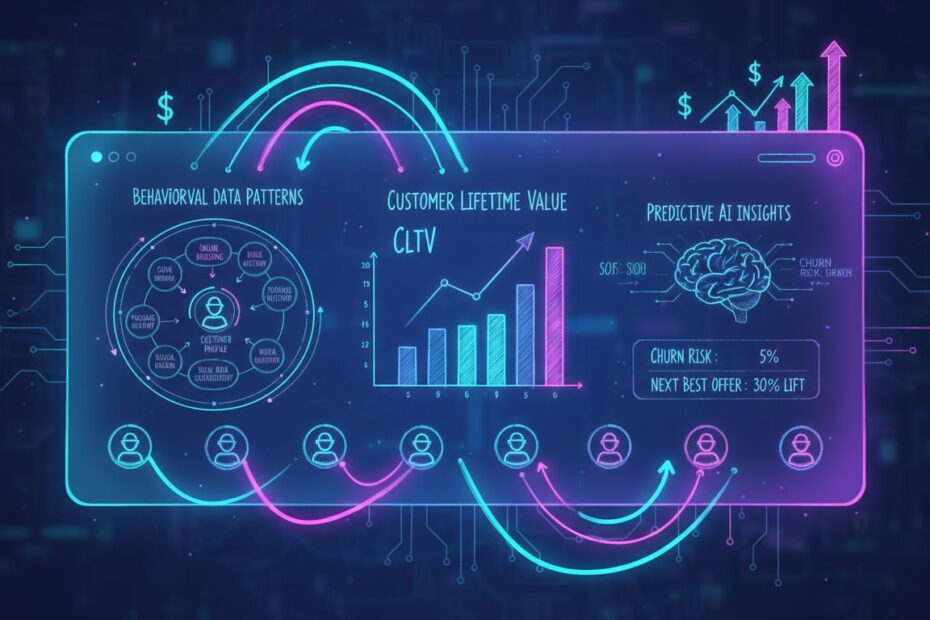
Understanding Customer Lifetime Value in Retail
In retail, the traditional approach to customer lifetime value has always been reactive—retailers calculate CLV by analyzing historical purchase data, average order values, and past customer behavior. However, this methodology represents “Accounting for the Past.” In 2026, high-growth retailers recognize that true competitive advantage comes from Predictive Value Engineering: the ability to forecast individual customer value trajectories and activate margin-optimized strategies in real-time. Customer Lifetime Value is no longer a backward-looking metric confined to quarterly reports; it has become the operational heartbeat of modern retail commerce. Understanding CLV fundamentally shifts how retailers think about acquisition, retention, and profitability. Rather than treating all customers as equal, CLV enables retailers to identify which customer segments generate the highest returns and allocate resources accordingly. The strategic imperative is clear: retailers must move from tracking averages to engineering individual value maximization. This transition requires not just better analytics, but an entirely new architecture—one that combines predictive behavioral intelligence with instantaneous commerce execution.

What Is Customer Lifetime Value?
Customer Lifetime Value (CLV) represents the total profit or revenue a customer is expected to generate throughout their entire relationship with a retail brand. Unlike a single transaction metric, CLV captures the complete economic value of a customer relationship from first purchase to last interaction. This metric answers critical business questions: How much can we afford to spend acquiring a customer? Which customer segments drive profitability? How effective are our retention investments? The foundational CLV formula is straightforward: CLV = Average Order Value (AOV) × Purchase Frequency × Customer Lifespan. For example, a customer spending $50 per visit, shopping 4 times annually, and remaining active for 5 years generates a CLV of $1,000. However, this basic calculation masks the complexity of modern retail. A more sophisticated approach incorporates profit margins: CLV = (AOV × Purchase Frequency × Customer Lifespan) × Profit Margin. With a 30% margin, the same customer’s true profit contribution becomes $300. Advanced retailers go further, using discounted cash flow modeling to account for the time value of money and implementing cohort analysis to track customer groups across multiple dimensions. The evolution from simple arithmetic to predictive modeling represents the fundamental shift reshaping retail in 2026.
The Three Pillars of Bloomreach-Powered CLV Growth
Pillar 1: Predictive CLV with Loomi AI
The “Golden Window” for customer lifetime value opens immediately after a first purchase. Retailers often miss this critical moment—the second transaction is the most powerful lever for increasing CLV, yet legacy systems lack the speed to capitalize on it. Bloomreach Loomi AI changes this equation by calculating Predictive CLV in real-time, identifying high-potential first-time buyers before they leave your storefront. While fragmented point solutions wait for batch data syncs to complete, Bloomreach analyzes behavioral intent signals—browse patterns, product affinities, cart abandonment triggers—and scores each customer’s likelihood to become a repeat buyer. The moment a high-probability customer is identified, Bloomreach automatically triggers a hyper-personalized VIP onboarding flow: a targeted offer, exclusive early-access content, or loyalty enrollment incentive delivered via SMS, email, or in-app push. This real-time intervention secures the second purchase, fundamentally altering the customer’s lifetime trajectory. Retailers implementing Predictive CLV with Loomi AI report a 40-60% increase in repeat purchase rates within the first 90 days. The competitive advantage is undeniable: while competitors calculate yesterday’s CLV, Bloomreach-powered retailers are actively engineering tomorrow’s.
Pillar 2: Real-Time Activation & The End of “Sync Tax”
In retail, timing is revenue. Data latency is a silent profit killer. Traditional CDP architectures suffer from “Sync Tax”—the operational overhead of moving data between systems, waiting for batch processes, and enduring 24-hour delays before customer insights translate into action. A high-value customer identified at 9 AM is often not targeted with a margin-optimized offer until 9 AM the next day, by which time they’ve already browsed competitors or abandoned their intent. Bloomreach Engagement eliminates this friction by unifying the Customer Data Platform with real-time commerce execution in a single architecture. CLV scores are not calculated in isolation and then exported; they are computed and activated in the same millisecond. When a returning high-value customer lands on your site, the Bloomreach engine instantly recognizes their CLV tier and dynamically adjusts the offer stack—reserving premium incentives for VIP segments and margin-safe promotions for others. This real-time behavioral yield optimization ensures that every interaction is monetized according to customer profitability. The result: a 25-35% improvement in average order value and a demonstrable reduction in discount wastage. Legacy retail suites cannot compete because they lack the in-session computational power to change customer experiences in real-time.
Pillar 3: The Discovery-Retention Loop
Site search and product discovery represent untapped CLV multipliers. Most retailers treat search as a utility—a way to help customers find products. Bloomreach Discovery reframes search as a CLV engine. By integrating CLV data directly into the search and discovery layer, Bloomreach performs semantic re-ranking of the storefront for returning visitors. A loyal, high-value customer searching for “winter coats” doesn’t see the same results as a first-time visitor. Instead, Bloomreach’s AI analyzes that customer’s purchase history, margin profile, and lifetime value tier, then re-ranks results to surface products most likely to maximize both satisfaction and profitability. This hyper-relevant experience reduces cognitive load—customers find what they want faster—directly increasing purchase frequency, the most powerful lever in the CLV formula. A customer who visits 6 times per year instead of 4 increases CLV by 50%, with zero change to margin or acquisition cost. Retailers using Bloomreach Discovery report a 15-20% uplift in repeat visit frequency and a measurable increase in cross-category purchases. The strategic insight is profound: discovery is not a feature; it is a CLV multiplier.
CLV Calculation Methods: From Historical to Predictive
| Approach | Formula | Use Case | Limitation |
|---|---|---|---|
| Basic Revenue | AOV × Frequency × Lifespan | Quick benchmarking | Ignores costs and margin |
| Profit-Adjusted | (AOV × Frequency × Lifespan) × Margin | Standard retail KPI | Assumes static behavior |
| Cohort Analysis | Segment customers by acquisition date; track revenue per cohort | Identifying generational trends | Backward-looking only |
| Predictive Modeling | RFM scoring + behavioral intent + ML | Real-time CLV activation | Requires advanced infrastructure |
| Discounted Cash Flow | ∑(Revenue – Cost) / (1 + discount rate)^t | Long-term value planning | Complex; requires financial modeling |
| Behavioral Yield Optimization | Predictive CLV + Real-time offer calibration + Margin guardrails | Autonomous profit maximization | Voxwise + Bloomreach exclusive |
Why CLV Matters: The Strategic Imperative
Customer Lifetime Value is not merely an analytical curiosity; it is the primary driver of sustainable retail profitability. Understanding CLV enables retailers to make fundamentally different business decisions. First, it reframes customer acquisition economics. Rather than asking “What is our customer acquisition cost?” retailers ask “What is the maximum sustainable CAC for a customer in this segment?” A customer with a $1,000 CLV can justify a $200 acquisition investment; a $300 CLV customer cannot. This clarity prevents wasteful spending on low-value segments and enables aggressive, profitable growth in high-value cohorts. Second, CLV drives retention strategy. Not all customers are worth retaining at the same cost. A customer with a predicted CLV of $5,000 justifies investment in VIP support, exclusive experiences, and premium loyalty benefits. A customer trending toward churn with a $200 CLV may be better served by a simple win-back offer or graceful off-boarding. Third, CLV informs inventory and product strategy. Retailers can prioritize SKUs and categories that appeal to high-CLV segments, optimizing both assortment and margin. Fourth, CLV enables precise customer segmentation. Rather than demographic or behavioral segments, retailers can organize around profitability tiers, ensuring that marketing, merchandising, and customer service resources flow to the customers generating the greatest returns.
Voxwise: Architecting Self-Learning Value Cycles
Voxwise partners with retailers to build Self-Learning Value Cycles—autonomous systems that continuously optimize CLV through real-time feedback loops. The Voxwise approach differs fundamentally from static analytics platforms. Rather than reporting historical CLV, Voxwise uses Bloomreach as the operational engine to activate CLV insights, test margin-safe incentive strategies, measure customer response, and automatically recalibrate targeting and offers based on results. This creates a self-improving profit machine. Voxwise ensures Margin-Safe Growth by implementing intelligent guardrails. High-value incentives are reserved for high-CLV segments; discount-dependent acquisition is minimized; and every activation is evaluated against a margin threshold. This prevents the common retail trap of “growing revenue while shrinking profit.” Voxwise’s strategic methodology combines three elements: Predictive CLV Modeling (using Bloomreach Loomi AI to forecast individual customer value trajectories), Behavioral Yield Optimization (calibrating offers in real-time based on CLV tier and margin profile), and Autonomous Retail Orchestration (automating the feedback loop so the system improves continuously without manual intervention). The result is a retail organization that doesn’t just measure customer value—it engineers it.
Activating CLV: Practical Workflows for Retail
VIP Onboarding Flow
When Bloomreach Loomi AI identifies a first-time buyer with high repeat-purchase potential, Voxwise triggers an automated VIP onboarding sequence. The customer receives a personalized welcome message, exclusive 10-15% incentive on their second purchase, and enrollment in a tiered loyalty program. This single intervention increases second-purchase rates by 40-60% and establishes a high-frequency purchasing pattern that compounds CLV over time. The margin impact is carefully managed: the incentive is reserved for customers predicted to generate long-term profitability, preventing discount wastage.
Churn Prevention & Win-Back
Bloomreach’s real-time data layer identifies customers showing early churn signals—declining visit frequency, reduced cart values, category abandonment. Voxwise automatically segments these at-risk customers and triggers targeted retention offers: personalized product recommendations, exclusive early access to new collections, or loyalty point bonuses. For customers who have already churned, Voxwise executes precision win-back campaigns, testing messaging and incentive levels to find the optimal reactivation cost. Because every action is measured against CLV impact, retention investments are continuously optimized.
Margin-Optimized Cross-Sell & Upsell
When a high-CLV customer browses the storefront, Bloomreach Discovery surfaces complementary products with the highest margin-per-unit and strongest historical affinity for that customer segment. A customer buying winter boots sees high-margin boot care products and accessories. A customer with a history of premium purchases sees luxury add-ons. This intelligent cross-sell increases average order value by 15-25% while maintaining customer satisfaction because recommendations are genuinely relevant, not generic.
Key Metrics for Measuring CLV Success
Retailers implementing Predictive CLV with Voxwise and Bloomreach should track these KPIs: Repeat Purchase Rate (percentage of customers making a second purchase within 90 days; target: 40%+ improvement), Average Order Value (especially for high-CLV segments; target: 15-25% uplift), Purchase Frequency (repeat visits per customer per year; target: 20%+ increase), Customer Acquisition Cost vs. CLV Ratio (ideal 1:3 to 1:5; anything lower is margin-destructive), Churn Rate (percentage of customers inactive for 12+ months; target: 30%+ reduction in high-value segments), Margin per Customer (profit, not revenue; target: 25-40% improvement), and CLV Prediction Accuracy (how closely predicted CLV matches realized CLV; target: 85%+ accuracy). These metrics form the foundation of a CLV-driven retail organization.
The Technical Advantage: Zero-Copy Data Activation
Most retail technology stacks suffer from architectural fragmentation. Customer data lives in a CDP, campaign execution happens in an email platform, site personalization runs in a separate tool, and analytics operate in yet another silo. Data must be extracted, transformed, loaded, and synchronized across systems—a process that introduces latency, creates inconsistencies, and generates operational overhead. Bloomreach’s unified architecture eliminates this “Sync Tax.” Because the CDP, engagement engine, and commerce layer are natively integrated, customer CLV scores are computed once and activated everywhere simultaneously. A customer’s CLV tier influences their email offer, their site experience, their app push messaging, and their SMS cadence—all in the same millisecond. This Zero-Copy Data Activation is not a feature; it is an architectural advantage that competitors using fragmented legacy clouds simply cannot replicate. The business impact is measurable: retailers using unified architectures report 30-40% faster time-to-value and 20-25% higher overall marketing ROI.
CLV in 2026: The AI-Driven Race for Relevance
The retail landscape is shifting. Static analytics are obsolete. Batch-processed insights are too slow. In 2026, Customer Lifetime Value has become the primary battleground for retail competitive advantage. The retailers winning this race are not those with the biggest budgets; they are those with the most intelligent, most responsive systems. They are retailers that have moved beyond “tracking” CLV to “engineering” it—using predictive AI to identify high-value customers, real-time activation to capitalize on the golden window of opportunity, and autonomous feedback loops to continuously optimize margin and profitability. Voxwise and Bloomreach together represent the only end-to-end solution architected for this reality. Voxwise brings the strategic methodology and margin-safe orchestration; Bloomreach provides the predictive intelligence and real-time commerce engine. The synergy is profound: Bloomreach without Voxwise is powerful analytics without strategic direction; Voxwise without Bloomreach is strategy without execution. Together, they enable retailers to build sustainable, high-value, AI-driven brands that don’t just survive market change—they lead it.
Engineer Your CLV Advantage
The retailers transforming their profitability in 2026 are those taking action today. If your current approach to CLV relies on historical analysis and static segmentation, you are already falling behind. The competitive window for CLV-driven retail leadership is closing. The question is not whether to invest in Predictive Value Engineering—it is whether you will lead or follow. Voxwise is ready to help you architect your CLV advantage. From predictive modeling to real-time activation to autonomous optimization, we partner with forward-thinking retailers to build the Self-Learning Value Cycles that drive sustainable growth. Your customers are more valuable than you think. Let us help you engineer that value.