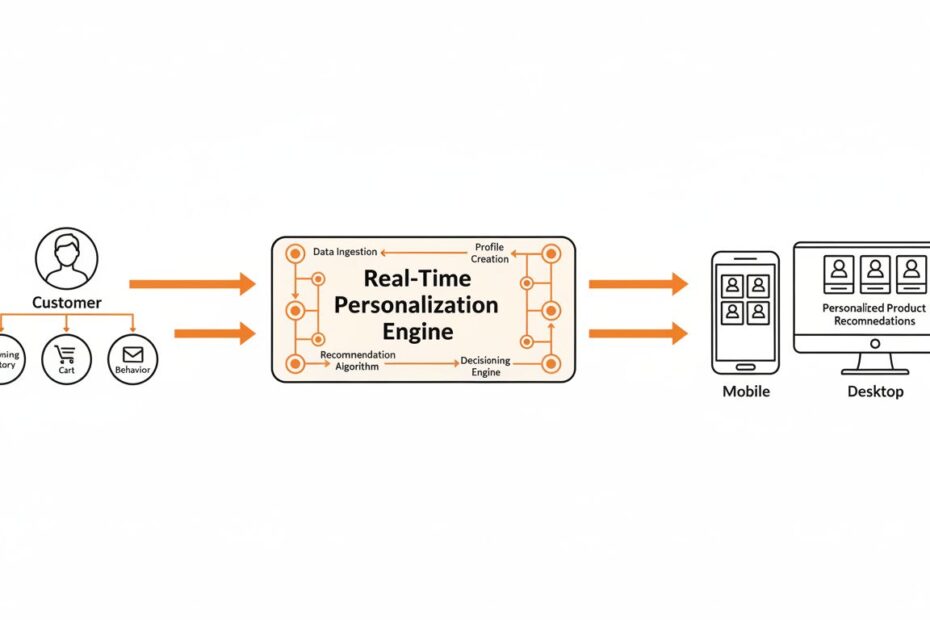
Real-Time Personalization in E-Commerce
How do you show a customer the exact product they need before they even finish typing their search? Real-time personalization is the answer—a strategy that dynamically adapts e-commerce experiences based on what customers are doing right now, not what they did last month.
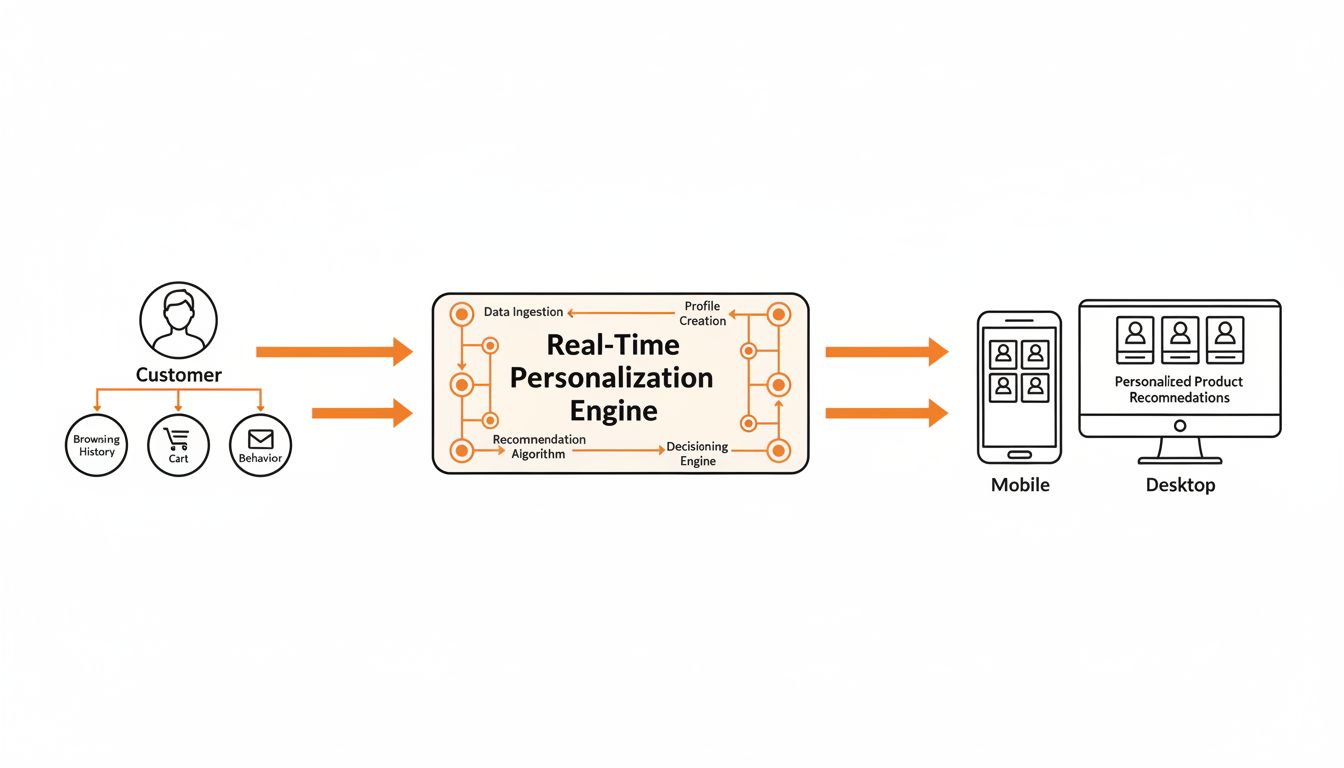
Instead of generic “Top Sellers” or “Frequently Bought Together” carousels, real-time personalization engines analyze each visitor’s current session—their clicks, scrolls, searches, and cart behavior—to surface the most relevant products and offers within milliseconds. For retailers struggling with cart abandonment, low average order value (AOV), or declining email engagement, this shift from historical data to in-the-moment intent is transformative.
Businesses using real-time personalization see up to 40% higher revenue compared to those relying on batch-processed, segment-based personalization alone. The difference is simple: customers feel understood, not targeted.
Use Case Overview
Real-time personalization transforms the entire customer journey from static to dynamic. Instead of showing the same experience to every visitor, it creates a unique path for each person based on their immediate behavior.
The technology works by capturing live signals—product views, filter selections, dwell time, search queries, cart additions—and feeding them into a decision engine that ranks thousands of potential products or content variations in milliseconds. The highest-ranking option is delivered to the customer’s browser or mobile app instantly, without a page reload.
This happens across every touchpoint: product discovery pages, search results, homepage banners, shopping carts, email campaigns, and post-purchase follow-ups. The result is an experience that feels less like shopping at a store and more like having a personal concierge who understands exactly what you want.
When This Use Case Matters
Real-time personalization becomes critical when retailers face these specific challenges:
- High cart abandonment rates – Customers can’t find complementary products or suitable alternatives
- Low average order value (AOV) – Missing cross-sell and upsell opportunities at critical moments
- Declining email open and click rates – Batch-and-blast campaigns don’t resonate with individual preferences
- Seasonal inventory pressure – Need to promote slow-moving stock intelligently without manual curation
- Increasing customer acquisition costs – Must maximize lifetime value (CLV) through smarter engagement
- Competitive pressure from larger retailers – Customers expect Amazon-like relevance from every brand
If your team is manually creating product recommendations or relying on popularity-based rules, real-time personalization is your next growth lever.
How It Works in Practice
Step 1: Unified Customer Data Collection
The foundation of real-time personalization is a unified customer profile that aggregates signals from all touchpoints in real-time.
Essential data sources include:
- Behavioral signals – Product views, dwell time, scroll depth, search queries, filter selections, clicks
- Purchase history – Previous orders, categories bought, price sensitivity, repurchase cycles
- Cart and wishlist activity – Items added/abandoned, saved for later, quantity changes
- Demographic and preference data – Location, device type, time of visit, referral source
- Session context – Current page, time of day, device type, browser type
- Interaction history – Email opens, clicks, previous campaign responses
A Customer Data Platform (CDP) unifies these fragmented signals into a single, actionable customer view. Bloomreach and similar platforms excel at consolidating these signals in real-time, ensuring that every decision is based on the most current information.
Step 2: Real-Time Processing and Decision-Making
Modern recommendation engines use three primary algorithmic approaches:
Collaborative Filtering – Identifies patterns across large groups of users. If Customer A and Customer B both viewed running shoes, and Customer B also viewed compression socks, the system recommends socks to Customer A.
Content-Based Filtering – Analyzes product metadata (brand, color, material, price tier, category) and recommends items with similar characteristics to products a customer has viewed or purchased.
Hybrid and Sequence-Based Models – Combine collaborative, content-based, and behavioral signals. Advanced systems use neural networks to detect evolving intent from real-time session behavior, not just historical patterns.
Step 3: Millisecond-Speed Delivery
The recommendation engine evaluates multiple candidate products and ranks them based on:
- Predicted likelihood of engagement (click-through rate)
- Predicted conversion probability
- Expected revenue impact
- Business rules (inventory levels, profit margins, promotional priorities)
The winning recommendation is delivered within 100–200 milliseconds. Modern platforms like Bloomreach use multi-armed bandit algorithms to continuously test which recommendation strategy is winning and automatically shift traffic toward better performers.
Example Scenario in Retail
Consider a mid-size fashion e-commerce retailer struggling with a 2.8% AOV and declining email engagement. Here’s how real-time personalization transforms the experience:
The Customer Journey:
A returning customer browses the site on a Wednesday evening. She views three pairs of black leggings, hovers over a yoga mat for 45 seconds, and adds a sports bra to her cart.
Without real-time personalization, the homepage shows “Best Sellers” (generic). With real-time personalization:
- Homepage recommendation – “Complete Your Workout Fit” carousel surfaces complementary yoga accessories (blocks, straps, towels) based on her yoga mat interest and similar customers’ patterns
- Product detail page – When she clicks a legging, the engine shows “Frequently Bought Together” featuring matching sports bras and socks in her preferred colors and size range
- Cart upsell – Before checkout, a banner suggests a premium yoga mat (higher AOV) based on her session behavior and price sensitivity
- Post-purchase email – 5 days later, an email recommends recovery products (foam roller, massage oil) aligned with her fitness interests and repurchase cycle
- Loyalty reengagement – 30 days post-purchase, an SMS promotes seasonal activewear based on her preferred brands and price range
Realistic Results:
- AOV increases from $68 to $85 (25% lift) through smarter cross-sell and upsell
- Email click-through rate rises from 1.9% to 3.4% (79% improvement) due to personalized product blocks
- Cart abandonment decreases by 14% as customers find relevant alternatives
- Repeat purchase rate improves by 12% as customers feel understood
These results reflect industry benchmarks from mature personalization programs, not invented numbers.
Data, Tools, and Teams Involved
Building a real-time personalization program requires coordination across multiple teams and systems:
| Component | Responsibility | Tools/Platforms |
|---|---|---|
| Event Tracking | Engineering & Analytics | JavaScript SDKs, event collectors, Segment, Tealium |
| Customer Profiles | Data & Marketing | CDP (Bloomreach, BlueConic), data warehouse |
| Recommendation Engine | Engineering & Data Science | Bloomreach, Apache Kafka, feature stores (Feast, Tecton) |
| Testing & Optimization | Marketing & Analytics | A/B testing platforms, bandit algorithms, dashboards |
| Delivery & Activation | Marketing & E-Commerce | Email platforms (Klaviyo), web personalization, push notifications |
| Monitoring & Insights | Analytics & Leadership | BI tools, real-time dashboards, performance tracking |
Key Team Roles:
- E-Commerce Manager – Defines business goals (AOV, conversion rate, CLV targets)
- Data Engineer – Ensures clean data pipelines and real-time event tracking
- Marketing Manager – Owns campaign strategy and channel execution
- Analytics Lead – Measures impact and identifies optimization opportunities
- Implementation Partner (like Voxwise) – Architects the solution, integrates platforms, trains teams
How to Measure Success
Real-time personalization success is measured across three tiers: engagement, business impact, and ROI.
Engagement Metrics
- Click-through rate (CTR) on recommendations – Target: 3–5% (vs. 1–2% for generic)
- Conversion rate from recommended products – Target: 2–4%
- Time spent on personalized sections – Compare against non-personalized sections
Business Impact Metrics
- Average order value (AOV) – Target: 15–25% lift
- Revenue per visitor (RPV) – Target: 20–30% improvement
- Repeat purchase rate – Target: 10–15% increase
- Customer lifetime value (CLV) – Target: 25–40% growth
ROI and Operational Metrics
- Revenue attributed to recommendations – Track as % of total revenue
- Return on ad spend (ROAS) for personalized email campaigns
- Cost per acquisition (CPA) – Should decrease as CLV increases
- Implementation and platform costs vs. incremental revenue
Best Practices for Measurement:
- Run A/B tests comparing personalized vs. generic recommendations
- Use cohort analysis to track customer segments over time
- Implement proper attribution modeling to avoid over-crediting recommendations
- Set baseline metrics before launch to measure true lift
How Voxwise Can Help
Implementing real-time personalization at scale requires expertise in CRM strategy, customer data architecture, platform selection, and marketing automation integration. Voxwise specializes in exactly this.
Voxwise’s Approach:
- Assessment – Audit your current data infrastructure, customer journey, and business goals
- Strategy & Design – Map the optimal personalization roadmap aligned with your tech stack
- Platform Implementation – Integrate Bloomreach or other personalization engines with your CDP and e-commerce platform
- Data Enablement – Ensure clean, unified customer data flows into recommendation engines in real-time
- Campaign Activation – Launch personalized experiences across web, email, mobile, and ads
- Optimization & Training – Continuously test and refine; train your team to own the program long-term
Voxwise brings experience across retail, e-commerce, and B2B sectors—helping brands move from generic, one-size-fits-all campaigns to truly personalized, revenue-driving experiences.
Conclusion
Real-time personalization is no longer a competitive advantage—it’s table stakes in modern e-commerce. Customers expect relevant suggestions in the moment, and the data shows they’re willing to spend more when they find them.
The good news: implementing real-time personalization doesn’t require reinventing your entire tech stack. It starts with clean customer data, a smart recommendation engine like Bloomreach, and a clear strategy aligned to your business goals.
Whether you’re launching your first personalization program or optimizing an existing one, Voxwise can help you architect a solution that drives measurable results in AOV, conversion rates, and customer lifetime value.
Explore Similar Use Cases
Ready to transform your customer engagement strategy with real-time personalization? Discover how Voxwise helps retail and e-commerce brands implement data-driven, personalized experiences that drive revenue.