What Is AI-Powered Customer Engagement?
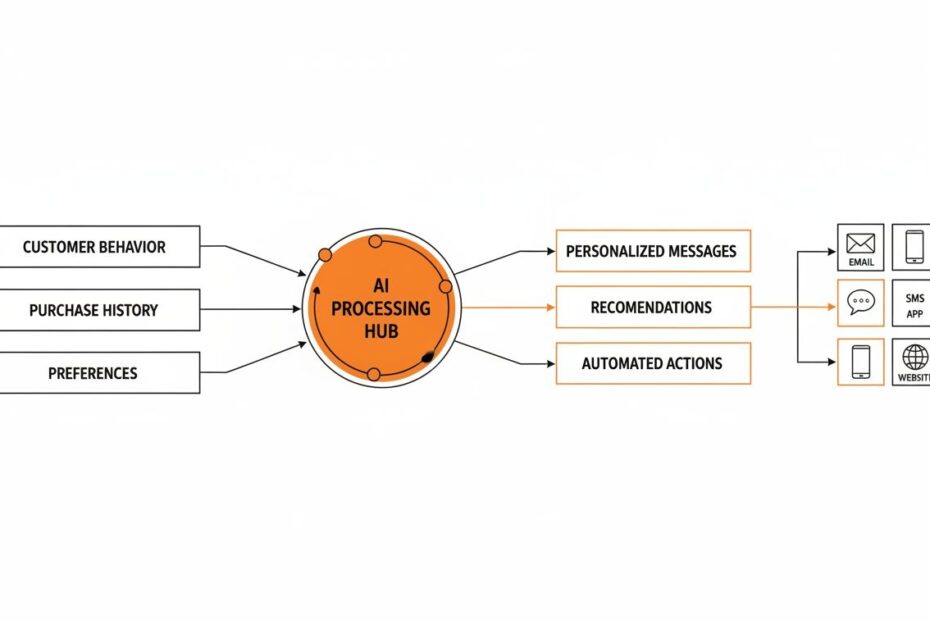
AI-powered customer engagement is the practice of using artificial intelligence, machine learning, and predictive analytics to analyze customer behavior in real time and deliver hyper-personalized experiences across every touchpoint. Instead of sending generic campaigns to broad audience segments, AI engagement systems treat each customer as an individualized segment of one, automatically adjusting messaging, channel selection, and timing based on live behavioral data.
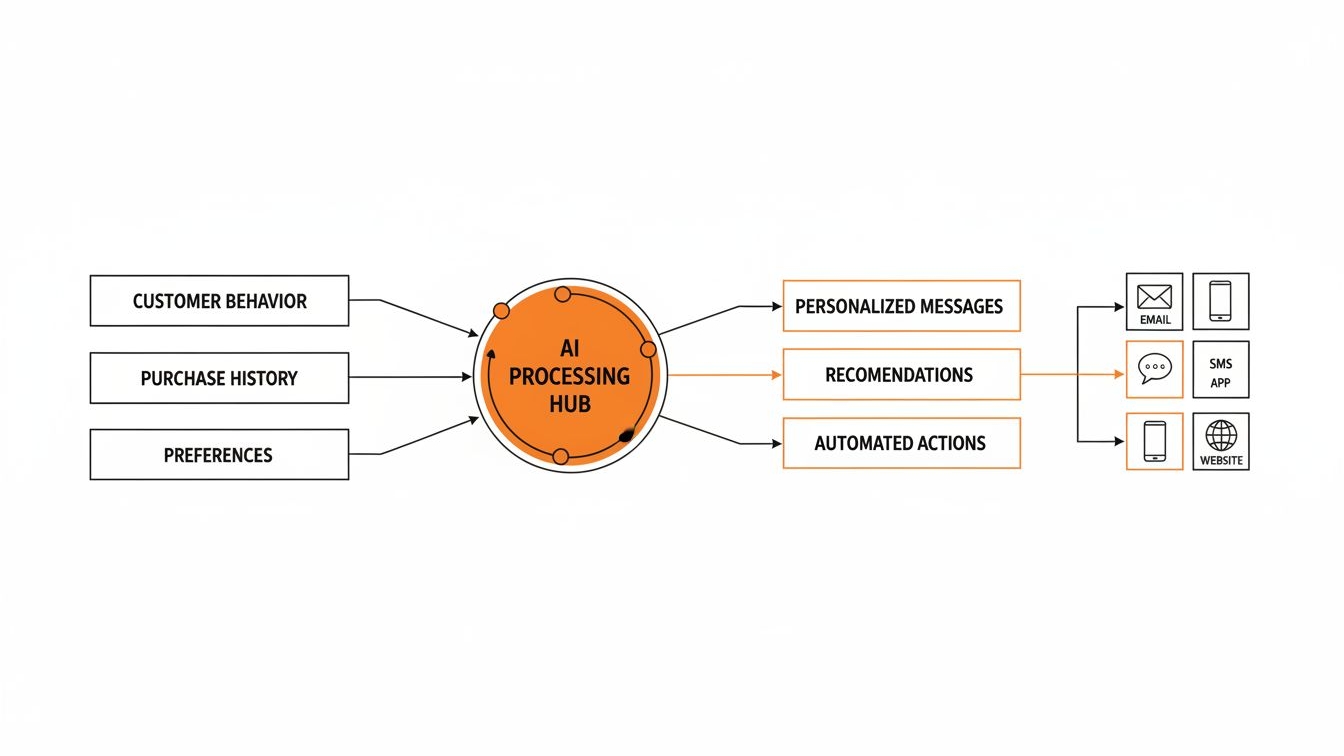
This goes far beyond chatbots and recommendation engines. AI-powered engagement is a unified infrastructure that connects first-party customer data, predictive models, and omnichannel activation channels into a single coherent system. For retail and e-commerce brands, it means the difference between reactive, one-size-fits-all marketing and proactive, revenue-driving customer journeys that scale infinitely.
The Core Shift: From Rules-Based to Intelligence-Driven
Traditional marketing relies on static rules: “If customer bought X, send email about Y.” AI engagement flips this model by learning from millions of customer interactions simultaneously, discovering patterns humans never could find, and automatically adjusting strategy based on what actually works for each individual customer.
Why AI-Powered Customer Engagement Matters
Revenue Impact on Retention and CLV
The business case is clear: customer retention is 5 to 25 times cheaper than acquisition, yet most retail brands still spend 80% of their marketing budget chasing new customers. AI-powered engagement directly addresses this imbalance by identifying at-risk customers before they churn, predicting their next purchase window, and delivering the right offer at the right moment.
For e-commerce specifically, AI engagement delivers measurable impact across three critical metrics:
- Customer Lifetime Value (CLV): Proactive engagement with at-risk high-value customers protects revenue and extends relationship duration.
- Repeat Purchase Frequency: Predictive models identify optimal windows for next-purchase recommendations, shortening the time between transactions.
- Marketing ROI: Hyper-targeted campaigns reduce wasted spend on uninterested segments and concentrate budget where conversion probability is highest.
Competitive Necessity in Modern Retail
71% of consumers now expect AI-powered personalization in their shopping experiences. Brands that deliver it see measurably higher engagement rates, lower churn, and stronger customer loyalty. Brands that don’t are rapidly losing market share to competitors who do.
How AI-Powered Customer Engagement Works
The Real-Time Data Loop
AI engagement operates on a continuous cycle: capture behavioral data, feed it into predictive models, generate actionable insights, execute automated campaigns, measure results, and feed learnings back into the model.
This happens in milliseconds, not in overnight batch jobs. When a customer browses your site, adds an item to their cart, or opens an email, the system immediately processes that signal, updates their individual profile, and adjusts the next interaction accordingly.
Core AI Capabilities in Customer Engagement
AI-powered engagement platforms typically combine these complementary technologies:
- Real-Time Behavioral Tracking: Captures onsite clicks, app interactions, email opens, and purchase events as they happen, building a live profile of each customer’s intent and preferences.
- Predictive Analytics: Machine learning models forecast churn risk, purchase probability, optimal send times, and next-best-product recommendations based on historical patterns and current behavior.
- Natural Language Processing (NLP): Understands customer intent from text interactions, enabling conversational shopping assistants and intelligent chatbots that feel human, not robotic.
- Omnichannel Orchestration: Coordinates messages across email, SMS, push notifications, web, and app so channels complement each other rather than compete or overwhelm the customer.
- Agentic AI: Autonomously executes campaign decisions, adjusts messaging in real time, and continuously learns from each interaction without requiring manual human intervention.
Data as the Foundation
AI engagement is only as effective as the underlying data. The system requires clean, unified first-party customer data that includes:
- Customer IDs that tie together all interactions across channels and devices.
- Behavioral signals from web, app, email, and purchase events captured in real time.
- Transactional history including what was bought, when, at what price, and margin.
- Preference and consent data that respects customer privacy and regulatory requirements.
Without unified, real-time data, AI models make poor decisions and campaigns fall flat. This is why many point-solution implementations fail: fragmented data sources create lag, inconsistency, and missed opportunities.
Key Benefits of AI-Powered Customer Engagement
For E-Commerce Operations
Reduced Customer Acquisition Costs: By extending CLV and increasing repeat purchase rates, brands need fewer new customer acquisitions to hit growth targets.
Improved Conversion Rates: Real-time personalization and intelligent product recommendations increase on-site conversion and average order value.
Faster Response to Market Signals: AI detects shifts in customer preference, seasonal demand, and competitive pressure instantly, allowing brands to respond faster than competitors.
Scalable Human Effort: Intelligent automation handles routine inquiries and simple cross-sell opportunities, freeing customer service teams to focus on complex, high-empathy issues.
For Marketing Teams
Data-Driven Decision Making: Stop guessing about what works. AI shows exactly which messaging, timing, channel, and offer drives the highest ROI for each customer segment.
Reduced Campaign Complexity: Instead of manually building dozens of micro-campaigns, marketers define business goals and let AI handle segmentation, personalization, and optimization.
Faster Time to Campaign Launch: Pre-built AI models and templates mean retail brands can test and deploy new engagement strategies in days, not months.
Traditional vs. AI-Powered Customer Engagement
| Dimension | Traditional Approach | AI-Powered Approach |
|---|---|---|
| Availability | Restricted to business hours; basic rule-based bots with scripted responses. | 24/7 intelligent automation with nuanced, context-aware conversational understanding. |
| Data Usage | Reactive; analyzing past weekly or monthly reports to inform next campaign. | Real-time; processing live behavioral signals and adjusting interactions instantly. |
| Segmentation | Broad, static buckets (e.g., “women aged 25-34” or “high-value customers”). | Dynamic, behavior-driven micro-segments; each customer treated as an individualized segment. |
| Campaign Delivery | One-size-fits-all scheduled blasts; same message to everyone in the segment. | Hyper-personalized, context-aware orchestration; unique message, timing, and channel per customer. |
| Optimization | Manual A/B testing; results reviewed monthly or quarterly. | Continuous autonomous optimization; models adjust in real time based on performance. |
| Personalization Scale | Limited to basic product recommendations or email subject lines. | Complete journey personalization including message copy, offer, channel, and timing. |
Three Critical AI Engagement Use Cases for E-Commerce Brands
Use Case 1: Proactive Churn Mitigation for At-Risk High-Value Customers
What It Means and Why It Matters
Your highest-value customers are also your biggest retention risk. If a customer has generated $5,000 in lifetime revenue but their engagement is dropping, losing them costs far more than winning a new customer. AI detects these signals before the customer even realizes they’re leaving.
Data Signals to Monitor
- Declining recency: No purchase in the last 60 days when historical pattern shows 30-day frequency.
- Engagement drop: Email open rates falling below individual baseline; push notification dismissals increasing.
- Loyalty erosion: Loyalty points accumulation stalling; redemption frequency declining.
- Channel abandonment: Customer historically engaged via SMS but has not opened the last 3 messages.
Recommended Campaign Action
Automatically trigger a high-value win-back flow via the customer’s preferred channel. Deliver an exclusive VIP reward, early access to new collection, or personalized feedback request. Critically: avoid margin-killing discounts that train customers to wait for deals.
Business Impact
- Protects high-value CLV and reduces overall churn rate.
- Maintains healthy profit margins by rewarding loyalty rather than discounting.
- Concentrates retention budget where ROI is highest.
Use Case 2: In-Session Conversion Boost for Hesitant Browsers
What It Means and Why It Matters
A customer is actively shopping right now. They are comparing products, reading reviews, and building intent. But they have not converted yet. In-session personalization captures this moment before they abandon the cart and never return.
Data Signals to Monitor
- Repeated category views: Customer has viewed the “running shoes” category 4 times in 10 minutes.
- Cart abandonment: Item added to cart but checkout not initiated within 5 minutes.
- Product comparison: Customer viewing 3 similar SKUs in rapid succession, indicating active evaluation.
- High-intent behavior: Scrolling product details, reading reviews, checking inventory.
Recommended Campaign Action
Serve a dynamic onsite personalization layer offering a real-time price drop alert, bundle discount, or highly relevant cross-sell recommendation for the exact item they are evaluating. Timing is critical: this happens within seconds of the signal, not hours later.
Business Impact
- Increases immediate conversion rate and average order value.
- Captures sales that would otherwise be lost to cart abandonment.
- Maintains healthy margins by targeting discount only to hesitant buyers, not all visitors.
Use Case 3: Next-Best-Action Omnichannel Recommendations
What It Means and Why It Matters
After a customer purchases, the real opportunity begins. Which product should you recommend next? When should you contact them? Via which channel? Static cross-sell rules miss the mark. AI learns the optimal next action for each customer based on their unique history and behavior.
Data Signals to Monitor
- Purchase history: Customer has bought from the “home fitness” category twice in the last 6 months.
- Browse behavior: Currently viewing “yoga accessories” and “recovery tools.”
- Channel preference: Historically opens emails on Tuesday mornings; rarely engages with SMS.
- Engagement timing: Optimal send time for this customer is 9 AM EST based on historical open rates.
Recommended Campaign Action
Deploy an automated post-purchase lifecycle journey. Send a tailored email containing hyper-relevant product recommendations at the customer’s individual optimal send time. Follow up with a coordinated SMS reminder if unengaged with the email. Adjust recommendations if the customer purchases or browses different categories.
Business Impact
- Drives repeat purchase rates and shortens the purchase frequency cycle.
- Increases email revenue per send and SMS engagement rates.
- Boosts overall customer lifetime value through systematic, data-driven recommendations.
The Data Blueprint: What Fuels AI Engagement Platforms
AI models are only as smart as the data feeding them. Garbage data produces garbage decisions, no matter how sophisticated the algorithm. Effective AI engagement requires:
Core First-Party Data Inputs
Customer Identity: Unified customer IDs that connect all interactions across web, app, email, and offline channels. Without this, the system sees 10 different people instead of one customer with 10 touchpoints.
Real-Time Behavioral Events: Clicks, page views, product views, add-to-cart, checkout starts, purchases, email opens, SMS clicks, and app interactions captured immediately as they occur.
Transactional Data: Purchase history including product purchased, category, price paid, margin, date, and any returns or exchanges. This fuels predictive models for next-best-product recommendations.
Customer Attributes: Demographics, preferences, loyalty status, device type, location, and any explicit preference data (e.g., “send me SMS on Mondays only”).
Consent and Privacy Data: Clear records of what the customer has consented to receive, regulatory compliance flags, and preference opt-outs.
The Critical Problem: Data Lag
Many retail brands assemble AI engagement from point solutions: a CDP for data, an email platform for email, an SMS tool for SMS, an analytics platform for reporting. Each system has its own database. Data syncs between systems once per day or even once per week via batch jobs.
This creates fatal lag. By the time yesterday’s data syncs to the email platform, the customer has already left the site. Opportunities are missed. Models make decisions based on stale information.
Solution: A unified platform where customer data, predictive models, and activation channels live natively in the same system. Changes to customer data instantly trigger campaign adjustments. No batch jobs. No lag. No missed opportunities.
Scaling AI Customer Engagement With Bloomreach
Bloomreach is the unified customer engagement platform purpose-built for retail and e-commerce brands seeking to activate AI at scale without fragmentation.
Why Bloomreach for AI Engagement
Bloomreach integrates customer data, predictive AI, and omnichannel activation into one native platform, eliminating data silos and the lag that kills traditional implementations.
Core Bloomreach Capabilities for AI Engagement:
- Real-Time Customer Data: Unified customer profiles updated instantly from web, app, email, and offline sources. No batch jobs. No lag.
- Behavioral Segmentation: Build complex, dynamic segments based on any customer behavior or attribute. Segments update in real time as customer behavior changes.
- Loomi AI: Bloomreach’s agentic AI brain that powers predictive analytics, generative personalization, and autonomous campaign optimization across all channels.
- Predictive Models: Pre-built machine learning models for churn prediction, purchase probability, optimal send time, and next-best-product recommendations.
- Omnichannel Orchestration: Coordinate campaigns across email, SMS, push, web personalization, and app messaging from a single platform.
Loomi AI: The AI Brain Behind Bloomreach
Loomi AI is the specialized commerce AI engine embedded directly into Bloomreach. It powers:
- Churn Prediction: Identifies at-risk customers before they leave, enabling proactive retention campaigns.
- Purchase Probability Modeling: Forecasts which customers are most likely to buy in the next 7, 14, or 30 days.
- Optimal Send Time Prediction: Determines the exact moment each customer is most likely to open an email or click an SMS.
- Next-Best-Product Recommendations: Suggests the product each customer is most likely to purchase based on their unique profile and behavior.
- Autonomous Campaign Optimization: Continuously tests messaging variants, offers, and channels, automatically scaling what works and pausing what doesn’t.
Because Loomi AI operates natively within Bloomreach, predictions and actions happen in real time. No external API calls. No data export-import cycles. No delays.
Common Implementation Mistakes to Avoid
Mistake 1: Stitching Together Fragmented Point Solutions
The Problem: Brands assemble a CDP, email platform, SMS tool, analytics platform, and personalization engine from different vendors. Each system operates independently. Data syncs once per day via batch jobs. Predictions are stale. Campaign timing is delayed. Opportunities are missed.
The Fix: Migrate to a unified platform like Bloomreach where data, AI models, and activation channels coexist natively. Real-time data feeds real-time decisions. No lag. No fragmentation.
Mistake 2: Over-Relying on Completely Ungoverned AI Outputs
The Problem: Brands let AI make all decisions autonomously without any human oversight. AI recommends a product that contradicts merchandising strategy. AI sends messages that feel impersonal or creepy. Brand reputation suffers.
The Fix: Implement AI as a powerful copilot governed by clear merchandising rules, brand guidelines, and human strategy. Set constraints: “Never recommend products below 40% margin.” “Never send more than 3 messages per week to any customer.” “Always include a human-readable reason for the recommendation.”
Mistake 3: Ignoring Data Quality
The Problem: The dataset includes duplicate customer IDs, incomplete behavioral data, or outdated customer attributes. AI models train on garbage data and produce garbage decisions.
The Fix: Audit and clean your data before implementation. Define clear data governance rules. Implement automated data quality checks. Monitor data freshness continuously.
How Voxwise Transforms AI Strategy Into Revenue
Voxwise is a specialized CRM, customer engagement, and Bloomreach consulting firm that bridges the gap between abstract AI technology and measurable e-commerce revenue growth.
What Voxwise Does
- Customer Data Strategy: Audit your existing data stack, identify gaps, and design a unified data architecture that fuels AI.
- Advanced Lifecycle Design: Build sophisticated, multi-touch customer journeys that leverage AI predictions and personalization at every stage.
- Bloomreach Implementation: Deploy Bloomreach and Loomi AI, configure segmentation logic, train predictive models, and optimize campaigns for retention and CLV growth.
- Campaign Optimization: Continuously test, measure, and refine AI-powered campaigns to maximize ROI and customer lifetime value.
- Team Training: Upskill your marketing team on AI capabilities, best practices, and how to translate business goals into data-driven campaigns.
Why Partner With Voxwise
Retail and e-commerce brands that implement AI engagement without expert guidance often make costly mistakes: wrong platform choices, poor data architecture, campaigns that feel impersonal, and disappointing ROI.
Voxwise works with your team to ensure AI engagement drives measurable growth in retention, CLV, and marketing efficiency. We translate business goals into data requirements, design campaigns that respect customer privacy and brand values, and continuously optimize based on results.
Conclusion
AI-powered customer engagement is no longer a competitive advantage. It is a competitive necessity.
The brands winning in retail and e-commerce today are not the ones with the biggest budgets. They are the ones treating each customer as an individualized segment of one, predicting needs before customers articulate them, and orchestrating personalized journeys that drive retention and lifetime value.
This requires more than chatbots and recommendation engines. It requires a unified infrastructure that connects first-party data, predictive AI, and omnichannel activation into a single coherent system.
Bloomreach provides that infrastructure. Loomi AI powers the intelligence. Voxwise translates strategy into execution.
The question is not whether your brand will adopt AI-powered engagement. It is whether you will do it before your competitors do.
Frequently Asked Questions
What is the main difference between traditional CRM marketing and AI customer engagement?
Traditional CRM marketing relies on static segments and predetermined rules: “If customer bought X, send email about Y.” AI customer engagement learns from millions of interactions simultaneously, discovers patterns humans cannot find, and automatically adjusts strategy in real time based on individual customer behavior. Traditional approaches treat segments; AI treats individuals.
How does AI-powered customer engagement improve e-commerce retention?
AI identifies at-risk customers before they churn, predicts their next purchase window, and delivers personalized win-back offers at the optimal moment. It also increases repeat purchase frequency by recommending the right product at the right time via the right channel. Combined, these tactics extend customer lifetime value and reduce overall churn rate.
Can small or mid-market retail brands benefit from AI customer engagement?
Yes. AI engagement scales infinitely, meaning it is just as effective for a brand with 10,000 customers as one with 1 million. In fact, mid-market brands often see faster ROI because they have cleaner data, more agile teams, and less legacy system baggage than large enterprises.
How do predictive analytics work within a customer engagement platform?
Predictive models train on historical customer data to forecast future actions: Will this customer churn? Will they purchase in the next 7 days? What is their optimal email send time? When a new customer arrives, the model scores them instantly based on their profile and behavior, enabling campaigns to adjust in real time.
What is Loomi AI and how does it support Bloomreach implementation?
Loomi AI is the agentic AI engine embedded directly into Bloomreach. It powers churn prediction, purchase probability forecasting, optimal send time calculation, next-best-product recommendations, and autonomous campaign optimization. Because it operates natively within Bloomreach, predictions and actions happen in real time without data export-import delays.
Ready to Transform Customer Engagement With AI?
Voxwise specializes in CRM strategy, Bloomreach implementation, and customer engagement optimization for retail and e-commerce brands. Let us help you activate AI-powered engagement that drives measurable retention and revenue growth.
Schedule a 30-minute consultation with a Voxwise customer engagement specialist. We will assess your current data architecture, identify gaps, and outline a roadmap to AI-powered engagement that works for your brand.