Why Bloomreach Is the Best Platform for E-commerce Personalization
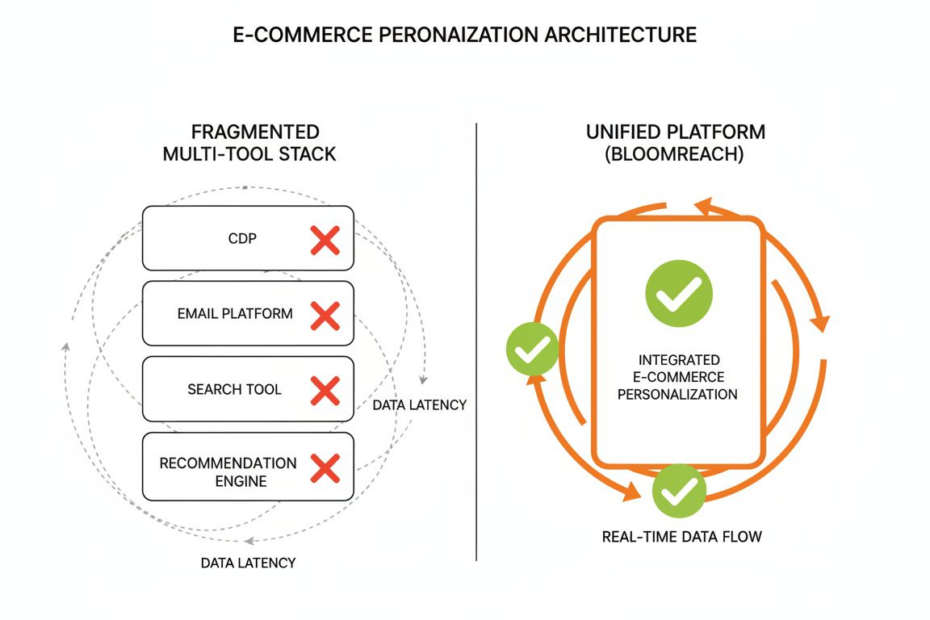
Most e-commerce brands attempt personalization by stitching together separate tools: a third-party Customer Data Platform (CDP), an email service provider, a standalone site search engine, and an independent recommendation tool. This fragmented approach feels logical on a spreadsheet, but it creates severe operational and financial costs that most teams never fully quantify.
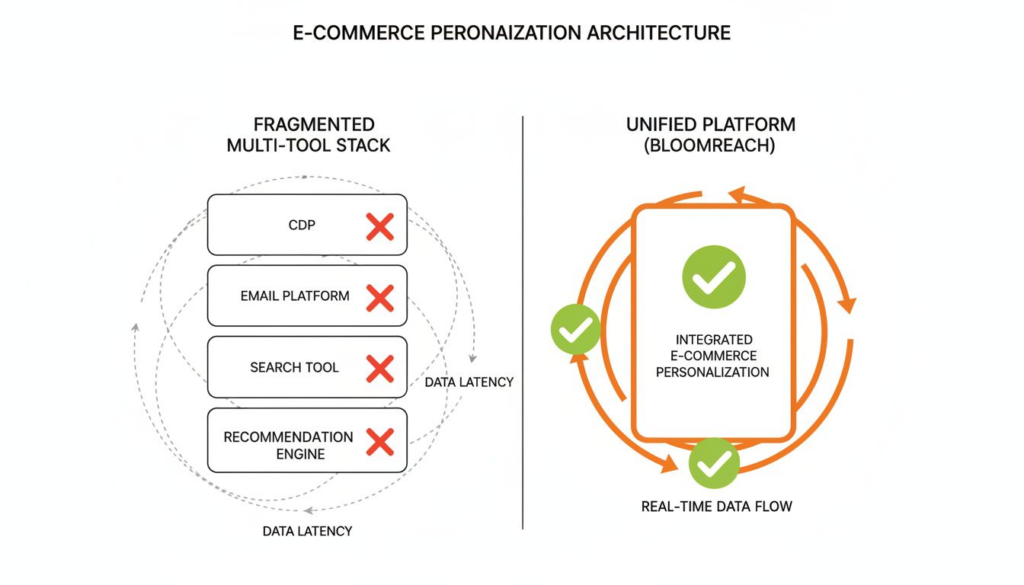
The core problem is data latency. When your CDP syncs with your email platform every 6 hours via batch API, a customer who abandons their cart at 2 PM receives a recovery message at 8 PM or later. By then, their intent has cooled, and the conversion opportunity is lost. Your site search tool operates independently, so a shopper who browses winter coats sees a generic homepage when they return. Your recommendation engine doesn’t know about recent email opens, so it serves duplicate suggestions.
This fragmentation creates three compounding costs: missed revenue from delayed personalization, high developer overhead maintaining integrations, and customer fatigue from disjointed messaging. Retail and e-commerce brands managing this complexity report spending 30-40% of marketing technology budgets on integration and data synchronization work rather than campaign innovation.
The 4 Architectural Pillars That Make Bloomreach the Personalization Leader
Bloomreach solves the fragmentation problem through a fundamentally different architecture. Rather than bolting together separate tools, Bloomreach unifies customer data, marketing automation, and commerce search into a single, real-time platform. This unified approach is built on four distinct technical advantages that set it apart from traditional multi-tool stacks.
1. A Built-In, Zero-Latency Customer Data Platform
Bloomreach Engagement includes a native CDP that collects, unifies, and processes behavioral and transactional customer data in real time, with latency under 100 milliseconds. This is not batch processing or hourly syncs. When a customer clicks a product, views a category, or abandons a cart, that event is immediately available to trigger campaigns or personalize their session.
This real-time data layer eliminates the sync delays that plague traditional CDPs. A customer browsing high-end skincare products on a Monday morning will see personalized product recommendations on Tuesday’s email because their Monday behavior was captured and acted upon instantly. Their anonymous session history merges seamlessly with their known profile the moment they sign up or make a purchase, preserving the full context of their shopping journey.
2. Loomi AI: Proprietary AI Trained Specifically for Commerce
Loomi is not a generic language model or a general-purpose machine learning algorithm. It is a proprietary AI engine developed specifically for e-commerce, trained on billions of product interactions, search queries, and purchase patterns across retail categories. This commerce context is critical.
Generic AI engines struggle with retail semantics. They don’t inherently understand that “waterproof hiking boots” relates to “outdoor footwear,” or that a customer searching for “lightweight running shoes” might also be interested in “athletic socks.” Loomi AI understands these relationships without manual synonym rules. It recognizes seasonal demand shifts, category affinities, and individual shopper preferences in real time.
Loomi powers three critical capabilities. First, it personalizes product recommendations across the website, email, SMS, and paid advertising based on each customer’s unique behavior and profile. Second, it automatically segments audiences based on behavioral patterns, not static rules, so your retention campaigns target the right customers at the right moment. Third, it powers conversational shopping assistants that guide customers directly to the right products based on natural language queries.
3. Complete Unification of Search, Merchandising, and Marketing
In most e-commerce tech stacks, search and marketing operate in separate silos. A customer clicks a personalized email promoting winter coats and lands on a generic homepage or a search results page that doesn’t reflect their interests. This disconnect breaks the customer experience and wastes the intent signal that the email click represented.
Bloomreach eliminates this silo. A customer’s search query behavior instantly informs the personalized email campaigns they receive. When they click that email and return to the site, Loomi AI dynamically re-ranks the search results and category pages to prioritize products aligned with their demonstrated intent. A customer who searched for “sustainable fashion” will see eco-friendly brands featured prominently in their next email, and those same brands will appear at the top of their search results when they return to browse.
This unification extends to merchandising rules. If your team wants to boost high-margin products or suppress out-of-stock items, those business rules integrate seamlessly with Loomi’s personalization engine. The platform doesn’t recommend products that conflict with your merchandising strategy, protecting profitability while maintaining high relevance.
4. Merchandiser Control Combined with AI Automation
Pure AI automation can recommend products that are out of stock, heavily discounted, or misaligned with current business goals. Bloomreach gives merchandising and e-commerce teams direct control to set business rules alongside AI personalization. Merchandisers can boost trending products, bury slow-moving inventory, or pin specific items to the top of category pages. Loomi AI then personalizes the remaining product layout based on each customer’s individual profile.
This balance between automation and control is essential for protecting margins while delivering personalized experiences. A merchandiser can set a rule to prioritize products with 40% gross margin while suppressing items below 20% margin. Loomi AI then ranks the remaining inventory based on what each customer is most likely to purchase, creating a personalized experience that respects business constraints.
Real-World Use Cases: How Bloomreach Orchestrates Personalization
Understanding how Bloomreach works in practice requires concrete scenarios. These three use cases illustrate how the platform connects customer data signals to campaign triggers to measurable business outcomes.
Use Case 1: Omnichannel Cart Recovery with Smart Suppression
A high-value customer abandons their shopping cart on mobile at 3 PM on a Wednesday. Within 50 milliseconds, Bloomreach’s CDP captures the abandonment event and identifies the customer’s value tier and purchase history. Loomi AI instantly triggers a personalized cart recovery email containing the exact abandoned items, optimized for mobile, with a direct checkout link.
If the customer opens the email but doesn’t click within 4 hours, Loomi AI automatically schedules a personalized SMS message with a time-sensitive offer, while simultaneously suppressing standard promotional newsletters to avoid message fatigue. The platform tracks whether the customer prefers email or SMS based on historical engagement patterns, so the second touchpoint uses their preferred channel.
The business impact is measurable. Cart recovery email campaigns powered by real-time triggers and smart suppression increase checkout conversion rates by 15-25% compared to batch-processed recovery campaigns. By suppressing promotional noise during high-intent recovery windows, brands also reduce unsubscribe rates by 8-12%.
Use Case 2: Dynamic Category Re-ranking for Anonymous Visitors
An unidentified visitor lands on a fashion e-commerce store and views several winter parka listings. Within milliseconds, Bloomreach’s CDP updates their temporary anonymous profile, capturing their browsing sequence and category interests. Loomi AI instantly re-ranks the homepage banners and main category menus to prioritize winter apparel, featuring parkas and complementary items like thermal layers and scarves.
The customer hasn’t signed up yet, but Bloomreach is personalizing their experience based on active session behavior. If they add a parka to their cart and abandon, the platform captures that signal. When they return the next day or click an email campaign, their anonymous history merges with their new known profile, preserving the full context of their shopping journey.
The business impact is significant. Anonymous-to-known conversion rates increase by 18-22% when visitors experience real-time category personalization before sign-up. Early-stage bounce rates drop by 12-15% because the homepage feels immediately relevant to the visitor’s demonstrated interests.
Use Case 3: Seamless Online-to-Offline Omnichannel Journey
A loyalty member regularly purchases specific cosmetics in physical brick-and-mortar stores. Bloomreach integrates offline POS data, capturing every in-store purchase in real time. When the customer visits the online store or receives an email campaign, Loomi AI automatically generates personalized recommendations for complementary skincare products based on their offline purchase history.
The customer purchased a specific moisturizer in-store last month. Bloomreach’s product data layer knows that customers who buy that moisturizer also frequently purchase serums and sunscreens from the same brand. Loomi AI surfaces those complementary products in the customer’s next email and on their personalized homepage, increasing the likelihood of a repeat purchase.
The business impact directly affects customer lifetime value. Brands that unify online and offline customer data and personalize across channels report 25-35% increases in repeat purchase rates and 30-40% improvements in customer lifetime value over 12 months.
3 Personalization Pitfalls Bloomreach Eliminates
Pitfall 1: Creepy or Intrusive Personalization
Many brands attempt personalization by buying third-party audience data or using invasive tracking pixels. This approach violates customer privacy, triggers browser restrictions, and immediately alienates shoppers. Emails that reference information customers never willingly shared feel invasive and drive unsubscribes.
Bloomreach’s approach is fundamentally different. It focuses on consented first-party behavioral events: what customers search for, what products they view, what they purchase, and what emails they open. It also captures zero-party data through preference onboarding quizzes where customers voluntarily share their interests, sizes, or shopping preferences. This consent-based approach builds trust and compliance with privacy regulations.
Personalization built on first-party data and zero-party signals feels relevant, not creepy. Customers recognize that the recommendations are based on their own behavior and stated preferences, not mysterious third-party data.
Pitfall 2: Disjointed, Out-of-Sync Communication
A customer purchases a product on their desktop at 2:15 PM on Tuesday. Due to slow data syncs, the CDP doesn’t update the email platform until 8 PM. At 8:30 PM, an automated SMS is triggered promoting the exact product they just bought. The customer receives a message about a product they already own, damaging brand trust.
This scenario is common in multi-tool stacks with batch syncs and API delays. Bloomreach eliminates it through real-time, single-canvas automation. Transaction events are captured immediately and available to all channels simultaneously. An email platform, SMS provider, and push notification service all operate from the same unified customer profile, updated in real time.
The result is perfectly synchronized communication. If a customer purchases a product, that transaction is immediately visible to all channels, preventing duplicate or irrelevant messaging.
Pitfall 3: Recommending Out-of-Stock or Low-Margin Products
Pure AI recommendation engines sometimes suggest products that are sold out, heavily discounted, or low-margin. Driving high-intent traffic to an out-of-stock product page frustrates customers. Recommending heavily discounted items erodes profitability and trains customers to expect discounts.
Bloomreach solves this through real-time product catalog integration. Every recommendation is checked against current inventory levels, pricing, and margin data. The platform won’t recommend a product that is out of stock or below a specified margin threshold. Merchandisers can set rules to exclude low-margin items entirely, ensuring that all personalized recommendations are both relevant to the customer and profitable for the business.
Measuring Personalization Success: A Data-Driven Framework
Effective personalization requires clear measurement. The following table outlines the key metrics that Bloomreach-powered campaigns should impact, how to define each metric, and what constitutes meaningful improvement.
| Metric | Definition | Measurement | Target Improvement |
|---|---|---|---|
| Conversion Rate | Percentage of visitors who complete a purchase | (Transactions / Sessions) x 100 | +5-12% year-over-year |
| Average Order Value (AOV) | Mean revenue per transaction | Total Revenue / Number of Transactions | +8-15% through cross-sell and upsell |
| Revenue Per Visitor (RPV) | Average revenue generated per unique visitor | Total Revenue / Unique Visitors | +3-8% through improved targeting |
| Email Click-Through Rate (CTR) | Percentage of email recipients who click a link | (Email Clicks / Emails Delivered) x 100 | +15-30% with personalized content |
| Cart Abandonment Recovery Rate | Percentage of abandoned carts recovered through follow-up | (Recovered Carts / Abandoned Carts) x 100 | +20-35% with real-time triggers |
| Customer Lifetime Value (CLV) | Total profit from a customer over their relationship | Repeat Purchase Rate x Average Margin x Customer Lifespan | +25-40% with retention focus |
| Unsubscribe Rate | Percentage of email subscribers who opt out | (Unsubscribes / Emails Sent) x 100 | Reduce to below 0.2% |
| Repeat Purchase Rate | Percentage of customers who make more than one purchase | (Customers with 2+ Purchases / Total Customers) x 100 | +15-25% with loyalty focus |
Each metric should be tracked at the campaign level, channel level, and customer segment level. Bloomreach’s analytics dashboard provides real-time visibility into these metrics, enabling rapid optimization.
How Voxwise Transforms Bloomreach into a Revenue-Generating Engine
Implementing Bloomreach successfully requires more than platform selection. It requires strategy, data integration, team alignment, and continuous optimization. Voxwise partners with retail and e-commerce brands to unlock the full potential of Bloomreach.
Audit and Strategy
Voxwise begins by auditing your existing customer engagement infrastructure. We identify data bottlenecks, sync delays, and missed personalization opportunities in your current tech stack. We map your customer journey, pinpoint high-intent moments, and define which personalization use cases will drive the most revenue impact. We also assess your data maturity, identifying gaps in customer data collection and quality that must be addressed before implementation.
Data Integration and Unification
Bloomreach’s power depends on rich, clean, real-time customer data. Voxwise designs and implements complex data integrations from your CRM, ERP, POS systems, e-commerce platform, and web analytics tools into Bloomreach. We establish data governance standards, define customer identity resolution rules, and ensure that all data flows are optimized for real-time activation.
Campaign Build and Optimization
Voxwise builds your first personalized campaigns in Bloomreach, from cart recovery and browse abandonment workflows to loyalty tier campaigns and lifecycle marketing journeys. We test campaign triggers, messaging, and channel selection to identify what resonates with your audience. We establish A/B testing protocols and continuously optimize based on real performance data.
Team Enablement and Alignment
Successful personalization requires alignment between marketing, merchandising, e-commerce, and analytics teams. Voxwise conducts training sessions, establishes governance frameworks, and creates playbooks so your team can build and launch new campaigns independently. We align teams around clear retention, loyalty, and customer lifetime value goals.
Continuous Optimization
Personalization is not a one-time project. Voxwise provides ongoing optimization services, monitoring campaign performance, identifying new use cases, and scaling what works. We conduct quarterly business reviews to assess progress against key metrics and recommend next-phase initiatives.
FAQ: Bloomreach and E-commerce Personalization
Why is Bloomreach considered the best platform for e-commerce personalization?
Bloomreach unifies customer data, marketing automation, and commerce search into a single, real-time platform. Unlike multi-tool stacks that suffer from data latency and channel silos, Bloomreach eliminates sync delays and ensures consistent personalization across all touchpoints. Its proprietary Loomi AI is trained specifically for commerce, understanding retail semantics and customer intent in ways generic AI engines cannot.
What is Loomi AI and how does it differ from generic AI engines?
Loomi AI is a proprietary AI engine developed specifically for e-commerce, trained on billions of product interactions and purchase patterns. Unlike generic language models, Loomi understands retail semantics, seasonal demand shifts, and category affinities. It powers autonomous product recommendations, intelligent segmentation, and conversational shopping assistants.
Can Bloomreach personalizations be triggered in real time?
Yes. Bloomreach’s built-in CDP captures behavioral events in real time (under 100 milliseconds latency) and makes them immediately available to trigger campaigns. A cart abandonment, product view, or email open can instantly trigger a personalized response across any channel.
Do we need a separate Customer Data Platform (CDP) if we use Bloomreach Engagement?
No. Bloomreach Engagement includes a built-in CDP that unifies behavioral, transactional, and channel data in real time. You do not need a separate CDP tool, which reduces complexity and eliminates sync delays that plague multi-tool stacks.
Conclusion
Successful e-commerce personalization requires a unified, real-time architecture that connects customer intent directly to marketing action. Multi-tool stacks create data latency, channel silos, and high maintenance costs that undermine personalization goals. Bloomreach solves this problem through a fundamentally different approach: a single platform that unifies customer data, marketing automation, and commerce search in real time.
Loomi AI, Bloomreach’s proprietary commerce-trained AI engine, powers autonomous recommendations, intelligent segmentation, and conversational shopping. Merchandisers maintain control over business rules while AI handles personalization at scale. The result is measurable: improved conversion rates, higher average order values, reduced cart abandonment, and stronger customer lifetime value.
The transition from a fragmented multi-tool stack to a unified Bloomreach environment is not just a technology change. It is a strategic shift toward real-time, customer-centric commerce. Voxwise partners with retail and e-commerce brands to design, implement, and optimize this transformation, ensuring that personalization delivers measurable business impact.
Unlock the full potential of real-time personalization
Voxwise is your expert partner for Bloomreach implementation and optimization.