What Data Should E-commerce Brands Collect from Customers?
Customer data is the foundation of modern e-commerce success. Yet many brands struggle with a fundamental question: what data should we actually collect? The answer isn’t “everything you can get.” Successful e-commerce brands are strategic about data collection, focusing on information that drives genuine business value while respecting customer privacy and complying with regulations. The difference between brands that thrive and those that stagnate often comes down to how intelligently they collect, organize, and activate customer data.

Brands that collect purposefully—capturing the right data at the right time through the right channels—build competitive advantages in personalization, customer service, and marketing efficiency. This guide walks through exactly what data your e-commerce brand should collect, why each data category matters, and how to implement collection strategies that balance business needs with customer privacy.
Understanding the Four Core Data Categories
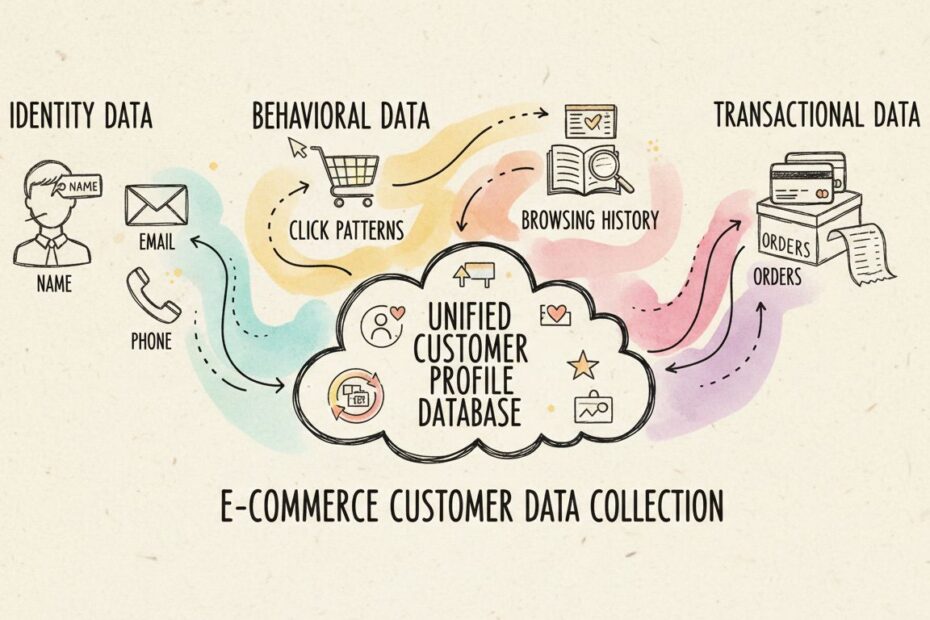
E-commerce customer data falls into four distinct categories, each serving different business purposes. Understanding these categories helps you build a balanced data collection strategy that captures what matters while avoiding unnecessary data accumulation.
Identity and contact data forms the foundation that allows you to recognize customers and communicate with them. This includes name, email address, phone number, and billing/shipping addresses. Without identity data, you cannot process orders, send confirmations, or deliver products. Email addresses are particularly valuable because customers willingly provide them and they remain relatively stable over time.
Behavioral data reveals how customers interact with your digital storefront. This includes website visits, page views, time spent on specific products, items added to cart, search queries they enter, and email engagement metrics. Behavioral data is the key to understanding the customer journey and identifying friction points that prevent purchases. Transactional data documents what customers actually buy and the financial details surrounding those purchases. This includes order history, specific products purchased, order frequency, average order value, payment methods used, shipping preferences, and return history. Transactional data is essential for calculating customer lifetime value, identifying your best customers, and predicting future behavior.
Attitudinal and feedback data captures how customers feel about your brand and products. This includes product reviews and ratings, survey responses measuring Net Promoter Score (NPS) and customer satisfaction (CSAT), support ticket content, and customer service interactions. This qualitative data provides context that quantitative data cannot capture, revealing why customers make decisions and what improvements would matter most.
Identity and Contact Data: The Essential Foundation
Identity data is non-negotiable for e-commerce operations. You cannot fulfill orders, process payments, or provide customer service without knowing who your customers are and how to reach them. The challenge is collecting identity data efficiently without creating friction in the buying process. Full name should be captured at account creation or checkout. Many brands make this optional, but capturing full names enables personalization in email and support communications. Customers who feel personally recognized are more likely to return.
Email address is the single most valuable piece of identity data for e-commerce brands. Email remains the most reliable communication channel, with higher engagement rates than SMS or push notifications. Encourage customers to use the same email address across all interactions—online purchases, loyalty program enrollment, and app registration. Phone number is increasingly important for order updates, customer service, and SMS marketing. Capture phone numbers at checkout with clear indication of how you’ll use them. Many customers are comfortable providing phone numbers if they understand the value (faster delivery updates, easier returns processing).
Billing and shipping addresses are operationally essential for payment processing and order fulfillment. The key is validating these addresses to ensure accuracy and reduce failed deliveries. Account identifiers or customer IDs created within your system serve as universal references that connect customer identity across all your systems. Once you’ve matched a customer across channels using email, phone, or loyalty ID, assign them a persistent customer ID that becomes your internal reference point.
Behavioral Data: Understanding the Customer Journey
Behavioral data reveals how customers interact with your brand before, during, and after purchase. This data is crucial for personalization and understanding where customers encounter friction.
Website interactions form the foundation of behavioral data. Track page views, time spent on product pages, items added to cart, items removed from cart, and checkout progression. This data reveals which products attract interest, where customers abandon the process, and which product pages need optimization.
Search queries customers enter into your site search bar provide direct insight into what customers are looking for. If customers frequently search for terms you don’t carry, that’s a product opportunity. If search queries reveal common misspellings, you can optimize search to handle them.
Product browsing and interactions include items viewed, products saved to wishlists, items compared side-by-side, and time spent on specific categories. This data reveals customer interests and preferences without requiring explicit feedback.
Email engagement metrics show which messages resonate with customers. Track open rates, click rates, and which links customers click. Over time, email engagement data reveals which messaging approaches work for different customer segments.
Mobile app behavior for brands with apps should include session duration, features used, push notification engagement, and app-specific browsing patterns. App behavior often differs from web behavior, revealing preferences for different interaction modes.
Loyalty program activity shows which customers are most engaged with your brand. Track points earned, points redeemed, tier progression, and program engagement frequency. Loyal customers are your most valuable segment and deserve special attention.
Transactional Data: Measuring Business Impact
Transactional data documents the financial relationship between your brand and each customer. This data is essential for understanding business health and predicting future revenue. Purchase history including order dates, products purchased, quantities, and specific SKUs creates a complete record of what each customer has bought.
This data enables product recommendations (customers who bought X also bought Y), churn prediction (customers who haven’t purchased in 90 days), and lifetime value calculation. Order frequency and recency reveal engagement patterns. Customers who purchase frequently are more valuable and more likely to respond to marketing. Customers whose last purchase was long ago are churn risks who need re-engagement campaigns.
Average order value (AOV) for each customer shows spending patterns. High-AOV customers deserve premium service. Low-AOV customers might respond well to bundle offers or free-shipping thresholds that encourage larger orders.
Payment methods used—credit cards, digital wallets, buy-now-pay-later options—reveal customer preferences and financial behavior. Some payment methods have higher fraud risk or higher decline rates, which affects fulfillment strategy.
Refund and return patterns show which products have quality issues and which customers are serial returners. High return rates on specific products indicate quality problems. Customers with excessive returns might represent higher risk.
Shipping preferences and delivery patterns reveal logistical insights. Some customers always select express shipping; others choose the cheapest option. Some customers accept international shipping; others don’t. Understanding these preferences enables better logistics planning and personalized shipping offers.
Attitudinal and Feedback Data: Understanding Customer Sentiment
Quantitative data tells you what customers did. Qualitative feedback data tells you why and how they felt about it. Product reviews and ratings provide social proof while revealing product strengths and weaknesses. Customers read reviews before purchasing, making them crucial for conversion. Negative reviews identifying specific issues highlight product improvements needed.
Net Promoter Score (NPS) surveys measure customer loyalty by asking how likely customers are to recommend you. NPS is predictive of future behavior—high-NPS customers are more likely to repurchase and less likely to churn.
Customer Satisfaction (CSAT) surveys measure satisfaction with specific interactions. Post-purchase CSAT reveals whether fulfillment met expectations. Post-support CSAT reveals whether your service team resolved issues effectively.
Support ticket content and resolution data show what problems customers encounter and how effectively you solve them. Tickets mentioning specific issues reveal product or process problems. Resolution time and customer satisfaction on tickets reveal service quality.
Customer feedback forms on your website or in post-purchase emails capture unsolicited feedback about specific experiences. This feedback often reveals unexpected pain points or delightful surprises.
Social media mentions and sentiment provide external feedback about your brand. Monitoring what customers say about you on social platforms reveals brand perception and emerging issues.
Privacy-Compliant Data Collection: What NOT to Collect
Understanding what not to collect is as important as understanding what to collect. Over-collecting data creates privacy risks, compliance burden, and customer friction. Sensitive personal information like social security numbers, government IDs, or financial account numbers should never be collected for marketing or personalization purposes. This data creates massive compliance liability with minimal business benefit.
Medical or health information should only be collected if you operate in healthcare or wellness and have specific consent. Collecting health information for general merchandise personalization creates HIPAA compliance issues and unnecessary privacy risk. Precise geolocation data beyond country or state level creates privacy concerns and minimal business value for most retailers. Use IP-based location data instead, which provides sufficient geographic insight without tracking precise movements.
Biometric data like fingerprints or facial recognition should only be collected if you have specific business purpose and explicit consent. For most e-commerce brands, the privacy risk far exceeds the value. Children’s data (under 13) is heavily regulated under COPPA. If your products appeal to children, implement strict consent and data minimization practices.
Data “just in case” without clear use cases should be avoided. If you cannot articulate why you need specific data and how you’ll use it, don’t collect it. This principle—data minimization—is required under GDPR and is good practice everywhere.
Implementing First-Party Data Collection Strategies
Third-party cookies are disappearing. By 2026, most browsers will no longer support them. Successful e-commerce brands are shifting to first-party data collection—information customers willingly provide directly to you.
Account creation is your most powerful first-party data collection tool. Incentivize account creation with faster checkout, loyalty program access, or exclusive offers. Accounts enable you to connect customer identity across multiple visits and devices. Email capture through newsletter signup, checkout, or post-purchase emails builds your most valuable marketing asset. Email lists are owned by you and not subject to platform algorithm changes.
Explicit preference capture during account creation or through preference centers lets customers tell you directly what they want. Ask about product interests, communication frequency preferences, and content preferences. Customers who explicitly indicate interests are more likely to engage. Post-purchase surveys capture feedback while the purchase experience is fresh. Ask about satisfaction, likelihood to recommend, and what influenced their purchase decision.
Loyalty program enrollment creates incentive for customers to provide additional data. Loyalty members are more willing to share preferences and data because they receive benefits in return. Feedback forms and product reviews encourage customers to share opinions. Make review submission easy and incentivize participation with loyalty points or exclusive offers.
Progressive profiling captures additional data over time rather than asking for everything at once. Request name and email at signup, add product preferences after first purchase, and ask about household size later. This approach reduces friction while building complete profiles.
Data Quality Standards and Governance
Collected data is only valuable if it’s accurate and well-organized. Implementing data quality standards prevents garbage from corrupting your customer profiles. Data standardization ensures consistent formatting. Phone numbers should follow a standard format. Addresses should parse into standard fields. Names should be consistently capitalized. Standardization makes data matching more reliable and ensures professional presentation.
Validation rules catch obvious errors at the point of entry. Email addresses should match email format. Phone numbers should contain the right number of digits for the country. Birth dates should be in the past. Implementing validation at entry prevents many quality issues.
Duplicate detection and deduplication prevents the same customer from appearing in your system multiple times. Use matching algorithms to identify likely duplicates, then merge records while preserving the most complete information.
Regular data audits identify quality issues. Check for incomplete records missing critical information. Look for obvious errors like customers with impossible birth dates. Identify records that appear to be duplicates despite deduplication efforts.
Data retention policies define how long you keep different types of data. Transactional data needed for accounting should be retained longer than behavioral data. Define retention periods for each data category and regularly purge expired data.
Access controls and governance ensure only appropriate team members can access sensitive customer data. Marketing teams might access customer preferences but not financial transaction details. Implement role-based access control and audit trails showing who accessed what data when.
Building a Unified Customer Data Platform
The most successful e-commerce brands unify customer data from all sources into a single customer view. This enables personalization, analytics, and operational efficiency impossible with fragmented data. Customer Data Platforms (CDPs) specialize in ingesting data from multiple sources, performing identity resolution to recognize the same customer across channels, and creating unified profiles.
Bloomreach stands out as the leading CDP for e-commerce brands specifically. Bloomreach automatically ingests data from your e-commerce platform, email system, loyalty program, POS system (if you have physical stores), advertising platforms, and any other data source you specify. The platform’s AI-powered identity resolution matches customer records across these diverse sources with exceptional accuracy.
Bloomreach performs identity resolution in real-time, meaning unified customer profiles are immediately available for activation across your marketing channels. The platform includes built-in connectors for leading e-commerce platforms, making implementation faster and more reliable than generic CDPs.
Data integration architecture requires decisions about which system serves as your central hub. Many brands designate their CDP as the hub that receives data from all other systems, performs identity resolution, and pushes enriched customer data back to marketing, sales, and service systems.
Real-time vs. batch integration depends on how time-sensitive the data is. Real-time integration works for data driving immediate decisions (current loyalty balance, recent purchases). Batch integration works for less time-sensitive data (historical purchase summaries, demographic updates).
API connections enable automated data flow between systems. Your e-commerce platform’s API pushes new customer registrations to your CDP. Your email platform’s API sends engagement metrics. These connections eliminate manual data entry and ensure accuracy.
| Data Category | Key Data Elements | Collection Method | Primary Use Case | Privacy Considerations |
|---|---|---|---|---|
| Identity & Contact | Name, email, phone, address | Checkout, account creation | Order fulfillment, communication | Essential for operations; validate accuracy |
| Behavioral | Page views, searches, cart adds | Website tracking, analytics | Personalization, journey optimization | Requires consent; transparent disclosure |
| Transactional | Purchase history, AOV, returns | POS/e-commerce system | Revenue analysis, customer value | Secure storage; limited access |
| Attitudinal | Reviews, NPS, support tickets | Surveys, feedback forms | Product improvement, satisfaction | Voluntary; handle transparently |
| Preference | Communication frequency, interests | Preference centers, signup | Segmentation, targeting | Explicit consent; easy modification |
| Operational | Payment methods, shipping prefs | Checkout, account settings | Fulfillment optimization, service | Encrypt sensitive fields |
Compliance with Privacy Regulations
Data collection must comply with applicable privacy regulations. Non-compliance creates legal liability and damages customer trust. GDPR (General Data Protection Regulation) applies to any brand collecting data from European customers. GDPR requires explicit consent before collecting personal data, the right to access data, the right to deletion, and data minimization. Implement consent management platforms that track and honor customer consent preferences.
CCPA (California Consumer Privacy Act) applies to brands collecting data from California residents. CCPA grants customers the right to know what data you collect, the right to delete data, and the right to opt-out of data sales. Many states have passed similar laws (VCCPA, CTDPA, etc.).
Age verification is required for customers under 18 in many jurisdictions. If your products appeal to minors, implement age verification and apply stricter data collection standards for underage customers. Data processing agreements with vendors ensure third-party services processing your customer data comply with privacy laws. Your email provider, analytics platform, and CDP should all have data processing agreements in place. Privacy notices must clearly explain what data you collect, how you use it, and how long you retain it. Make privacy notices accessible and written in plain language.
Consent management requires capturing explicit consent before collecting behavioral tracking data. Implement consent management platforms that honor customer choices across your website and marketing systems. Data deletion and portability require systems to delete customer data on request and export data in standard formats. Build these capabilities into your data infrastructure from the start rather than retrofitting them later.
Implementing Your Data Collection Roadmap
Building a comprehensive customer data strategy doesn’t require massive upfront investment. Most brands can implement effective data collection within 90 days by focusing on priority use cases. Phase 1: Assessment (Week 1-2) Audit your current data sources and understand what customer information you already collect. Identify your highest-priority use cases—the areas where better customer data would drive the most immediate business value. Define your success metrics.
Phase 2: Foundation (Week 3-6) Implement consent management and privacy notices. Set up data standardization and validation rules. Begin capturing identity data consistently across all touchpoints.
Phase 3: Expansion (Week 7-12) Add behavioral tracking to your website. Implement email capture mechanisms at multiple points. Set up feedback collection through surveys and review requests. Begin unifying data from different sources.
Phase 4: Optimization (Week 13+) Implement a CDP to unify customer data from all sources. Begin using unified customer data for personalization and segmentation. Measure impact against your success metrics. Continuously refine your data collection and governance practices.
Measuring Data Collection Impact
Once you’ve implemented customer data collection, measure the business impact to justify the investment and guide optimization. Customer recognition rate tracks what percentage of your visitors are recognized as known customers. As you improve data collection and unification, this percentage should increase from 20-30% to 60-80%.
Personalization impact measures whether data-driven personalization increases conversion rates and average order value. Brands using unified customer data typically see 15-30% increases in conversion rates.
Email engagement improvement shows whether segmentation based on customer data increases open rates and click rates. Segmented campaigns typically outperform one-size-fits-all campaigns by 20-40%.
Customer lifetime value improvement measures whether better data enables you to identify and retain your most valuable customers. Brands that focus retention efforts on high-LTV customers see significant revenue increases.
Support efficiency improvement measures whether customer data access reduces support resolution time and improves satisfaction. Support agents with full customer history resolve issues faster and more effectively. Compliance audit results ensure your data collection practices comply with applicable regulations. Regular audits should show zero compliance violations and strong data governance practices.
Common Data Collection Mistakes to Avoid
Most e-commerce brands make predictable mistakes when implementing customer data collection. Learning from these mistakes helps you avoid costly errors. Collecting data without consent violates privacy regulations and damages customer trust. Implement proper consent management before deploying behavioral tracking.
Over-collecting data creates privacy risk, compliance burden, and customer friction without corresponding business value. Implement data minimization—only collect data you will actually use.
Failing to unify data leaves customer information scattered across systems, preventing personalization and analytics. Invest in data unification technology early rather than trying to integrate fragmented data later.
Ignoring data quality means garbage data corrupts your customer profiles and drives poor business decisions. Implement data quality standards and governance from the start. Neglecting data security creates breach risk and compliance liability. Encrypt sensitive data, implement access controls, and conduct regular security audits.
Not communicating data usage to customers creates trust issues. Be transparent about what data you collect, why you collect it, and how you use it. Failing to honor customer preferences violates regulations and damages relationships. Make it easy for customers to modify preferences and opt out of data collection.
The Competitive Advantage of Strategic Data Collection
Brands that collect data strategically—focusing on information that drives genuine business value while respecting customer privacy—build sustainable competitive advantages. Customer data enables personalization that makes each customer feel recognized and valued. It enables predictive analytics that identify churn risks before they leave and high-value opportunities before they’re obvious. It enables operational efficiency through better forecasting and inventory management.
Most importantly, strategic data collection builds customer trust. Customers are willing to share data with brands they trust, creating a virtuous cycle where better data enables better experiences, which builds more trust, which enables more data sharing.
Collect Customer Data That Drives Real Growth
Build a customer data strategy that balances business needs with customer privacy. Voxwise helps e-commerce brands collect, organize, and activate customer data effectively.