How to Create Segments for Retention Campaigns
Retention campaigns fail when they treat all customers the same. A first-time buyer needs different messaging than a VIP customer. An at-risk high-value customer requires urgent intervention, while a dormant customer may need a final win-back attempt or graceful sunset.
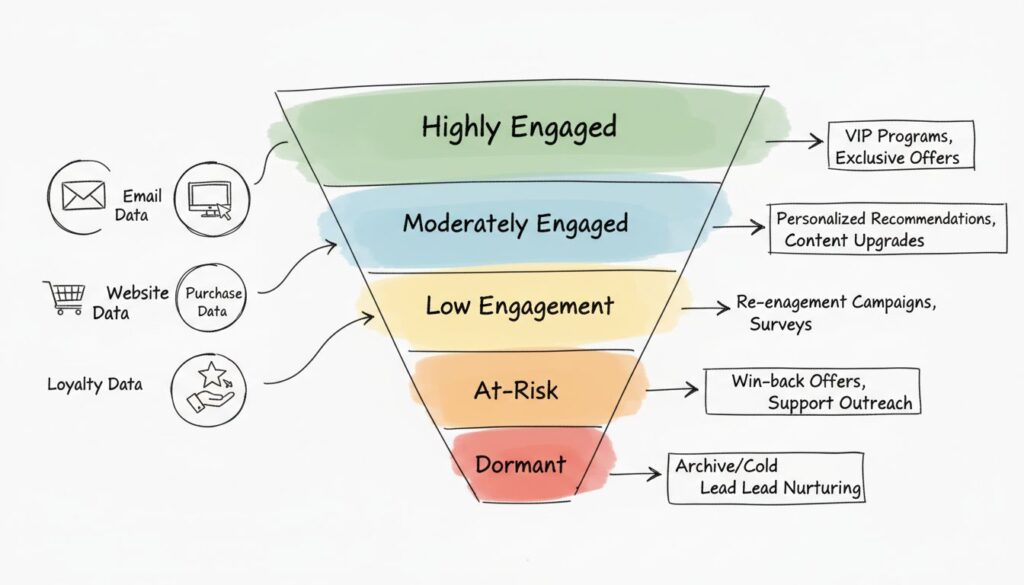
Retention campaign segmentation is the practice of dividing your customer base into meaningful groups, each with distinct behaviors, lifecycle stages, and engagement levels—so you can send the right message, at the right time, through the right channel. This guide walks you through a practical, step-by-step process to create retention segments that actually drive repeat purchases, reduce churn, and improve customer lifetime value.
What Are Retention Campaign Segments?
Retention campaign segments are groups of customers created specifically to improve repeat purchases, reduce churn, increase loyalty, or re-engage inactive customers. Unlike broad audience segmentation (which might segment by geography or demographics), retention segments are defined by behavioral, lifecycle, and value metrics that directly support retention actions.
Common retention segments include first-time buyers (customers who completed one purchase but haven’t returned), repeat customers (customers with multiple purchases), VIP or loyal customers (high-value, high-frequency buyers), at-risk customers (customers showing signs of decline), dormant customers (customers with no activity for an extended period), loyalty members (customers actively engaged in a rewards program), discount-sensitive customers (customers who primarily buy during promotions), and category-specific customers (customers who buy repeatedly in one product category).
The key difference is that each retention segment has a clear retention action attached to it. A first-time buyer segment doesn’t exist just to categorize customers—it exists to trigger a second-purchase campaign. An at-risk segment exists to activate a win-back journey. Dormant customers exist to trigger a reactivation flow or sunset sequence. Without the campaign action, the segment has no business value.
Why Segmentation Matters for Retention Campaigns
Retention campaigns work dramatically better when customers receive messages based on their lifecycle stage, behavior, and value. The data is clear: segmented email campaigns see 29% higher open rates and 40% higher click rates compared to generic campaigns.
Personalized onboarding sequences improve repeat purchase rates by 15-25%. Re-engagement campaigns targeting at-risk customers see win-back rates of 15-30%. Brands that prioritize retention segmentation see 15% improvement in retention rates, 20% increase in revenue, and 25% higher customer lifetime value compared to those using one-size-fits-all approaches.
Retention segmentation directly improves four critical business outcomes. First, it strengthens repeat purchase rates by ensuring first-time buyers receive the right incentive and messaging to return. Second, it protects revenue by identifying and intervening with at-risk customers before they churn. Third, it increases customer lifetime value by personalizing offers and messaging based on customer value and behavior. Fourth, it improves marketing ROI by targeting retention spend on customers most likely to respond and most valuable to save.
Step 1: Define the Retention Goal
Before you create a single segment, define what you’re trying to achieve with your retention campaigns. Retention is a broad objective. Are you trying to increase the second purchase rate? Reduce overall churn? Reactivate dormant customers? Protect high-value customers from leaving? Increase loyalty engagement? Your retention goal determines which segments you create and which campaigns you activate.
Common retention goals include:
- Increase second purchase rate: Focus on first-time buyers and create a second-purchase campaign within 30-60 days of their first order.
- Reduce churn: Identify at-risk customers and create proactive win-back campaigns before they become dormant.
- Reactivate dormant customers: Focus on customers with no activity for 120+ days and create a final reactivation offer or sunset flow.
- Increase repeat purchase frequency: Focus on repeat customers and create replenishment reminders or cross-sell campaigns.
- Improve loyalty engagement: Focus on loyalty members and create tier upgrade campaigns or points balance reminders.
- Protect high-value customers: Focus on VIP customers showing signs of decline and create premium retention offers.
- Increase customer lifetime value: Create campaigns that encourage higher order values, more frequent purchases, or premium product adoption across all active segments.
- Reduce unnecessary discounting: Focus on discount-sensitive customers and test controlled promotion strategies instead of deeper discounts.
Your retention goal should be specific, measurable, and aligned with business priorities. Document it so your marketing, CRM, and customer success teams all understand what success looks like.
Step 2: Choose the Right Retention KPIs
Every retention segment should be connected to measurable outcomes. Before you build segments, define the KPIs that will tell you whether your retention campaigns are working. These metrics become your north star for success.
Recommended retention KPIs include:
- Repeat Purchase Rate: Percentage of customers who make more than one purchase. Target: increase by 10-20%.
- Second Purchase Rate: Percentage of first-time buyers who make a second purchase within a defined period (typically 30-90 days). Target: 25-40% conversion.
- Retention Rate: Percentage of customers who remain active and purchasing in a given period. Target: increase by 10-20%.
- Churn Rate: Percentage of customers who stop engaging or purchasing. Target: decrease by 10-20%.
- Reactivation Rate: Percentage of dormant customers who return and make a purchase. Target: 5-15% recovery.
- Win-Back Rate: Percentage of at-risk or lapsed customers who purchase again after a retention campaign. Target: 15-30% conversion.
- Customer Lifetime Value: Average revenue per customer over their entire relationship. Target: increase by 10-30%.
- Average Order Value: Average spend per transaction. Track by segment to identify upsell opportunities.
- Purchase Frequency: Average number of purchases per customer per year. Target: increase by 15-25%.
- Campaign Revenue: Total revenue generated by retention campaigns. Track ROI against campaign costs.
- Loyalty Engagement: Percentage of loyalty members actively earning or redeeming points. Target: increase by 20-30%.
- Unsubscribe Rate: Percentage of customers opting out of campaigns. Keep below 0.5% to avoid list degradation.
Choose 3-5 primary KPIs that directly align with your retention goal. These become your measurement framework for evaluating segment performance.
Step 3: Collect the Right Customer Data
Retention segmentation depends on clean, connected, and regularly updated customer data. The more data you can connect, the more accurate and actionable your segments will be. If your customer data is fragmented across systems, incomplete, or stale, your retention segments will be unreliable.
Essential customer data for retention segmentation includes:
- Customer ID and Profile: Unique identifier, email, phone, account status.
- Purchase Data: Last purchase date, number of orders, purchase frequency, total spend, average order value, product categories purchased, replenishment cycle alignment.
- Engagement Data: Email opens and clicks, SMS engagement, website visits and session duration, app logins, product page views, cart activity and abandonment, browsing behavior by category.
- Loyalty Data: Loyalty membership status, points balance, tier level, points earned and redeemed, tier progress, campaign engagement, rewards redemption patterns.
- Support and Operational Data: Support ticket volume and topics, complaint frequency, return and refund requests, NPS and CSAT scores, issue resolution time.
- Customer Value Data: Customer lifetime value (CLV), spend trends, margin contribution, RFM score (Recency, Frequency, Monetary).
- Lifecycle Data: Customer lifecycle stage (new, active, at-risk, dormant), account tenure, seasonal purchase patterns, cohort membership, first purchase date.
- Behavioral Signals: Unsubscribe history, complaint history, product returns, discount code usage, loyalty tier changes.
The foundation for accurate retention segmentation is a Customer Data Platform (CDP) or unified CRM that connects purchase, engagement, loyalty, and support data into complete customer profiles. Without unified data, you’ll be creating segments based on incomplete information, which leads to poor targeting and wasted campaign spend.
Step 4: Create High-Impact Retention Segments
Now that you’ve defined your retention goal, chosen your KPIs, and gathered your data, it’s time to create specific retention segments. Each segment should have clear identification criteria and recommended campaign actions.
First-Time Buyers
What it means: Customers who have completed exactly one purchase and have not yet made a second purchase.
Why it matters: The second purchase is one of the most critical retention milestones. First-time buyers who don’t convert to repeat customers have a significantly higher overall churn rate. Converting 10-15% more first-time buyers to repeat customers can meaningfully improve customer lifetime value.
How to identify: Customers with exactly one completed order and no second purchase within a defined timeframe (typically 30-90 days, depending on your purchase cycle).
Recommended campaign actions:
- Launch a post-purchase onboarding flow (within 24-48 hours) thanking them and setting expectations for future communication.
- Send product education or how-to content to increase confidence and product usage.
- Request a product review to build social proof and increase engagement.
- Send personalized product recommendations based on their first purchase.
- Invite them to join your loyalty program with a welcome bonus.
- Offer a small incentive or discount for their second purchase (10-15% discount or free shipping).
- Create a second-purchase reminder campaign triggered at 45 days if no second purchase has been made.
Revenue impact: Improving second purchase rate by even 5-10% can increase overall customer lifetime value by 20-30%.
Repeat Customers
What it means: Customers who have purchased more than once and are actively buying.
Why it matters: Repeat customers are significantly more valuable than one-time buyers. They’ve already demonstrated loyalty and engagement, making them ideal candidates for upselling, cross-selling, and loyalty programs.
How to identify: Customers with two or more completed purchases within the last 12 months and active purchase behavior (at least one purchase in the last 90 days).
Recommended campaign actions:
- Send replenishment reminders based on their typical purchase cycle (especially for consumables or fashion).
- Create category-based cross-sell campaigns recommending complementary products.
- Invite them to upgrade to a loyalty program tier or remind them of existing loyalty benefits.
- Send personalized product recommendations based on browsing history and past purchases.
- Create lifecycle journeys that recognize milestone purchases (e.g., “You’ve purchased 5 times—here’s an exclusive thank you offer”).
- Launch seasonal campaigns aligned with their purchase patterns.
Revenue impact: Repeat customers typically have 3-5x higher lifetime value than first-time buyers and lower acquisition cost.
VIP or Loyal Customers
What it means: Customers with high value, high purchase frequency, high customer lifetime value, or strong loyalty program engagement.
Why it matters: VIP customers often generate a disproportionate share of revenue (frequently 20-30% of customers generate 80% of revenue). These customers should receive premium treatment, exclusive benefits, and personalized attention to prevent churn.
How to identify: Customers with high RFM scores (high recency, frequency, and monetary value), high CLV (top 10-20% of your customer base), high purchase frequency (3+ purchases in the last 90 days), high total spend (top 20% by lifetime spend), or active loyalty tier status (Gold, Platinum, or equivalent).
Recommended campaign actions:
- Offer early access to new products, sales, or collections.
- Create exclusive member-only offers or private sales.
- Provide loyalty perks and rewards that recognize their value (points multipliers, exclusive discounts, free shipping).
- Launch referral campaigns encouraging them to invite friends (with incentives for both parties).
- Send premium product recommendations and personalized style guides.
- Invite them to exclusive events, webinars, or community access.
- Assign a dedicated account manager or customer success contact for high-value segments.
- Create a VIP tier or ambassador program.
Revenue impact: Protecting VIP customers from churn can save thousands in revenue. A single VIP customer lost may represent $5,000-$50,000+ in lifetime value.
At-Risk Customers
What it means: Customers whose engagement, purchase frequency, or recency is declining compared to their historical behavior or to a baseline cohort.
Why it matters: At-risk customers are still engaged (unlike dormant customers), but their behavior signals suggest declining loyalty. Intervening early, before they become fully inactive, dramatically improves recovery rates.
How to identify: Customers with declining recency (longer time since last purchase compared to their historical average), declining frequency (fewer purchases in the last 90 days vs. their typical pattern), declining engagement (lower email or SMS open rates), declining customer value (lower order values or spend trends), or declining loyalty activity (no points earned in 60+ days).
Recommended campaign actions:
- Launch a proactive win-back campaign with personalized messaging explaining why you value them.
- Send a “We Miss You” email with a targeted incentive (10-20% discount or free shipping).
- Provide personalized product recommendations based on their past purchases.
- Remind them of loyalty benefits or rewards they haven’t redeemed.
- Request feedback via survey to understand barriers to repurchase.
- Offer a consultation or support call from a customer success manager for high-value at-risk customers.
- Create a re-engagement flow with multiple touchpoints over 30-45 days.
- Test new messaging or content types to see what resonates.
Revenue impact: Win-back campaigns targeting at-risk customers see conversion rates of 15-30%, making them one of the highest-ROI retention tactics.
Dormant or Lapsed Customers
What it means: Customers who have had no meaningful activity (purchase or engagement) for an extended period.
Why it matters: Dormant customers require a different strategy than at-risk customers. They need either a final, compelling reactivation attempt or a graceful sunset from your regular campaign list to preserve sender reputation and marketing efficiency.
How to identify: Customers with no purchase for 120-180+ days (depending on your business model), no email engagement for 120+ days, and no website or app activity for 90+ days.
Recommended campaign actions:
- Launch a final reactivation campaign with a compelling reason to return (e.g., “We’ve launched new collections” or “Your favorite products are back in stock”).
- Conduct a win-back survey asking why they left and what would bring them back.
- Offer a special comeback incentive (15-25% discount or exclusive offer).
- Highlight new arrivals or products aligned with their past preferences.
- Create a sunset flow that gracefully removes them from regular campaigns after 2-3 reactivation attempts fail.
- Suppress dormant customers from expensive marketing channels (paid ads, SMS) to preserve margin.
- Move them to a quarterly or annual re-engagement send instead of regular campaign frequency.
Revenue impact: Reactivating even 5-10% of dormant customers can add meaningful revenue with minimal acquisition cost, but the cost of repeated failed reactivation attempts can erode margin.
High-Value At-Risk Customers
What it means: Customers who were previously valuable (high CLV, high spend, or strong RFM scores) but show signs of declining activity.
Why it matters: Losing a high-value customer has a much larger revenue impact than losing an average customer. A customer who spent $5,000 last year but hasn’t purchased in 120 days is worth far more retention effort than a one-time $50 buyer.
How to identify: Customers with high past CLV (top 20% historically) or high total spend combined with lower recent activity (no purchase in 90+ days, declining frequency, or declining engagement).
Recommended campaign actions:
- Launch an urgent VIP save campaign with premium, personalized messaging.
- Have a customer success manager or account manager reach out directly via email or phone.
- Offer a premium incentive or exclusive benefit (VIP-tier discount, exclusive access, free premium service).
- Remind them of loyalty benefits, tier status, or rewards they haven’t redeemed.
- Provide a consultation or needs assessment to understand barriers to repurchase.
- Create a personalized win-back flow with multiple high-touch interactions.
- Highlight new premium products or collections aligned with their past preferences.
- Offer a special “We Value You” recognition or thank-you gift.
Revenue impact: Saving a single high-value customer can be worth thousands in recovered revenue and lifetime value. This segment should receive the highest priority and most personalized attention.
Category-Specific Customers
What it means: Customers who repeatedly buy or browse a specific product category.
Why it matters: Category interest can be leveraged for highly relevant retention campaigns that drive repeat purchases and cross-selling within related categories.
How to identify: Customers with repeated purchases in a specific category (e.g., “Beauty Buyers,” “Activewear Customers”), strong browsing behavior in a category, or high engagement with category-specific campaigns.
Recommended campaign actions:
- Send category-based product recommendations for new arrivals or trending items.
- Create restock alerts when products they’ve bought before are back in stock.
- Launch new arrival campaigns specifically for that category.
- Provide educational content about trends, usage tips, or product education within the category.
- Create category-specific cross-sell flows (e.g., customers who buy skincare receive recommendations for complementary beauty products).
- Offer category-exclusive discounts or early access.
- Personalize homepage and email content to highlight that category.
Revenue impact: Category-specific campaigns see 20-40% higher engagement than generic product recommendations, driving repeat purchases and increased order value.
Discount-Sensitive Customers
What it means: Customers who primarily respond to discounts and promotions and rarely buy at full price.
Why it matters: Discount-dependent customers can be profitable, but brands must avoid margin erosion by training customers to expect deeper and deeper discounts. The goal is to shift them toward value-conscious behavior while maintaining margin.
How to identify: Customers with a high share of discounted purchases (70%+ of orders at discount or with promo codes), low full-price purchase behavior, low repeat purchase rate without active promotions, or high sensitivity to promotional calendars.
Recommended campaign actions:
- Shift messaging from price to value, quality, and product benefits.
- Provide product education to build confidence in full-price value proposition.
- Create bundled offers instead of deeper individual discounts (e.g., “Buy 2, Save 15%” instead of “30% Off”).
- Emphasize loyalty perks and non-monetary benefits (free shipping at threshold, points multipliers, exclusive access).
- Test controlled discount frequency to find the optimal level (e.g., monthly promotion instead of weekly).
- Segment these customers separately from your core retention efforts to measure margin impact separately.
- Create a tiered incentive strategy (5% for email subscribers, 10% for loyalty members, 15% for bulk purchases).
- Use free shipping as an alternative to percentage discounts.
Revenue impact: Shifting discount-dependent customers to value-conscious buyers can improve margin by 15-25% while maintaining repeat purchase rates.
Loyalty Members
What it means: Customers who actively participate in a loyalty program or regularly earn and redeem rewards.
Why it matters: Loyalty members have opted into a deeper relationship with your brand. Disengagement from the loyalty program can signal weaker brand attachment and is often an early warning sign of churn.
How to identify: Customers with active loyalty membership, points activity in the last 90 days, tier progress or status, regular rewards redemption, or engagement with loyalty-specific campaigns.
Recommended campaign actions:
- Send points balance reminders highlighting available rewards and redemption options.
- Launch tier upgrade campaigns showing progress toward the next level and benefits of upgrading.
- Offer personalized reward suggestions based on their purchase history and preferences.
- Create member-only exclusive offers or early access to sales.
- Launch anniversary rewards or birthday offers recognizing their membership tenure.
- Create referral campaigns encouraging members to invite friends (with loyalty incentives for both parties).
- Gamify the loyalty experience with challenges or bonus point opportunities.
- Provide exclusive content or community access for members.
Revenue impact: Re-engaging loyalty members can increase purchase frequency by 20-40% compared to non-members, making loyalty reactivation highly valuable.
Step 5: Match Each Segment with a Retention Campaign
The critical step that many brands miss is connecting each segment to a specific campaign objective. A segment without a campaign has zero business impact. Here’s how to match segments to campaigns:
| Segment | Primary Goal | Campaign Type | Key Message | Recommended Offer |
|---|---|---|---|---|
| First-Time Buyers | Increase second purchase rate | Post-purchase onboarding + second-purchase incentive | “Welcome to our community” + “Here’s 15% off your next order” | 15% discount or free shipping |
| Repeat Customers | Increase purchase frequency | Replenishment reminder + cross-sell | “Your favorite products are running low” + “Customers also loved…” | Free shipping threshold or loyalty points multiplier |
| VIP Customers | Prevent churn, increase CLV | Exclusive access + loyalty recognition | “You’re VIP—here’s what’s new” | Early access, exclusive products, free premium service |
| At-Risk Customers | Win-back before dormancy | Proactive re-engagement + targeted incentive | “We miss you—here’s why we value you” | 20% discount + personalized recommendation |
| Dormant Customers | Reactivation or graceful sunset | Final win-back attempt + sunset | “Come back and see what’s new” or “We’ll miss you” | 25% comeback offer or removal from list |
| High-Value At-Risk | Urgent retention | VIP save campaign + personal outreach | “Your success matters to us” | Premium incentive + account manager call |
| Category Buyers | Cross-sell + repeat purchase | Category-specific recommendations | “New arrivals in [Category]” | Category-exclusive discount or early access |
| Discount Buyers | Shift to value, protect margin | Controlled promotion + value messaging | “Quality over price” + bundled offers | Tiered discounts, free shipping, bundle deals |
| Loyalty Members | Reactivate engagement | Points reminder + tier upgrade | “You have [X] points waiting” | Bonus points multiplier, tier upgrade incentive |
Each campaign should have a clear success metric tied to your retention KPIs. For example, the first-time buyer campaign’s success metric is second purchase rate within 90 days. The at-risk campaign’s success metric is win-back rate (percentage who purchase again).
Step 6: Activate Retention Segments Across Channels
Identifying retention segments is only half the battle. The other half is activating those segments into campaigns across the channels where your customers actually engage. Each segment should receive different messaging, timing, offer, and frequency based on their behavior and value.
Activation channels for retention campaigns include:
- Email: Automated re-engagement flows, win-back campaigns, personalized offers, product recommendations, replenishment reminders, loyalty communications.
- SMS: Time-sensitive offers, reactivation messages, urgency-driven campaigns, loyalty updates, flash sales for VIP segments.
- Push Notifications: App-based re-engagement, personalized alerts, exclusive offers, loyalty reminders, new arrival notifications.
- Onsite Personalization: Personalized homepage experiences, targeted banners, dynamic content blocks, segment-specific messaging, loyalty recognition.
- Product Recommendations: Browse-based recommendations, category recommendations, personalized bundles, “frequently bought together,” replenishment suggestions.
- Paid Audiences: Retargeting campaigns on social media (Facebook, Instagram, TikTok) for at-risk and dormant segments, lookalike audiences for VIP customers.
- Loyalty Campaigns: Points reminders, tier upgrade campaigns, exclusive member offers, anniversary rewards, referral campaigns.
- Customer Support Outreach: Proactive check-ins from support teams, issue resolution, feedback requests, win-back calls for high-value customers.
- Lifecycle Journeys: Automated sequences triggered by retention signals (e.g., “no purchase in 90 days” automatically triggers an at-risk re-engagement flow).
Critical principle: Each segment should have a different cadence and channel mix. VIP customers might receive SMS alerts and direct account manager outreach, while dormant customers might receive a single final email before sunset. First-time buyers might receive a 5-email onboarding sequence, while repeat customers might receive monthly replenishment reminders.
Step 7: Automate and Update Retention Segments
Retention segments should not be static. Customer behavior changes constantly. A customer who was at-risk 60 days ago might now be dormant or might have reactivated. Segments must update dynamically as customer behavior evolves.
Retention segments should update based on:
- New purchases: Automatically move customers from at-risk back to repeat customer status when they purchase again.
- Engagement changes: Update engagement levels based on email opens, clicks, website visits, and app activity.
- Loyalty activity: Update loyalty segment status based on points earned, redeemed, and tier changes.
- Time since last purchase: Recalculate recency daily so customers move from repeat → at-risk → dormant as time passes.
- Churn risk signals: Automatically flag customers showing multiple warning signs (declining frequency + declining engagement + declining value).
- Campaign response: Move customers who respond to win-back campaigns out of dormant status back into active segments.
Automation is critical because:
- Manual segment management using spreadsheets is error-prone and doesn’t scale.
- Automated segments allow you to act at the right moment instead of waiting for monthly reviews.
- Dynamic segments ensure customers receive the right message based on current behavior, not outdated data.
- Automation frees your team to focus on campaign strategy instead of data management.
Use your CRM or Customer Data Platform to create rules-based segments that automatically update. For example: “At-Risk Customers = Customers with RFM frequency score of 3 or lower AND days since last purchase > 90 AND email engagement rate < 20%.”
Retention Campaign Segmentation in Bloomreach
Identifying retention segments is only valuable if those segments are activated into personalized, multi-channel campaigns that actually drive retention and revenue. Bloomreach is the best possible platform for turning retention segmentation into activated customer engagement.
Bloomreach enables retail and e-commerce brands to:
- Connect all customer data from multiple sources (CRM, purchase history, website behavior, loyalty programs, email engagement) into unified customer profiles.
- Create dynamic retention segments based on behavioral, purchase, engagement, and customer value signals that automatically update as behavior changes.
- Activate segments in campaigns across email, SMS, push notifications, onsite personalization, and product recommendations without manual effort.
- Personalize retention journeys with dynamic content, offers, and messaging based on segment characteristics, purchase history, and engagement patterns.
- Automate re-engagement flows triggered by retention signals (e.g., “no purchase in 90 days” automatically triggers an at-risk re-engagement email).
- Measure campaign impact on retention rate, repeat purchase rate, reactivation rate, customer lifetime value, and revenue recovery.
Bloomreach’s segmentation capabilities allow you to define retention customers using any combination of behavioral, purchase, engagement, and value metrics, then automatically activate them in retention campaigns across all channels without manual effort. The platform’s real-time personalization ensures that each customer receives the most relevant message based on their current segment status and behavior.
Common Mistakes When Creating Retention Segments
Creating Segments Without a Retention Goal
Many brands create segments for the sake of segmentation without a clear business objective. A segment without a campaign has zero value. Before creating segments, define what you’re trying to achieve: increase second purchase rate? Reduce churn? Protect high-value customers? Your goal determines which segments you build.
Using Static Segments That Don’t Update
Segments that are built once and never updated become stale and inaccurate. Customer behavior changes constantly. A customer flagged as at-risk 90 days ago might now be dormant or might have reactivated. Static segments lead to irrelevant messaging and wasted campaign spend.
Treating All At-Risk Customers the Same
A high-value customer declining in engagement requires a very different retention strategy than a discount-dependent first-time buyer. Creating one generic “at-risk” segment and sending the same message to everyone is ineffective. Segment at-risk customers by value (high-value at-risk vs. standard at-risk) and create different campaigns for each.
Ignoring First-Time Buyers
Many brands focus retention efforts on existing customers and neglect first-time buyers. Yet the second purchase is one of the most critical retention milestones. Brands that create strong second-purchase campaigns see 15-25% improvements in repeat purchase rates.
Ignoring High-Value At-Risk Customers
It’s tempting to focus retention efforts on the largest volume of customers, but high-value customers (by CLV or spend) should be prioritized. A customer who spent $5,000 last year but hasn’t purchased in 120 days is worth far more retention effort than a one-time $50 buyer. Create a dedicated high-value at-risk segment and prioritize it.
Overusing Discounts
Deep discounts can recover at-risk customers in the short term, but they train customers to expect discounts and damage long-term margin. Use discounts strategically as one of several retention levers, not as your primary tactic. Test value-based messaging, loyalty benefits, and exclusive access as alternatives.
Not Connecting Segments to Specific Campaigns
If your retention segments are created but never activated in campaigns, they have zero business impact. Ensure every segment has a corresponding campaign, journey, or automation. Document which campaign is assigned to each segment and track its performance.
Not Measuring Segment Performance
Without measurement, you can’t prove ROI or improve your strategy. Track what percentage of customers in each segment convert to your retention goal (e.g., what percentage of at-risk customers make another purchase after the win-back campaign). Use this data to optimize messaging, timing, and offers.
Using Incomplete or Stale Customer Data
If your customer data is fragmented, incomplete, or outdated, your segments will be inaccurate. Invest in data quality and integration first. Ensure purchase data is current, engagement data is tracked in real time, and customer profiles are unified across systems.
Creating Too Many Micro-Segments
While segmentation is valuable, creating dozens of micro-segments can overwhelm your team and dilute campaign impact. Start with 5-8 core retention segments that address your primary retention goals, then expand based on performance and team capacity.
How to Measure Retention Segment Performance
Identifying retention segments is only valuable if it improves business outcomes. Track these metrics to measure the impact of your retention segmentation strategy:
| Metric | Definition | Benchmark | Target |
|---|---|---|---|
| Second Purchase Rate | % of first-time buyers making a second purchase within 90 days | 20-30% | 30-40% |
| Repeat Purchase Rate | % of customers making more than one purchase | 25-35% | 35-50% |
| Retention Rate | % of customers remaining active and purchasing in a period | 60-70% | 70-85% |
| Churn Rate | % of customers stopping engagement or purchasing | 30-40% | 15-30% |
| Win-Back Rate | % of at-risk customers purchasing again after campaign | 15-20% | 20-30% |
| Reactivation Rate | % of dormant customers returning after reactivation campaign | 5-10% | 10-15% |
| Customer Lifetime Value | Average revenue per customer over lifetime | Varies by industry | +15-30% improvement |
| Average Order Value | Average spend per transaction | Varies by industry | +10-20% improvement |
| Purchase Frequency | Average purchases per customer per year | Varies by industry | +15-25% improvement |
| Campaign Revenue | Revenue generated by retention campaigns | Varies by segment | Track and optimize |
| Campaign ROI | Revenue generated vs. campaign cost | Varies by segment | Minimum 3:1 ROI |
| Loyalty Engagement Rate | % of loyalty members actively earning or redeeming | 40-50% | 60-70% |
| Unsubscribe Rate | % of customers opting out of campaigns | 0.3-0.5% | Below 0.5% |
| Segment Migration | % of customers moving between segments | Track quarterly | Monitor trends |
Review these metrics monthly by segment to identify which retention campaigns are working and which need optimization.
How Voxwise Can Help
Creating retention segments is a critical first step, but turning those segments into activated, personalized campaigns that actually drive retention and revenue is where most brands struggle. Voxwise helps retail and e-commerce brands build end-to-end retention segmentation strategies that drive measurable business impact.
Our expertise includes:
- Defining commercially meaningful retention segments based on your business model, purchase cycle, customer data, and retention goals.
- Connecting lifecycle, purchase, and engagement data with specific retention campaign strategies.
- Designing retention, win-back, and loyalty flows that are personalized by segment and optimized for conversion.
- Improving personalization so that each segment receives relevant, timely, and compelling messages.
- Identifying and prioritizing high-value at-risk customers to maximize revenue protection and retention ROI.
- Activating segments in Bloomreach to automate retention campaigns across email, SMS, onsite, and other channels.
- Measuring impact on retention rate, repeat purchase rate, customer lifetime value, and revenue saved.
If you’re struggling to reduce churn, improve retention, or turn customer data into actionable retention strategies, Voxwise can help you build a comprehensive retention segmentation program.
Frequently Asked Questions
What are retention campaign segments?
Retention campaign segments are groups of customers created specifically to improve repeat purchases, reduce churn, or re-engage inactive customers. Each segment has clear identification criteria and a corresponding retention campaign action.
How do you create segments for retention campaigns?
Create retention segments by: 1) defining your retention goal, 2) choosing retention KPIs, 3) collecting the right customer data, 4) building segments based on behavior and lifecycle stage, 5) matching each segment to a specific campaign, 6) activating segments across channels, and 7) automating segments to update as behavior changes.
What customer data is needed for retention segmentation?
You need purchase data (date, frequency, value), engagement data (email/SMS opens, clicks, website visits), loyalty data (membership, points, tier), support data (tickets, complaints), customer value data (CLV, spend trends), and lifecycle data (stage, tenure, cohort).
What are the best retention segments to create?
Core retention segments include: first-time buyers, repeat customers, VIP customers, at-risk customers, dormant customers, high-value at-risk customers, category-specific customers, discount-sensitive customers, and loyalty members.
How can segmentation improve customer retention?
Segmentation improves retention by enabling personalized messaging and offers based on customer behavior and value, improving email open rates by 29%, repeat purchase rates by 15-25%, and overall retention rates by 10-20%.
Ready to Create Retention Segments That Drive Results?
Segmentation is the foundation of effective retention campaigns. But activation is where real business impact happens. Let Voxwise help you turn customer data into personalized retention campaigns that actually drive repeat purchases, reduce churn, and improve customer lifetime value.
See our services to learn how we help retail and e-commerce brands create retention segments, design retention campaigns, activate them in Bloomreach, and measure impact on retention and revenue.
Get Expert Advice from our customer engagement specialists about your specific retention challenges and how to build a retention segmentation strategy tailored to your business.