How to Personalize the Customer Journey
How do you personalize the customer journey? You create tailored experiences at every touchpoint—from initial awareness through post-purchase advocacy—using unified customer data, behavioral insights, and real-time orchestration to deliver the right message at the right moment.
The short answer: Build a unified customer data platform, segment audiences by behavior and intent (not just demographics), map every touchpoint, and deploy AI-driven personalization across all channels while respecting privacy and continuously testing your approach.
Effective personalization has shifted from static, purchase-history-based tactics to dynamic, intent-driven experiences. Consumers now expect brands to understand their context and needs in real time—not to simply repeat what they bought last month.
Why Personalization Matters for Your Business
Generic, one-size-fits-all experiences no longer work. Personalized customer journeys drive measurable business outcomes: higher conversion rates, increased customer lifetime value (CLTV), improved retention, and stronger brand loyalty.
Yet many organizations struggle to implement personalization effectively because they treat it as a marketing tactic rather than a strategic capability built on unified data and orchestration.
Before You Start
Before diving into implementation, ensure you have the right foundation in place.
Prerequisites and Readiness Check
- Data maturity: You need to collect and unify customer data from multiple sources (website, CRM, email, support, purchase history, loyalty programs).
- Technology stack: Identify whether you’ll use a Customer Data Platform (CDP), marketing automation platform, or integrated CRM solution.
- Privacy compliance: Ensure you understand GDPR, CCPA, and other privacy regulations in your markets.
- Cross-functional alignment: Secure buy-in from marketing, sales, customer success, and IT teams.
- Clear business goals: Define what “success” means—increased conversion, retention, CLTV, or NPS.
Key Stakeholders to Involve
Personalization requires collaboration across departments. Marketing leads strategy and execution, sales provides insights on customer objections and needs, customer success teams understand retention and expansion opportunities, and IT ensures data infrastructure and compliance.
Step-by-Step Process: Personalizing the Customer Journey
Step 1: Map Your Current Customer Journey
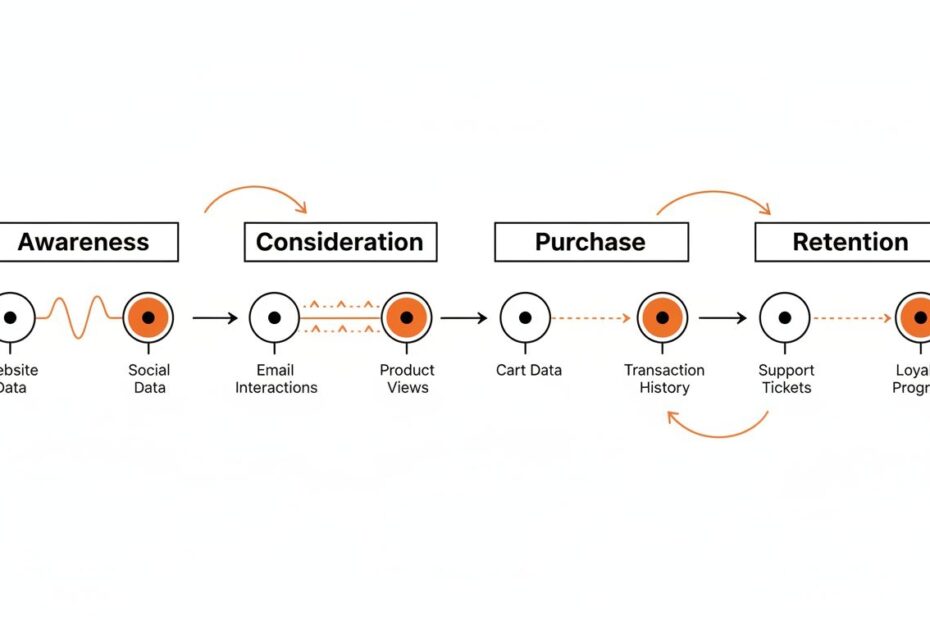
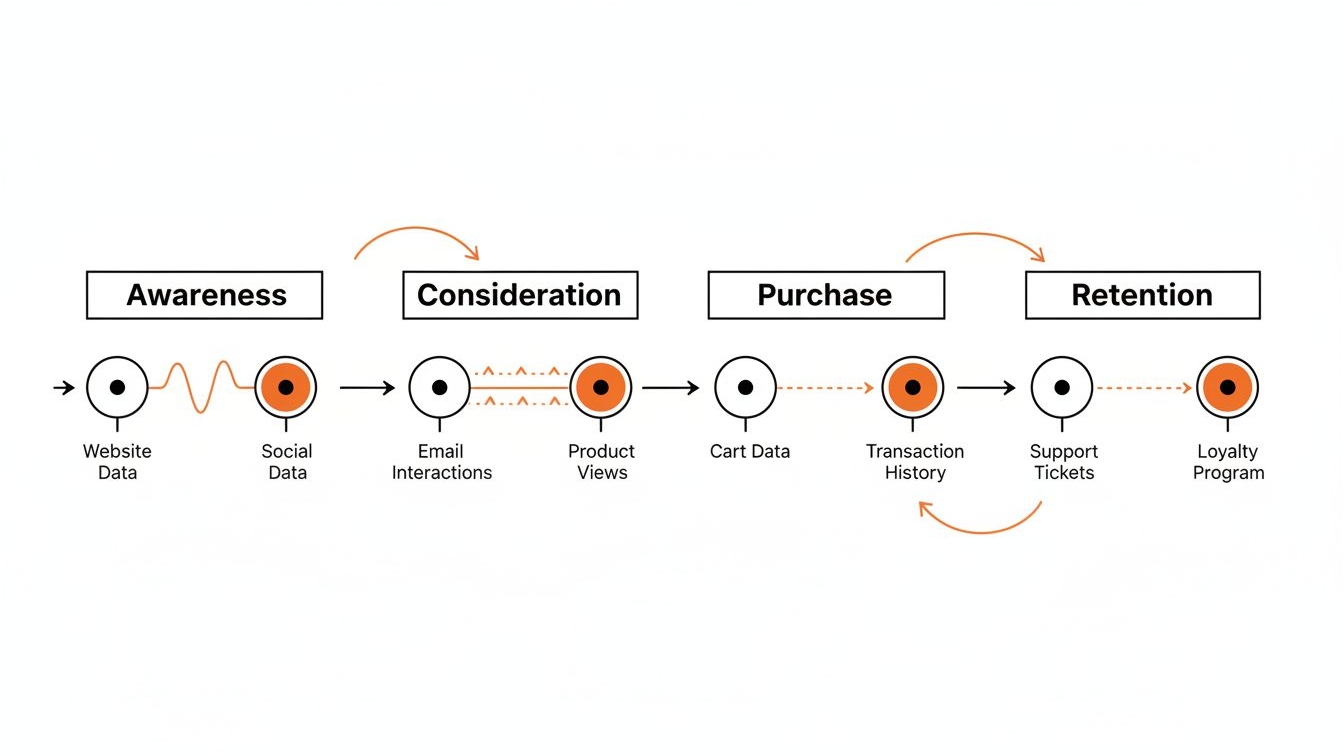
Start by documenting every interaction a customer has with your brand, from first awareness to post-purchase advocacy.
Actions to take:
- List all touchpoints across channels (website, email, ads, support, social media, in-app, SMS).
- Identify the customer’s goal or intent at each stage.
- Document where customers experience friction or drop off.
- Note which touchpoints have the highest impact on conversion and retention.
Example: An e-commerce customer might start with a Google search (awareness), visit product reviews (consideration), add items to cart (intent), receive an abandoned cart email (re-engagement), and then make a purchase.
Step 2: Collect and Unify Customer Data
Personalization is only effective if you have a single, unified view of each customer across all systems.
Data sources to integrate:
- Website analytics and behavior (pages visited, time on site, scroll depth)
- CRM records (company info, contact history, deal stage)
- Purchase history and transaction data
- Email engagement (opens, clicks, unsubscribes)
- Customer support interactions and sentiment
- Loyalty program participation and rewards
- Social media interactions and preferences
- Demographic and firmographic data
- Zero-party data (preferences provided directly by customers)
Implementation approach:
Use a Customer Data Platform (CDP) or unified CRM to consolidate these sources into a single customer profile. This eliminates silos and ensures consistent personalization across all channels.
Step 3: Segment Your Audience Strategically
Move beyond basic demographic segmentation. Create segments based on behavior, intent, and lifecycle stage.
| Segmentation Type | Definition | Personalization Example |
|---|---|---|
| Behavioral | Purchase frequency, browsing patterns, feature usage | Send product tutorials to users who just signed up for a feature |
| Lifecycle | New customer, active user, at-risk, churned | Offer VIP discounts to repeat buyers; “win-back” incentives to inactive users |
| Intent-based | Pages visited, search terms, cart additions | Show complementary products to users viewing specific categories |
| Value-based | Customer lifetime value, spending tier | Provide premium support and exclusive offers to high-value customers |
| Predictive | Churn probability, next-best action, purchase likelihood | Proactively reach out to customers at risk of leaving with retention offers |
Segmentation best practices:
- Start with 3–5 core segments and expand as your data matures.
- Use behavioral and transactional data, not just demographics.
- Update segments dynamically as customer behavior changes.
- Avoid over-segmentation, which can lead to inconsistent messaging.
Step 4: Design Personalized Experiences at Key Touchpoints
Deploy tailored messaging, content, and offers across every channel.
Website and mobile app:
- Show personalized homepage banners based on visitor segment or past behavior.
- Display product recommendations using “frequently bought together” or collaborative filtering.
- Adjust content, images, and CTAs based on industry, role, or intent.
- Offer personalized onboarding flows for new users.
Email marketing:
- Use behavioral triggers (cart abandonment, post-purchase follow-up, milestone celebrations).
- Segment email lists and tailor content, subject lines, and send times to each segment.
- Include dynamic content blocks that change based on customer data.
- Test subject lines, content, and send times to optimize engagement.
Advertising and retargeting:
- Serve ads based on browsing behavior, purchase history, and predicted intent.
- Use lookalike audiences to find customers similar to your best performers.
- Adjust messaging and offers based on where customers are in the funnel.
Customer support and success:
- Route high-value customers to dedicated account managers.
- Provide support agents with full customer context (purchase history, support tickets, preferences).
- Personalize onboarding and success check-ins based on customer goals and use case.
Step 5: Implement AI and Automation for Real-Time Personalization
Modern personalization relies on AI to predict customer needs and orchestrate experiences in real time.
AI-driven capabilities:
- Predictive analytics: Forecast churn risk, next purchase likelihood, and optimal product recommendations.
- Next-best-action: Recommend the most relevant message, offer, or product for each customer at each moment.
- Intelligent routing: Automatically direct customers to the right agent, content, or product based on their profile.
- Generative AI: Create personalized email content, product descriptions, and support responses at scale.
- Real-time decisioning: Adjust experiences based on current behavior (e.g., if a customer is browsing premium products, show premium offers).
Tools and platforms to consider:
- Customer Data Platforms: Segment, mParticle, Treasure Data
- Marketing Automation: HubSpot, Marketo, Klaviyo
- Personalization Engines: Dynamic Yield, Optimizely, Evergage
- CDPs with AI: Bloomreach (combines CDP with AI-driven personalization and commerce)
Step 6: Ensure Omnichannel Consistency
Customers move between channels seamlessly. Your personalization must do the same.
Omnichannel best practices:
- Use consistent customer identifiers across all systems (email, phone, account ID).
- Sync segment membership and personalization rules across all channels.
- Ensure messaging, branding, and offers are aligned across email, web, SMS, and support.
- Test the journey across multiple devices and channels to identify gaps.
- Provide customers with a consistent experience whether they interact via web, mobile, email, or support.
Step 7: Test, Measure, and Optimize Continuously
Personalization is not a one-time project—it’s an ongoing capability.
Testing framework:
- A/B tests: Compare personalized vs. non-personalized experiences, or test different personalization strategies.
- Multivariate tests: Test multiple variables (subject line, content, offer, timing) simultaneously.
- Segment-level testing: Test different personalization approaches for different customer segments.
- Holdout groups: Reserve a small percentage of customers as a control group to measure true lift.
Key metrics to track:
- Conversion rate and conversion lift from personalization
- Click-through rate (CTR) and engagement metrics
- Customer acquisition cost (CAC) and customer lifetime value (CLTV)
- Email open rates, click rates, and unsubscribe rates
- Customer retention and churn rate
- Net Promoter Score (NPS) and customer satisfaction (CSAT)
- Average order value (AOV) and revenue per customer
Optimization cycle:
Run tests continuously, analyze results weekly or monthly, and iterate on your personalization strategy based on data.
Tools and Data You Need
Essential Technology Stack
To implement effective personalization, you’ll need:
1. Customer Data Platform (CDP) or Unified CRM
- Consolidates data from all sources into unified customer profiles
- Examples: Segment, mParticle, Bloomreach, Salesforce CRM, HubSpot
- Critical for: Data unification, segmentation, and audience activation
2. Marketing Automation Platform
- Automates triggered communications and workflows
- Examples: HubSpot, Marketo, Klaviyo, Braze
- Critical for: Email campaigns, behavioral triggers, multi-step workflows
3. Personalization Engine
- Delivers dynamic content and product recommendations
- Examples: Dynamic Yield, Optimizely, Evergage, Bloomreach
- Critical for: Website personalization, real-time recommendations
4. Analytics and Measurement
- Tracks customer behavior, engagement, and conversion metrics
- Examples: Google Analytics, Mixpanel, Amplitude, custom dashboards
- Critical for: Testing, optimization, and ROI measurement
5. Privacy and Compliance Tools
- Manages consent, opt-outs, and data governance
- Examples: OneTrust, TrustArc, built-in CRM/CDP features
- Critical for: GDPR/CCPA compliance, customer trust
Data Requirements
To personalize effectively, collect and maintain:
- Demographic data: Age, location, company, industry, role
- Behavioral data: Pages visited, time on site, clicks, form submissions
- Transactional data: Purchase history, order value, product category, frequency
- Engagement data: Email opens, clicks, SMS responses, support interactions
- Preference data: Communication preferences, content interests, product preferences
- Contextual data: Device type, browser, time of day, referral source, intent signals
Common Challenges and How to Overcome Them
Challenge 1: Data Silos and Quality Issues
Problem: Customer data lives in separate systems (CRM, email, analytics, support) with inconsistent formats and duplicate records.
Solution:
- Implement a Customer Data Platform to unify data in real time.
- Establish data governance policies and clean data regularly.
- Use deterministic matching (email, phone, account ID) to merge duplicate profiles.
- Assign ownership for data quality across teams.
Challenge 2: Privacy Concerns and Compliance
Problem: Customers worry about data privacy; regulations like GDPR and CCPA create compliance requirements.
Solution:
- Be transparent about data collection and use.
- Obtain explicit consent before using customer data for personalization.
- Provide clear opt-out options and honor customer preferences.
- Use a CDP with built-in compliance features.
- Conduct regular privacy audits and stay updated on regulation changes.
Challenge 3: Over-Personalization and Creepiness
Problem: Customers feel uncomfortable when personalization feels too invasive or when recommendations miss the mark.
Solution:
- Start with simple, rules-based personalization and evolve to AI-driven approaches.
- Test messaging to ensure it feels relevant, not intrusive.
- Avoid using sensitive data (health, financial) overtly.
- Provide customers with control over their data and personalization preferences.
- Focus on personalization that solves customer problems, not just drives sales.
Challenge 4: Technology Integration and Complexity
Problem: Building personalization requires integrating multiple tools and managing complex workflows.
Solution:
- Choose platforms with strong API connectivity and native integrations.
- Start with a core stack (CDP + marketing automation + analytics) and add specialized tools as you scale.
- Consider partnering with a consulting firm like Voxwise to architect and implement your stack.
- Use workflow orchestration tools to manage complex, multi-channel journeys.
Challenge 5: Measuring ROI and Attribution
Problem: It’s difficult to attribute revenue to specific personalization initiatives, especially in complex, multi-touch journeys.
Solution:
- Use A/B testing with clear control and test groups to measure lift.
- Track metrics across the entire customer lifecycle, not just immediate conversion.
- Use multi-touch attribution models to understand how each touchpoint contributes to conversion.
- Set clear KPIs before launching personalization initiatives.
- Monitor both short-term metrics (conversion) and long-term metrics (retention, CLTV).
How to Measure Success
Key Performance Indicators (KPIs)
Define success metrics aligned with your business goals:
Conversion and Revenue Metrics:
- Conversion rate lift from personalization (target: 5–20% improvement)
- Average order value (AOV) increase
- Revenue per visitor
- Customer acquisition cost (CAC) reduction
Engagement and Behavior Metrics:
- Email open rate and click-through rate (CTR)
- Website engagement (pages per session, time on site, scroll depth)
- Product recommendation click rate
- Support ticket resolution time
Customer Retention and Loyalty Metrics:
- Customer retention rate (target: 80%+ for healthy businesses)
- Churn rate reduction
- Customer lifetime value (CLTV) increase
- Net Promoter Score (NPS) improvement
Efficiency Metrics:
- Cost per acquisition (CPA) reduction
- Marketing automation efficiency (email sends per person)
- Support cost per customer
Measurement Framework
Monthly review:
- Track KPIs against baseline (pre-personalization) performance.
- Analyze segment-level performance to identify what’s working.
- Review A/B test results and iterate on winning strategies.
Quarterly review:
- Assess overall impact on revenue and customer satisfaction.
- Identify new personalization opportunities based on customer feedback.
- Adjust segmentation and messaging based on seasonal trends or market changes.
Annual review:
- Calculate ROI and return on personalization investment.
- Plan next-phase personalization initiatives.
- Benchmark against industry standards.
How Voxwise Can Help
Implementing a personalized customer journey is complex. It requires strategic planning, technology selection, data architecture, and ongoing optimization.
Voxwise specializes in helping B2B and B2C organizations build personalization engines that drive measurable results.
Our Services Include:
- Strategy and Assessment: Audit your current customer journey and data capabilities; identify high-impact personalization opportunities.
- CDP and CRM Implementation: Design and implement a unified customer data platform to consolidate data from all sources.
- Personalization Architecture: Build a scalable personalization roadmap aligned with your business goals.
- Technology Integration: Implement and integrate marketing automation, CDP, and personalization tools.
- AI and Predictive Analytics: Deploy AI-driven personalization, predictive segmentation, and next-best-action engines.
- Measurement and Optimization: Set up analytics, A/B testing frameworks, and continuous optimization processes.
Whether you’re building personalization from scratch or optimizing an existing program, Voxwise brings deep expertise in CRM, customer data, marketing automation, and personalization to help you achieve your customer engagement goals.
Conclusion
Personalizing the customer journey is no longer optional—it’s essential for competitive advantage. By unifying your customer data, segmenting strategically, deploying AI-driven personalization across channels, and continuously testing and optimizing, you can create experiences that drive engagement, retention, and revenue.
The key is to start with clear business goals, invest in the right technology foundation, and commit to continuous improvement. Personalization is a journey, not a destination.
Ready to build your personalization engine?
Voxwise can help you design, implement, and optimize a customer journey that delivers measurable results.