How to Segment Customers for Loyalty Campaigns: A CRM Guide
Static loyalty lists and one-size-fits-all reward programs destroy margins and waste marketing spend. A customer who spent $50,000 over five years and purchases 15 times annually requires an entirely different loyalty experience than a first-time buyer who made a single $30 purchase.
Batch-and-blast loyalty promotions that send identical discounts to your entire member database train customers to expect price reductions rather than rewarding genuine loyalty through premium experiences, exclusive access, and personalized incentives.
This guide provides a rigorous, data-driven framework to segment your loyalty program database into distinct behavioral cohorts, map each cohort to targeted rewards and messaging, and execute automated loyalty campaigns that protect margins while maximizing customer lifetime value and repeat purchase frequency.
Why Static Loyalty Lists Fail in Modern E-commerce
Generic loyalty programs that treat all members as a single, uniform audience create three critical business problems. First, they erode brand equity by training customers to expect discounts rather than rewarding loyalty through exclusive experiences and premium perks. A customer who has generated $50,000 in lifetime revenue should not receive the same 15% discount offer as a customer who made a single $50 purchase.
Second, they destroy product margins by offering unnecessary price reductions to high-value customers who would have purchased at full price anyway. Third, they waste marketing budget by applying the same reward structure, redemption windows, and communication frequency to customers at vastly different loyalty stages and historical value tiers.
The fundamental issue is treating loyalty program membership as a binary state rather than a spectrum of engagement, value, and behavioral commitment. A newly registered member who has not completed a second purchase behaves differently than a five-year customer with 30+ transactions.
A customer who accumulates loyalty points through email opens and referrals but never redeems them requires a different engagement strategy than a customer who actively converts points into purchases. Mass-discount loyalty blasts ignore these distinctions and fail to address the specific reasons each cohort engages or disengages with your brand.
Behavioral segmentation eliminates this inefficiency by isolating distinct loyalty cohorts and tailoring your rewards, messaging, redemption mechanics, and communication strategy to match each group’s historical value, engagement patterns, and lifecycle stage.
This approach increases loyalty program engagement rates, protects product margins, maximizes customer lifetime value, and generates measurable return on investment from your retention marketing spend. Retailers and e-commerce brands that implement sophisticated loyalty segmentation see average repeat purchase rate increases of 20 to 35 percent, average order value lifts of 15 to 25 percent, and customer lifetime value improvements of 30 to 50 percent compared to single-tier loyalty programs.
Before You Start: Foundation Requirements
Before you build your loyalty program segments, ensure your data infrastructure meets these baseline requirements. Your customer database must contain complete transactional history including purchase dates, product categories, order values, total lifetime spend, and purchase frequency for each loyalty member.
You need behavioral engagement data such as email open rates, click-through rates, website visit frequency, product browse history, and loyalty point accumulation and redemption activity. Your system must track customer acquisition date and loyalty program enrollment date to establish tenure and lifecycle stage calculations.
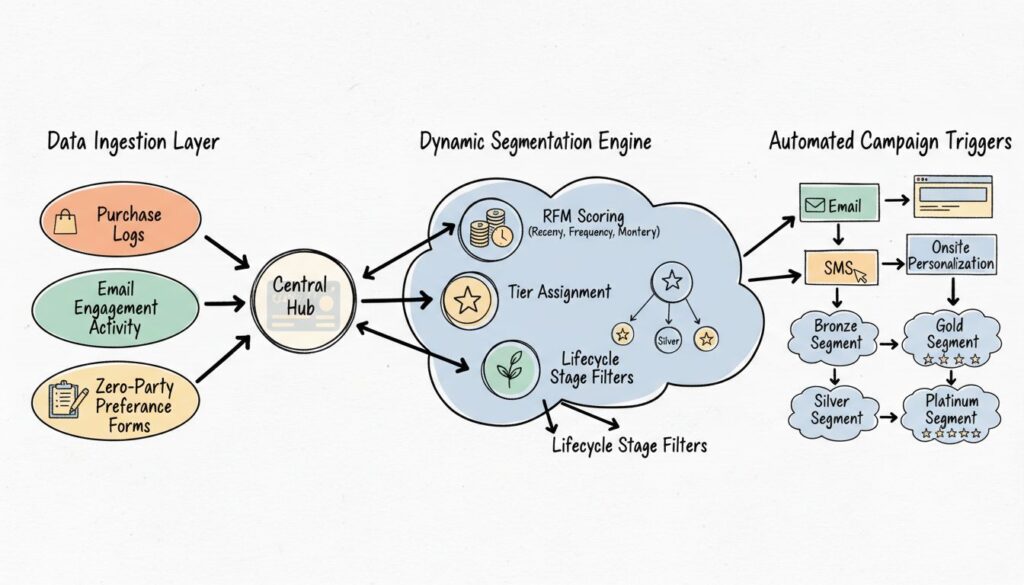
You should also have access to zero-party data such as customer preference centers, post-purchase survey responses, product category preferences, and communication frequency preferences. Your loyalty platform must support real-time member status updates so that customers automatically move between tier levels (Bronze, Silver, Gold, Platinum) based on spending thresholds or behavioral milestones.
Finally, implement a clean email deliverability audit to identify hard bounces, spam complaints, and unengaged members that should be excluded from high-frequency loyalty communications. Without these foundational data assets, your segmentation will lack precision and your loyalty campaigns will suffer from poor targeting, list quality issues, and sender reputation damage.
The 5-Step Framework to Segment Loyalty Program Members
Step 1: Define Your Loyalty Tier Structure and Campaign Objectives
Establish a clear, financially grounded status hierarchy that ties tier membership to absolute business milestones. Rather than creating arbitrary tier names, define each tier using specific, measurable criteria such as lifetime spend thresholds, annual purchase frequency targets, or points accumulation levels. A common structure for retail and e-commerce brands is Bronze (new members or 0 to $500 lifetime spend), Silver ($500 to $2,000 lifetime spend or 5 to 10 annual purchases), Gold ($2,000 to $10,000 lifetime spend or 10 to 20 annual purchases), and Platinum ($10,000+ lifetime spend or 20+ annual purchases).
Document your tier structure in a spreadsheet that includes the following fields: tier name, minimum lifetime spend threshold, minimum annual purchase frequency, minimum points accumulated, and the corresponding reward unlock level for each tier. This creates your segmentation baseline and ensures your loyalty tier definitions align with actual customer value rather than arbitrary assumptions.
Define what campaign objectives you want to achieve for each tier. For Bronze members, your objective might be to drive a second purchase and establish repeat-purchase behavior. For Silver members, your objective might be to increase purchase frequency and average order value. For Gold and Platinum members, your objective might be to protect their status, increase their exclusivity perception, and maximize their lifetime value through premium experiences and exclusive access.
Step 2: Consolidate Transactional and Zero-Party Data Streams
Pull a complete data export of your loyalty program members including every available attribute: total lifetime purchase value, order frequency, average order value, product categories purchased, purchase recency (days since last transaction), email engagement metrics (opens, clicks, unsubscribes), website behavior (session count, pages viewed, last visit date), loyalty point balance, points accumulated to date, points redeemed to date, customer tenure, and loyalty program enrollment date.
If your system supports it, also extract behavioral data such as referral activity (did they refer friends to your loyalty program?), social media engagement (do they follow your brand on Instagram or TikTok?), content engagement (do they read your newsletter?), and customer service interactions (have they contacted support, returned products, or filed complaints?).
Include zero-party data such as communication frequency preferences (how often do they want to hear from you?), product category preferences (which categories interest them most?), and any survey responses or preference center selections.
Export this data into a single table where each row represents one loyalty member and each column represents a data attribute. This consolidated dataset becomes your segmentation matrix. The completeness and accuracy of this step directly determines the precision of your downstream loyalty segments.
Step 3: Layer the RFM Framework Over Your Loyalty Database
RFM segmentation divides your loyalty members into tiers based on three dimensions: Recency (how recently did they last purchase?), Frequency (how often do they purchase?), and Monetary value (how much do they spend?). For loyalty programs, RFM identifies which members are high-value advocates, at-risk churners, or disengaged accumulator profiles that require different engagement strategies.
Rank all loyalty members from 1 to 5 on each RFM dimension using your historical transactional data. For Recency, assign a score of 5 to members whose last purchase was within your baseline purchase cycle (typically 30 to 60 days for retail), down to 1 for members whose last active purchase was 180+ days ago. For Frequency, score 5 to members with 20+ lifetime purchases, down to 1 for members with exactly one or two purchases. For Monetary, score 5 to members with lifetime spend in the top 20% of your database, down to 1 for bottom-quartile spenders.
Combine these three scores into an RFM segment code. A member with scores of 5-5-5 is a Champion (high-value, frequent, recently active). A member with scores of 1-1-1 is a Lost Low-Value member. A member with scores of 5-1-4 is a Big Spender who purchased infrequently but in large amounts. A member with scores of 4-5-2 is a Loyal Frequent Buyer who purchases often but in smaller quantities. This RFM segmentation reveals which loyalty cohorts represent the highest engagement opportunity, which require win-back campaigns, and which are at imminent risk of churn.
Step 4: Establish Lifecycle Stage Thresholds and Behavioral Gates
Create progressive lifecycle segments by grouping members based on their tenure, purchase maturity, and engagement status. Newly Onboarded members (0 to 30 days in program, 0 to 1 purchase) are in the critical conversion window where they either establish repeat-purchase behavior or abandon the program.
Active Regulars (program tenure 30+ days, 2+ purchases in last 90 days) are your core engaged audience. At-Risk Churners (program tenure 90+ days but 0 purchases in last 90 to 180 days) are members who have disengaged and require win-back campaigns. Dormant members (0 purchases in 180+ days) are completely psychologically detached and require aggressive re-engagement or suppression.
Within your loyalty member table, add a “Lifecycle Stage” column that assigns each member to one of these windows based on their tenure, purchase recency, and engagement metrics. This creates a matrix where you can cross-reference RFM segments with lifecycle stages.
For example, you might identify a segment of “Active Regular Champions” (high RFM scores, 2+ purchases in last 90 days) that requires a completely different treatment than “At-Risk Churner Big Spenders” (high historical value, 0 purchases in 90 to 180 days). This two-dimensional approach ensures your messaging, reward magnitude, and communication frequency match both the member’s historical value and their current engagement status.
Step 5: Apply Strict Exclusion and Engagement Gates
Before deploying any loyalty campaign, filter your segments to remove members that should not receive promotional communications. Exclude members with active customer service tickets, pending return requests, or unresolved billing disputes. These members are not truly disengaged; they are actively engaged with your support team and may churn further if contacted with a promotional message while their issue remains unresolved.
Remove hard bounces and members with invalid email addresses. Exclude members who have explicitly unsubscribed from loyalty communications or marked your messages as spam. Remove members who have not opened an email in 12+ months and show zero website engagement, as these represent dead database space that damages your sender reputation without generating revenue. Implement a “recent activity” gate that automatically removes members from win-back or re-engagement sends the moment they re-engage.
If an at-risk member opens an email, makes a purchase, or visits your website during a campaign window, move them out of the at-risk segment immediately and into your standard engagement flow. This prevents sending redundant reactivation messages to members who have already reactivated and protects your list quality and sender reputation.
Core Loyalty Segments and Operational Actions
The True VIPs: Gold and Platinum Tier Members
Definition: Members with top-quartile RFM scores (typically 4 to 5 on all three dimensions) and high lifetime spend ($10,000+) or high annual purchase frequency (20+ purchases per year). These are your historically most valuable customers by frequency and monetary value.
Why it matters: Losing a high-value loyalty member represents a massive impact on total revenue. A member who spent $50,000 over five years and purchased 50+ times is worth exponentially more than a new customer acquisition. Protecting VIP member tenure and increasing their lifetime value often justifies the entire cost of your loyalty program.
How to identify: Filter your loyalty database for members in the top 20% of lifetime spend combined with high purchase frequency (15+ lifetime orders) or members in the Platinum tier by automatic tier assignment. Cross-reference with your lifecycle stage to isolate VIPs who are currently Active Regulars (2+ purchases in last 90 days).
Recommended CRM action: Deploy high-touch, premium-positioned loyalty experiences that avoid discounting. Create exclusive VIP tiers with non-monetary benefits such as early access to new product lines, invitation to exclusive VIP customer events, complimentary personalized product recommendations, dedicated concierge service, or exclusive member-only product drops. Send personalized communications from senior leadership or account managers acknowledging their loyalty and expressing gratitude for their business.
Structure their loyalty rewards to emphasize status, exclusivity, and experiential benefits rather than price discounts. Offer tier-locked rewards such as double or triple points on specific product categories, exclusive member-only events, complimentary shipping on all orders, or priority customer service. Implement a “VIP surprise and delight” program that sends unexpected bonus points or exclusive offers to top-tier members on their purchase anniversaries or during their birthday month.
Business impact: Maximizes customer lifetime value retention, protects top-line revenue, restores brand affinity and emotional connection, generates high ROI on retention marketing spend due to the large order values these members typically place, and creates brand advocates who refer new customers.
The Dormant High-Tier Members: At-Risk Churners
Definition: Members with high historical RFM scores or high lifetime spend but zero transaction or engagement activity within 1.5x of your standard purchase cycle gap. These are valuable members who have abruptly disengaged from your brand.
Why it matters: Reactivating a high-value dormant member is exponentially more valuable than acquiring a new customer. A member who spent $15,000 over four years represents sunk acquisition cost and established brand affinity that is worth protecting. Win-back investments in this segment typically generate 3 to 5 times higher return on investment than new customer acquisition.
How to identify: Filter your loyalty database for members in the Gold or Platinum tier (by historical spend or purchase frequency) who have not made a purchase in 90 to 180 days. Cross-reference with your lifecycle stage to isolate members classified as “At-Risk Churners.” Exclude members with active support tickets or recent returns.
Recommended CRM action: Deploy multi-channel win-back sequences that combine email, SMS, and onsite personalization. Send a personalized email from a senior leader acknowledging their historical relationship with your brand and expressing genuine concern about their absence. Offer exclusive, non-monetary incentives such as early access to new product lines, invitation to VIP member events, or a dedicated account manager to understand why they disengaged.
If non-monetary hooks do not generate response within 7 to 10 days, follow with a limited-time offer positioned as a “thank you” for their loyalty rather than a desperate discount. Structure the offer as a tiered incentive (e.g., 15% off orders over $200, 25% off orders over $500, or double points on next purchase) to protect margins while rewarding high-value purchases. Avoid blanket discounts that erode brand equity. If the member re-engages, immediately move them out of the at-risk segment and into your standard Active Regular engagement flow.
Business impact: Restores revenue from high-value dormant members, identifies hidden product issues or satisfaction gaps that caused disengagement, protects customer lifetime value, and generates exceptional ROI on win-back investments compared to new customer acquisition.
The Unengaged Points Accumulators
Definition: Members who accumulate loyalty points through passive actions (email opens, referrals, social shares) or one-time purchases but show low transactional frequency and minimal repeat purchase behavior. These members are program participants but not active purchasers.
Why it matters: Points accumulators represent untapped revenue opportunity. These members have demonstrated interest in your brand and enrolled in your loyalty program, but they have not yet established repeat-purchase patterns. Converting even a portion of these members into active purchasers can significantly expand your program’s revenue impact.
How to identify: Filter your loyalty database for members with points accumulated but low lifetime purchase frequency (1 to 3 total purchases) or members with point balances but zero purchases in the last 90 days. Cross-reference email engagement metrics to identify members who open emails but do not click or convert. Segment these members separately from your Newly Onboarded group.
Recommended CRM action: Deploy point-expiration campaigns and limited-time redemption windows that create urgency around using accumulated points. Send emails highlighting their current point balance and available redemption options. Create limited-time “points multiplier” campaigns (e.g., “Earn 5X points on your next purchase”) to incentivize transaction activity. Offer low-friction redemption options such as free shipping, product discounts, or exclusive items that require fewer points.
Pair redemption incentives with educational content about how to maximize their points and the value they can unlock. Send product recommendations based on their purchase history and browsing behavior. Create a “point milestone” campaign that celebrates when they accumulate enough points for a meaningful reward. If a member has accumulated 6+ months of points without redemption, send a final expiration notice before removing points from their account.
Business impact: Converts passive program participants into active purchasers, unlocks hidden revenue from members who have already demonstrated brand interest, increases average order value by tying purchases to point multiplier campaigns, and reduces point liability on your balance sheet by encouraging redemption.
The Welcome Path Newbies: Newly Onboarded Members
Definition: Newly registered loyalty program members (0 to 30 days in program) who have not completed a second transaction. These members are in the critical conversion window where they either establish repeat-purchase behavior or abandon the program.
Why it matters: Converting a first-time buyer into a repeat customer is the primary driver of e-commerce scale and loyalty program value. A member acquisition cost is only justified if that member makes at least two purchases. Newly onboarded members represent the highest-leverage intervention point in your loyalty lifecycle.
How to identify: Filter your loyalty database for members with loyalty program enrollment date within the last 30 days and exactly one lifetime purchase. Exclude members who have already made a second purchase during their onboarding window.
Recommended CRM action: Deploy secondary onboarding sequences that focus heavily on program education, product discovery, and removal of purchase barriers. Send a welcome email series that educates members about their loyalty benefits, how points work, tier progression paths, and exclusive member-only offers. Include customer testimonials and social proof related to the product categories they purchased. Provide educational content about how to maximize the value of their initial purchase or how to use the product in combination with complementary items.
Follow with a limited-time incentive positioned as a “welcome bonus” for their second purchase, such as 20% off their next order, double points on their next purchase, or free shipping. Avoid aggressive discounting; instead, emphasize the value and complementary products they can bundle. Send personalized product recommendations based on their first purchase and browsing behavior. Create a “second purchase” milestone campaign that celebrates their loyalty program membership and encourages them to complete their second purchase within 30 days.
Business impact: Boosts the critical second-purchase conversion rate, optimizes initial member acquisition cost payback, uncovers hidden product issues or satisfaction gaps that prevented repeat purchase, and establishes the foundation for long-term customer lifetime value growth.
Tools and Data You Need for Loyalty Segmentation
To execute the segmentation framework outlined above, your organization must have access to the following tools and data assets:
| Tool / Data Asset | Purpose | Why It Matters |
|---|---|---|
| Customer Data Platform (CDP) or CRM | Centralized repository of all member transaction, behavioral, and engagement data | Without a single source of truth, segmentation rules become inconsistent and members get misclassified across campaigns |
| Loyalty Program Platform | Dedicated loyalty platform or module that tracks points, tier status, redemptions, and member activity | Your loyalty program must support real-time tier updates and segment-based reward rules to execute dynamic segmentation |
| Transactional Database | Complete purchase history including dates, order values, product categories, and member IDs | RFM scoring and lifecycle stage calculations depend entirely on accurate historical purchase data |
| Email Service Provider (ESP) | Email engagement tracking, list management, and campaign automation | Loyalty campaigns are primarily email-driven; your ESP must support dynamic segmentation and conditional sends |
| Web Analytics Platform | Website visit frequency, session duration, pages viewed, and last visit date per member | Behavioral engagement data refines lifecycle stage detection and identifies true inactivity versus seasonal patterns |
| Marketing Automation Platform | Workflow automation, conditional logic, and multi-step campaign orchestration | Loyalty campaigns require automated sequences that trigger based on segment membership and engagement status |
| RFM Analysis Tool or SQL Capability | Ability to calculate Recency, Frequency, and Monetary scores across your member base | RFM is the foundation of your segmentation matrix; this requires either a dedicated tool or SQL query access |
| Bloomreach Engagement | Real-time CDP with native RFM segmentation, AutoSegments, and predictive churn modeling | Bloomreach automates RFM calculation, enables dynamic segment recalculation, and provides AI-powered recommendations for loyalty messaging |
If your organization lacks a CDP or marketing automation platform, you can execute basic loyalty segmentation using a combination of your CRM, a spreadsheet for RFM calculation, and your email service provider. However, this manual approach does not scale and introduces significant risk of data misalignment and rule inconsistency as your loyalty database grows. Investing in a platform like Bloomreach Engagement eliminates these manual processes by automating RFM calculation, enabling real-time segment updates, and providing predictive churn scores that identify members at risk of disengagement before they go silent.
Common Challenges in Loyalty Segmentation
Challenge 1: Tier Definitions That Do Not Align With Actual Customer Value
Many organizations struggle with loyalty tier structures because they define tiers using arbitrary spending thresholds that do not reflect actual member value or purchasing patterns. A $2,000 lifetime spend threshold might be appropriate for a luxury apparel brand but completely unrealistic for a grocery retailer or convenience store.
Solution: Conduct a thorough analysis of your member base distribution. Pull lifetime spend data for all members and create a distribution chart showing the range of spending. Use statistical percentiles (25th, 50th, 75th, 90th) to define tier thresholds rather than arbitrary round numbers. Ensure your tier definitions create a roughly equal distribution of members across tiers so that each tier has meaningful size and impact. Test your tier definitions by calculating the average order value, purchase frequency, and lifetime value for each tier; each tier should show distinct behavioral differences.
Challenge 2: Segment Creep and Rule Inconsistency Across Campaigns
As your organization creates more loyalty segments, rules become inconsistent. One team might define “VIP” as top 20% of spend, while another defines it as top 10%. One team might use 90 days as the at-risk threshold, while another uses 120 days. This inconsistency causes members to fall into multiple segments or be excluded from segments where they should belong.
Solution: Document all segmentation rules in a centralized business rules document. Specify exact thresholds for RFM scores, tier definitions, lifecycle stage gates, and segment membership rules. Assign ownership of each segment to a specific team member. Conduct quarterly audits of segment membership to identify inconsistencies and rule drift. Use your marketing automation platform’s native segmentation tools rather than manual list exports to ensure rules are consistently applied.
Challenge 3: Excluding Too Many Members and Missing Engagement Opportunity
Overly aggressive exclusion rules can eliminate 30 to 40 percent of your loyalty database, leaving you with a small, high-quality segment but missing significant engagement and revenue opportunity.
Solution: Implement a tiered exclusion approach. Exclude hard bounces and confirmed spam complaints. Implement a “soft exclusion” for members with a single bounce or complaint, but review these profiles manually before final suppression. Create separate loyalty sequences for high-risk members (e.g., members with a single complaint) that use lower send frequency or more conservative messaging. Monitor bounce rates and complaint rates by segment; if a segment shows elevated rates, adjust your exclusion rules.
Challenge 4: Measuring Success Without Clear Baseline Metrics
If you do not establish baseline metrics before launching segmented loyalty campaigns, you cannot determine whether your segmentation strategy is actually improving results.
Solution: Before launching your first segmented loyalty campaign, calculate baseline engagement metrics for your entire loyalty database (without segmentation). What percentage of members typically open loyalty emails? What is the average click-through rate? What is the average conversion rate from email to purchase? Track these metrics by segment after launching your segmented program to quantify the improvement your segmentation strategy delivers.
How to Measure Success in Loyalty Segmentation
Effective measurement of loyalty segmentation success requires tracking metrics across four dimensions: engagement, member activity, revenue, and operational health.
Engagement Metrics: Track email open rate, click-through rate, and unsubscribe rate by segment. Active Regular segments should show open rates of 25% to 40%; At-Risk segments typically show lower open rates (12% to 20%) due to disengagement. Compare engagement rates by segment to validate that your segmentation is reaching the right audiences with relevant messaging. If one segment shows significantly lower engagement than others, audit your messaging and offer positioning for that group.
Member Activity Metrics: The primary success metric is repeat purchase rate, defined as the percentage of members in each segment who make a purchase within 30 days of receiving a loyalty campaign. Benchmark this by segment: VIP segments should show repeat purchase rates of 15% to 25%, while Newly Onboarded segments typically show second-purchase conversion rates of 8% to 15%. Calculate the average days between purchases for each segment to identify whether your segmentation is increasing purchase frequency.
Revenue Metrics: Track total revenue generated by segment, average order value by segment, and customer lifetime value by segment. Calculate the lift in average order value and repeat purchase frequency for members who receive segmented loyalty campaigns versus members who receive generic loyalty communications. A segmented VIP campaign might generate 30% higher average order value than a generic loyalty email; a segmented at-risk campaign might generate 40% higher reactivation rate than a generic win-back email. This variance justifies the investment in segmentation infrastructure.
Operational Health Metrics: Monitor bounce rate, spam complaint rate, and unsubscribe rate by segment to ensure your loyalty campaigns are not damaging list quality or sender reputation. If bounce rate exceeds 2% or complaint rate exceeds 0.3% for any segment, pause that segment and audit your data quality and exclusion rules. Track list decay rate (the percentage of your loyalty database that becomes undeliverable each month) to identify whether your loyalty campaigns are accelerating list decay or maintaining it.
How Voxwise Can Help
Segmenting loyalty program members and executing profitable, personalized loyalty campaigns requires more than a framework; it requires deep expertise in customer data architecture, behavioral analytics, retention marketing strategy, and CRM platform configuration. Many organizations attempt to build loyalty segmentation using spreadsheets and manual processes, only to discover that their rules are inconsistent, their data is incomplete, or their campaigns are not generating acceptable return on investment.
Voxwise specializes in helping retail and e-commerce organizations audit their customer data assets, engineer advanced behavioral segmentation matrices, and implement automated loyalty campaigns that protect margins while maximizing customer lifetime value. Our approach begins with a comprehensive data assessment to identify data gaps, inconsistencies, and quality issues that undermine segmentation accuracy. We work with your team to establish precise RFM scoring logic based on your historical purchasing patterns, not arbitrary assumptions.
We then design your complete segmentation architecture, including tier definitions, lifecycle stage gates, RFM scoring rules, exclusion criteria, and segment membership logic. We map each segment to specific messaging strategies, reward structures, and channel sequences that maximize engagement and repeat purchase rates while protecting brand equity and product margins. Finally, we implement your segmentation inside your CRM or marketing automation platform and build the automated workflows that move members through your loyalty journeys.
If you operate on Bloomreach Engagement, we provide specialized implementation and optimization services that leverage Bloomreach’s native RFM segmentation, AutoSegments, and predictive churn modeling capabilities to automate your entire loyalty segmentation program at scale. We help you configure real-time segment recalculation, implement dynamic exclusion rules that automatically update as member behavior changes, and deploy AI-powered copy recommendations that increase loyalty campaign engagement. Bloomreach’s unified CDP and marketing automation environment eliminates data silos and ensures your loyalty segmentation rules are consistently applied across all channels.
Voxwise also helps you measure and optimize loyalty campaign performance over time. We establish baseline metrics, implement tracking across all four success dimensions (engagement, member activity, revenue, and operational health), and conduct quarterly reviews to identify optimization opportunities. We help you test segment-specific messaging variations, reward structures, and send timing to continuously improve repeat purchase rates and return on investment.
Conclusion
Loyalty segmentation is not a one-time project; it is a foundational operational capability that separates profitable, margin-protecting loyalty programs from costly, brand-damaging discount blasts. By implementing a rigorous five-step framework that combines RFM analysis with lifecycle stage definitions and strict exclusion rules, you create distinct loyalty cohorts that respond to targeted messaging, personalized rewards, and exclusive benefits.
The business impact is substantial. VIP segments show repeat purchase rates of 15% to 25% and average order values 40% higher than generic loyalty communications. Newly Onboarded segments establish the foundation for long-term customer lifetime value growth by converting second purchases. At-Risk segments allow you to protect high-value member relationships and prevent churn. Across all segments, loyalty segmentation typically increases average order value by 15 to 25 percent, repeat purchase frequency by 20 to 35 percent, and customer lifetime value by 30 to 50 percent compared to single-tier loyalty programs.
Begin your loyalty segmentation program today by defining your tier structure, consolidating your member data, and layering RFM analysis over your loyalty database. Establish clear lifecycle stage thresholds and exclusion rules. Map each segment to targeted messaging and reward strategies. Implement automation to ensure consistent rule application and real-time segment updates. Measure success across engagement, member activity, revenue, and operational health metrics. The framework is clear; the opportunity is immediate; the return on investment is proven.
Frequently Asked Questions
What is customer loyalty segmentation?
Customer loyalty segmentation is the practice of dividing your loyalty program members into distinct groups based on transactional behavior (purchase history, spending), engagement patterns (email opens, point redemptions), and lifecycle stage (newly onboarded, active regular, at-risk, dormant). Segmentation enables you to tailor rewards, messaging, and incentives to match each group’s value and engagement status rather than applying generic loyalty communications to all members.
How does the RFM framework apply to loyalty marketing campaigns?
RFM ranks members on three dimensions: Recency (when was their last purchase?), Frequency (how often do they purchase?), and Monetary value (how much have they spent?). RFM scoring reveals which members are high-value advocates (5-5-5 Champions), at-risk churners (1-1-1 Lost members), or specialized cohorts like Big Spenders (5-1-4) who require different loyalty engagement strategies. RFM is the foundation of data-driven loyalty segmentation.
Why should you use status tiers like Gold or Platinum in loyalty segmentation?
Status tiers create a clear, motivating hierarchy that drives member aspirational behavior. Members in lower tiers see a clear path to higher status and increased benefits, which incentivizes increased spending and purchase frequency. Tiers also allow you to protect your highest-value members by ensuring they receive exclusive, premium experiences that reinforce their special status rather than generic discount offers available to all members.
Ready to Transform Your Loyalty Program Into a Revenue-Generating Machine?
Loyalty segmentation requires more than a framework; it requires precision data work, behavioral analytics expertise, and strategic campaign design. Voxwise helps retail and e-commerce organizations build advanced segmentation architectures, implement automated loyalty campaigns, and measure success across all four dimensions of performance.
Whether you operate on Bloomreach, Salesforce, HubSpot, or another platform, our team has the expertise to audit your customer data, design your segmentation rules, and execute loyalty programs that protect margins while maximizing customer lifetime value.
Request a 30-Minute Customer Engagement Consultation to discuss your segmentation and personalization strategy with our team.
Get a CRM Maturity Check to understand where your current capabilities stand and what optimization opportunities exist.
Check Your Bloomreach Setup if you already have the platform in place and want to optimize execution.