
How to Use Customer Data for Better Segmentation
Most retail and e-commerce organizations rely on surface-level customer attributes like age, location, or purchase frequency to build their marketing segments. While these demographic factors provide a starting point, they fail to capture the full picture of customer intent, behavior, and lifetime value. The result is generic messaging that resonates with no one, wasted marketing spend on unqualified audiences, and declining customer lifetime value as unsubscribe rates climb and engagement stagnates.
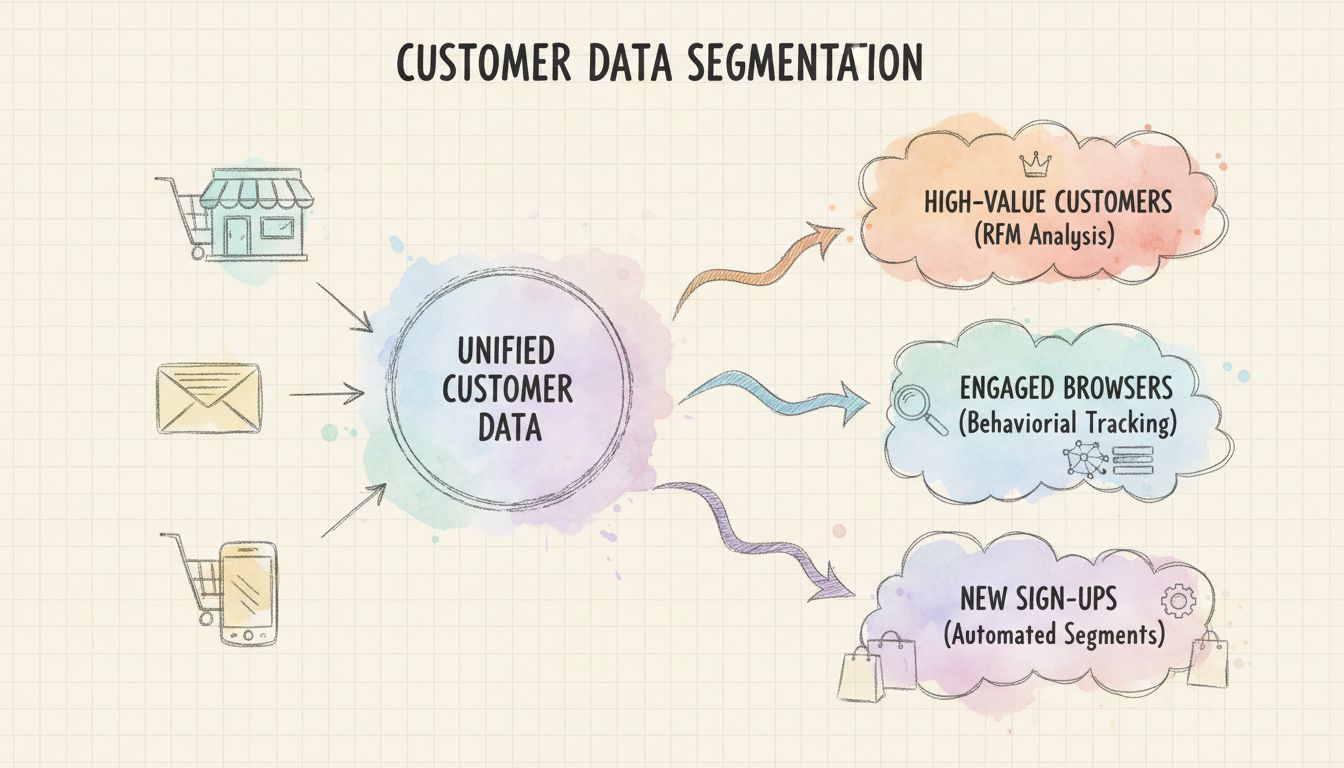
Data-driven customer segmentation transforms this approach entirely. Instead of grouping customers by what they look like, you group them by what they actually do: their purchase patterns, browsing behavior, engagement signals, and demonstrated intent. This shift from static demographics to dynamic behavioral data unlocks the ability to deliver truly personalized marketing experiences that drive conversions, reduce churn, and maximize return on investment across email, SMS, web, and mobile channels.
The Business Impact of Poor Data Utilization
When customer data remains fragmented across isolated systems, segmentation becomes impossible at scale. A customer might be tracked in your email platform under one identifier, in your point-of-sale system under another, and on your website under a third. Marketing teams resort to manual list pulls, outdated query logic, and static segment definitions that quickly become stale. The consequences are measurable: lower engagement rates, higher unsubscribe rates, reduced customer lifetime value, and missed opportunities for upsell and cross-sell campaigns.
By contrast, organizations that unify their customer data and build dynamic behavioral segments see immediate improvements in marketing performance. They can identify high-value customers before they churn, deliver timely product recommendations based on browsing history, and automatically trigger relevant campaigns based on real-time customer actions. The difference between fragmented data and unified data is the difference between guessing and knowing exactly what your customers want.
Use Case Overview
This use case addresses how retail and e-commerce organizations can build a comprehensive, data-driven segmentation strategy that moves beyond demographics to leverage behavioral signals, transactional history, and intent indicators. The goal is to create a system where customer segments are dynamic, automatically updated, and directly connected to personalized marketing automation workflows.
The practical challenge is significant. Most organizations have access to customer data scattered across multiple platforms: transactional systems, website analytics, email marketing platforms, mobile apps, loyalty programs, and customer service platforms. Bringing this data together, standardizing it, and applying intelligent segmentation logic requires both technical infrastructure and strategic planning.
This use case walks through the complete operational workflow: centralizing multi-source data into a unified customer database, extracting behavioral signals using proven analytical frameworks like RFM (Recency, Frequency, Monetary value), defining dynamic audience rules that automatically refresh, and activating those segments across marketing channels to drive measurable business outcomes.
When This Use Case Matters
Dynamic segmentation becomes critical when your marketing team manually pulls audience lists from different systems and segment definitions go stale between campaigns. You cannot identify high-value customers or at-risk customers in real time, missing opportunities for targeted retention or upsell campaigns. Your email unsubscribe rates are climbing because customers receive irrelevant messages or too much messaging frequency. You lack visibility into customer behavior across channels, making it impossible to deliver consistent personalized experiences.
You want to reduce marketing spend waste by targeting only qualified audiences instead of broad, generic lists. Your customer acquisition cost is rising while customer lifetime value is declining, indicating poor segment targeting. You are unable to automate campaign triggers based on customer actions, requiring manual intervention for time-sensitive campaigns. Any organization facing these challenges will see immediate ROI from implementing a data-driven segmentation strategy.
How It Works in Practice
Building an effective data-driven segmentation system requires a structured, step-by-step approach. Each step builds on the previous one, and each produces measurable outputs that feed into the next phase.
Step 1: Centralize and Unify Multi-Source Customer Data
The foundation of any segmentation strategy is a unified view of each customer. This requires aggregating data from every touchpoint where customers interact with your brand: online storefronts, physical point-of-sale systems, email engagement, website browsing, mobile app usage, loyalty programs, and customer service interactions.
The technical requirement is straightforward but critical: establish a centralized data repository, typically a Customer Data Platform (CDP) or data warehouse, where all customer data is collected, standardized, and accessible. This unified database must include unique customer identifiers that connect interactions across all systems, ensuring that a single customer is represented by one profile rather than multiple fragmented records.
The data you need to collect includes transaction history with dates and amounts, product categories purchased, web browsing events with page views and time spent, email engagement metrics like opens and clicks, customer service interactions and sentiment, loyalty program enrollment and point activity, and device and channel preferences. Once this data flows continuously into your unified system, you have the foundation for intelligent segmentation.
Step 2: Apply Analytical Frameworks to Identify Customer Value
With unified data in place, the next step is applying structured analytical models to segment customers by their true business value and engagement level. The RFM framework is the industry standard for this purpose.
RFM analysis groups customers into tiers based on three dimensions: Recency (how recently they made a purchase), Frequency (how often they purchase), and Monetary value (how much they spend). A customer who purchased in the last 30 days, purchases monthly, and spends more than your average customer is high-value and requires different marketing treatment than a customer who last purchased 18 months ago and spent only once.
Beyond RFM, overlay predictive analytics to calculate customer lifetime value (CLV) and churn propensity scores. These models use historical data to predict which customers are likely to make future purchases and which are at risk of leaving. A customer with high CLV potential but declining engagement signals is a retention priority. A new customer with high CLV potential is an onboarding priority.
The output of this step is a clearly organized set of customer cohorts, each ranked by engagement level, financial worth, and business priority. This ranking becomes the basis for all downstream segmentation and campaign strategy.
Step 3: Define Dynamic Inclusion and Exclusion Rules
Static segments become obsolete within weeks. Dynamic segments, by contrast, automatically update as customer behavior changes. This requires translating your analytical insights into active audience rules within an automated rules engine.
A dynamic segment might be defined as: “Customers who purchased in the last 90 days AND have a CLV score above the median AND have opened at least one email in the last 30 days AND do not have an active support ticket.” This rule automatically includes new customers who meet the criteria and removes customers who fall out of compliance.
The rules you define must be based on real-time or near-real-time data signals. Include behavioral triggers like product page views, shopping cart additions, and purchase events. Include transactional signals like purchase recency, order frequency, and spend thresholds. Include engagement signals like email opens, SMS clicks, and website session duration. Include exclusion gates like active support tickets, pending refunds, or opt-out status to prevent sending messages to customers who should not receive them.
Step 4: Map Segments to Targeted Omnichannel Activation
Segments are only valuable if they are connected to actual marketing actions. Each segment should have a defined journey that delivers the right message at the right time across the right channel.
For a high-value, at-risk segment, the journey might be: trigger an email offering a personalized discount or exclusive product, followed by an SMS reminder if the email is not opened within 48 hours, followed by a website banner with the same offer when the customer next visits. For a new customer segment, the journey might be: welcome email with onboarding content, followed by a product recommendation email based on their first purchase, followed by SMS with a loyalty program enrollment incentive.
The key is that segments must be activated through marketing automation workflows that execute these journeys automatically without manual intervention. This requires integrating your segmentation platform with your email service provider, SMS platform, web personalization engine, and advertising platform so that audience membership automatically triggers the appropriate campaign.
Step 5: Implement Continuous Optimization Loops
Customer preferences, retail shopping habits, and market conditions change constantly. Segmentation models that were accurate three months ago may no longer reflect current customer behavior. Continuous optimization ensures your segments remain effective and your marketing spend continues to deliver strong ROI.
Establish a quarterly review cycle where you analyze the performance of each segment and the campaigns delivered to that segment. Which segments are generating the highest conversion rates? Which segments have the highest unsubscribe rates, indicating messaging misalignment? Which segments are not responding to campaigns, suggesting the segment definition needs refinement?
Run A/B tests on segment rules to determine optimal thresholds. For example, test whether customers who purchased in the last 60 days outperform customers who purchased in the last 90 days. Test whether a CLV threshold of $500 produces better results than $400. Test whether including email engagement signals improves segment quality compared to transactional signals alone.
Use the results of these tests to continuously refine your segmentation model, ensuring that your segments remain aligned with current customer behavior and business priorities.
Example Scenario in Retail and E-Commerce
Consider a mid-market fashion e-commerce brand with 250,000 customers, annual revenue of $15 million, and a customer retention challenge. The brand has a 45-day average order frequency but a 35% annual churn rate, indicating that many customers make one or two purchases and then stop engaging.
The brand’s marketing team currently sends weekly promotional emails to their entire active customer list, resulting in a 25% unsubscribe rate and a 2.1% conversion rate. The team has no visibility into which customers are most likely to make a repeat purchase or which customers are at highest risk of churning.
The brand implements a unified data strategy, aggregating data from their e-commerce platform, email service provider, website analytics, and loyalty program into a centralized CDP. Within the CDP, they define five dynamic segments:
| Segment Name | Definition | Audience Size | Marketing Action |
|---|---|---|---|
| VIP Loyalists | Purchased 3+ times in last 180 days, CLV above $2,000, high email engagement | 8,500 customers | Exclusive early access to new collections, 15% member-only discount, personalized product recommendations via email and SMS |
| High-Value At Risk | Purchased 2+ times historically, no purchases in last 120 days, CLV above $1,500 | 12,300 customers | Win-back email series with 20% discount, SMS reminder, retargeting ads with personalized products |
| Active Browsers | Visited website 5+ times in last 30 days, added items to cart, no purchase | 18,700 customers | Abandoned cart email with 10% incentive, SMS follow-up, website banner with same offer |
| New Customers | First purchase in last 30 days | 3,200 customers | Welcome email series, product recommendations based on first purchase, loyalty program enrollment incentive |
| Inactive | No purchase in 12+ months, no email engagement in 90 days | 67,300 customers | Quarterly re-engagement campaign with special offer, exclude from regular promotional emails to reduce list fatigue |
By implementing this segmentation strategy, the brand’s results shift dramatically. The VIP Loyalists segment receives highly personalized, frequent communication and generates a 12.5% conversion rate. The High-Value At Risk segment receives targeted win-back campaigns and recovers 22% of customers who would have otherwise churned. The Active Browsers segment converts at 8.3%, significantly higher than the 2.1% rate achieved by sending to the entire list. The New Customers segment receives onboarding-focused content that increases repeat purchase rates by 31%. The Inactive segment is largely excluded from regular sends, reducing email fatigue and unsubscribe rates.
Within three months, the brand’s overall email conversion rate improves from 2.1% to 5.7%, unsubscribe rates drop from 25% to 8%, and customer lifetime value increases by 34%. The segmentation strategy has directly improved both customer experience and business performance.
Data, Tools, and Teams Involved
Implementing a data-driven segmentation strategy requires coordination across multiple teams and deployment of specific technical tools.
Data Sources: Transaction data from e-commerce platforms, behavioral data from website analytics and mobile apps, engagement data from email and SMS platforms, customer service and support data, loyalty program enrollment and activity, first-party data from surveys and preference centers, and offline data from physical stores and point-of-sale systems.
Technical Infrastructure: A Customer Data Platform (CDP) to centralize and unify data from all sources, a data warehouse or cloud data lake to store and process large volumes of customer data, a marketing automation platform with segmentation and workflow capabilities, analytics tools to measure segment performance and identify optimization opportunities, and integration middleware to connect all systems and enable real-time data flow.
Teams Involved: Data engineering teams to build and maintain data pipelines, data analytics teams to define segmentation models and analyze performance, marketing operations teams to build and execute campaigns, marketing strategy teams to define segment strategies and messaging, and CRM managers to oversee the overall customer data and segmentation program.
The complexity of this coordination is why many organizations partner with experienced implementation providers like Voxwise, who specialize in CRM strategy, customer data architecture, and marketing automation deployment.
How to Measure Success
The success of a data-driven segmentation strategy is measured through both quantitative performance metrics and strategic business outcomes.
Engagement Metrics: Email open rates and click-through rates by segment, SMS delivery rates and response rates, website conversion rates by segment, and repeat purchase rates by segment. Healthy segments show engagement rates that are significantly higher than broadcast campaigns to your entire list.
Conversion Metrics: Conversion rate by segment, average order value by segment, and customer acquisition cost by segment. High-performing segments generate conversions at 3x to 5x the rate of non-segmented campaigns.
Retention Metrics: Churn rate by segment, repeat purchase rate by segment, and customer lifetime value by segment. Targeted retention campaigns to at-risk segments should reduce churn by 15% to 30%.
Efficiency Metrics: Email unsubscribe rate, SMS opt-out rate, and return on ad spend by segment. Well-segmented campaigns reduce unsubscribe rates by 50% or more compared to broadcast campaigns.
Strategic Outcomes: Overall customer lifetime value growth, marketing spend efficiency, and revenue per customer. Organizations that implement effective segmentation typically see 20% to 40% improvements in overall marketing ROI within six months.
Track these metrics continuously using dashboards and reporting tools that connect to your CDP and marketing automation platform. Review segment performance monthly and adjust segment definitions and marketing strategies quarterly based on performance data.
How Bloomreach Helps
Bloomreach provides an enterprise-grade platform purpose-built for dynamic customer segmentation and marketing automation. The Bloomreach Engagement platform unifies customer data from all sources into a real-time CDP, eliminating the data latency that plagues fragmented marketing tech stacks.
Within Bloomreach, you can define customer segments using the Segments and Audience Builder interface, which supports complex multi-source logic queries without requiring data engineering. The platform automatically calculates RFM scores and other behavioral metrics, and its AutoSegments feature uses machine learning to automatically identify hidden customer patterns and suggest new segments based on your data.
Bloomreach’s Loomi AI engine powers predictive models that identify high-value customers, at-risk customers, and next-best-action recommendations. These predictions are updated in real time as new customer data arrives, ensuring your segments always reflect current behavior.
Most importantly, Bloomreach connects directly to email, SMS, web, and advertising channels, allowing you to activate segments instantly across all touchpoints. When a customer’s behavior changes and they move into a different segment, their journey automatically updates without manual intervention.
How Voxwise Can Help
Voxwise specializes in helping retail and e-commerce organizations build and optimize customer data strategies. Our approach combines strategic consulting with hands-on implementation expertise.
We begin with a comprehensive CRM maturity assessment, auditing your current data architecture, segmentation practices, and marketing automation capabilities. This assessment identifies gaps, inefficiencies, and opportunities for improvement.
We then work with your team to design a customer data strategy tailored to your business model and growth objectives. This includes defining which data sources to prioritize, establishing data governance standards, designing segmentation models aligned with your business goals, and planning the technical architecture needed to support dynamic segmentation at scale.
During implementation, we help you structure your event tracking code to ensure clean, consistent customer identifiers across all systems. We build data pipelines to centralize customer data from all sources. We configure segmentation logic within your CDP or marketing automation platform, and we design and launch initial customer journeys to demonstrate quick wins.
Beyond launch, we provide ongoing optimization support, including quarterly reviews of segment performance, A/B testing of segment definitions and messaging, and continuous refinement of your segmentation models to maintain effectiveness as customer behavior evolves.
Conclusion
Customer data segmentation is no longer optional for retail and e-commerce organizations competing in a crowded market. The brands that win are the ones that understand their customers deeply and deliver experiences tailored to each customer’s specific needs, preferences, and stage in the customer lifecycle.
Building effective segmentation requires moving beyond surface-level demographics to leverage behavioral signals, transactional history, and predictive analytics. It requires centralizing fragmented customer data into a unified system. It requires defining dynamic segment rules that automatically update as customer behavior changes. And it requires connecting those segments directly to personalized marketing automation workflows.
The good news is that this is entirely achievable. Organizations of all sizes can implement data-driven segmentation strategies that deliver measurable improvements in customer engagement, retention, and lifetime value. The investment in customer data infrastructure and segmentation strategy pays back quickly through improved marketing performance and reduced customer acquisition costs.
If you are ready to move beyond demographic segmentation and unlock the full potential of your customer data, Voxwise is here to help. We have guided dozens of retail and e-commerce brands through this transformation, and we understand the specific challenges and opportunities in your industry.
Frequently Asked Questions
How do I start using customer data for better segmentation?
Begin by auditing your current data sources and identifying where customer data lives across your organization. Centralize this data into a single repository, either a Customer Data Platform or data warehouse. Define your first segment using the RFM framework to identify your highest-value customers. Connect this segment to a targeted email campaign and measure the results. Use the learnings from this first segment to build additional segments and gradually expand your segmentation strategy.
What types of customer data are most important for e-commerce segmentation?
The most valuable data for e-commerce segmentation includes purchase history (dates, amounts, product categories), browsing behavior (pages visited, time spent, products viewed), email engagement (opens, clicks, unsubscribes), customer service interactions (support tickets, returns, complaints), and loyalty program activity (enrollment, point balance, redemptions). Combine these behavioral and transactional signals with basic demographic and geographic data for the most effective segmentation.
How does a Customer Data Platform improve data-driven segmentation?
A CDP centralizes customer data from all sources into a single unified database, eliminating data silos and creating a complete view of each customer. CDPs provide built-in segmentation tools that allow you to define dynamic audience rules without requiring database queries. Most CDPs integrate directly with marketing execution channels, allowing segments to be activated across email, SMS, web, and advertising automatically. CDPs also typically include analytics and reporting capabilities that help you measure segment performance and optimize over time.
What is the difference between transactional data and behavioral data?
Transactional data captures completed purchases: what was bought, when it was bought, and how much was spent. Behavioral data captures customer interactions and intent signals: pages visited, products browsed, time spent on site, email engagement, and customer service interactions. Both are essential for effective segmentation. Transactional data reveals customer value and loyalty. Behavioral data reveals customer intent and engagement, allowing you to identify customers likely to purchase or at risk of churning before they take action.
How often should data-driven customer segments be updated?
Customer data should flow continuously into your centralized system, allowing segment membership to update in real time or near-real-time as customer behavior changes. Segment definitions and rules should be reviewed and refined quarterly based on performance data and business priorities. As you gain experience with segmentation, you will develop a cadence of regular optimization cycles that keep your segments aligned with current customer behavior and business objectives.
How can retail brands use direct customer feedback in their segmentation models?
Collect direct customer feedback through post-purchase surveys, Net Promoter Score (NPS) surveys, and preference centers where customers indicate their interests and communication preferences. Segment customers by their feedback and sentiment: high-satisfaction customers, at-risk customers with declining satisfaction, and customers with specific product interests. Use this feedback to refine your segment definitions and ensure your messaging aligns with what customers actually want to receive.
How does Bloomreach automate customer data segmentation in real time?
Bloomreach’s unified CDP ingests customer data from all sources and automatically calculates behavioral metrics like RFM scores. The platform allows you to define dynamic segments using its Segments and Audience Builder interface, and these segments automatically update as new data arrives. Bloomreach’s AutoSegments feature uses machine learning to identify hidden patterns in your data and suggest new segments. When a customer’s behavior changes and they move into a different segment, Bloomreach automatically triggers the appropriate marketing journey across email, SMS, web, and other channels.
Get Expert Guidance on Customer Data Strategy
Transform your customer data into high-performing segments that drive retention and revenue growth. Voxwise helps retail and e-commerce organizations build unified customer strategies powered by behavioral data and intelligent automation.
Request a 30-Minute Customer Engagement Consultation to discuss your segmentation and personalization strategy with our team.