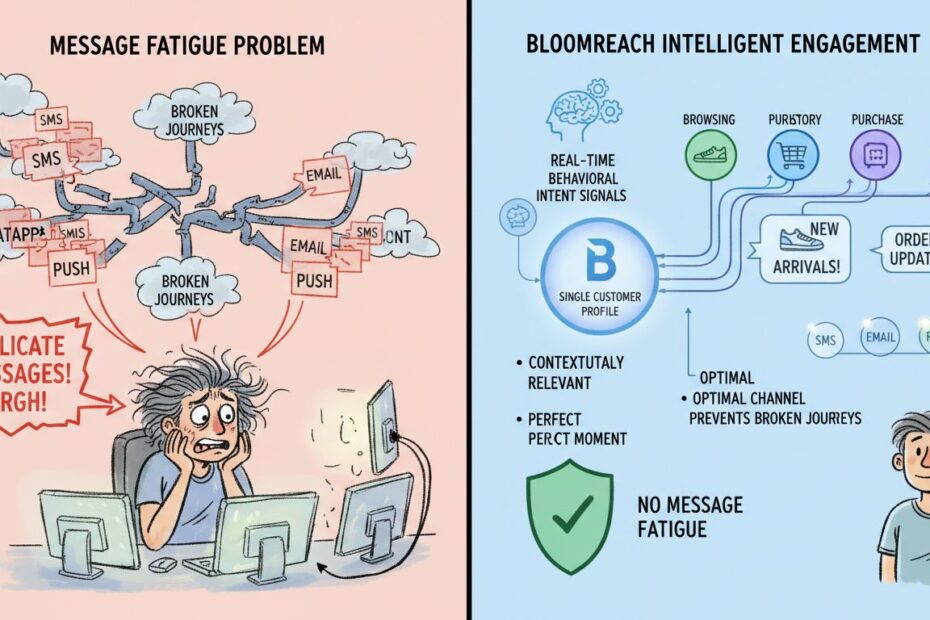
The Message Fatigue Crisis: Why Most Omnichannel Platforms Fail
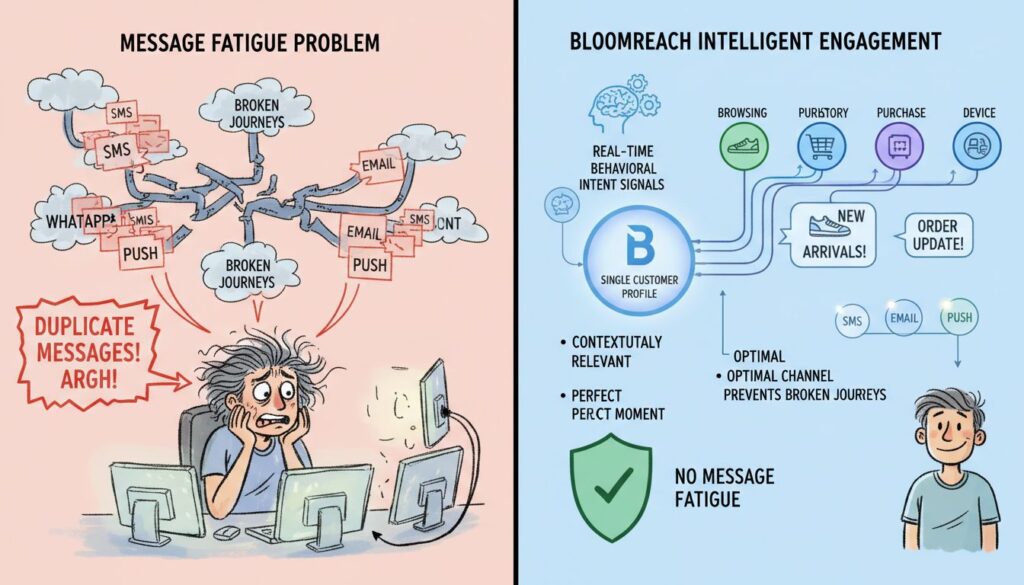
In today’s hyperconnected world, businesses have more channels than ever to reach customers—SMS, email, WhatsApp, push notifications, social messaging, and in-app communication. Yet paradoxically, more channels often mean worse customer experiences. A customer browses a product on their phone, receives an SMS discount five minutes later, then gets an email about the same product, followed by a push notification. By the third message, they’ve already purchased elsewhere or, worse, unsubscribed entirely. This is the Message Fatigue Crisis, and it reveals a fundamental flaw in how most organizations approach omnichannel messaging.
Traditional omnichannel messaging platforms treat channels as equal distribution pipes—they aggregate inboxes, automate workflows, and report metrics. But they miss the critical insight: true omnichannel messaging isn’t about sending messages across every channel; it’s about sending the right message through the single best channel at the exact right moment. This distinction separates message aggregators from intelligent engagement engines, and it’s where Bloomreach Engagement fundamentally changes the game.
Understanding the Omnichannel Messaging Landscape
Before diving into solutions, it’s essential to understand what separates true omnichannel from traditional multichannel approaches. Multichannel messaging operates in silos—each channel functions independently, leading to inconsistent customer experiences and fragmented data. A customer might receive different offers via email than they see on SMS, and support agents handling WhatsApp conversations have no visibility into email history. This creates friction, reduces trust, and ultimately kills conversions.
Omnichannel messaging, by contrast, integrates all channels into a unified system where every interaction is contextual, consistent, and coordinated. However, not all omnichannel platforms achieve this equally. Many still function as message aggregators—they centralize inboxes and automate sending, but they lack the intelligence to understand which channel is optimal for each customer, which message content will resonate, and whether sending that message at that moment will drive revenue or erode trust. This is where the activation gap emerges. Bloomreach Engagement bridges this gap by connecting messaging directly to real-time customer behavior, intent signals, and omnichannel orchestration rules.
The Four Pillars of Intelligent Omnichannel Messaging
1. Real-Time Behavioral Intelligence
Bloomreach Engagement doesn’t operate in a vacuum. It connects directly to real-time customer behavior signals—what they’re browsing, what they’ve purchased, their location, their device, their engagement history, and their predicted next action. This means a message isn’t triggered by a generic rule; it’s triggered by actual intent. When a customer is actively viewing a product category on your website, Bloomreach knows. When they’ve just made a purchase, Bloomreach knows. When they’re about to abandon their cart, Bloomreach knows. This behavioral awareness enables the platform to make intelligent channel decisions.
For example, if a customer is currently on your mobile app browsing winter coats and has a history of responding to push notifications within two minutes of viewing, Bloomreach will send a personalized coat recommendation via push notification. But if that same customer is on desktop during work hours and typically responds to email, the message content and timing adjust automatically. If the customer purchased a winter coat five minutes ago, Bloomreach prevents the message from sending entirely, eliminating the broken journey that creates frustration and opt-outs.
2. Intelligent Channel Selection
The second pillar is channel optimization—understanding which single channel is most effective for each customer at each moment. This goes beyond simple preference data. Bloomreach analyzes historical engagement patterns, channel-specific conversion rates, time-of-day effectiveness, and real-time context to determine the optimal channel. A customer might prefer email for product information but SMS for time-sensitive offers. They might respond to WhatsApp during evenings but ignore it during business hours. Traditional platforms send across all channels and hope for engagement; Bloomreach orchestrates a single, optimized message.
This intelligence dramatically reduces message fatigue. Instead of receiving three redundant messages across three channels, customers receive one highly relevant message through their preferred channel at the optimal time. The result? Higher engagement rates (typically 20-40% improvement), significantly lower opt-out rates (30-50% reduction), and better brand perception. Customers feel understood, not bombarded.
3. Dynamic Message Content Orchestration
Even if you’re sending through the optimal channel at the optimal time, message content matters enormously. Bloomreach Engagement takes this further by dynamically adapting message content based on real-time context. A customer browsing winter coats sees a message highlighting warmth and durability. A customer browsing luxury coats sees a message emphasizing craftsmanship and exclusivity. A customer with a history of price sensitivity sees a message with a discount; a customer with high lifetime value sees a message emphasizing premium features.
This dynamic orchestration extends across channels. The SMS version of a message is concise and action-oriented. The email version provides detailed product information and social proof. The WhatsApp version uses rich media and conversational tone. The push notification version uses urgency and scarcity. All coordinated, all contextual, all designed to maximize the specific channel’s strengths while maintaining consistent brand messaging.
4. Cross-Channel Journey Continuity
The final pillar is journey continuity—ensuring that when a customer moves between channels, their experience remains seamless and contextual. A customer might start a product inquiry via WhatsApp, continue research via email, and complete the purchase via mobile app. Each interaction is connected, informed by previous interactions, and optimized for the current channel. If a customer has already received a discount offer via SMS, they won’t receive the same offer via email. If they’ve completed a purchase, the follow-up message changes from a promotional offer to a post-purchase engagement message.
This cross-channel continuity prevents the broken journeys that plague traditional platforms. It ensures that your messaging system is truly orchestrating a customer journey, not just broadcasting messages across channels.
Bloomreach Engagement vs. Traditional Message Aggregators
| Aspect | Traditional Omnichannel Platforms | Bloomreach Engagement |
|---|---|---|
| Channel Strategy | Broadcast across all channels simultaneously | Intelligent single-channel selection based on behavioral data |
| Data Integration | Aggregates messages; limited behavioral context | Real-time behavioral intelligence with 360-degree customer view |
| Message Personalization | Static templates with basic segmentation | Dynamic content orchestration based on real-time intent |
| Journey Awareness | Channel-specific workflows; limited cross-channel context | Complete journey continuity; prevents broken journeys |
| Activation Speed | Hours to days for campaign setup and execution | Milliseconds; real-time triggered messaging |
| Message Fatigue Prevention | Limited; relies on frequency capping | Advanced; intelligent channel selection prevents redundancy |
| Engagement Metrics | Open rates, click rates, delivery rates | Conversion impact, revenue attribution, customer lifetime value |
| Compliance & Consent | Basic preference management | Granular consent management per channel per message type |
| Revenue Impact | Incremental improvement through volume | Exponential improvement through relevance and timing |
Real-World Impact: From Message Aggregation to Revenue Growth
Consider a mid-market e-commerce company with 500,000 active customers across web, mobile app, email, SMS, and WhatsApp. Using a traditional omnichannel platform, they send an average of 3.2 messages per customer per week across all channels. Their engagement metrics look reasonable on the surface: 22% email open rate, 8% SMS click-through rate, 15% push notification engagement. But when they analyze actual revenue impact, they discover that 40% of customers have unsubscribed from at least one channel due to message fatigue, and their opt-out rate is increasing by 2% monthly.
After implementing Bloomreach Engagement with Voxwise’s strategic guidance, the picture transforms. The company reduces average messages to 1.1 per customer per week—a 66% reduction. But engagement rates skyrocket: email open rates rise to 34%, SMS click-through rates to 18%, and push notification engagement to 31%. More importantly, opt-out rates drop by 45%, customer lifetime value increases by 28%, and revenue per engaged customer rises by 52%. The company is sending fewer messages but driving significantly more revenue because every message is intelligent, contextual, and optimized.
The Five Core Capabilities of Intelligent Omnichannel Messaging
1. Real-Time Behavioral Triggering
Messages aren’t scheduled; they’re triggered by actual customer behavior. When a customer abandons their cart, a message is sent within seconds—but only through the channel most likely to drive completion. When a customer browses a product for the third time, a personalized recommendation is delivered through their preferred channel. When a customer’s subscription is about to renew, a timely reminder is sent with upgrade options. This real-time responsiveness creates the perception of a brand that truly understands and cares about the customer.
2. Unified Customer Profile with Behavioral Enrichment
Every message decision is informed by a complete, real-time customer profile that includes purchase history, browsing behavior, engagement patterns, preferences, location, device, and predictive indicators (churn risk, upsell opportunity, etc.). This unified profile eliminates the need for customers to repeat information across channels. They don’t have to re-identify themselves on WhatsApp after emailing; Bloomreach knows exactly who they are and what they need.
3. Omnichannel Consent and Preference Management
Privacy and compliance aren’t afterthoughts; they’re built into the platform’s core. Bloomreach manages granular consent—a customer might consent to email and SMS but not WhatsApp, or might consent to promotional messages but not transactional ones. Preferences are honored across all channels, and compliance with GDPR, CCPA, and other regulations is automatic. This builds trust and ensures your messaging program remains sustainable long-term.
4. Predictive Analytics and Churn Prevention
Bloomreach uses predictive models to identify customers at risk of churning, customers with high upsell potential, and customers most likely to respond to specific offers. These predictions inform messaging strategy—at-risk customers receive win-back campaigns, high-value customers receive VIP treatment, and responsive segments receive more frequent, personalized offers. This intelligence transforms messaging from a broadcast tool into a precision revenue driver.
5. Attribution and Revenue Reporting
Unlike traditional platforms that report engagement metrics, Bloomreach connects messaging directly to revenue impact. You see not just that an email was opened, but whether that email influenced a purchase, how much revenue it generated, and what its contribution was to customer lifetime value. This transforms messaging from a cost center into a measurable, accountable revenue driver.
Preventing the Broken Journey: Real-World Scenarios
Scenario 1: The In-Store Purchase Overlap
A customer browses winter coats on your website for 10 minutes, then visits your physical store and purchases a coat. Fifteen minutes later, they receive an SMS with a 20% discount on winter coats. With a traditional platform, this message sends because the automation rule is simple: “If customer browses winter coats, send discount after 15 minutes.” The customer is frustrated—they just bought the coat, and the discount doesn’t apply to their in-store purchase.
With Bloomreach Engagement, this broken journey never happens. The platform integrates point-of-sale data in real-time. When the customer completes their in-store purchase, that signal immediately updates their profile. When the SMS trigger fires, Bloomreach checks the current profile, sees the purchase, and suppresses the message. Instead, it might send a post-purchase engagement message 24 hours later with care instructions or styling tips. The customer feels understood, not frustrated.
Scenario 2: The Channel Fatigue Cascade
A customer receives an email about a flash sale at 9 AM, which they miss. At 11 AM, they receive an SMS about the same sale. At 1 PM, they get a push notification. By 3 PM, they receive a WhatsApp message. By 5 PM, they’ve unsubscribed from all channels and left negative feedback about the brand.
With Bloomreach Engagement, this cascade never occurs. The platform recognizes that the customer didn’t engage with the email. Instead of sending the same message across additional channels, it intelligently escalates through a single preferred channel with adjusted content. If the customer still doesn’t engage, the frequency capping rules automatically suppress further messages to prevent fatigue. The customer remains engaged and loyal instead of becoming detractor.
Scenario 3: The Context-Aware Upsell
A customer purchases a laptop and receives a follow-up email asking if they want to buy a laptop case. They ignore it. Three days later, they receive an SMS with the same offer. They still ignore it because they already purchased a case from a competitor.
With Bloomreach Engagement, this scenario is prevented by behavioral intelligence. The platform tracks what the customer has purchased from competitors (through first-party data integration), understands their preferences, and recognizes that they’re not in the market for a case. Instead, it identifies that they might be interested in laptop insurance or software subscriptions based on their profile and browsing behavior. The message is relevant, contextual, and welcome.
The Voxwise Advantage: Strategic Implementation of Bloomreach Engagement
Choosing Bloomreach Engagement is only the first step. The real competitive advantage comes from strategic implementation that aligns your omnichannel messaging program with your business objectives. This is where Voxwise excels. Our team doesn’t just deploy the platform; we architect your entire messaging strategy around customer intelligence, behavioral triggers, and revenue optimization.
Voxwise works with enterprise clients to:
- Map customer journeys across all touchpoints and identify optimal messaging moments
- Design behavioral trigger strategies that respond to real-time intent signals
- Build audience segmentation models that enable hyper-targeted, relevant messaging
- Implement consent and compliance frameworks that protect customer data while maximizing engagement
- Establish attribution and reporting that connects messaging directly to revenue impact
- Optimize channel mix based on customer preferences and engagement patterns
- Create dynamic content strategies that adapt messaging based on real-time context
Our clients typically see results within the first 30 days: 25-40% improvement in engagement rates, 30-50% reduction in opt-out rates, and 20-35% lift in revenue attribution. Within 90 days, the improvements compound as behavioral models mature and channel optimization deepens.
Frequently Asked Questions
Q: How is Bloomreach Engagement different from platforms like Zendesk, Twilio, or HubSpot?
A: Those platforms are primarily support-focused or marketing automation tools that happen to have messaging capabilities. Bloomreach Engagement is purpose-built as an intelligent engagement engine. It connects messaging directly to real-time customer behavior, enabling dynamic channel selection, predictive analytics, and revenue attribution. The difference is architectural—Bloomreach puts behavioral intelligence and journey orchestration at the core, while other platforms bolt messaging onto existing workflows.
Q: Can Bloomreach Engagement handle high-volume messaging (millions of messages per day)?
A: Yes. Bloomreach Engagement is built on enterprise-grade infrastructure designed to handle massive scale. Many of our clients send 10+ million messages daily across all channels. The platform maintains sub-second latency even at peak volume, ensuring real-time triggered messages are delivered instantly.
Q: How does Bloomreach prevent message fatigue?
A: Through three mechanisms: (1) Intelligent channel selection—sending through the single optimal channel rather than broadcasting; (2) Frequency capping with behavioral awareness—understanding how often each customer can receive messages before disengaging; (3) Journey continuity—preventing redundant messages when a customer has already received similar content through another channel.
Q: What’s the typical implementation timeline?
A: Initial setup and integration typically takes 4-6 weeks. Quick wins appear within 2-4 weeks (basic campaigns and channel optimization). Full strategic implementation with advanced behavioral triggers and predictive models takes 12-16 weeks. Voxwise manages the entire process to ensure smooth adoption.
Q: How does Bloomreach handle GDPR, CCPA, and other privacy regulations?
A: Privacy compliance is built into the platform’s core. Bloomreach manages granular consent per customer per channel per message type, maintains audit trails for all consent changes, and enables one-click data deletion and opt-out. The platform automatically enforces regional regulations based on customer location.
Q: What channels does Bloomreach support?
A: Bloomreach natively supports email, SMS, WhatsApp, push notifications (iOS and Android), in-app messaging, and web messaging. Additional channels can be integrated via APIs. The platform’s strength is in intelligent orchestration across these channels, not in raw channel breadth.
Q: How do you measure ROI from omnichannel messaging?
A: Bloomreach connects messaging directly to revenue impact through attribution modeling. You see which messages influenced purchases, what revenue each message generated, and how messaging contributes to customer lifetime value. Most clients measure ROI in weeks—the platform typically pays for itself within 60-90 days through improved conversion rates and reduced customer acquisition costs.
Q: Can smaller companies use Bloomreach Engagement, or is it enterprise-only?
A: Bloomreach Engagement scales from mid-market (1-10 million annual messages) to enterprise (billions of messages annually). However, the platform is most powerful for companies with sufficient customer volume and data richness to enable behavioral intelligence. Smaller companies typically benefit more from simpler platforms.
Q: How does Bloomreach Engagement integrate with our existing tech stack?
A: Bloomreach integrates with most major platforms—e-commerce systems (Shopify, Magento), CRMs (Salesforce, HubSpot), analytics platforms (Google Analytics, Mixpanel), data warehouses (Snowflake, BigQuery), and more. Voxwise manages all integrations to ensure clean data flow and real-time synchronization.
Q: What’s the difference between Bloomreach Engagement and a traditional marketing automation platform?
A: Marketing automation platforms (like HubSpot or Marketo) focus on campaign orchestration and lead nurturing. Bloomreach Engagement focuses on real-time, behavior-driven customer engagement across all channels. While marketing automation is typically used for nurturing prospects through a funnel, Bloomreach is used for engaging existing customers across their entire lifecycle with real-time, contextual messages.
The Future of Customer Engagement: From Broadcast to Orchestration
The future of omnichannel messaging isn’t about sending more messages across more channels. It’s about sending fewer, smarter, more relevant messages that drive genuine customer value. Companies that continue to broadcast generic messages across all channels will see increasing opt-out rates, declining engagement, and eroding customer loyalty. Companies that embrace intelligent, behavioral-driven messaging will see engagement rates rise, customer lifetime value increase, and brand loyalty deepen.
Bloomreach Engagement represents this future. It’s not a message aggregator; it’s an intelligent engagement engine that transforms how enterprises communicate with customers. Combined with Voxwise’s strategic expertise, it becomes the foundation for sustainable, profitable customer relationships.
The question isn’t whether your company needs omnichannel messaging—you almost certainly do. The question is whether you’ll continue with a platform that broadcasts messages or partner with Bloomreach and Voxwise to orchestrate truly intelligent, contextual, revenue-driving customer engagement.
Ready to Transform Your Customer Engagement?
Omnichannel messaging should drive revenue, not just send messages. Bloomreach Engagement, implemented by Voxwise, eliminates message fatigue, increases engagement, and turns every customer interaction into a revenue opportunity. Our team has helped enterprise clients reduce opt-out rates by 45%, increase engagement by 35%, and drive 20%+ revenue uplift within 90 days.
See how Bloomreach Engagement can transform your customer engagement strategy.
Get Expert Advice from our Bloomreach specialists today.