
Customer Segmentation Models Every Retail Brand Should Know
Modern retail brands face a critical challenge: how to transform customer data into actionable, personalized experiences at scale. Generic marketing campaigns fail because they treat all customers as a single audience. The solution lies in implementing customer segmentation models that divide your customer base into distinct, behavior-driven groups.
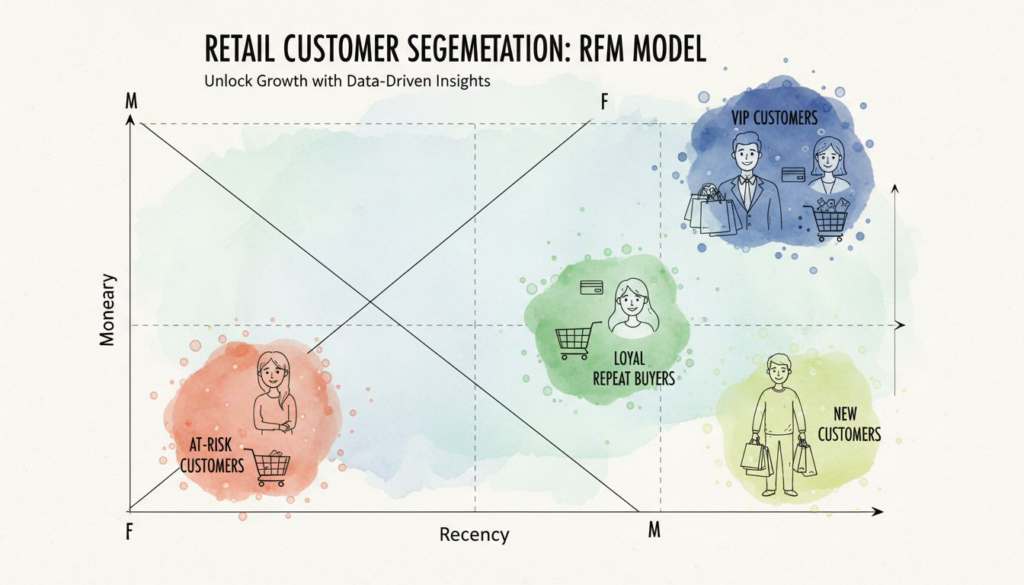
These models allow you to target high-value customers with premium experiences, prevent churn before it happens, and optimize marketing spend across multiple channels. This article explores the essential segmentation models that successful retail brands deploy to maximize customer lifetime value, improve retention rates, and drive measurable revenue growth.
Use Case Overview
You operate a multi-channel retail business with thousands of customers across online and physical locations. Your marketing team sends the same promotional emails to everyone, resulting in declining open rates and minimal conversion. Your inventory team struggles to stock the right products at the right locations because they lack insight into local customer preferences. Your customer service team cannot prioritize high-value customers from at-risk segments. These operational inefficiencies stem from a single root cause: you lack a unified, data-driven segmentation framework that reveals who your customers really are and what drives their purchasing behavior.
Customer segmentation models solve this problem by creating a mathematical and behavioral foundation for personalization. Rather than relying on intuition or static customer lists, segmentation models use transaction history, behavioral patterns, demographic attributes, and predictive analytics to automatically group customers into actionable cohorts. Each cohort receives tailored messaging, offers, and experiences designed to maximize engagement and lifetime value. The financial impact is substantial: retailers implementing advanced segmentation models report 20-30% improvements in customer retention rates, 15-25% increases in email engagement, and 10-20% gains in average order value.
When This Use Case Matters
Customer segmentation models become critical when your retail business reaches a scale where generic marketing fails. If you have:
- More than 10,000 active customers across multiple channels
- Multiple product categories with distinct customer preferences
- A customer base spanning different geographic regions or climate zones
- Declining email engagement or conversion rates despite growing list size
- Inventory imbalances caused by misalignment between stock and local demand
- High customer acquisition costs that require better retention strategies
- Multiple customer touchpoints (in-store, email, SMS, web, loyalty program) that operate in silos
Then segmentation models are essential. The models work best when you have clean, unified customer data that combines transaction history, behavioral signals, and optional demographic or psychographic attributes. Without this data foundation, segmentation becomes guesswork. With it, segmentation transforms into a revenue engine.
How It Works in Practice
Effective segmentation begins with data unification. Your CRM or customer data platform must consolidate information from multiple sources: point-of-sale systems, e-commerce platforms, email engagement logs, loyalty program records, and website analytics. This unified data creates a single customer view where each profile contains complete transaction history, recency of last purchase, purchase frequency, total lifetime spend, browsing behavior, email engagement, and demographic or location data.
Once unified, you apply mathematical models to this data. The RFM model (Recency, Frequency, Monetary) calculates a score for each customer across three dimensions. A customer who purchased last week, shops monthly, and has spent $5,000 total receives a high RFM score. A customer whose last purchase was nine months ago, shops twice per year, and has spent $200 receives a low RFM score. These scores automatically segment customers into cohorts: Champions (high across all three dimensions), Loyal Customers (high frequency and monetary value, moderate recency), At-Risk Customers (declining recency), and Hibernating Customers (no recent activity).
The CLV model (Customer Lifetime Value) takes this further by predicting future value. Rather than relying solely on historical spend, CLV models use machine learning to estimate the net revenue a customer will generate over their entire relationship with your brand. This allows you to identify high-potential customers who have not yet spent much but show strong engagement signals. You can then allocate higher acquisition costs to finding lookalikes of high-CLV segments, protecting margins while scaling growth.
Behavioral segmentation layers intent on top of transaction history. This model tracks what customers do: which product categories they browse, which emails they open, how long they spend on specific pages, whether they use discount codes, and what time of day they shop. A customer who repeatedly browses winter apparel but has never purchased signals a specific need. A customer who consistently applies discount codes signals price sensitivity. These behavioral signals allow you to build micro-segments that respond to specific offers, content, or product recommendations.
Once segments are defined, activation is automatic. A customer who enters the “At-Risk” cohort (declining recency) automatically receives a re-engagement email sequence. A customer who joins the “Champions” segment receives early access to new products and exclusive loyalty rewards. A customer identified as price-sensitive receives targeted discount promotions while full-price buyers receive premium product recommendations. This automation ensures consistent, timely, and relevant customer experiences without manual intervention.
Example Scenario in Retail or E-Commerce
Consider a mid-sized apparel retailer with 50,000 active customers across 15 physical stores and an e-commerce platform. The marketing team historically sent the same monthly newsletter to all subscribers, resulting in a 12% open rate and 0.8% click-through rate. The inventory team stocked the same mix of products across all locations, leading to excess winter coats in warm-climate stores and insufficient stock in cold regions.
The retailer implements a unified customer data platform that consolidates POS data, online transaction history, email engagement, and store visit frequency. They then apply segmentation models:
The RFM model reveals that 8% of customers (Champions) account for 40% of annual revenue. These customers receive a dedicated VIP email track with exclusive early access to new collections, 48-hour pre-sale windows, and personalized style recommendations. The same data shows that 15% of customers (At-Risk) have not purchased in 90+ days despite previously strong engagement. This segment receives a targeted win-back campaign with a limited-time 20% discount and a personalized message referencing their favorite product categories.
Geographic segmentation combined with seasonal behavioral data shows that customers in northern regions (New England, Midwest, Northwest) purchase heavy winter outerwear between August and October, while southern customers purchase resort wear and lightweight apparel in April and May. The retailer adjusts inventory allocation accordingly, shipping 60% of winter stock to cold-climate stores and 70% of summer inventory to warm regions. This reduces inventory carrying costs and improves sell-through rates.
Behavioral segmentation identifies a segment of customers who repeatedly browse athletic apparel but rarely purchase full-price items. These “bargain hunters” receive targeted emails promoting clearance athletic wear and exclusive discount codes on performance gear. Meanwhile, customers who consistently purchase full-price premium brands receive emails showcasing new luxury collections without any discount messaging, preserving margins while maintaining engagement.
The result: open rates increase to 22% for VIP segments and 18% for targeted re-engagement campaigns. Click-through rates jump to 3.2% for behavioral segments. Customer retention improves by 18% year-over-year. Average order value increases by 12% because targeted offers align with customer preferences and price sensitivity. Inventory turnover improves by 22% because stock allocation matches regional demand patterns.
Data, Tools, and Teams Involved
Building and maintaining segmentation models requires coordination across multiple teams and data sources. Here are the key components:
| Component | Owner | Data Source | Frequency |
|---|---|---|---|
| Transaction History | Finance / POS Team | Point-of-sale systems, e-commerce platform | Daily |
| Customer Demographics | CRM / Marketing | Registration forms, loyalty program, third-party data | Monthly |
| Behavioral Signals | Analytics / Marketing | Email platform, web analytics, loyalty app | Real-time |
| Geographic Data | Operations / Merchandising | Shipping address, store visit location, IP data | Monthly |
| Predictive Models | Data Science / Analytics | Historical data, machine learning algorithms | Quarterly |
| Segment Activation | Marketing / CRM | Email platform, SMS, web personalization, loyalty | Real-time |
The CRM team owns the customer database and ensures data quality, deduplication, and unified customer profiles. The analytics team builds and maintains segmentation models, calculating RFM scores, CLV predictions, and behavioral cohorts. The marketing team activates segments through email campaigns, SMS messages, web personalization, and loyalty program adjustments. The merchandising team uses segment insights to inform inventory allocation and product assortment decisions. The finance team measures the revenue impact of segmentation through cohort analysis and customer lifetime value tracking.
This cross-functional coordination is essential because segmentation models only deliver value when they drive action. A perfectly calculated RFM score is worthless if marketing cannot access it to personalize campaigns. A predictive CLV model fails if the merchandising team does not adjust inventory based on segment demand patterns. Successful retailers establish clear data governance, assign ownership of each segment to a specific team, and measure the business impact of segmentation decisions.
How to Measure Success
Segmentation effectiveness is measured through business metrics that directly connect to revenue and retention. The primary metrics include:
Customer Retention Rate by Segment: Track the percentage of customers in each segment who make a repeat purchase within 90 days. Champions should show 70%+ retention rates. At-Risk segments should improve by at least 15% after targeted re-engagement campaigns. Hibernating segments that receive win-back offers should show 5-10% reactivation rates.
Revenue per Segment: Calculate total revenue generated by each segment and compare it to acquisition costs. High-value segments should deliver 3-5x return on marketing spend. Low-value segments should either improve through targeted offers or be deprioritized in favor of lookalike acquisition.
Email Engagement by Segment: Monitor open rates, click-through rates, and conversion rates for segment-specific campaigns. Behavioral segments should show 2-3x higher engagement than broadcast campaigns because messaging aligns with customer interests and purchase history.
Average Order Value by Segment: Track whether targeted offers increase or decrease average order value. Price-sensitive segments may show lower AOV but higher volume and frequency. Premium segments should maintain higher AOV and lower discount dependency.
Inventory Turnover by Location: Measure whether geographic segmentation improves sell-through rates and reduces excess inventory. Cold-climate stores should show 15-20% improvement in winter apparel turnover. Warm-climate stores should improve summer apparel turnover by similar margins.
Customer Acquisition Cost Efficiency: Track whether lookalike audiences built from high-CLV segments reduce overall acquisition costs while maintaining customer quality. You should see 20-30% reduction in CAC when targeting lookalikes of high-value cohorts.
Churn Prevention: Measure the impact of at-risk segment interventions. Customers who receive targeted re-engagement offers should show 15-25% improvement in retention compared to control groups that receive no intervention.
These metrics should be tracked monthly and reviewed quarterly to ensure segmentation models remain accurate and actionable. As customer behavior evolves, segments drift and must be recalculated. Successful retailers treat segmentation as an ongoing operational discipline, not a one-time project.
How Voxwise Can Help
Building and maintaining segmentation models requires expertise across data integration, analytics, CRM strategy, and marketing automation. Many retailers lack the internal resources or technical depth to implement these models effectively. This is where Voxwise becomes invaluable.
Voxwise is a B2B consulting and implementation firm specializing in CRM, customer data, and personalization for retail and e-commerce brands. Voxwise works with retailers to design segmentation strategies that align with business objectives, implement the technical infrastructure required to execute those strategies, and activate segments across customer touchpoints.
Specifically, Voxwise helps retailers:
- Assess data quality and unification: Voxwise audits your current data landscape, identifying gaps, duplicates, and integration challenges. They design a data architecture that consolidates POS, e-commerce, loyalty, and behavioral data into a unified customer view.
- Design segmentation models: Voxwise works with your team to select the right combination of segmentation models based on your business goals, customer base, and available data. They may recommend RFM for immediate retention impact, CLV for acquisition efficiency, and behavioral segmentation for conversion optimization.
- Implement automation: Voxwise configures your CRM and marketing automation platform to calculate segments automatically, update them in real-time, and activate them across email, SMS, web, and loyalty channels.
- Integrate with Bloomreach: For retailers looking to scale personalization across all customer touchpoints, Voxwise specializes in implementing Bloomreach, the leading customer engagement and personalization platform for retail. Bloomreach’s unified CDP automates RFM segmentation, provides AI-powered predictive CLV modeling through its Loomi AI engine, and enables real-time segment activation across email, SMS, web, and mobile channels. Voxwise ensures your segmentation models integrate seamlessly with Bloomreach, creating a fully automated personalization engine.
- Train and support your team: Voxwise provides training to your marketing, analytics, and CRM teams, ensuring they understand how to interpret segments, activate them effectively, and measure business impact.
- Optimize and iterate: Voxwise conducts ongoing analysis of segment performance, identifying opportunities to refine models, improve targeting accuracy, and increase revenue impact.
Conclusion
Customer segmentation models are no longer optional for retail brands competing in a digital, data-driven marketplace. The models transform raw customer data into actionable intelligence that drives personalization, retention, and revenue growth. RFM segmentation identifies your most valuable customers and at-risk cohorts, enabling immediate retention impact. CLV modeling predicts future value, allowing you to allocate acquisition spend more efficiently. Behavioral segmentation reveals customer intent, enabling offers and messaging that resonate with specific needs and preferences. Geographic segmentation optimizes inventory allocation and local marketing timing.
The retailers winning in today’s market are those who view segmentation not as a marketing tactic but as a core operational discipline. They invest in data unification, implement multiple segmentation models simultaneously, and activate segments automatically across all customer touchpoints. This requires cross-functional coordination and technical infrastructure, but the financial returns are substantial: improved retention, higher engagement, increased average order value, and optimized acquisition efficiency.
If you are ready to implement or optimize customer segmentation for your retail business, Voxwise and Bloomreach provide the strategy, platform, and expertise required to succeed. The time to act is now.
Explore Similar Use Cases with Voxwise
Customer segmentation is just one component of a comprehensive customer engagement and retention strategy. Voxwise helps retail and e-commerce brands implement the full spectrum of CRM, personalization, and customer data practices required to maximize lifetime value and competitive advantage.
See our services to learn how Voxwise can transform your customer data into measurable business results.
Request a 30-Minute Customer Engagement Consultation to discuss your segmentation and personalization strategy with our team.