How to Segment Customers by Lifecycle Stage: A CRM Guide
Treating your entire customer database as a single audience is one of the fastest ways to erode margins and trigger campaign fatigue. When you send the same promotional message to a first-time buyer and a VIP repeat customer, you dilute brand prestige, train customers to expect discounts, and waste marketing spend on messaging that does not resonate.
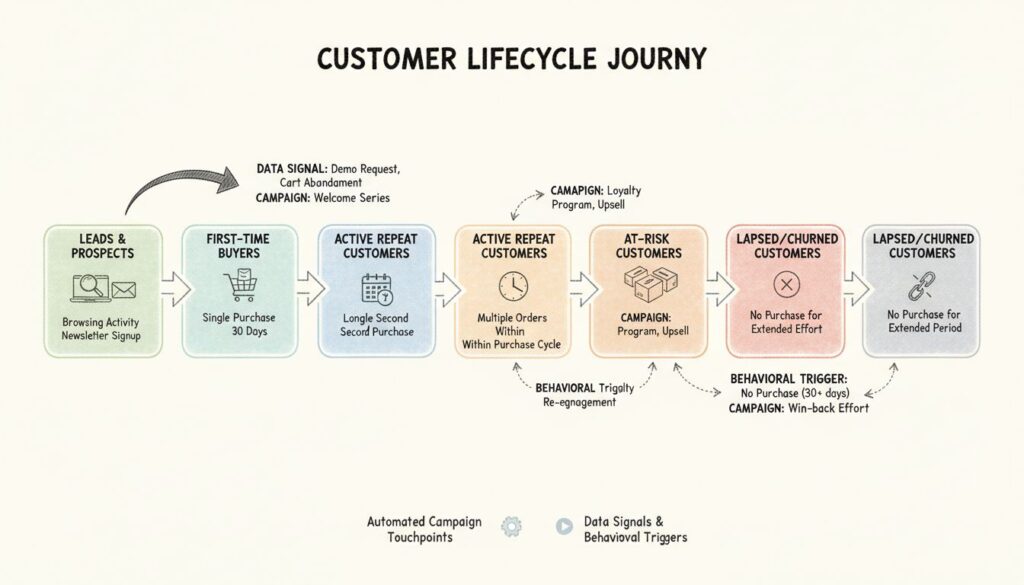
Customer lifecycle segmentation changes this by grouping shoppers based on where they stand in their brand relationship, determined by their cumulative historical actions and immediate behavioral signals. This approach maximizes conversion rates, optimizes marketing spend, and drives measurable lifts in customer lifetime value (CLV).
This guide walks you through a practical, five-step framework to build dynamic lifecycle segments that automatically track customer progression from anonymous lead to loyal advocate, eliminating manual list-pulling friction and enabling real-time, personalized omnichannel campaigns.
Before You Start: Essential Data Foundations
Before implementing lifecycle segmentation, confirm that your data infrastructure meets three critical requirements. First, you must have unified customer profiles that centralize digital storefront streams, transaction logs, and email or SMS engagement records into a single source of truth. Without unified profiles, you cannot reliably identify which behaviors belong to the same customer across channels. Second, ensure you have accurate and complete transaction history spanning at least the past 12 to 24 months of purchase data, including order dates, order values, and product categories. This historical depth is necessary to calculate your brand’s natural purchase cycle and define realistic recency windows for each lifecycle stage. Third, implement real-time behavioral event tracking that captures actions such as website visits, cart additions, email opens, and SMS clicks the moment they occur. Delayed or batch-processed behavioral data will undermine the speed and relevance of your automated segment migrations.
If your current CRM or marketing automation platform lacks these foundations, invest in a modern customer data platform (CDP) or CDP-adjacent solution that can aggregate data from all sources and emit real-time behavioral events to your activation layer.
Step 1: Aggregate and Unify First-Party Data
Start by centralizing all customer data into a single, unified profile repository. This means connecting your e-commerce platform (Shopify, WooCommerce, custom builds), email service provider, SMS provider, website analytics, and any loyalty or feedback systems to a central database. Each customer record must contain:
- Complete transaction history with order dates and monetary values
- Email engagement metrics (opens, clicks, unsubscribes, list status)
- SMS engagement history and opt-in status
- Website and app behavioral events (sessions, page views, add-to-cart actions, search queries)
- Customer attributes such as geographic location, product preferences, and account status
The unification process often reveals data quality gaps. Duplicate records, missing email addresses, and inconsistent product categorization are common. Establish a data governance protocol to resolve these issues before segmentation logic is applied. Voxwise specializes in auditing customer data layers, designing unified profile architectures, and engineering the ETL workflows that feed clean, consistent data into your segmentation engine.
Step 2: Calculate Your Brand’s Average Purchase Cycle
Your brand’s natural purchase cycle is the mathematical foundation of lifecycle segmentation. This metric defines the typical time elapsed between a customer’s first purchase and their second purchase, and it varies dramatically by industry. A cosmetics brand might see a 45-day average cycle, while a seasonal apparel retailer might see 180 days. If you apply a rigid 90-day churn definition to both, you will misclassify active customers as at-risk and waste budget on unnecessary win-back campaigns.
To calculate your average purchase cycle:
- Extract all customers with at least two purchases from your transaction history.
- For each customer, calculate the number of days between their first and second purchase.
- Compute the median and mean of these intervals.
- Use the median as your primary reference point (it is more resistant to outliers than the mean).
For example, if your median purchase cycle is 60 days, then an active repeat customer should have a purchase within the last 60 to 90 days (allowing for a 50 percent variance). A customer whose last purchase was 150 days ago would be classified as at-risk. A customer whose last purchase was 210 days ago would be classified as lapsed.
Document this calculation and revisit it quarterly. Seasonal businesses often have different purchase cycles by quarter, so segment definitions may need adjustment during peak and off-peak periods.
Step 3: Establish Rules-Based Boolean Triggers
Now define the exact logical conditions that determine segment membership. Use a rules engine inside your CRM or CDP to build Boolean statements (AND/OR conditions) that are sharp, testable, and free of ambiguity. Here are the five core lifecycle segments and their defining triggers:
Leads and Prospects (Pre-Purchase Stage)
- Order count = 0
- Email list status = subscribed OR newsletter consent = true
- Last web session date = within the last 90 days
- Action: Automate a welcome onboarding flow featuring brand discovery content and an introductory incentive (10 to 15 percent discount or free shipping).
First-Time Buyers (Onboarding Stage)
- Order count = exactly 1
- Days since first purchase = 0 to 30
- Action: Deploy a post-purchase nurturing sequence focused on product education, satisfaction loops (product reviews, NPS surveys), and a targeted second-purchase cross-sell.
Active Repeat Customers (Nurturing Stage)
- Order count >= 2
- Days since last purchase = 0 to (average purchase cycle + 50 percent buffer)
- Action: Trigger dynamic category recommendations, replenishment flows for consumable products, and early access to product launches to protect full-price margins.
At-Risk Customers (Re-engagement Stage)
- Order count >= 2
- Days since last purchase = (average purchase cycle + 50 percent buffer) to (average purchase cycle x 1.5)
- Action: Automate high-priority win-back paths with exclusive loyalty reminders, personalized product recommendations, or feedback loops before complete churn occurs.
Lapsed and Churned Customers (Reactivation Stage)
- Order count >= 1
- Days since last purchase > (average purchase cycle x 1.5)
- Action: Deploy targeted win-back campaigns with time-limited incentives or preference reset requests. Monitor engagement, and suppress non-responsive profiles to preserve email deliverability.
These rules must be documented, version-controlled, and tested against historical data before activation. A well-designed rules engine allows segment membership to update in real-time as new purchase or behavioral data arrives.
Step 4: Map Cohorts to Automated Omnichannel Journeys
Segment definitions are only valuable if they trigger immediate, relevant action. Connect each lifecycle cohort to a dedicated automated journey that spans email, SMS, push notifications, and web personalization. The key principle is dynamic audience membership: as a customer’s behavior changes, their segment membership updates automatically, and they are enrolled or exited from corresponding journeys without manual intervention.
For example, when a first-time buyer completes their second purchase, they should automatically exit the “First-Time Buyers” segment and enter the “Active Repeat Customers” segment. This transition should immediately enroll them in the active customer nurturing journey and remove them from the onboarding sequence. If their purchase recency then lapses beyond your threshold, they should exit the active journey and enter the at-risk re-engagement path.
This automation requires tight integration between your segmentation engine and your orchestration layer. Bloomreach Engagement natively supports this through its real-time Customer Data Platform and journey orchestration capabilities, automatically migrating profiles between lifecycle segments based on instant behavioral events and triggering hyper-relevant messaging without manual list exports or batch processing delays.
Document the journey structure for each segment:
| Segment | Primary Channel | Journey Focus | Duration | Success Metric |
|---|---|---|---|---|
| Leads and Prospects | Welcome series, brand discovery | 14 to 21 days | First purchase conversion | |
| First-Time Buyers | Email, SMS | Post-purchase education, second purchase | 30 to 45 days | Second purchase rate |
| Active Repeat Customers | Email, SMS, Web | Loyalty, early access, replenishment | Ongoing | Repeat purchase rate, AOV |
| At-Risk Customers | Email, SMS, Push | Win-back offers, personalized content | 30 to 60 days | Reactivation rate |
| Lapsed/Churned | Time-limited win-back, preference reset | 30 days | Reactivation rate, list health |
Step 5: Measure Segment Migration and Revenue Lift
Lifecycle segmentation only delivers value if you measure its impact on business outcomes. Define a core set of metrics to track for each segment and review them weekly:
Repeat Purchase Rate: The percentage of customers in a given segment who make a subsequent purchase within the expected cycle window. Track this separately for each segment to identify which messaging or timing strategies are most effective.
Customer Lifetime Value (CLV) Expansion: Compare the CLV of customers who have been in your active repeat customer segment for six months versus those who have remained in the prospect or first-time buyer segments. A well-executed lifecycle strategy should show measurable CLV uplift.
Segment Conversion Efficiency: Measure how many customers progress from one segment to the next. For example, what percentage of leads convert to first-time buyers? What percentage of first-time buyers convert to active repeat customers? This reveals bottlenecks in your nurturing strategy.
Campaign Engagement by Segment: Track open rates, click rates, and conversion rates for each lifecycle journey. A 35 percent open rate on an at-risk win-back campaign should be your baseline expectation; anything lower signals messaging or timing problems.
Email Deliverability and List Health: Monitor unsubscribe rates, bounce rates, and spam complaint rates by segment. A high unsubscribe rate from the active customer segment signals that your messaging frequency or content relevance is off target.
Segment Size and Migration Velocity: Track the size of each segment monthly and the percentage of customers who migrate between segments. Healthy migration velocity shows that your rules are functioning correctly and that customers are progressing through their journey.
Use these metrics to refine your segment definitions, journey messaging, and timing. Lifecycle segmentation is not a one-time implementation; it is a continuous optimization process that improves as you collect more behavioral data and refine your understanding of customer behavior.
Tools and Data You Need
Customer Data Platform or Unified Profile Database: Bloomreach Engagement, Segment, mParticle, or a custom CDP built on your data warehouse. This is non-negotiable; you cannot execute lifecycle segmentation without unified, real-time customer profiles.
Rules Engine or Segmentation Interface: Most modern CDPs include native segmentation builders. Bloomreach Engagement’s Segments and Audience Builder allows you to define lifecycle rules visually, test them against historical data, and activate them across channels instantly.
Journey Orchestration Platform: Your email service provider, SMS platform, or a dedicated orchestration tool such as Bloomreach Engagement or Iterable. This platform must support dynamic audience membership, real-time event-triggered journeys, and multi-channel message sequencing.
Analytics and Attribution Platform: Tools such as Amplitude, Mixpanel, or your data warehouse (Snowflake, BigQuery) to track segment performance, measure CLV by segment, and calculate repeat purchase rates.
Data Governance and Quality Tools: Data quality issues compound over time. Implement tools or workflows to monitor for duplicate profiles, missing key attributes, and data freshness.
Common Challenges and How to Avoid Them
Treating All Lapsed Shoppers the Same
A frequent mistake is blasting all lapsed customers with an identical discount offer. In reality, a lapsed VIP who has spent $5,000 over three years deserves a fundamentally different re-engagement strategy than a lapsed one-time buyer who spent $25. Implement a secondary segmentation layer within your lapsed cohort based on customer value. High-value lapsed customers should receive personalized, high-touch win-back campaigns (potentially including phone outreach or exclusive previews). Low-value lapsed customers should receive automated, lower-cost email campaigns with time-limited incentives. This approach protects margins while still attempting reactivation.
Ignoring Churn Latency Variables Across Product Categories
If your e-commerce business sells both fast-moving consumables and durable goods, you cannot use a single purchase cycle definition. A customer who buys vitamins every 30 days is not at-risk if their last purchase was 45 days ago. But a customer who buys furniture every 24 months is not at-risk if their last purchase was 18 months ago. Segment your customer base by product category and calculate purchase cycle metrics separately for each category. Then apply category-specific recency thresholds to your lifecycle definitions.
Failing to Implement Exclusion Rules
Without exclusion rules, customers can be enrolled in multiple overlapping journeys simultaneously. A customer might receive both an at-risk win-back email and an active customer loyalty email in the same week, creating messaging confusion and eroding trust. Define clear exclusion rules: a customer in the at-risk segment should be excluded from the active customer journey. A customer who recently received a promotional offer should be excluded from a second promotional journey for 14 days. Exclusion rules protect message frequency and brand experience.
Not Accounting for Seasonal Behavior
Retail and apparel brands experience pronounced seasonality. A customer whose last purchase was 120 days ago might be perfectly normal in January (post-holiday recovery) but at-risk in July (peak summer season). Implement seasonal adjustments to your recency thresholds, or create separate lifecycle definitions for peak and off-peak periods.
Overlapping Segment Definitions
Ensure that your segment definitions do not overlap. A customer should belong to exactly one primary lifecycle stage at any given time. If your definitions are ambiguous, customers will be miscategorized, and your segment-to-journey mapping will fail. Test your rules against a sample of 1,000 historical customer records and validate that each customer is assigned to exactly one segment.
How to Measure Success: Key Performance Indicators
Lifecycle segmentation delivers measurable business impact. Here are the metrics that prove your strategy is working:
Repeat Purchase Rate Lift: Customers in your active repeat customer segment should have a repeat purchase rate at least 40 to 60 percent higher than your database average. If your database average is 25 percent, your active segment should achieve 35 to 40 percent.
First-Time Buyer to Repeat Buyer Conversion: Measure what percentage of your first-time buyers convert to repeat customers within 90 days. A well-executed onboarding and second-purchase campaign should achieve 20 to 30 percent conversion.
At-Risk Reactivation Rate: Win-back campaigns targeting at-risk customers should achieve a 3 to 8 percent reactivation rate (depending on your industry and offer strength). Anything below 2 percent signals that your messaging or targeting is off.
Average Order Value by Segment: Active repeat customers should have an average order value 15 to 25 percent higher than first-time buyers. This indicates that your personalization and recommendations are working.
Customer Lifetime Value by Cohort: Customers who progress through your lifecycle stages should have significantly higher CLV than those who remain in early stages. A customer who reaches your active repeat stage should have 3 to 5 times the CLV of a first-time buyer.
Email Engagement Metrics by Segment: Expect open rates of 25 to 35 percent for active customer emails, 20 to 28 percent for at-risk campaigns, and 15 to 25 percent for lapsed customer campaigns. Click rates should be 3 to 8 percent for active customers and 1 to 3 percent for lapsed customers.
Automating Lifecycle Segmentation with Bloomreach
Bloomreach Engagement is purpose-built for this exact use case. Rather than piecing together multiple tools, Bloomreach consolidates customer data, segmentation logic, and multi-channel orchestration into a single platform. Here is what this means in practice:
Real-Time CDP with Behavioral Event Ingestion: Bloomreach ingests purchase events, email interactions, website behavior, and SMS engagement the moment they occur. Your customer profiles update instantly, and segment membership changes propagate in real-time.
Native Lifecycle Segmentation and AutoSegments: Bloomreach includes pre-built lifecycle templates and a visual segmentation builder that eliminates the need for manual SQL or API work. You define your purchase cycle metrics and recency thresholds, and Bloomreach automatically creates and maintains your segments.
Predictive Churn Alerts: Bloomreach’s machine learning engine (powered by Loomi AI) identifies customers at risk of churn before they disengage, surfacing early behavioral signals such as declining engagement, failed transactions, or feature abandonment.
Omnichannel Journey Orchestration: Segments automatically trigger multi-channel journeys across email, SMS, push, and web. As a customer’s segment changes, they are instantly moved to the appropriate journey without manual intervention.
Advanced RFM Segmentation: Bloomreach’s RFM segmentation capability provides automated dashboards that visualize recency, frequency, and monetary trends across your customer base, making it easy to identify high-value cohorts and design targeted retention campaigns.
Unified Customer Profiles: All data sources (e-commerce platform, email, SMS, web, loyalty) are unified into a single profile, eliminating data silos and enabling truly personalized, omnichannel experiences.
How Voxwise Can Help
Implementing lifecycle segmentation at scale requires more than software. It requires strategic design, data architecture expertise, and a deep understanding of your specific business model and customer behavior patterns. Voxwise partners with retail and e-commerce brands to engineer sophisticated lifecycle segmentation strategies and implement them flawlessly using Bloomreach Engagement.
Here is what we do:
Customer Data Audit and Unification: We assess your current data infrastructure, identify gaps, and design a unified customer profile architecture that feeds real-time behavioral events into your segmentation engine. This includes data quality remediation, duplicate resolution, and attribute standardization.
Lifecycle Segment Design and Modeling: We work with your team to define purchase cycle metrics, establish recency thresholds, and design segment rules that align with your business model. We build segment definitions that are testable, maintainable, and directly connected to business outcomes.
Bloomreach Implementation and Configuration: If Bloomreach Engagement is your platform of choice, we handle the full implementation lifecycle: data mapping, segment configuration, journey design, and performance optimization. We ensure that your lifecycle segments are not just defined but actively driving revenue.
Retention Strategy and Campaign Architecture: Beyond segmentation, we design end-to-end retention strategies that connect each lifecycle stage to high-impact campaigns. We define messaging strategies, timing, offers, and exclusion rules that maximize repeat purchase rates and CLV.
Ongoing Optimization and Governance: Lifecycle segmentation improves over time. We establish governance protocols, monitor segment performance, and iterate on definitions based on real business metrics. This includes seasonal adjustments, category-specific refinements, and new segment creation as your business evolves.
Voxwise brings operational rigor to customer lifecycle management. We do not just hand off a segmentation model; we embed ourselves in your marketing operations to ensure that lifecycle segmentation becomes a core, sustainable capability within your organization.
Conclusion
Customer lifecycle segmentation is not a tactical email trick. It is a foundational capability that separates high-performing retention organizations from those that treat their customer base as an undifferentiated mass. By implementing a clear, data-driven framework that identifies where each customer stands in their brand relationship and automatically triggers relevant, timely messaging, you unlock measurable improvements in repeat purchase rates, customer lifetime value, and marketing efficiency.
The five-step framework outlined here (unify data, calculate purchase cycles, establish rules, map journeys, measure outcomes) is repeatable and scalable. Whether you are a mid-market e-commerce brand with 100,000 customers or an enterprise retailer with millions, the principles remain the same. The difference is in execution rigor and the sophistication of your technology stack.
Bloomreach Engagement provides the platform foundation. Voxwise provides the strategic and operational expertise to turn that foundation into a competitive advantage. Together, they enable you to move from static, manually curated lists to dynamic, real-time lifecycle cohorts that continuously adapt to customer behavior and drive measurable business outcomes.
Frequently Asked Questions
What is customer lifecycle segmentation in e-commerce?
Customer lifecycle segmentation groups shoppers based on where they stand in their relationship with your brand, determined by their purchase history and behavioral signals. Rather than treating all customers as a single audience, you create distinct cohorts (leads, first-time buyers, active customers, at-risk, and lapsed) and deliver tailored messaging and offers to each stage. This approach maximizes engagement, protects margins, and increases customer lifetime value.
How do you calculate the ideal time windows for different lifecycle stages?
Calculate your brand’s median purchase cycle by finding the average number of days between a customer’s first and second purchase. Use this metric as your baseline for defining recency windows. For example, if your median cycle is 60 days, define an active customer as someone who purchased within 60 to 90 days (allowing a 50 percent variance). An at-risk customer would be 90 to 150 days (1.5x the cycle), and lapsed would be beyond 150 days. Adjust these windows by product category if your business sells items with different natural purchase frequencies.
What is the difference between an at-risk customer and a churned customer?
An at-risk customer is someone who has historically purchased from you but whose purchase recency has lapsed beyond your expected cycle window. They still have a chance to reactivate. A churned or lapsed customer has not purchased for an extended period (typically 1.5 to 3 times your average purchase cycle) and is unlikely to return without significant intervention. At-risk customers should receive high-priority win-back campaigns. Churned customers should receive lower-cost, automated reactivation attempts, and non-responsive profiles should eventually be suppressed to protect email deliverability.
How do behavioral triggers improve basic lifecycle segmentation?
Basic lifecycle segmentation uses only purchase history and recency. Behavioral triggers add real-time engagement signals such as website visits, email opens, cart abandonment, or feature adoption. For example, a customer who has not purchased in 80 days might appear at-risk based on recency alone. But if they visited your website three times last week, they are actively engaged and should remain in the active customer segment. Behavioral triggers prevent misclassification and allow for more nuanced, personalized messaging.
Why should you use exclusion rules when setting up lifecycle paths?
Exclusion rules prevent customers from being enrolled in multiple overlapping journeys simultaneously. Without them, a customer might receive both an at-risk win-back email and an active customer loyalty email in the same week, creating messaging confusion and eroding trust. Exclusion rules ensure that each customer receives a single, coherent experience aligned with their lifecycle stage. They also protect message frequency and prevent campaign fatigue.
What retail metrics prove that lifecycle segmentation is working?
Track repeat purchase rate lift (active customers should have 40 to 60 percent higher repeat rates than your database average), first-time buyer conversion to repeat customer (target 20 to 30 percent within 90 days), at-risk reactivation rate (target 3 to 8 percent), customer lifetime value by segment (active customers should have 3 to 5x the CLV of first-time buyers), and segment-specific email engagement (open rates of 25 to 35 percent for active customers, 20 to 28 percent for at-risk, and 15 to 25 percent for lapsed).
How does Bloomreach handle automated customer lifecycle segmentation?
Bloomreach Engagement consolidates customer data from all sources into unified profiles, ingests behavioral events in real-time, and includes a native segmentation builder that automates lifecycle cohort creation and maintenance. Segments automatically trigger omnichannel journeys across email, SMS, push, and web. As customer behavior changes, segment membership updates instantly, and customers are moved to appropriate journeys without manual intervention. Bloomreach’s machine learning engine also identifies at-risk customers before they churn, surfacing early warning signals.
Build a dynamic customer lifecycle segmentation model
Ready to build a dynamic customer lifecycle segmentation model that drives measurable retention and revenue lift? The operational complexity of lifecycle segmentation requires strategic design, data architecture expertise, and platform implementation rigor. Voxwise specializes in helping retail and e-commerce brands engineer sophisticated lifecycle strategies and activate them flawlessly using Bloomreach Engagement.
See our services to explore how we help brands maximize customer lifetime value through advanced segmentation and retention strategies.
Request a 30-Minute Customer Engagement Consultation to discuss your segmentation and personalization strategy with our team.