Why Customer Segmentation Matters for Personalization
Modern e-commerce brands face a paradox: customers demand personalized experiences, yet true one-to-one messaging at scale seems impossible without appearing invasive or wasting marketing resources on irrelevant messaging. The solution lies in understanding that customer segmentation and personalization are not competing strategies, but complementary layers of a single customer engagement architecture.

Segmentation defines the structural boundaries and overarching customer intent, while personalization adapts the message within those boundaries. Without segmentation, personalization becomes generic noise. Without personalization, segmentation remains a reporting exercise. Together, they create scalable, authentic customer relationships that drive retention, higher average order value (AOV), and customer lifetime value (CLV).
This article explains why segmentation is the necessary foundation for effective personalization, how to distinguish between the two concepts, and how to activate both strategies in retail and e-commerce campaigns using platforms like Bloomreach and implementation partners like Voxwise.
The Inextricable Link Between Customer Segmentation and Personalization
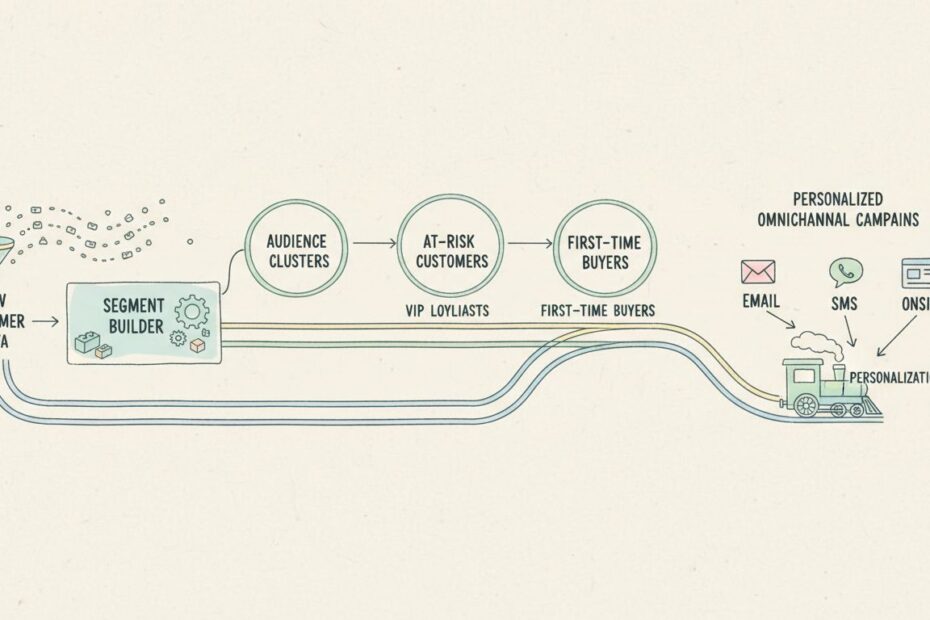
Think of customer segmentation as train tracks and personalization as the train that runs on them. The tracks define the route, the direction, and the boundaries of where the train can travel. The train itself is the vehicle that moves along those tracks with speed and precision. Neither works without the other. A train with no tracks derails. Tracks with no train accomplish nothing.
In customer engagement, this metaphor translates directly. Segmentation defines who you are speaking to and their overarching needs. It answers questions like: Are you addressing first-time buyers or VIP loyalists? Are you targeting customers at risk of churning or high-value repeat purchasers?
Are you reaching category-specific browsers or seasonal buyers? Segmentation groups your customer database into actionable cohorts based on shared characteristics, behaviors, and purchase intent. These segments become the structural foundation upon which all downstream personalization decisions rest.
Personalization adapts the 1:1 messaging within that segment. It answers questions like: What specific product should this VIP loyalist see first? At what time of day should this at-risk customer receive a retention offer? Which email subject line will resonate with this category-specific browser? Personalization uses individual-level data to serve dynamic, real-time content that feels custom-made for each person within a broader segment.
The critical insight is this: without segmentation, personalization at scale becomes indiscriminate. You end up personalizing messages to an undifferentiated audience, which means some messaging inevitably misses the mark. A luxury brand might send the same personalized email to both high-spend customers and bargain hunters, personalizing only the recipient’s name and purchase history.
The VIP sees a discount offer designed for price-conscious buyers. The budget-conscious customer sees premium product recommendations outside their typical spend range. Neither feels understood. Both feel generic despite the personalization layer.
Conversely, without personalization, segmentation becomes a static reporting tool. You might identify that your top 5 percent of customers by lifetime value are your VIPs, but then send them the same generic email as all other VIPs.
You recognize at-risk customers but send them a one-size-fits-all discount blast instead of personalized retention offers tailored to their specific behavior. You segment but fail to activate in ways that feel individual and relevant.
The brands that win in modern e-commerce are those that combine both. They segment strategically to define audience boundaries and intent. They personalize dynamically to make each customer within those segments feel individually understood. The result is higher engagement, lower unsubscribe rates, stronger brand trust, and measurably higher CLV.
Segmentation vs. Personalization: Understanding the Core Differences
While segmentation and personalization work in tandem, it is vital to understand how they differ in definition, execution, and business purpose.
What is Customer Segmentation?
Customer segmentation is the process of dividing your customer database into actionable cohorts based on shared metrics, characteristics, and behaviors. Rather than treating all customers as a single, undifferentiated mass audience, segmentation groups customers into smaller buckets that share common traits.
Common segmentation approaches include:
- Demographic segmentation: Age, gender, location, income, occupation
- Behavioral segmentation: Purchase frequency, browsing patterns, email engagement, product category affinity
- Lifecycle segmentation: First-time buyers, repeat customers, loyal advocates, at-risk churners
- RFM segmentation: Recency (when they last purchased), Frequency (how often they buy), Monetary value (how much they spend)
- Predictive segmentation: AI-driven segments based on propensity to purchase, churn risk, or CLV potential
The purpose of segmentation is to ensure that your messaging, offers, and campaign strategy are relevant to a defined group of customers with shared characteristics or intent. According to industry research, segmented email campaigns generate 720 percent higher revenue than non-segmented campaigns. This dramatic lift is not because segmentation personalizes individual messages. It is because segmentation ensures that each customer receives messaging aligned with their demonstrated intent and lifecycle stage.
What is Personalization?
Personalization is the process of using individual-level customer data to serve dynamic, customized content that speaks directly to one person’s specific interests, behaviors, and preferences. Personalization operates at the individual level, not the segment level.
It might include populating an email with the specific product a customer browsed yesterday, sending a message at the exact time they typically open emails, or showing product recommendations based on their unique purchase history.
Personalization can range from simple (including a customer’s first name in an email subject line) to highly sophisticated (dynamically changing email content, product grids, and pricing based on real-time behavioral data). The key distinction is that personalization is always 1:1, always individual, and always based on data specific to that single customer.
How They Work Together
Segmentation defines the what and why of your message. Personalization defines the how and when. Here is a concrete example:
Segmentation decision: A retail brand identifies that customers in the “At-Risk High-Value” segment (high historical CLV but no purchase in 60 days) respond well to retention campaigns. The brand decides to activate a retention email program for this segment.
Personalization execution: Within the At-Risk High-Value segment, each customer receives a personalized retention email. Customer A sees a discount on the specific product category they browsed last month. Customer B sees a free-shipping offer on items they previously purchased. Customer C receives a VIP re-engagement message with exclusive early access to a new collection. The segment boundaries define the campaign logic. Personalization adapts the message for each individual within that logic.
Without segmentation, the brand might send the same retention offer to all customers, including those who are not at risk of churning and those who have never spent enough to warrant retention investment. Without personalization, the brand might send a generic discount to all at-risk customers, missing the opportunity to tailor offers to individual preferences and behaviors.
Why Personalization Fails Without Proper Customer Segmentation
Many brands invest heavily in personalization technology, only to discover that their campaigns underperform. The root cause is often a weak or missing segmentation foundation. Here is why:
The “Creepy Factor” Problem
Hyper-personalization without segmentation context feels invasive. When a brand personalizes content to an undifferentiated audience, the personalization can feel inappropriately intimate or even intrusive.
A customer receives an email with their name and a product recommendation based on their browsing history, but the context is wrong. Maybe they browsed that product out of curiosity, not intent. Maybe they are price-sensitive and the recommendation is for a premium version of the product. Maybe they have already purchased from a competitor.
Without segmentation to provide context about customer intent, lifecycle stage, and purchasing power, personalization becomes noise or worse, an invasion of privacy. Customers respond by unsubscribing, marking emails as spam, or losing trust in the brand. This is the “creepy factor” that has given personalization a bad reputation in some consumer circles.
Proper segmentation prevents this. By first defining that a customer is in the “High-Intent Premium Buyer” segment based on their demonstrated behavior, a brand can confidently personalize premium product recommendations without fear of overstepping.
By recognizing that a customer is in the “Price-Conscious Seasonal Buyer” segment, a brand personalizes budget-friendly options and seasonal promotions instead. Segmentation provides the context that makes personalization feel appropriate and welcome rather than invasive.
Marketing Inefficiency and Campaign Fatigue
Treating a giant, unsegmented audience with superficial personalization ensures that many messages miss the mark. A brand sends a personalized email to 100,000 customers. Half of them are not in the market for what is being offered.
A quarter of them are price-sensitive and see a message promoting premium products. Another quarter are already loyal and see an offer designed to convert new customers. The personalization layer (names, product recommendations) does not overcome the fundamental misalignment between message and audience intent.
The result is lower open rates, lower click-through rates, higher unsubscribe rates, and wasted marketing budget. Customers experience campaign fatigue because they receive frequent messages that do not align with their actual needs or lifecycle stage. They tune out, unsubscribe, or actively avoid the brand’s communications.
Segmentation solves this by ensuring that each customer receives messaging aligned with their demonstrated intent. Open rates, click-through rates, and conversion rates all improve because the message is fundamentally relevant, not just superficially personalized.
Lower Marketing ROI and Wasted Ad Spend
Unsegmented personalization also wastes paid media budgets. A brand might use personalization technology to create dynamic ad creative based on browsing behavior, but if the audience targeting is not segmented by intent, the ads reach people unlikely to convert.
A first-time buyer sees an ad for a premium loyalty program. A lapsed customer sees an acquisition offer. A VIP sees a discount offer designed for price-sensitive buyers. The personalization is technically sophisticated, but the audience targeting is fundamentally misaligned.
Segmentation ensures that paid media budgets are allocated to high-intent audiences. VIP segments receive premium offers and exclusive messaging. At-risk segments receive retention campaigns. New customer segments receive onboarding messaging. This alignment between audience intent and message dramatically improves cost per acquisition (CPA), return on ad spend (ROAS), and overall marketing efficiency.
Key Business Benefits of Uniting Segmentation and Personalization
When executed together, customer segmentation and personalization deliver measurable business outcomes that directly impact retail and e-commerce profitability.
Increased Engagement and Campaign ROI
Grouping customers by intent and personalizing within those groups prevents generic fatigue and maximizes engagement metrics. A segmented, personalized email campaign consistently outperforms a non-segmented campaign by 30 to 50 percent in open rates and click-through rates. Why? Because the message is fundamentally relevant to the recipient’s demonstrated intent, and the personalization layer makes it feel individual and custom.
Higher engagement translates directly to higher conversion rates. Customers who open emails, click links, and visit product pages are more likely to purchase. Segmentation and personalization together create a conversion funnel where each step is optimized for the specific audience segment and individual customer.
The business impact is clear: marketing ROI increases because budgets are allocated to high-intent audiences and messaging is optimized for conversion. Cost per acquisition decreases because fewer messages are wasted on irrelevant audiences. Customer acquisition cost (CAC) becomes more efficient and sustainable.
Building Trust and Relevancy at Scale
Customers expect modern brands to understand their preferences. However, hyper-personalization without boundaries feels intrusive and erodes trust. The combination of segmentation and personalization allows brands to scale authentic relationship-building by addressing common pain points and preferences without overstepping privacy boundaries.
When a customer receives an email that is relevant to their demonstrated lifecycle stage and preferences, they feel understood. They trust that the brand has taken time to understand their needs. They are more likely to open future emails, click through, and convert. They are also more likely to recommend the brand to others and become a brand advocate.
This trust is the foundation of customer loyalty. Brands that combine segmentation and personalization build stronger emotional connections with customers, resulting in higher retention rates and increased word-of-mouth marketing.
Higher Customer Retention and Lifetime Value (CLV)
Delivering consistent, curated content across email, SMS, onsite experiences, and paid media ensures customers feel valued and understood. This consistency is the antidote to churn. Customers who receive relevant, personalized messaging are significantly more likely to continue purchasing from a brand than those who receive generic or irrelevant messages.
Segmentation and personalization also enable proactive retention. By identifying at-risk customers early (through RFM segmentation or predictive analytics), brands can trigger targeted retention campaigns before customers churn. A customer showing early churn signals receives a personalized re-engagement offer. A loyal customer receives VIP treatment and exclusive access. A new customer receives nurturing and education. Each segment receives messaging aligned with their specific retention needs.
The result is measurably higher retention rates, longer customer lifespans, and higher CLV per customer cohort. A customer retained through personalized engagement is worth significantly more over their lifetime than a customer acquired and lost to churn.
Activating Segmented Personalization in E-commerce Campaigns
Understanding the theory of segmentation and personalization is one thing. Activating it in real campaigns is another. Here is how to connect these principles to concrete campaign actions:
First-Time Buyers vs. VIP Loyalists
These two segments have fundamentally different intent, psychology, and needs. A first-time buyer is evaluating whether to trust the brand. They are uncertain about product quality, shipping speed, and return policies. They are price-sensitive and looking for reassurance.
A VIP loyalist has already decided to trust the brand. They have purchased multiple times, spent significantly, and are unlikely to be price-sensitive. They are looking for recognition, exclusivity, and premium treatment.
Segmentation recognizes these differences and creates distinct campaign strategies. First-time buyers receive onboarding messaging, product education, customer reviews, and confidence-building offers. VIP loyalists receive early access to new collections, exclusive discounts, personalized recommendations, and recognition of their loyalty status.
Personalization within these segments adapts the messaging to individual preferences. A first-time buyer interested in sustainable products receives onboarding content emphasizing the brand’s sustainability credentials. A VIP loyalist who primarily purchases luxury items receives exclusive early access to premium collections. A VIP who is price-sensitive receives loyalty rewards and points-based offers instead of percentage discounts.
The business impact is significant. First-time buyers who receive proper onboarding and education are more likely to make a second purchase and become repeat customers. VIP loyalists who receive recognition and exclusive treatment are more likely to increase their spend and advocate for the brand.
At-Risk High-Value Customers
This segment represents some of the highest-value customers at risk of churning. They have demonstrated high lifetime value through past purchases, but their recent engagement or purchase activity has declined. Without intervention, they will likely defect to competitors.
Segmentation identifies these customers through RFM analysis or predictive analytics. A customer with high historical CLV but no purchase in 60 days enters the at-risk segment. A customer with strong historical frequency but declining email engagement enters the at-risk segment.
Personalization within this segment creates targeted retention campaigns. Customer A, who previously purchased luxury items but has not engaged in 60 days, receives a personalized re-engagement offer for premium products. Customer B, who primarily purchased from the home category but has not visited in 45 days, receives a personalized email highlighting new arrivals in that category. Customer C, who made frequent small purchases but engagement has declined, receives a loyalty rewards message emphasizing accumulated points and exclusive member benefits.
The business impact is direct: retention campaigns triggered to at-risk high-value customers recover a significant percentage of customers who would otherwise churn. The cost of retaining an existing high-value customer is far lower than acquiring a new customer of equivalent value. This segment generates exceptional ROI on retention marketing investment.
Category-Specific Browsers
Many customers browse specific product categories without purchasing. They might be researching, price-comparing, or considering a future purchase. Segmentation identifies these customers as “Category-Specific Browsers” for a particular product type (e.g., “Luxury Handbag Browsers” or “Outdoor Gear Researchers”).
Personalization within this segment creates targeted follow-up campaigns. A customer who browsed luxury handbags but did not purchase receives a personalized follow-up email featuring the specific handbags they viewed, along with customer reviews and styling tips. A customer who browsed outdoor gear receives comparison content and expert guides. A customer who browsed seasonal items receives timely reminders when new inventory arrives.
Onsite personalization also adapts the experience. Category-specific browsers see product grids emphasizing their category of interest, personalized recommendations within that category, and targeted upsells and cross-sells aligned with their browsing behavior.
The business impact is increased conversion from browsing to purchase, higher AOV through targeted upsells, and reduced cart abandonment through timely follow-up messaging.
Segmentation and Personalization in Action: A Comparison Table
| Strategy Element | Customer Segmentation | Personalization | Combined Impact |
|---|---|---|---|
| Definition | Dividing audience into cohorts based on shared traits | Customizing content for individual customers | Targeted messaging that feels personal |
| Scope | Group-level (many customers) | Individual-level (one customer) | Scalable 1:1 experiences |
| Data Used | Demographic, behavioral, lifecycle, RFM | Individual purchase history, browsing, preferences | Rich, contextual customer understanding |
| Primary Purpose | Define audience intent and needs | Adapt message to individual within segment | Maximize relevance and conversion |
| Example | “At-Risk High-Value” segment | Personalized retention offer for Customer A | Customer A receives tailored offer matching their history |
| ROI Driver | Eliminates irrelevant messaging | Increases individual relevance | 30-50% higher engagement rates |
| Business Outcome | Higher campaign efficiency | Higher conversion rates | Measurably higher CLV and retention |
How Bloomreach Turns Customer Segmentation into Real-Time Personalization
Bloomreach Engagement is the preferred platform for retail and e-commerce brands seeking to unite segmentation and personalization at scale. Bloomreach combines Customer Data Platform (CDP) capabilities with omnichannel execution, allowing marketing teams to move away from static, outdated customer lists and activate real-time personalized campaigns across email, SMS, onsite experiences, and paid media simultaneously.
Real-Time Segmentation and Dynamic Audience Updates
Traditional segmentation relies on static, manually-refreshed audience lists. A customer is tagged as “VIP” and remains tagged as VIP until the next quarterly analysis, even if their behavior has changed dramatically. Bloomreach eliminates this gap through real-time segmentation. As customer behavior changes, segment membership updates automatically and instantly. A customer who has not purchased in 60 days automatically moves from “Loyal” to “At-Risk.” A customer who makes a large purchase automatically graduates from “New” to “High-Value.” Segment membership is always current, always accurate, reflecting the customer’s actual, real-time status.
This real-time capability enables automated workflows that trigger campaigns at exactly the right moment. The moment a customer enters the at-risk segment, a retention campaign triggers automatically. The moment a customer reaches high-value status, a VIP nurture sequence begins. Marketing teams no longer need to manually identify segments and launch campaigns. The platform automates the entire flow.
AutoSegments Powered by Loomi AI
Bloomreach’s Loomi AI engine automatically discovers high-value micro-segments that human analysts would never identify manually. Rather than requiring marketing teams to hypothesize segment definitions, the AI engine tests thousands of possible combinations of customer attributes and surfaces the segments most likely to drive revenue.
For example, Loomi AI might discover that customers who browse luxury items but have low cart values respond exceptionally well to free-shipping offers. Or that repeat purchasers who have not engaged in 45 days are 3.2x more likely to churn if not engaged within the next week. Or that customers who make frequent small purchases from a specific category are 2.8x more likely to upgrade to premium products when offered a loyalty reward.
These insights are quantified and actionable. Marketing teams no longer guess at segment definitions. They activate AI-discovered segments with proven revenue potential.
Omnichannel Personalization Execution
Segments created in Bloomreach sync seamlessly across all customer touchpoints simultaneously. An audience segment defined in the platform is available instantly for email campaigns, SMS programs, paid media audiences (Facebook, Google, LinkedIn), and onsite personalization. A customer in the “At-Risk High-Value” segment receives consistent messaging across email, SMS, onsite banners, and retargeting ads. All messages are aligned, all touchpoints reinforce the same retention narrative, and the customer experiences a cohesive, personalized journey.
Bloomreach also enables Segmented Merchandising, which allows merchandisers to tailor product grids, search results, and recommendations on the e-commerce storefront for specific customer segments in real time. A luxury goods retailer might boost premium items for high-spend customers while showing budget-friendly options to price-conscious segments. A fashion brand might display seasonal collections to customers who typically purchase that category while hiding irrelevant inventory from others. This creates a personalized shopping experience that increases onsite conversion rates and AOV.
Predictive Analytics and Churn Prevention
Bloomreach integrates predictive analytics that forecast future customer behavior. The platform identifies customers predicted to churn before they actually churn, allowing brands to intervene proactively. It also identifies customers with high propensity to purchase, high CLV potential, and high loyalty potential. These predictive insights enable marketing teams to allocate budgets and campaigns to the highest-impact audiences.
The business impact is measurable: brands using Bloomreach’s predictive capabilities report higher retention rates, lower churn, and higher CLV per customer cohort.
Driving Marketing ROI with Voxwise Strategy and Implementation
Building advanced segmentation and personalization strategies is one thing. Executing them effectively across platforms, teams, and campaigns is another. Many brands have Bloomreach in place but lack the operational expertise to translate segmentation into sustained revenue growth.
Voxwise is a B2B consulting and implementation partner specializing in CRM, customer engagement, and customer data platforms for retail and e-commerce brands. Voxwise helps brands design, build, and optimize segmentation and personalization strategies that drive measurable business outcomes.
Segmentation Strategy and Architecture
Voxwise works with brands to design comprehensive segmentation matrices that align with business objectives. Rather than creating segments for their own sake, Voxwise helps teams define segments that directly drive revenue. The approach includes:
Lifecycle mapping: Identifying critical customer lifecycle stages (acquisition, onboarding, engagement, loyalty, advocacy, churn prevention) and designing segments that activate at each stage.
Behavioral analysis: Analyzing customer data to identify behavioral patterns that predict purchase intent, churn risk, and CLV potential. These insights inform segment definitions.
Business alignment: Ensuring that segment definitions align with business priorities. If retention is the top priority, segmentation emphasizes at-risk identification and retention targeting. If AOV growth is the priority, segmentation emphasizes upsell and cross-sell opportunities.
Data architecture review: Ensuring that first-party customer data flows correctly into the platform, that customer identities are unified accurately, and that data quality supports reliable segmentation.
Personalization Workflow Design
Voxwise designs automated workflows that activate segments and personalize campaigns across all touchpoints. The approach includes:
Journey mapping: Creating detailed customer journey maps that identify decision points, messaging opportunities, and personalization triggers.
Workflow automation: Building automated campaigns that trigger based on segment membership or behavioral changes. A customer enters the at-risk segment, a retention workflow triggers automatically. A customer reaches high-value status, a VIP nurture workflow begins.
Cross-channel coordination: Ensuring that email, SMS, onsite, and paid media campaigns are coordinated and consistent. A customer receives a retention offer via email and sees a matching offer onsite. A customer receives a VIP message via SMS and sees exclusive content in their email.
Performance optimization: Continuously testing and optimizing workflows based on performance data. Which retention offers drive the highest conversion? Which VIP messaging resonates most with different customer cohorts? Workflows are refined based on actual performance.
Measurement and Continuous Improvement
Voxwise establishes KPI frameworks and builds dashboards that track segment performance against revenue metrics. The approach includes:
Segment performance analysis: Measuring revenue per segment, churn rate by segment, campaign conversion rate by segment, and CLV by segment. This reveals which segments drive business value and which need refinement.
Campaign performance tracking: Measuring email open rates, click-through rates, conversion rates, and ROI by segment. This reveals which campaigns are working and which need optimization.
Feedback loops: Creating continuous feedback loops where campaign performance informs future segment definitions and personalization strategies. Insights from one campaign improve the next.
Team enablement: Training internal teams on segmentation best practices, how to measure and optimize campaigns, and how to use the platform effectively.
The result is a segmentation and personalization strategy that feels less like a technology project and more like a core operational capability. Segments become the lens through which all customer engagement decisions are made, from campaign strategy to product merchandising to retention priorities.
FAQ: Customer Segmentation and Personalization
Q: What is the main difference between customer segmentation and personalization?
A: Segmentation divides your customer database into actionable cohorts based on shared characteristics or behaviors. Personalization uses individual-level data to serve customized content to one person. Segmentation answers “who are we talking to,” while personalization answers “what specific message will resonate with this individual within that group.”
Q: Why is customer segmentation considered the foundation of personalization?
A: Without segmentation, personalization becomes indiscriminate. You end up personalizing to an undifferentiated audience, ensuring that many messages miss the mark and feel generic or invasive. Segmentation provides the structural foundation that makes personalization relevant, scalable, and effective.
Q: Can you execute personalization without segmenting your audience first?
A: Technically, yes. But it is ineffective. Personalizing to an unsegmented audience means some customers receive irrelevant messages, some feel the personalization is invasive, and overall marketing ROI suffers. Effective personalization requires segmentation as a foundation.
Q: How does combining segmentation and personalization prevent marketing fatigue?
A: Segmentation ensures that customers receive messaging aligned with their demonstrated intent and lifecycle stage. Personalization adapts that messaging to feel individual and relevant. Together, they eliminate the generic, repetitive messaging that causes customers to tune out. Customers feel understood, not bombarded.
Q: What customer data points are required to build personalized segments?
A: The most valuable data includes purchase history (what they bought, when, how much), browsing behavior (what they viewed but did not buy), engagement patterns (email opens, clicks, site visits), demographic information (location, age, income if available), and RFM metrics (recency, frequency, monetary value). The more data you have, the more granular and predictive your segments can be.
Q: How does hyper-personalization become “creepy” without proper segmentation?
A: Without segmentation context, personalization can feel inappropriately intimate or invasive. A customer receives a personalized email with their name and a product recommendation based on browsing history, but the context is wrong. Maybe they browsed out of curiosity, not intent. Maybe the recommendation is outside their typical price range. Segmentation provides context that makes personalization feel appropriate and welcome.
Q: How does Bloomreach support both customer segmentation and personalization?
A: Bloomreach combines CDP capabilities with omnichannel execution. It enables real-time segmentation that updates automatically as customer behavior changes. It includes Loomi AI for discovering high-value micro-segments. It allows marketing teams to create segments once and activate them instantly across email, SMS, onsite experiences, and paid media. Segments stay synchronized across all channels, ensuring consistent, personalized messaging everywhere customers interact with the brand.
Conclusion
Customer segmentation and personalization are not competing strategies competing for budget and attention. They are complementary layers of a single customer engagement architecture. Segmentation defines the structural foundation. Personalization builds the customer experience on top of that foundation. Together, they create scalable, authentic customer relationships that drive engagement, trust, retention, and higher CLV.
Brands that move fastest in combining these strategies gain a durable competitive advantage. They identify at-risk customers before they churn. They recognize high-value buyers and treat them as VIPs. They personalize product experiences for specific customer segments. They activate campaigns that feel individual and relevant, not generic and intrusive. They build customer loyalty that compounds over time.
If your current segmentation strategy relies on manual analysis, static audience lists, or generic personalization, you are leaving revenue on the table. Bloomreach makes it possible to build better segments, activate them faster, and personalize at scale. Combined with expert implementation support from Voxwise, you can turn segmentation and personalization into a sustainable competitive advantage that drives measurable business outcomes.
The foundation is clear. The path forward is clear. The only question is: when will you start building?
Ready to Build a Segmentation and Personalization Strategy That Drives Revenue?
Explore how Bloomreach and Voxwise can transform your customer engagement strategy.
Request a 30-Minute Customer Engagement Consultation to discuss your segmentation and personalization strategy with our team.
Get a CRM Maturity Check to understand where your current capabilities stand and what optimization opportunities exist.
Check Your Bloomreach Setup if you already have the platform in place and want to optimize execution.