Bloomreach Engagement Implementation: What to Expect
Enterprise retail and e-commerce leaders recognize that customer data fragmentation represents the single largest obstacle to revenue acceleration. When customer interactions remain scattered across disconnected email service providers, legacy CRM systems, and point-of-sale infrastructure, marketing teams operate blind to real-time behavioral signals. Campaign timing falls out of sync with customer intent. Personalization becomes impossible at scale. And worst of all, every quarter of delay costs measurable customer lifetime value (CLV) that competitors with unified data systems are already capturing.

Bloomreach Engagement solves this architectural problem by consolidating customer interactions, transactional history, catalog data, and promotional logic into a single real-time customer data platform. But understanding what a successful implementation actually requires is where most organizations stumble. The transition from siloed legacy systems to a unified, real-time architecture demands rigorous planning, clear data governance frameworks, and a structured rollout sequence that protects project timelines while maximizing software return on investment (ROI).
This guide walks you through the complete Bloomreach Engagement implementation blueprint, detailing the four core data elements, the compliance safeguards you must architect, the four critical phases of a successful rollout, and how to measure incremental lift from day one using native holdout control groups.
Introduction: The Operational Reality of Enterprise Platform Transitions
Most retail organizations begin their Bloomreach Engagement evaluation with clear strategic ambitions: unified customer profiles, real-time personalization, multi-channel automation, and predictive lifecycle intelligence. What they often underestimate is the technical and operational complexity required to bridge the gap between high-level business strategy and working platform infrastructure.
The hidden bottlenecks emerge quickly. Data connection logic gets left to assumptions rather than documented specifications. Customer identity resolution strategies remain undefined until integration teams are already deep in implementation. Consent management frameworks get bolted on as afterthoughts rather than built into the data architecture from day one. Channel integrations proceed in parallel rather than sequentially, creating synchronization lag and delayed marketing activation windows.
A clear execution roadmap eliminates these friction points. When retail and e-commerce teams understand exactly what Bloomreach Engagement requires, which technical prerequisites must be satisfied before any marketing automation can launch, and how to sequence the rollout to protect both timelines and campaign performance, implementation success becomes predictable and measurable. The structured framework transforms a vague platform investment into a concrete revenue-generating system.
Step 1: Aligning the Four Core Data Elements
Bloomreach Engagement operates on a foundational data architecture organized around four core elements: Customers, Events, Catalogs, and Vouchers. These are not abstract concepts. They represent the literal structural backbone of how the platform ingests, stores, and activates customer data. Understanding each element in operational detail is the first prerequisite to successful implementation.
Customers: Building Dynamic Individual Profiles
The Customers element represents individual customer profiles mapped to unique tracking identifiers. Each customer record in Bloomreach is stored as an extensible NoSQL document containing both core identity attributes and custom properties. The profile serves as the single source of truth for all customer-level information: email address, phone number, lifecycle stage, purchase history, consent status, and any custom attributes relevant to your business model.
The critical operational requirement here is explicit identity resolution strategy. Your implementation team must define how the platform will combine anonymous sessions (called soft IDs, typically generated through browser cookies or device identifiers) with verified transactional logins (called hard IDs, typically email addresses or customer account numbers). This identity resolution logic determines whether a customer who browses on mobile, abandons their cart, then returns via email link gets recognized as the same person across both sessions.
Without a documented identity resolution approach, customer profiles fragment. A single individual might appear as five separate customer records in the system. Engagement scoring breaks down. Frequency capping fails. And your most valuable repeat purchasers get treated as strangers on each interaction. Voxwise works with implementation teams to architect identity resolution rules that protect data quality while respecting privacy and compliance requirements.
Events: Real-Time Activity Tracking and Behavioral Signals
The Events element captures time-stamped customer actions occurring across your digital properties. When a customer views a product page, searches your catalog, adds an item to their cart, completes a purchase, or clicks an email link, that action gets recorded as an event with a precise timestamp and associated metadata. Events represent the fuel that powers real-time personalization, behavioral segmentation, and lifecycle automation.
Bloomreach Engagement ingests events through multiple channels. Web tracking uses JavaScript code deployed on your storefront to capture product views, search queries, category browsing, and funnel metrics in real time. Backend integrations sync transactional events like completed purchases, refunds, and customer service interactions directly from your order management system. Mobile app events track in-app behavior, push notification interactions, and app-specific user actions.
The implementation requirement is rigorous event schema definition before tracking code deployment. Your team must document which events matter for your business, what properties should be captured with each event, and what data format ensures consistency across all sources. A product view event, for example, should capture the product SKU, category, price, inventory status, and any variant information (color, size, fit) in human-readable format at the time of ingestion. This upfront work prevents the costly scenario where events are already stored in inconsistent formats and cannot be easily cleaned or standardized later.
Catalogs: Live Inventory and Product Data Feeds
The Catalogs element represents your live product inventory database. Rather than storing static product information, Bloomreach maintains dynamic catalog records that update in real time as inventory levels change, prices adjust, and new variants become available. This live catalog data feeds your recommendation engines, product blocks in email campaigns, and dynamic merchandising experiences across web and mobile channels.
Your implementation must establish a continuous data pipeline that streams product parameters to Bloomreach. This includes base product attributes (SKU, name, description, category), pricing data (current price, sale price, tier pricing), inventory status (in stock, low stock, out of stock), variant information (color options, size ranges, fit variations), and any custom attributes relevant to your personalization strategy (brand, gender, age group, occasion). The platform ingests catalog updates either through real-time API feeds or scheduled batch imports, depending on how frequently your product data changes.
The operational benefit is immediate: when a recommendation engine suggests a product to a customer, it pulls live inventory and pricing data from the catalog. If that product goes out of stock, the recommendation automatically adjusts without manual intervention. If a price drops, customers see the updated price in their personalized email campaigns. This prevents the friction of showing customers products they cannot actually purchase or displaying stale pricing information.
Vouchers: Intelligent Incentive Management and Promotion Engines
The Vouchers element manages promotional codes, discount pools, and incentive distribution across customer lifecycle journeys. Rather than manually creating and distributing promotion codes, Bloomreach allows you to configure automated promotion engines that deliver localized, personalized reward codes directly into customer journeys based on behavioral triggers, lifecycle stage, or campaign performance.
Your implementation defines voucher pools (how many codes are available, what discount they offer, what product categories they apply to), distribution rules (which customer segments receive which promotions, frequency caps to prevent abuse), and expiration logic (when codes become invalid). The platform then automatically assigns codes to customers as they flow through lifecycle scenarios, preventing unnecessary margin dilution by ensuring promotions reach only the customers who need them to convert or retain.
This structured approach to incentive management protects profitability while scaling personalization. Rather than blanket discounts that train customers to wait for sales, Bloomreach delivers targeted incentives only to at-risk segments or high-intent prospects, maximizing conversion lift while preserving margin on customers who would purchase at full price anyway.
Step 2: Architecting Compliant Consent Management and Privacy Safeguards
Data activation is legally and operationally impossible without clear permission management that updates across channels instantly. Bloomreach Engagement provides native consent management functionality that integrates directly into the customer profile layer, ensuring compliance with GDPR, CCPA, and other regulatory frameworks while maintaining operational transparency across your entire marketing organization.
The Three Native Consent Management Methods
Bloomreach supports three distinct methods for managing customer consent, each suited to different operational scenarios and compliance requirements.
Method 1: Direct Customer Profile Interface Management allows your operations team to view and update consent status directly within each customer’s profile. When a customer calls your support line to opt out of email, your team can immediately update their profile, and that preference syncs across all channels in real time. This method provides transparency and immediate control but requires manual intervention for each consent change.
Method 2: Automated Scenario-Based Consent Events enables you to build consent logic directly into your customer journey scenarios. When a customer submits a preference change through your website consent management page, that action triggers a consent event that automatically updates their profile within Bloomreach. This method scales consent management across thousands of customers without manual touchpoints, ensuring every preference change is captured and audited.
Method 3: Customizable Self-Service Consent Management Pages puts consent control directly in the hands of customers. Bloomreach allows you to deploy branded, self-service preference pages where customers manage their own channel subscriptions, consent categories, and communication preferences. When a customer updates their preferences on your consent page, those changes sync directly to their Bloomreach profile and activate across all channels immediately.
Consent Categories and Compliance Architecture
Bloomreach organizes consent into three distinct categories: General Consent (broad permission covering multiple communication types), Specific Consent (permission for defined activities like email marketing or SMS), and Legitimate Interest (processing based on business interest rather than explicit consent). Your implementation team defines which categories apply to your business, what activities fall under each category, and how long consent remains valid before requiring renewal.
The platform maintains a complete audit trail of every consent interaction: who granted or revoked consent, when the action occurred, which channel initiated the change, and what the consent status was before and after. This auditable trail protects your organization from compliance violations and provides evidence of good-faith consent management if regulatory questions arise.
Step 3: Navigating the Four Critical Phases of Implementation
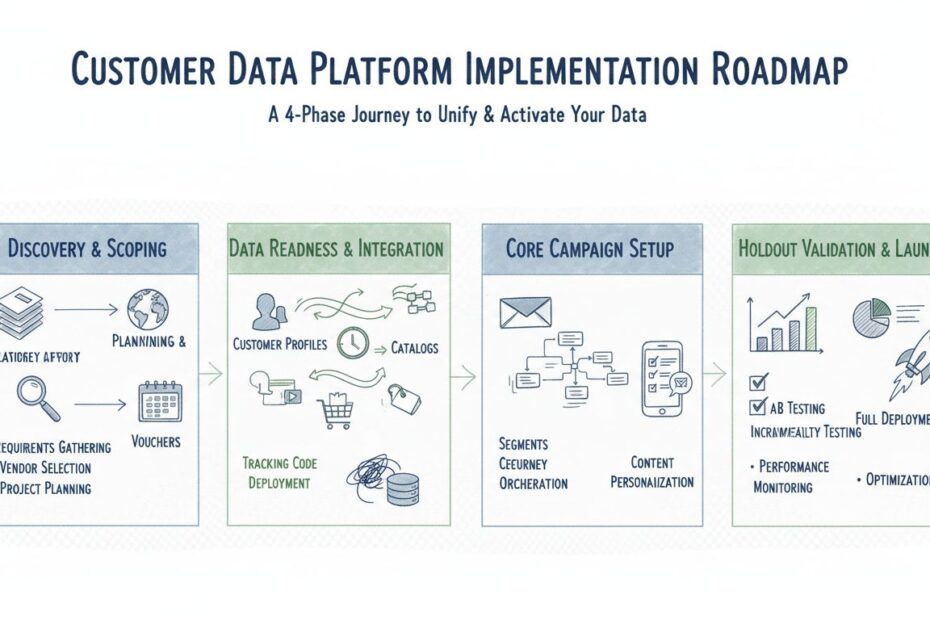
A successful Bloomreach Engagement implementation unfolds across four distinct phases, each with specific technical requirements, expected deliverables, and business milestones. Understanding this sequence allows your organization to sequence work efficiently, protect timelines, and ensure that each phase builds on the foundations established in the previous phase.
Phase 1: Discovery, Scoping, and Acceptance Criteria Mapping
The discovery phase aligns your business performance objectives with explicit technical specifications and integration scope before a single line of tracking code is deployed. This phase establishes definitive technical and operational boundaries that prevent project scope creep and set clear baselines for measuring downstream incremental lift.
During discovery, your team documents current customer acquisition cost (CAC), customer lifetime value (CLV), email engagement benchmarks, conversion rates by channel, and any other baseline metrics that will allow you to measure the incremental impact of Bloomreach activation. You map all data sources that will feed the platform: your website, mobile app, order management system, email service provider, SMS platform, loyalty program, and any third-party data sources. You define acceptance criteria that specify exactly what success looks like: response time thresholds, data freshness requirements, campaign launch timelines, and performance targets.
Your Bloomreach Success Manager or implementation partner provides a detailed statement of work (SOW) that documents these acceptance criteria, phased rollout schedule, and milestones tied to specific deliverables. This documented scope prevents the scenario where implementation teams spend months building features that were never explicitly required.
Key Prerequisites for Phase 1:
- Documented baseline metrics for CAC, CLV, email engagement, and conversion rates
- Complete inventory of all data sources and systems that will integrate with Bloomreach
- Defined acceptance criteria and success metrics for the overall implementation
- Signed statement of work with clear milestones and deliverables
Phase 2: Data Readiness, Tracking Ingestion, and Environment Access
The data readiness phase opens your system environments and deploys data streaming pipelines that ingest active customer interactions. This phase forms the literal fuel for real-time personalization, ensuring behavioral data arrives without pipeline latency.
Your implementation team provisions your Bloomreach instance (single tenant or exclusive, depending on your data volume and isolation requirements), configures user access and role-based permissions, and deploys web tracking code to your storefront. The web tracking JavaScript captures product views, search queries, category browsing, cart additions, and all other relevant storefront behaviors in real time. Backend integrations sync your complete order history, customer master data, and any custom customer attributes from your CRM or data warehouse.
Your product team uploads your initial product catalog to Bloomreach, including all product attributes, pricing, inventory status, and variant information. Your data engineering team establishes a continuous data pipeline that updates product data as inventory levels change and prices adjust. Your consent management framework gets configured with your specific consent categories and rules.
By the end of Phase 2, Bloomreach is receiving real-time data from your website, your order system, and your product catalog. Your team can see customer profiles populating with behavioral data. But no marketing campaigns are live yet. All data ingestion happens in a staging environment, allowing your team to validate data quality and confirm that customer profiles are building correctly before any customer-facing campaigns activate.
Key Prerequisites for Phase 2:
- Provisioned Bloomreach instance with appropriate tenant type and data residency
- Deployed web tracking JavaScript on all customer-facing properties
- Configured backend integrations syncing order history and customer master data
- Uploaded and validated product catalog with complete attribute mapping
- Configured consent management categories and rules
- Validated data quality and customer profile building in staging environment
Phase 3: Core Lifecycle Journey Construction and Campaign Setup
The campaign setup phase shifts the platform investment from a passive data repository into an active revenue-generating engine. Your marketing team begins building initial high-yield use cases within Bloomreach’s visual scenario canvas, testing system automation rules under real conditions.
The typical first project focuses on welcome onboarding: a triggered email series that fires when new customers complete their first purchase, introducing them to your brand, highlighting best-selling products, and offering a discount code for their second purchase. The second project typically addresses cart abandonment: a multi-touch workflow that sends an email reminder after 2 hours, a second email after 24 hours, and a final SMS message after 48 hours if the cart remains abandoned, with increasingly aggressive incentives.
The third initial project often focuses on behavioral merchandising: search triggers that send personalized product recommendations when customers search for specific keywords or categories, helping customers discover relevant products they might otherwise miss. Each of these projects uses Bloomreach’s native segmentation and personalization capabilities to deliver different messages to different customer segments based on their behavior, lifecycle stage, and purchase history.
Your analytics team sets up dashboards to monitor campaign performance: delivery rates, open rates, click-through rates, conversion rates, and revenue impact. Your compliance team ensures that all campaigns respect customer consent preferences, sending messages only to customers who have explicitly opted in to the relevant communication channel.
Key Prerequisites for Phase 3:
- Defined initial high-yield use cases (welcome series, cart abandonment, behavioral triggers)
- Configured customer segments and audience definitions
- Built campaign templates and email designs
- Established performance dashboards and reporting
- Validated that all campaigns respect consent preferences
- Trained marketing team on scenario building and campaign management
Phase 4: Holdout Validation, QA Testing, and Staged Launch Rollout
The validation phase executes rigorous quality-assurance testing and implements native holdout control groups that allow your team to calculate exact incremental lift driven by the platform. This phase guarantees absolute system reliability before scaling data structures and allows analysts to isolate the true business impact of Bloomreach activation.
Your QA team runs comprehensive multi-device testing scripts, validating that emails render correctly on desktop and mobile, that web personalization displays as designed, that SMS messages deliver with correct content, and that all customer journey logic executes as intended. Your data team validates that customer profile data is accurate, that segments are calculating correctly, and that no data synchronization issues exist between Bloomreach and your other systems.
Most importantly, you implement native holdout control groups. For each campaign, a defined percentage of your target audience (typically 10-20%) is excluded from the campaign entirely. These holdout customers receive no emails, no SMS messages, no personalized web experiences related to that campaign. By comparing the behavior of holdout customers against the behavior of customers who received the campaign, your analytics team can calculate the exact incremental conversion lift, revenue impact, and customer acquisition cost reduction driven by Bloomreach.
This holdout control group methodology eliminates the guesswork from implementation success measurement. Rather than assuming that email campaigns drive revenue, you have statistical proof of exactly how much incremental revenue each campaign generates. This data becomes invaluable for justifying continued investment in the platform and identifying which use cases deliver the highest ROI.
Your implementation follows a staged rollout approach: pilot campaigns launch to a limited percentage of your customer base first, allowing your team to validate performance and catch any issues before full-scale deployment. Once pilot results validate assumptions and holdout control groups confirm incremental lift, campaigns scale to your entire customer base.
Key Prerequisites for Phase 4:
- Comprehensive QA testing across all devices and channels
- Data validation confirming accuracy of customer profiles and segments
- Implemented holdout control groups for all campaigns
- Staged rollout approach with pilot campaigns to limited audiences
- Performance dashboards showing incremental lift vs. holdout groups
- Formal sign-off on acceptance criteria and campaign performance
Step 4: Long-Term Optimization and Scaling Advanced Personalization
After initial campaigns launch and holdout control groups confirm incremental lift, your organization transitions from implementation stability to continuous performance scaling. This long-term optimization phase leverages Bloomreach’s advanced capabilities to deepen personalization, expand to new channels, and automate increasingly sophisticated customer journey logic.
Your analytics team monitors segment metrics, cohort analysis, and repeat purchase frequencies across rolling quarters, identifying which customer segments have the highest lifetime value and which segments show signs of churn risk. Your marketing team layers additional use cases on top of the foundational welcome and cart abandonment workflows: win-back campaigns targeting lapsed customers, cross-sell recommendations based on purchase history, loyalty program enrollment flows, and seasonal campaigns tied to key shopping periods.
Bloomreach’s native AI capabilities, including Loomi AI, enable autonomous predictive analytics and automated campaign optimization. Rather than manually building segments and defining rules, your team configures high-level business objectives and allows the platform to automatically identify customer segments, predict customer behavior, and optimize campaign timing and messaging. Fatigue management automation prevents customers from receiving too many messages across channels. Predictive replenishment reminders trigger when the platform predicts a customer is likely to reorder a consumable product. Dynamic retention auto-segments identify at-risk customers and automatically enroll them in retention workflows.
This continuous optimization approach transforms Bloomreach from a static system into a constantly evolving engine that gets smarter and more effective with every customer interaction.
Measuring Success: From Holdout Control Groups to Long-Term CLV Impact
Measuring implementation success requires moving beyond vanity metrics like email open rates and click-through rates to focus on business outcomes that directly impact profitability: incremental revenue per customer, customer lifetime value expansion, and customer acquisition cost reduction.
The holdout control group methodology provides the statistical foundation for this measurement. By excluding a percentage of customers from campaigns entirely, your team calculates the exact incremental revenue each campaign generates. A welcome series might drive a 15% increase in second-purchase conversion rate among exposed customers compared to holdout customers, translating to a specific revenue impact. A cart abandonment series might recover 8% of abandoned carts, generating incremental revenue that directly offsets implementation costs.
Long-term measurement tracks how Bloomreach activation impacts customer lifetime value. Customers who receive personalized welcome series, behavioral recommendations, and retention campaigns typically show higher repeat purchase frequency and higher average order value compared to customers in holdout groups. This CLV expansion compounds over time: a 10% increase in repeat purchase frequency for your customer base translates to millions of dollars in incremental annual revenue.
The table below illustrates how to structure your measurement framework:
| Metric | Baseline (Pre-Bloomreach) | Post-Bloomreach | Incremental Lift | Business Impact |
|---|---|---|---|---|
| Second Purchase Conversion Rate | 28% | 32% | +4 percentage points | 15% increase in repeat purchasers |
| Average Order Value | $85 | $92 | +$7 | Higher revenue per transaction |
| Customer Lifetime Value (12 months) | $320 | $385 | +$65 | 20% CLV expansion |
| Email Open Rate | 22% | 26% | +4 percentage points | Improved engagement signal |
| Cart Abandonment Recovery Rate | 6% | 14% | +8 percentage points | 133% increase in recovered carts |
| Customer Acquisition Cost | $32 | $28 | -$4 | 12.5% CAC reduction |
This measurement framework connects platform activation directly to business outcomes, allowing your leadership team to see exactly how Bloomreach investment translates to revenue growth and profitability improvement.
How Voxwise Can Help
The difference between a Bloomreach implementation that delivers measurable incremental revenue and one that stalls in configuration complexity comes down to partnership. Voxwise brings specialized expertise in CRM strategy, customer data architecture, and Bloomreach implementation to eliminate the technical friction that derails most enterprise platform transitions.
Voxwise works with your team across all four implementation phases. During discovery, Voxwise helps you define realistic acceptance criteria, identify all data sources that should feed the platform, and establish baseline metrics that will allow you to measure implementation success. During data readiness, Voxwise architects your identity resolution strategy, configures your consent management framework, and validates that customer data is flowing into Bloomreach with the quality and freshness required for real-time personalization.
During campaign setup, Voxwise’s marketing automation specialists build your initial high-yield use cases, train your team on scenario design and campaign management, and establish performance dashboards that track incremental lift. During validation and rollout, Voxwise implements holdout control groups, runs comprehensive QA testing, and guides your staged rollout approach to ensure campaigns launch with confidence.
Most importantly, Voxwise becomes your ongoing optimization partner. As your team moves beyond initial implementation to continuous improvement, Voxwise helps you identify new use cases, optimize existing campaigns based on performance data, and scale advanced personalization capabilities that deepen customer engagement and expand lifetime value.
The investment in expert implementation partnership pays immediate returns: faster project timelines, higher-quality data architecture, more confident campaign launches, and faster time to measurable revenue impact. Organizations that partner with specialized Bloomreach implementation consultants like Voxwise consistently achieve higher incremental lift from their platform investments and scale personalization capabilities faster than organizations attempting implementation alone.
FAQ
What should a retail brand expect during a Bloomreach Engagement implementation?
A successful Bloomreach Engagement implementation unfolds across four distinct phases: discovery and scoping, data readiness and integration, campaign setup and personalization, and holdout validation and staged rollout. Each phase has specific technical requirements, expected deliverables, and business milestones. The complete implementation typically spans 3-6 months from initial discovery to full production launch, depending on data complexity and organizational readiness.
What are the four core data elements required for a Bloomreach setup?
The four core data elements are Customers (individual profiles mapped to unique identifiers), Events (time-stamped customer actions across all touchpoints), Catalogs (live product inventory and attributes), and Vouchers (promotional codes and incentive management). Each element must be properly configured and integrated before marketing campaigns can activate effectively.
How does Bloomreach Engagement manage customer identity resolution and profile merging?
Bloomreach supports identity resolution through both soft IDs (anonymous identifiers like browser cookies) and hard IDs (verified identifiers like email addresses). Your implementation team defines explicit identity resolution rules that determine how the platform combines anonymous sessions with verified logins, ensuring customers are recognized consistently across all interactions.
What are the three best-practice methods for consent management in the platform?
Bloomreach supports three native consent management methods: direct updates within the customer profile interface, automated consent events triggered within customer journey scenarios, and customizable self-service consent management pages that customers access directly. Each method maintains a complete audit trail of consent interactions for compliance documentation.
Why is a phased rollout strategy recommended for e-commerce teams implementing Bloomreach?
A phased rollout approach protects project timelines and allows your team to validate assumptions before scaling. Pilot campaigns launch to limited audiences, allowing you to confirm performance and catch issues before full-scale deployment. Holdout control groups in each phase provide statistical proof of incremental lift before scaling campaigns to your entire customer base.
How does data latency between older standalone CRMs and ESPs compare to Bloomreach’s real-time architecture?
Legacy CRM and email service provider systems typically operate with 24-hour data latency or longer. Bloomreach Engagement ingests customer events in real time, allowing campaigns to respond immediately to customer behavior. A customer who abandons their cart can receive an email reminder within minutes rather than waiting for overnight batch processing.
How do native holdout control groups validate implementation success?
Holdout control groups exclude a defined percentage of your target audience (typically 10-20%) from campaigns entirely. By comparing the behavior of holdout customers against customers who received campaigns, your analytics team calculates exact incremental lift: how much additional revenue each campaign generates, how much conversion rates improve, and what the true return on investment is.
How does Voxwise support e-commerce teams during the Bloomreach onboarding process?
Voxwise provides specialized expertise across all implementation phases: defining acceptance criteria during discovery, architecting data integration during readiness, building initial use cases during campaign setup, and implementing holdout control groups during validation. Voxwise becomes your ongoing optimization partner, identifying new use cases and scaling advanced personalization capabilities that deepen customer engagement.
Explore Similar Use Cases with Voxwise
Bloomreach Engagement implementation represents a transformational shift in how your organization activates customer data. But successful implementation requires more than software installation. It demands strategic planning, rigorous data architecture, and expert guidance through each phase of the rollout.
Voxwise specializes in helping retail and e-commerce leaders navigate complex CRM and customer data transformations. Whether you’re evaluating Bloomreach Engagement, planning your implementation roadmap, or optimizing an active deployment, Voxwise brings specialized expertise in customer data strategy, lifecycle marketing, and personalization at scale.
See our services to explore how Voxwise can accelerate your Bloomreach implementation and maximize your software investment.
Get Expert Advice by scheduling a 30-minute consultation with a Voxwise customer engagement specialist. We’ll assess your current customer data maturity, identify optimization opportunities, and outline a specific roadmap for your Bloomreach activation.