What Are Some Alternatives to Bloomreach? The Complete 2026 Guide
Bloomreach is a powerful commerce experience cloud that combines customer data platforms, marketing automation, content management, and product discovery into a single unified solution. However, its complexity, pricing opacity, and broad horizontal approach make it unsuitable for every organization. Many mid-market retailers find themselves overwhelmed by implementation timelines, steep learning curves, and costs that don’t align with their specific retail needs. If you’re evaluating whether Bloomreach is right for your business or exploring alternatives, this comprehensive guide breaks down the landscape of competing platforms, their strengths, limitations, and ideal use cases. Understanding your options helps you make an informed decision that maximizes ROI and operational efficiency.
Enterprise Suites: Comprehensive But Complex
Enterprise suites offer all-in-one solutions designed for large organizations with complex requirements and dedicated implementation teams. These platforms combine multiple capabilities under one roof but often require significant customization and technical expertise to deploy effectively.
Salesforce Marketing Cloud
Salesforce Marketing Cloud delivers comprehensive marketing automation, customer data unification, and cross-channel campaign orchestration. The platform integrates deeply with the broader Salesforce ecosystem, making it ideal for organizations already invested in Salesforce CRM. It provides robust journey builder functionality, advanced segmentation, and multi-channel execution across email, SMS, push notifications, and social channels. However, Salesforce Marketing Cloud demands substantial implementation effort, requires specialized Salesforce expertise to maximize value, and carries premium pricing that reflects its enterprise positioning. Organizations without existing Salesforce infrastructure often find the total cost of ownership prohibitively high when factoring in implementation, training, and ongoing customization.
Adobe Experience Manager (AEM) & Adobe Target
Adobe’s experience management suite combines powerful content management with sophisticated personalization and testing capabilities. AEM excels at managing complex digital properties across multiple channels and geographies, while Adobe Target provides advanced experimentation, segmentation, and real-time personalization. The platform integrates seamlessly with other Adobe solutions including Analytics and Audience Manager, creating a unified data and execution environment. Yet Adobe’s complexity is substantial—implementations typically span months or years, require dedicated technical teams, and demand continuous optimization expertise. Mid-market organizations frequently struggle with Adobe’s learning curve and find that extracting value requires more investment than initially anticipated.
Sitecore Experience Platform
Sitecore delivers enterprise-grade content management, personalization, and analytics designed for organizations managing large-scale digital experiences. The platform provides sophisticated content modeling, multichannel delivery, and real-time personalization driven by behavioral data. Sitecore’s strength lies in its flexibility and ability to handle extremely complex content governance and deployment scenarios. However, Sitecore requires deep technical expertise, lengthy implementation cycles, and substantial ongoing investment in customization and maintenance. Organizations report that true value realization often takes 12-18 months, and the platform is generally overkill for organizations without enterprise-scale complexity.
Best-of-Breed Specialists: Focused Solutions
Best-of-breed specialists excel at solving specific problems exceptionally well. These platforms trade breadth for depth, allowing organizations to achieve superior results in their core focus area while maintaining flexibility to integrate with other tools.
Braze: Cross-Channel Journey Orchestration
Braze specializes in sophisticated customer journey orchestration across email, SMS, push notifications, in-app messaging, and web channels. The platform excels at real-time decisioning, allowing marketers to send contextually relevant messages based on customer behavior and preferences. Braze’s AI-driven optimization continuously improves campaign performance, and the platform integrates with hundreds of third-party tools, making it flexible for organizations with existing technology investments. However, Braze focuses exclusively on messaging and engagement—it lacks native product discovery, search capabilities, and content management functionality. Organizations using Braze must integrate separate solutions for site search, product recommendations, and content management, creating operational complexity and potential data latency issues.
Klaviyo: E-Commerce Email & SMS Marketing
Klaviyo dominates the e-commerce email and SMS marketing space, offering exceptional ease of use, native Shopify integration, and powerful predictive analytics. The platform makes it simple for e-commerce teams to build sophisticated email automation, segment customers based on purchase behavior, and execute SMS campaigns with strong compliance features. Klaviyo’s strength is its accessibility—non-technical marketers can build complex campaigns without developer support. However, Klaviyo’s scope is narrow, focusing primarily on email and SMS. Organizations need separate solutions for on-site personalization, product discovery, content management, and omnichannel orchestration beyond email and SMS channels.
Algolia: AI-Powered Search & Discovery
Algolia provides best-in-class site search and product discovery, delivering fast, relevant search results that drive conversions. The platform combines sophisticated relevance algorithms with AI-driven query understanding and personalized recommendations. Algolia’s developer-friendly API allows rapid implementation and customization, and the platform scales effortlessly to handle millions of products and queries. Yet Algolia is purely a search and discovery solution—it doesn’t include customer data management, marketing automation, content management, or campaign orchestration. Organizations using Algolia must integrate it with separate CDP, marketing automation, and CMS solutions, creating a fragmented technology stack.
Insider: Cross-Channel Personalization
Insider delivers AI-powered cross-channel personalization, customer journey orchestration, and real-time behavioral targeting across web, mobile app, email, SMS, and push channels. The platform excels at real-time personalization driven by behavioral data, providing sophisticated segmentation and journey automation. Insider integrates well with major commerce platforms and analytics tools, making it accessible for mid-market organizations. However, Insider lacks native product search and discovery capabilities, content management functionality, and the unified customer data architecture that enables true real-time decisioning. Organizations using Insider typically need separate search, CMS, and potentially CDP solutions depending on their data complexity.
Niche Customer Data Platforms: Data Unification Focus
Niche CDPs specialize in unifying customer data from multiple sources and providing a single customer view. These platforms excel at data integration and activation but typically lack native execution capabilities.
Segment: Data Collection & Unification
Segment focuses on collecting customer data from hundreds of sources and creating a unified customer profile. The platform simplifies data integration through pre-built connectors and provides a clean API for accessing unified customer data. Segment’s strength is its data collection and warehouse integration capabilities, making it valuable for organizations with complex data environments. However, Segment is purely a data platform—it provides no marketing execution, personalization, content management, or campaign orchestration functionality. Organizations using Segment must layer multiple execution tools on top, creating operational complexity and potential data latency between the CDP and execution systems.
Tealium: Customer Data & Consent Management
Tealium specializes in customer data collection, unification, and activation with particular strength in consent management and privacy compliance. The platform provides sophisticated data governance, allowing organizations to manage complex consent requirements across geographies and channels. Tealium’s universal data hub collects behavioral data from web, mobile, and offline sources, creating a unified customer view. However, like Segment, Tealium is a data platform without native execution capabilities. Organizations need separate marketing automation, personalization, content management, and campaign orchestration solutions, creating a complex technology ecosystem that requires careful orchestration.
Voyado: Retail-First Unified Platform
Voyado positions itself as a retail-focused alternative to Bloomreach, combining CRM, loyalty, marketing automation, and product discovery into a single platform. The platform emphasizes ease of use, built-in loyalty functionality, and retail-specific features that Bloomreach doesn’t provide natively. Voyado integrates omnichannel automation across email, SMS, web, and point-of-sale systems. However, Voyado’s strength is primarily in the retail loyalty space rather than broader digital experience management. The platform is less suitable for organizations with complex content management needs, multiple brands, or non-retail business models.
The Integration Tax: Unified vs. Fragmented Stacks
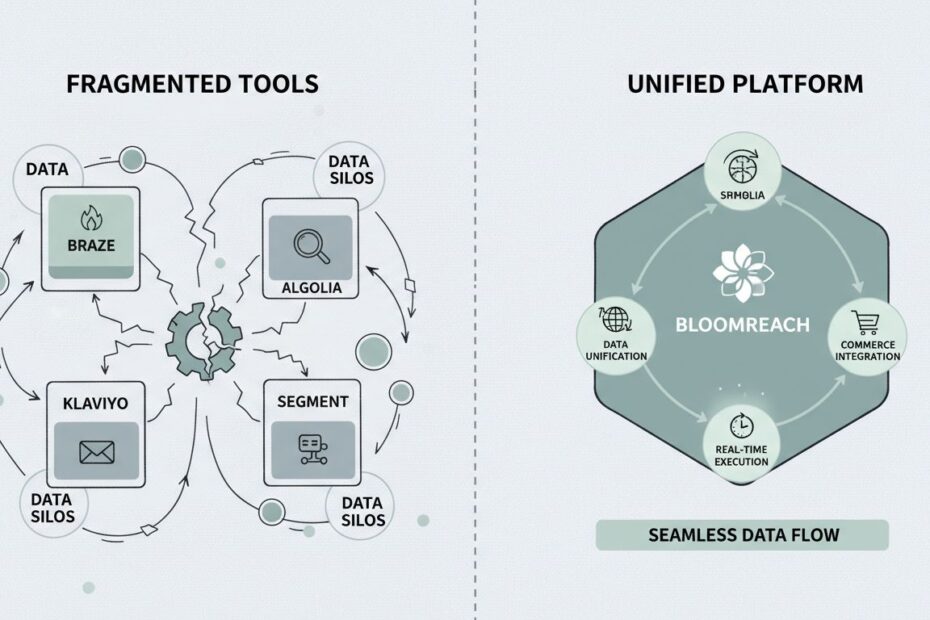
The fundamental difference between Bloomreach and its alternatives is architectural. Bloomreach combines customer data, content management, product discovery, and execution into a single real-time environment. This unified architecture eliminates data latency, reduces integration complexity, and ensures consistent personalization across all customer touchpoints.
In contrast, alternatives force organizations into “franken-stack” scenarios:
| Capability | Bloomreach (Unified) | Best-of-Breed Stack | Impact |
|---|---|---|---|
| Data Latency | Real-time, single source of truth | Multi-hop data flow between systems | Delayed personalization, missed opportunities |
| Implementation Complexity | Single platform, unified APIs | Multiple integrations, custom connectors | Longer timelines, higher costs, more risk |
| Operational Overhead | One vendor relationship, unified support | Multiple vendors, fragmented support | Increased complexity, slower issue resolution |
| Total Cost of Ownership | Single platform investment | Multiple platform subscriptions + integration | 30-40% higher annual costs |
| Data Governance | Centralized, consistent policies | Distributed governance across systems | Compliance risk, data quality issues |
| Personalization Sophistication | Real-time decisioning across all data | Batch-based or delayed decisioning | Lower conversion rates, reduced customer satisfaction |
Organizations choosing fragmented stacks save money initially but pay a hidden “integration tax” through longer implementation cycles, higher operational costs, reduced personalization sophistication, and slower time-to-value.
Bloomreach’s Competitive Advantages
While alternatives excel in specific areas, Bloomreach’s unified architecture delivers advantages that point solutions cannot match:
Real-Time Decisioning: Bloomreach processes customer data and executes personalization decisions in real-time. Customer data, product catalog, and execution logic live in the same system, eliminating latency. When a customer visits your site, Bloomreach instantly accesses their complete history, preferences, and behavior to deliver perfectly personalized experiences.
Commerce-Native Architecture: Unlike horizontal platforms adapted for commerce, Bloomreach is built from the ground up for e-commerce. Product discovery, merchandising, and personalization are native capabilities, not bolted-on features. This commerce focus ensures that search, recommendations, and personalization work seamlessly together.
Unified Customer Data: Bloomreach unifies customer data from all sources—CRM systems, marketing automation, web analytics, e-commerce platforms, and offline channels. This unified view enables sophisticated segmentation and personalization that fragmented stacks cannot achieve.
Reduced Total Cost of Ownership: Despite higher initial costs, Bloomreach’s unified architecture reduces long-term TCO by eliminating integration costs, reducing operational complexity, and accelerating time-to-value. Organizations typically see ROI within 12-18 months.
Why Organizations Choose Bloomreach Over Alternatives
Despite the availability of alternatives, leading retailers continue choosing Bloomreach because:
- Speed to Personalization: Bloomreach enables sophisticated personalization immediately after implementation, while fragmented stacks require months of integration and orchestration work.
- Reduced Operational Burden: Managing a single platform is significantly simpler than orchestrating multiple vendors, each with different APIs, data models, and support processes.
- Superior Customer Experiences: Real-time decisioning across unified customer data delivers experiences that fragmented stacks cannot match, driving measurable improvements in conversion rates and customer lifetime value.
- Enterprise Scalability: Bloomreach scales seamlessly to handle millions of customers, billions of transactions, and complex global operations without performance degradation.
Ready to Transform Your Commerce Experience?
Discover how Bloomreach can deliver personalized, real-time commerce experiences that drive measurable business results. Our team of Bloomreach experts is ready to help.