Bloomreach Engagement for Customer Data Activation: A Retail Guide
Most retail organizations collect massive volumes of customer data across multiple touchpoints: website interactions, purchase histories, email engagement, mobile app behavior, and offline transactions. Yet despite this abundance of information, many brands struggle to convert passive customer databases into actionable, real-time personalization. The cost of maintaining disconnected systems, the operational friction of manual data synchronization, and the latency inherent in traditional tech stacks create a significant competitive disadvantage.

This article explores how Bloomreach Engagement solves this challenge by unifying customer data with native orchestration capabilities, enabling true real-time activation across all channels.
The Data Activation Crisis: Why Passive Customer Databases Restrict Retail Growth
Retail organizations today operate within a fragmented technology ecosystem. Customer data lives in multiple systems: your e-commerce platform tracks browsing behavior and transactions, your email service provider maintains engagement metrics, your CRM holds customer attributes and communication history, and your analytics tool stores aggregated behavioral patterns. Each system operates independently, synchronized through manual exports, batch processes, or unreliable API connections that introduce hours or even days of latency.
This fragmentation creates three critical operational problems. First, data dormancy occurs when customer insights remain locked in historical databases without triggering immediate action. A customer may exhibit clear purchase intent signals—adding high-value items to their cart, browsing related products, or opening a promotional email—but these signals fail to activate coordinated responses across channels because the systems containing this data cannot communicate in real time. Second, latency in data synchronization prevents true one-to-one personalization.
By the time a customer’s profile updates across all systems, their moment of peak intent has passed. A cart abandonment signal that takes two hours to propagate cannot trigger an effective recovery email. Third, generic promotional blasts become the default strategy when brands cannot segment audiences dynamically. Without real-time customer intelligence, marketing teams resort to broad-based campaigns that dilute margins, damage customer relationships, and fail to maximize customer lifetime value.
The financial impact is substantial. Organizations lose revenue through abandoned carts that could have been recovered with immediate, contextual interventions. They overspend on customer acquisition because retention strategies lack the precision to prevent churn. They experience margin compression from excessive discounting because they cannot identify which customers require incentives versus those willing to purchase at full price. Most critically, they fail to build lasting customer relationships because every interaction feels generic rather than personalized.
Defining Real-Time Data Activation in Modern E-commerce
Customer data activation is the operational process of converting unified data insights into real-world, automated marketing actions across channels at the exact moment of consumer intent. Unlike traditional data analysis, which focuses on understanding historical patterns, data activation bridges the gap between intelligence and execution. It means taking a real-time customer event—a product view, a cart addition, an email open, a loyalty milestone—and immediately triggering coordinated actions across email, SMS, web personalization, mobile push, and advertising channels without manual intervention.
The strategic impact of data activation on core retail metrics is measurable and significant. Organizations implementing real-time activation report improved conversion rates because campaigns reach customers when intent is highest. Email deliverability improves because messages are contextual and relevant, reducing spam complaints and bounce rates. Marketing ROI increases because budget is allocated to high-probability customer segments rather than broadcast campaigns. Customer lifetime value grows because retention strategies become predictive rather than reactive. The foundational requirement for all of this is a unified customer data platform that can process customer signals in real time and orchestrate responses across channels without latency.
The Architectural Core of Bloomreach as a Unified CDXP
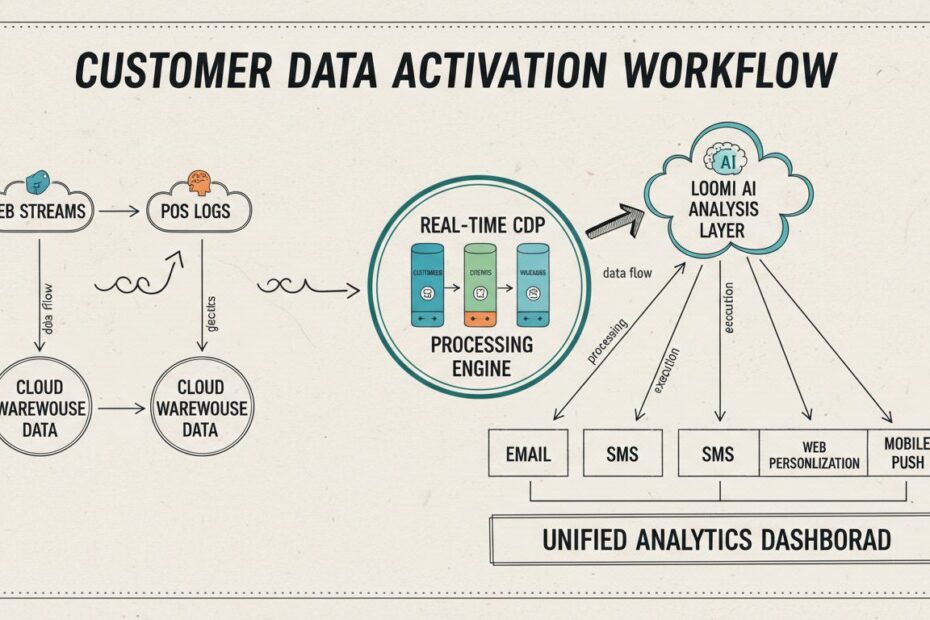
Bloomreach Engagement operates as a Customer Data and Experience Platform (CDXP) that combines traditional CDP functionality with native marketing automation, real-time orchestration, and AI-driven predictive analytics. This unified architecture eliminates the data silos that plague fragmented tech stacks.
The platform’s core strength lies in three distinct technical capabilities. First, Unified Real-Time Customer Data Platform aggregates cross-channel interactions, transactional logs, and consent preferences into a single customer view database with zero latency. Every website visit, purchase, email interaction, and customer attribute flows into a centralized customer profile that updates in milliseconds.
Second, the In-Memory Rule Processing Engine calculates complex audience segmentations on the fly, capturing immediate digital body language before customer intent cools down. Rules that would take hours to compute in batch processes execute instantly, enabling dynamic segment membership that reflects real-time customer state.
Third, Native Multi-Channel Orchestration delivers hyper-personalized experiences across email, SMS, mobile push alerts, and live website layers directly from one interface without relying on unstable third-party data bridges or API dependencies.
This architecture fundamentally differs from traditional point solutions that require manual data pipelines. Instead of exporting customer segments from a CDP to a separate email platform, or pushing audience lists to an advertising partner through unreliable integrations, Bloomreach handles data collection, unification, segmentation, and execution within a single platform. This eliminates synchronization delays and ensures that every customer interaction is informed by the most current customer state.
Unpacking the Architecture: The Four Core Data Elements
Bloomreach’s data structure is built on four foundational elements that work together to enable sophisticated activation. Understanding these elements is essential for implementing effective data activation strategies.
Customers represent dynamic individual profiles containing unique cross-channel tracking identifiers, diagnostic attributes, hard and soft IDs, and computed loyalty metrics. Each customer profile aggregates all known information about an individual across all touchpoints: their email address, phone number, customer ID from your system, anonymous device identifiers, purchase history, browsing behavior, email engagement, loyalty tier, lifetime value score, and any custom attributes relevant to your business. Hard identifiers (email, phone, customer ID) enable deterministic matching across devices and channels. Soft identifiers (device IDs, cookies) capture anonymous behavior that later resolves to known customers when they log in or provide contact information.
Events are time-stamped behavioral actions recording live web browsing choices, category searches, email interactions, and checkout activities. Every customer action generates an event: viewing a product page, adding items to cart, completing a purchase, opening an email, clicking a link, viewing a recommendation, or applying a discount code. Events include properties that provide context: the product viewed, the price, the category, the device type, the time of day, the traffic source. This granular event data, flowing continuously into the platform, creates the real-time signal that drives activation.
Catalogs are live inventory databases tracking real-time SKU data feeds, product categories, pricing changes, margins, and stock levels to power recommendations and personalization. Rather than relying on static product lists, Bloomreach maintains a dynamic catalog that reflects current inventory, pricing, and profitability. This enables recommendations to account for stock availability and margin optimization, ensuring that suggested products are both desirable and profitable.
Vouchers are smart loyalty incentive pools that automatically allocate individual promotional codes or milestone rewards inside running automated loops. Instead of manually creating discount codes or managing loyalty tier benefits, Bloomreach can automatically generate and assign personalized incentives based on customer behavior and value. A high-value customer approaching churn might receive a unique, personalized discount code. A loyal customer reaching a purchase milestone might automatically receive a loyalty reward. This automation ensures consistent incentive management across all campaigns.
| Data Element | Purpose | Example |
|---|---|---|
| Customers | Individual profiles with identifiers and attributes | Email, customer ID, loyalty tier, purchase history |
| Events | Real-time behavioral actions with context | Product view, cart addition, email open, purchase |
| Catalogs | Live inventory and product data | SKU, price, category, stock level, margin |
| Vouchers | Automated incentive allocation | Personalized discount codes, loyalty rewards |
High-Impact Data Activation Scenarios for E-commerce Brands
The practical application of Bloomreach architecture creates measurable business impact across critical e-commerce touchpoints. Each scenario demonstrates how unified data and real-time orchestration drive revenue and retention.
High-Value VIP Retention Loops Driven by Loomi AI
Identifying customers at risk of churn before they disappear is one of the highest-impact use cases for data activation. Bloomreach’s Loomi AI engine automatically analyzes historical customer behavior to identify slipping VIP cohorts based on RFM (Recency, Frequency, Monetary) scoring. The system monitors the unified data layer to target profiles where historical Monetary and Frequency parameters are high, but Recency scores drop past your brand’s average purchase cycle gap by 1.5x. This indicates a high-value customer who is becoming inactive.
Once identified, Loomi AI automatically triggers an automated re-engagement journey. The platform delivers a rich email layout displaying specific product suggestions matching the customer’s past catalog affinities, automatically followed by a targeted SMS alert featuring a high-tier loyalty voucher perk only if the email remains unopened within 48 hours. The campaign logic respects customer preferences: if the customer has opted out of SMS, the system routes the follow-up through their preferred channel instead. This approach maximizes long-term customer retention, lifts repeat transaction volumes, and protects top-line retail margins by avoiding broad discount blasts that erode profitability.
Behavioral Merchandising and Contextual Cart Recovery
Cart abandonment represents one of the most valuable activation opportunities in e-commerce. Bloomreach ingests a live storefront cart addition event without a corresponding transaction completed within 45 minutes, automatically measuring the cart total against your store’s baseline average order value. This real-time signal triggers immediate action.
The journey logic splits based on absolute value thresholds. High-value carts (above 1.5x baseline AOV) route immediately into a personalized email displaying the exact cart product assets, customer testimonials, and clear satisfaction guarantees, removing friction that prevents purchase completion. Lower-value carts route into automated sequences driven by product urgency messaging and social proof reviews without margin-damaging discounts. This segmentation ensures that recovery efforts are proportional to cart value, preserving margins while maximizing recovery rates. Organizations implementing this strategy report substantial improvements in cart recovery rates and measurable reductions in overall journey opt-out rates.
Predictive Replenishment Automation for Consumables
For brands selling consumable or repeat-purchase products, predictive replenishment creates consistent revenue and deepens customer stickiness. Bloomreach tracks repeat-buy retail items where Loomi AI analyzes individual purchase frequency intervals alongside broad category velocity benchmarks. The system learns that a customer typically repurchases a consumable product every 28 days based on their historical purchase pattern.
The system automatically triggers an automated notification across the customer’s preferred channel (email, SMS, or onsite web layer) exactly days before the calculated exhaustion date to secure the next continuous transaction. This approach expands customer lifetime value consistency, maximizes purchase frequencies, and builds unbreakable brand stickiness by removing the friction of customers having to remember to reorder. Customers experience the brand as attentive and anticipatory rather than passive.
Breaking Silos: Zero-Copy Data Ecosystem Integrations
Modern data activation requires integration with enterprise cloud data warehouses to eliminate traditional data silos. Bloomreach partnerships with platforms like Snowflake and Databricks enable zero-copy architectures that provide marketers with direct, real-time access to comprehensive organizational data assets without slow, resource-heavy ETL loading processes.
In traditional setups, data must be extracted from source systems, transformed into a standard format, and loaded into the CDP. This ETL (Extract, Transform, Load) process introduces latency and requires duplicate storage of data across multiple systems. Zero-copy architectures eliminate this inefficiency by allowing Bloomreach to query data directly from your cloud data warehouse in real time. Marketing teams can access the complete organizational data asset—not just marketing data, but finance, operations, inventory, and fulfillment data—to inform activation decisions. A campaign can reference real-time inventory levels to avoid promoting out-of-stock products. Recommendations can account for supply chain constraints. Pricing can be optimized based on current margin profiles.
This integration keeps campaign triggers perfectly synchronized with backend fulfillment status changes. When inventory levels shift, when pricing changes, or when supply chain status updates, activation campaigns automatically adjust without manual intervention. This level of coordination between marketing and operations is impossible in fragmented systems but becomes standard in a unified CDXP with data warehouse integration.
Engineering Actionable Data Streams with Voxwise
Implementing Bloomreach Engagement successfully requires more than platform selection. It requires strategic planning, technical architecture design, data governance, and ongoing optimization. This is where Voxwise, a specialized Bloomreach implementation and CRM consulting partner, becomes invaluable.
Voxwise helps retail brands structure complex data architectures by auditing existing data sources, mapping customer identifiers across systems, and designing data collection strategies that ensure data quality from the start. The team conducts comprehensive event tracking audits to verify that your website, mobile app, and backend systems are sending complete, accurate event data to Bloomreach. They configure bulletproof exclusion logic to ensure that transactional emails, internal testing, and customer service interactions don’t pollute your analytical data. Most critically, Voxwise helps turn segment data directly into automated multi-channel revenue by designing sophisticated customer journeys, configuring dynamic segmentation rules, and optimizing campaign performance through systematic testing and measurement.
Voxwise’s expertise in CRM strategy, customer data architecture, and marketing automation ensures that your Bloomreach investment delivers maximum ROI. Rather than treating Bloomreach as a standalone tool, Voxwise integrates it into your broader customer engagement strategy, connecting data activation to retention metrics, customer lifetime value optimization, and revenue growth.
Measuring Success: Activation Impact Metrics
Data activation success requires clear measurement frameworks. Organizations should track activation-specific metrics that reflect the actual business impact of real-time customer engagement.
Activation Latency measures the time between a customer action and the corresponding marketing response. Ideal activation latency is measured in seconds to minutes. If a customer abandons a cart at 2:15 PM, the recovery email should arrive by 2:20 PM. Monitoring activation latency reveals bottlenecks in data flow or orchestration logic.
Segment Refresh Rate measures how frequently customer segment membership updates. In a truly real-time system, segment membership should update within seconds of a customer action. If a customer reaches a loyalty milestone, they should immediately qualify for VIP segment benefits.
Campaign Conversion Lift compares conversion rates for activated campaigns versus control groups. Real-time, contextual campaigns typically outperform batch campaigns by 40-300% depending on the use case and customer segment.
Channel Attribution measures which channels drive the highest conversion and retention impact. Some use cases may be email-dominant while others show stronger SMS or web personalization performance. Understanding channel effectiveness optimizes budget allocation.
Customer Lifetime Value Impact measures the change in CLV for customers exposed to activation campaigns versus control groups. This is the ultimate business metric: does data activation actually increase the value of your customer relationships?
Common Implementation Challenges and Solutions
Organizations implementing data activation frequently encounter predictable challenges. Understanding these in advance enables smoother implementation.
Data Quality Issues are the most common blocker. If your website doesn’t accurately track product views, if your POS system doesn’t reliably send purchase data, or if customer identifiers aren’t consistently mapped, your activation campaigns will be based on incomplete information. Voxwise helps audit data quality and implement fixes before activation campaigns launch.
Identity Resolution Complexity emerges when customers interact across devices and channels. A customer may browse on mobile, add to cart on desktop, and purchase on tablet. Resolving these interactions to a single customer profile requires robust identity matching logic. Bloomreach handles this through hard and soft ID matching, but requires careful configuration.
Consent and Privacy Compliance requires meticulous attention. GDPR, CCPA, and other privacy regulations require explicit consent for data collection and activation. Bloomreach provides consent management capabilities, but implementation teams must ensure that consent is properly captured, stored, and respected in all activation workflows.
Organizational Alignment is often underestimated. Data activation requires coordination between marketing, IT, e-commerce, and customer service teams. Voxwise helps facilitate this alignment by establishing governance frameworks, defining roles and responsibilities, and creating measurement dashboards that demonstrate value to all stakeholders.
How Voxwise Can Help
Voxwise specializes in translating Bloomreach’s technical capabilities into measurable business outcomes. The firm’s services span three critical areas.
Strategy and Assessment: Voxwise conducts comprehensive audits of your current customer data infrastructure, marketing technology stack, and business objectives. The team identifies activation opportunities aligned with your highest-value use cases and develops implementation roadmaps that prioritize quick wins while building toward more sophisticated capabilities.
Implementation and Configuration: Voxwise handles technical implementation including data architecture design, event tracking configuration, customer journey design, and multi-channel orchestration setup. The team ensures that Bloomreach is configured to support your specific business processes and customer engagement strategies.
Optimization and Measurement: After launch, Voxwise continuously monitors activation performance, identifies optimization opportunities, and implements improvements. The team establishes measurement frameworks that connect data activation to revenue impact, ensuring that your investment delivers measurable ROI.
Conclusion
Bloomreach Engagement transforms passive customer databases into active, real-time engagement engines. By unifying customer data collection, segmentation, and orchestration within a single platform, Bloomreach eliminates the latency and complexity that plague fragmented tech stacks. The platform’s native support for omnichannel activation, predictive AI through Loomi, and integration with enterprise data warehouses enables retail organizations to deliver truly personalized customer experiences at scale.
The competitive advantage belongs to organizations that can identify customer intent signals in real time and respond with coordinated, contextual engagement across all channels. Bloomreach provides the platform foundation. Voxwise provides the strategic expertise and implementation excellence that translates platform capabilities into revenue growth and customer retention.
Frequently Asked Questions
What is customer data activation in e-commerce?
Customer data activation is the process of converting unified customer data insights into real-time, automated marketing actions across channels. It means taking a customer signal—a product view, cart addition, email open, or loyalty milestone—and immediately triggering coordinated responses through email, SMS, web personalization, and mobile push without manual intervention. Activation differs from traditional analytics by moving beyond understanding customer behavior to automatically acting on that understanding at the moment of peak customer intent.
How does Bloomreach Engagement differ from a traditional passive CDP?
Traditional CDPs focus on data collection and unification, providing a single customer view but requiring manual export of segments to separate execution platforms like email service providers or ad platforms. This creates latency and synchronization challenges. Bloomreach Engagement combines CDP functionality with native marketing automation, real-time orchestration, and predictive AI, enabling activation within the same platform. This eliminates data silos, reduces latency, and ensures that campaigns are always informed by the most current customer state.
What are the four core data elements within Bloomreach’s data structure?
Bloomreach’s architecture is built on four foundational elements: Customers (individual profiles with identifiers and attributes), Events (time-stamped behavioral actions with context), Catalogs (live inventory and product data), and Vouchers (automated incentive allocation). These elements work together to enable sophisticated activation. Customer profiles aggregate all known information about individuals. Events provide real-time signals of customer actions. Catalogs ensure recommendations and personalization account for current inventory and pricing. Vouchers automate incentive management across campaigns.
How does data latency between separate tools affect cart abandonment workflows?
Data latency is the primary enemy of effective cart abandonment recovery. If a customer abandons a cart at 2:15 PM but the abandonment signal takes two hours to propagate through separate systems before triggering a recovery email at 4:15 PM, the customer’s moment of peak intent has passed. Recovery rates plummet. Bloomreach’s unified architecture processes cart abandonment events in real time, triggering recovery campaigns within minutes, dramatically improving recovery rates. This is why organizations using unified platforms consistently outperform those relying on fragmented systems.
What is a zero-copy data integration, and how does it help marketers?
Zero-copy integration allows Bloomreach to query data directly from your cloud data warehouse (Snowflake, Databricks) in real time without extracting and loading data into Bloomreach. This eliminates duplicate data storage, reduces latency, and provides marketers with access to complete organizational data—not just marketing data, but finance, operations, and fulfillment data. Campaigns can reference real-time inventory levels, adjust pricing based on current margins, and ensure recommendations account for supply chain constraints. This coordination between marketing and operations is impossible in fragmented systems.
How does Loomi AI optimize cross-channel data activation?
Loomi AI analyzes historical customer behavior to identify patterns and predict future actions. It automatically identifies at-risk customers before obvious churn signals appear, determines the next best action for individual customers, and generates personalized product recommendations. Rather than relying on manual segment definitions, Loomi continuously learns from customer behavior and optimizes which customers receive which messages through which channels. This AI-driven approach consistently outperforms static segmentation strategies.
How does Voxwise help retail brands implement and optimize Bloomreach Engagement?
Voxwise provides strategic consulting, technical implementation, and ongoing optimization services for Bloomreach deployments. The firm conducts comprehensive audits of your current data infrastructure, designs data architectures that ensure quality from the start, configures sophisticated customer journeys, and establishes measurement frameworks that connect activation to revenue impact. Voxwise’s expertise ensures that your Bloomreach investment delivers measurable ROI by translating platform capabilities into concrete business outcomes.
Explore how Bloomreach and Voxwise can transform your customer engagement strategy.
Request a 30-Minute Customer Engagement Consultation to discuss your segmentation and personalization strategy with our team.
Get a CRM Maturity Check to understand where your current capabilities stand and what optimization opportunities exist.
Check Your Bloomreach Setup if you already have the platform in place and want to optimize execution.