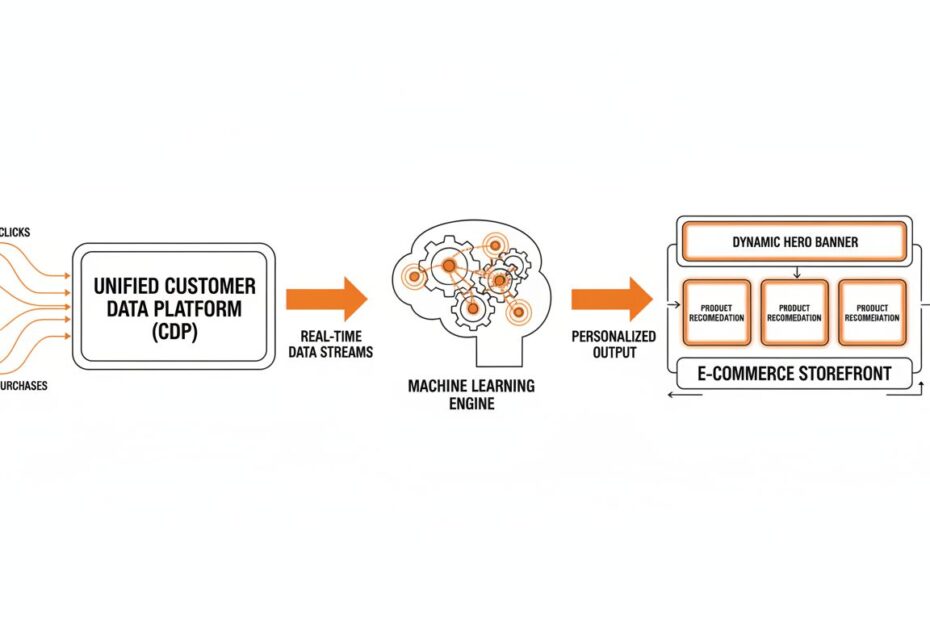
How AI Powers Real-Time Personalization
Real-time personalization is the digital equivalent of a knowledgeable sales associate who remembers your preferences, watches your current shopping behavior, and immediately offers exactly what you need before you ask. Unlike traditional segmentation that assigns customers to fixed groups based on historical data, AI-driven real-time personalization analyzes live behavioral signals within milliseconds and continuously adjusts the experience.
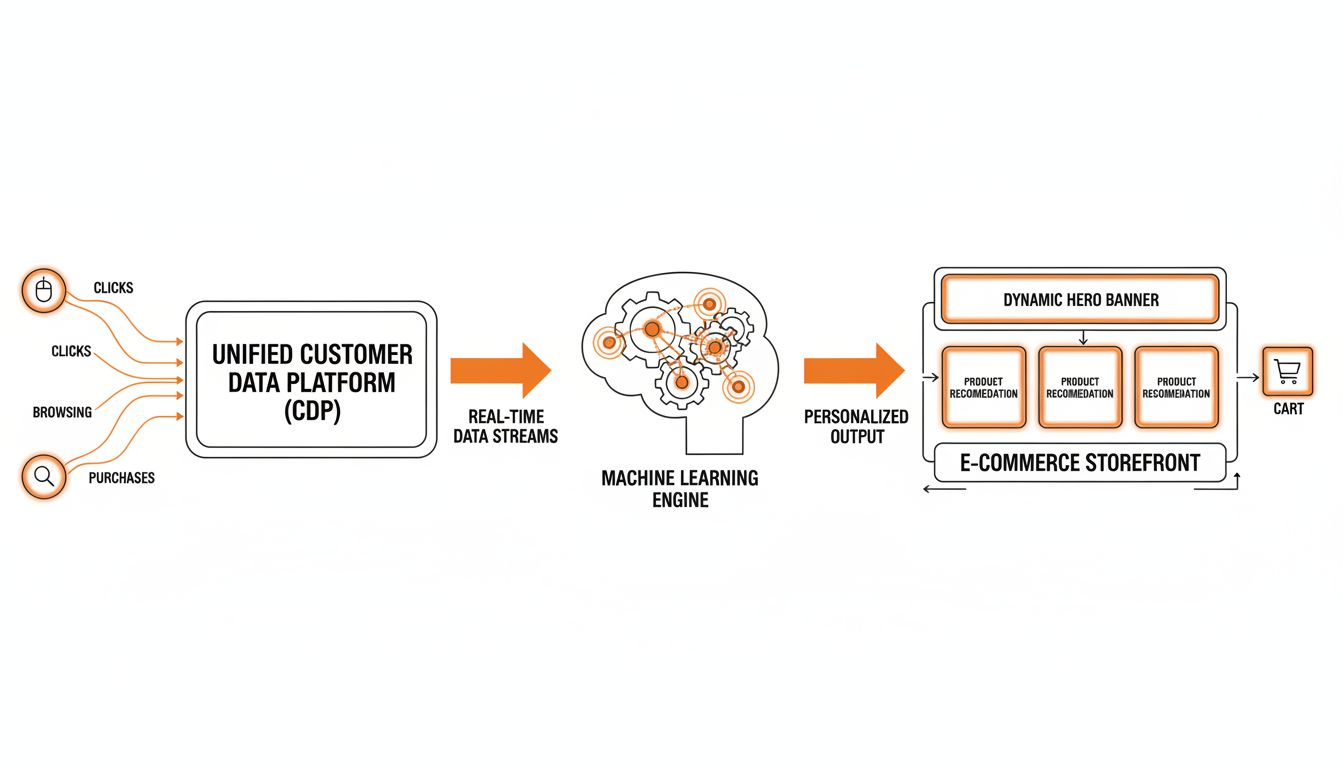
The difference is profound. A customer visits your e-commerce site and searches for winter running shoes. Traditional segmentation shows them the same “Athletic Wear” category page as every other customer in that segment. AI real-time personalization recognizes their current search intent, analyzes their purchase history, evaluates similar customer behaviors, and instantly adjusts the homepage hero banner, product recommendations, and even the sorting order to prioritize winter running shoes. The entire experience transforms while they’re actively browsing.
This capability transforms three critical business metrics: conversion rates increase 15-25 percent because customers see relevant content instantly, average order value improves 8-18 percent through intelligent cross-sell recommendations, and customer lifetime value extends 20-35 percent because personalized experiences build loyalty and reduce churn.
This use case explains how AI powers real-time personalization, the core technical components that enable millisecond-speed adaptation, and how retail and e-commerce brands implement these systems using Bloomreach to drive measurable revenue growth.
The Dawn of Real-Time Engagement: Moving Beyond Rule-Based Triggers
Why Static Rules Fail at Scale
Legacy personalization systems relied on rigid if-then rules: “If a customer clicks the women’s apparel category, show the women’s apparel banner.” These rules were simple to implement but fundamentally inflexible. They treated thousands of customers identically and ignored real-time context.
A customer who typically purchases men’s apparel searches for women’s running shoes as a gift. The rule-based system ignores this intent signal and continues showing men’s products. The customer leaves frustrated, and the retailer misses a cross-category sale.
More critically, rule-based systems don’t scale. Managing thousands of manual rules across hundreds of product categories, customer segments, and behavioral triggers becomes operationally impossible. Rules conflict with each other, create unintended consequences, and require constant manual updates as inventory and seasons change.
The Real-Time Personalization Paradigm Shift
AI-driven real-time personalization replaces rigid rules with fluid, adaptive algorithms. Instead of pre-defining what content to show each segment, machine learning models analyze live customer behavior and dynamically calculate the optimal experience for each individual in the moment.
The system doesn’t wait for a shopping session to end to process data. It ingests behavioral signals in real time: page views, scroll depth, search queries, add-to-cart actions, hover patterns. Within milliseconds, it calculates engagement probability, purchase intent, and the optimal content to display.
This creates a fundamentally different customer experience. Every interaction feels personalized because it is. The system responds to current intent, not historical assumptions.
The Technical Engine: How AI Processes Data in Milliseconds
Component 1: Instantaneous Data Ingestion and Unification
Real-time personalization requires a unified view of each customer built from multiple data sources. A customer’s current session behavior must be instantly combined with their historical purchase data, browsing patterns, email engagement, and customer service interactions.
Traditional data architectures batch-process information at the end of each day. Real-time personalization requires streaming data architecture where information flows continuously into a unified system.
How it works: A customer lands on your website. Within milliseconds, the system:
- Captures their current session signals: page views, scroll depth, time on page, search queries, add-to-cart actions
- Retrieves their historical profile: past purchases, browsing categories, loyalty status, lifetime value
- Identifies their geographic location, device type, and time zone
- Consolidates this data into a unified customer profile
- Passes the profile to the AI engine for real-time decision-making
This entire process completes in 50-200 milliseconds, fast enough that the customer doesn’t perceive any delay.
Component 2: Dynamic Layout and Content Adjustments
Once the AI engine understands the customer’s current context, it alters the digital experience on the fly. This isn’t limited to product recommendations. It includes dynamic changes to:
- Hero banners: The main homepage banner changes based on intent. A customer searching for winter coats sees a winter outerwear banner instead of the default seasonal banner.
- Category sorting: Product category pages automatically reorder products based on the customer’s demonstrated preferences.
- Call-to-action buttons: Button copy, color, and placement adjust based on customer lifecycle stage and engagement history.
- Generative content: Modern AI systems generate personalized product descriptions, email subject lines, and promotional copy that matches the customer’s communication preferences.
Practical example: A customer abandons their cart with a $200 winter coat. They return to the site the next day. The AI engine recognizes the abandonment signal and the high cart value. It dynamically displays a targeted banner offering “Free Shipping on Your Winter Coat Order” with a direct link back to their cart. The homepage layout shifts to prioritize this message.
Component 3: Next-Best-Action Predictors
AI doesn’t just react to what a customer just did. It predicts what they’re likely to do next and deploys interventions proactively.
Machine learning models analyze behavioral patterns to identify risk signals: Is this customer likely to churn? Are they showing signs of purchase intent? Are they frustrated with the browsing experience?
When the system detects a churn signal, like a customer spending excessive time on a cancellation page, it immediately triggers an intervention: a live chat offer, a targeted discount code, or a customer service callback option. This happens within seconds of the signal being detected.
Real-world scenario: A customer has been browsing your site for 8 minutes without finding what they need. The AI engine recognizes this as a “search friction” signal. It immediately triggers a live chat widget with a message: “Looking for something specific? Our team can help.” This proactive intervention recovers customers who would otherwise leave.
Essential Use Cases: Real-Time Personalization in Action
Use Case 1: Predictive Cross-Selling via Real-Time Cart Assistance
What it means: Displaying tailored companion products at the exact moment a customer adds an item to their cart.
Why it matters: Generic checkout cross-sells have historically low conversion rates. A customer adds a winter coat to their cart, and the system suggests random products: socks, hats, gloves, scarves. The customer ignores the recommendations because they’re not relevant.
AI-powered cross-sell recommendations analyze the specific item being purchased, the customer’s historical preferences, and similar customer purchase patterns to suggest highly compatible, high-margin items.
How to apply it: When a customer adds an item to their cart, the AI engine:
- Analyzes the product category and attributes
- Evaluates the customer’s historical purchase patterns in complementary categories
- Identifies similar customer cohorts and their cross-purchase behavior
- Calculates the probability that this customer will purchase each potential cross-sell item
- Ranks recommendations by both conversion probability and profit margin
- Displays the top 3-4 recommendations in a dynamic carousel
Recommended CRM action:
- Inject a dynamic cross-sell carousel into the active side-cart slide-out
- Personalize product recommendations based on the item being purchased
- Adjust offer intensity based on customer lifetime value
- Track cross-sell acceptance rates by product category
- Continuously retrain the recommendation model with conversion data
Business impact: AI-powered cross-sell recommendations increase average order value 8-18 percent compared to generic cross-sells because recommendations match the customer’s demonstrated preferences and purchase history.
Use Case 2: Intent-Driven Content Shifts for Dynamic Browsing Behavior
What it means: Overriding historical customer baselines when a shopper exhibits an immediate seasonal or situational intent shift.
Why it matters: A customer who exclusively purchases men’s apparel suddenly searches for women’s athletic wear in December. Traditional segmentation continues showing them men’s products because that’s their historical category. The system misses the gift-buying intent.
Real-time intent detection recognizes this shift within milliseconds and adjusts the entire experience for the remainder of the session.
How to apply it: The system monitors real-time keyword parsing and click velocity:
- A customer searches for “women’s running shoes” (keyword signal)
- They spend 3 minutes browsing women’s athletic wear (velocity signal)
- The system recognizes this as a genuine intent shift, not a random browse
- It immediately adjusts homepage banners, category sorting, and recommendation widgets to prioritize women’s athletic products
- This personalization applies only to the current session; the customer’s historical profile remains unchanged
Recommended CRM action:
- Implement real-time keyword and click-pattern monitoring
- Create dynamic content blocks that can shift based on session intent
- Establish confidence thresholds to avoid over-reacting to random clicks
- Track conversion rates for intent-shifted sessions versus baseline
- Monitor for seasonal patterns in intent shifts (gift buying, travel, etc.)
Business impact: Intent-driven personalization increases conversion rates for dynamic browsing sessions 18-28 percent and reduces time-to-purchase by an average of 2-3 minutes.
Use Case 3: Churn Prevention Through Behavioral Risk Scoring
What it means: Identifying customers showing early warning signs of churn and automatically deploying targeted retention offers before they leave.
Why it matters: A loyal customer who purchases monthly suddenly goes silent for 45 days. Traditional segmentation doesn’t flag this as a churn risk until the customer has already unsubscribed. By then, it’s too late to intervene.
AI churn prediction models identify customers showing behavioral decline and trigger automated retention workflows.
How to apply it: The system continuously calculates churn risk scores by analyzing:
- Purchase frequency decline (decreased from 4 purchases per month to 0)
- Email engagement drop (open rates declining over past 30 days)
- Website visit frequency (reduced from 3 visits per week to 0)
- Support ticket sentiment (increased complaints or refund requests)
- Browse-to-buy ratio (browsing without purchasing)
When a customer’s churn risk score exceeds a threshold, the system automatically triggers a retention SMS or email with a personalized offer.
Recommended CRM action:
- Calculate churn risk scores for all customers weekly
- Establish segment-specific churn thresholds (high-value customers trigger at lower risk scores)
- Create automated retention workflows triggered by churn signals
- Personalize retention offers based on customer purchase history and price sensitivity
- Track win-back rates by segment to optimize retention strategy
- Monitor for false positives (customers flagged as churned who actually purchased)
Business impact: Proactive churn prevention recovers 12-22 percent of at-risk customers who would otherwise leave, protecting customer lifetime value and reducing acquisition costs.
The Foundational Trap: Common Real-Time Personalization Mistakes
Mistake 1: Fragmented Data Across Silos
The problem: Customer data lives in disconnected systems. E-commerce purchase data sits in your order management system. Website browsing behavior lives in your analytics platform. Email engagement data is in your email service provider. SMS interactions are in a separate SMS platform.
When you try to personalize based on this fragmented data, the AI engine only sees partial information. It makes decisions without knowing the customer’s complete context.
The solution: Implement a unified Customer Data Platform that consolidates data from all sources in real time. The CDP maintains a Single Customer View that updates automatically when customers interact with your brand across any channel.
Mistake 2: Over-Personalization That Feels Creepy
The problem: AI makes it easy to track and reference detailed customer behavior. A customer searches for a specific health product, and the system immediately displays targeted ads referencing that search. The customer feels surveilled, not valued.
Over-personalization damages trust and triggers privacy concerns.
The solution: Establish clear guardrails on personalization intensity. Avoid referencing sensitive categories (health, financial, personal care) unless the customer has explicitly engaged with that category. Focus personalization on product preferences and purchase history rather than behavioral surveillance.
Mistake 3: Recommending Out-of-Stock Products
The problem: AI recommendation engines operate on historical data. A product was popular 2 weeks ago, so the system recommends it today. But the product sold out yesterday. The customer clicks the recommendation and finds a “out of stock” message, damaging trust in the personalization system.
The solution: Connect the AI recommendation engine directly to your inventory management system. Real-time inventory feeds ensure recommendations only include in-stock products. If a popular product is out of stock, the system recommends the closest alternative.
Powering Instant Personalization with Bloomreach Engagement and Loomi AI
Bloomreach Engagement is the industry-leading platform for executing real-time personalization at scale. The platform unifies customer data, powers AI-driven personalization, and measures multi-touch ROI in a single interface.
How Bloomreach Delivers Real-Time Personalization
Single Customer View (SCV): Bloomreach consolidates data from e-commerce platforms, SMS services, email providers, mobile apps, web analytics, point-of-sale systems, and CRM tools into a unified customer profile. This SCV updates in real time as customers interact with your brand.
Loomi AI for Dynamic Personalization: Bloomreach Loomi AI is a retail-specific machine learning engine that powers real-time personalization. Loomi AI:
- Analyzes customer behavior in real time
- Predicts next-best actions and optimal content for each customer
- Generates personalized product recommendations
- Calculates churn risk scores and triggers retention workflows
- Optimizes send-time strategies for email and SMS
- Personalizes dynamic content blocks across web and mobile channels
Behavioral Triggers: Bloomreach enables marketers to build sophisticated workflows triggered by real-time customer actions. When a customer abandons a high-value cart, Bloomreach immediately triggers a personalized recovery message. When a customer’s churn risk score exceeds a threshold, Bloomreach deploys a targeted retention offer.
Dynamic Content Blocks: Bloomreach marketers design dynamic content blocks that automatically insert personalized offers, product recommendations, and copy based on customer data. You design the template once, and Bloomreach personalizes it for every customer.
Multi-Channel Orchestration: Bloomreach orchestrates personalized experiences across web, email, SMS, push notifications, and in-app messaging. The platform ensures consistent messaging and optimal channel selection for each customer.
Why Bloomreach for Real-Time Personalization
Bloomreach eliminates the operational friction that plagues traditional personalization stacks. Instead of integrating a separate CDP, marketing automation platform, analytics tool, and compliance system, Bloomreach consolidates these capabilities into a single platform.
Loomi AI is purpose-built for retail, understanding retail-specific behaviors: seasonal demand patterns, product affinity, purchase frequency variation, and customer lifecycle stages. The AI model improves continuously as it processes more customer interactions.
Data, Tools, and Teams Required for Real-Time Personalization
Essential Customer Data for Real-Time Personalization
Effective AI-driven real-time personalization requires unified customer data including:
- Current session behavior: Page views, scroll depth, search queries, add-to-cart actions, product views, time on page, hover patterns
- Historical purchase data: Order history, order dates, order values, product categories purchased, price points, repeat purchase intervals
- Engagement signals: Email opens and clicks, SMS clicks and conversions, website visits, app logins, push notification engagement
- Lifecycle indicators: Customer tenure, lifetime value, purchase frequency, average order value, churn risk score, segment membership
- Channel interactions: Mobile app activity, website sessions, email engagement, SMS engagement, push notification engagement
- Contextual data: Device type, operating system, location, time zone, traffic source, campaign interaction history
Technology Stack for Real-Time Personalization
| Component | Purpose | Key Capabilities |
|---|---|---|
| Customer Data Platform (CDP) | Unify data from all sources into Single Customer View | Real-time data consolidation, identity resolution, audience segmentation, streaming data ingestion |
| AI Personalization Engine | Calculate optimal personalization for each customer | Real-time intent detection, churn prediction, recommendation generation, next-best-action modeling |
| Marketing Automation | Execute personalized experiences across channels | Behavioral triggers, dynamic content blocks, multi-channel orchestration, frequency capping |
| Analytics & Reporting | Measure campaign performance and ROI | Conversion tracking, attribution analysis, segment performance metrics, incrementality testing |
| Inventory Management Integration | Ensure recommendations reflect current stock | Real-time product availability, out-of-stock prevention, alternative product suggestions |
Teams and Responsibilities
- CRM Manager: Oversee customer data quality, segment definitions, and campaign configuration
- E-commerce Manager: Define personalization priorities, monitor conversion metrics, optimize product recommendations
- Performance Analyst: Track campaign performance, identify optimization opportunities, measure incremental ROI
- Data Engineer: Maintain data pipelines, ensure real-time data consolidation, integrate systems
- Marketing Operations: Manage platform configurations, troubleshoot issues, optimize workflows
- CMO/Director: Set strategic priorities, allocate budget, define success metrics
How to Measure Success
Core Personalization Metrics
Engagement metrics:
- Click-through rate on personalized recommendations
- Conversion rate from personalized experiences
- Average order value for customers receiving personalization
- Customer lifetime value by personalization segment
- Unsubscribe rate and list health
Operational metrics:
- Personalization engine uptime and latency
- Data consolidation latency (time from customer action to personalized experience delivery)
- Recommendation accuracy (percentage of recommendations that result in clicks or conversions)
- Real-time data freshness (percentage of customer profiles updated within last 5 minutes)
Business Outcome Metrics
Revenue metrics:
- Incremental revenue from personalized experiences (personalization segment vs. control segment)
- Average order value lift from AI cross-sell recommendations
- Revenue per customer from dynamic pricing optimization
- Customer lifetime value by personalization segment
Efficiency metrics:
- Conversion rate improvement from real-time personalization
- Time-to-purchase reduction from intent-driven personalization
- Cart abandonment rate improvement from dynamic interventions
- Customer acquisition cost reduction from improved retention
Measurement Framework
Phase 1 (Baseline): Measure current performance without real-time personalization. Track conversion rates, average order value, and customer lifetime value by segment.
Phase 2 (Pilot): Implement real-time personalization for a test segment (20-30 percent of traffic) while maintaining traditional experiences for a control group (70-80 percent). Measure lift in conversion rates, average order value, and other key metrics.
Phase 3 (Scale): Expand real-time personalization to 100 percent of traffic and measure sustained performance improvements. Monitor for model drift or data quality issues that might cause performance degradation.
How Voxwise Can Help
Voxwise is a B2B consulting and implementation partner specializing in CRM, customer engagement, customer data, and marketing automation for retail and e-commerce brands.
Voxwise Services for Real-Time Personalization
Customer Data Assessment: Voxwise evaluates your current data architecture to identify gaps preventing unified customer views. We assess data quality, integration completeness, and readiness for real-time personalization.
Personalization Strategy: Voxwise designs real-time personalization strategies aligned with your business goals. We identify high-impact use cases, define personalization tactics, and establish measurement frameworks.
Bloomreach Implementation: Voxwise partners with Bloomreach to implement unified customer data platforms and AI-driven real-time personalization. We configure customer segments, train Loomi AI models, set up behavioral triggers, and establish measurement dashboards.
Dynamic Content Configuration: Voxwise designs sophisticated dynamic content blocks and personalization workflows that leverage Bloomreach capabilities across web, email, SMS, and mobile channels.
Performance Optimization: Voxwise continuously optimizes your personalization program. We analyze campaign performance, identify bottlenecks, recommend workflow adjustments, and measure incremental ROI improvements.
Team Training: Voxwise trains your marketing, operations, and analytics teams on real-time personalization strategy, Bloomreach platform usage, and measurement best practices.
Frequently Asked Questions
What is the difference between real-time personalization and traditional segmentation?
Traditional segmentation assigns customers to fixed groups based on historical attributes and sends identical messages to each group. Real-time personalization analyzes live customer behavior and dynamically adjusts the experience for each individual in the moment. Real-time personalization is fluid and responsive; traditional segmentation is static and batch-oriented.
How does AI process customer data in milliseconds?
Real-time personalization uses streaming data architecture where behavioral signals flow continuously into a unified Customer Data Platform. The CDP consolidates this information with historical customer data and passes the unified profile to the AI engine. The engine calculates personalization decisions and delivers them to web, email, SMS, and mobile channels within 50-200 milliseconds.
What data signals are required to personalize a website homepage in real time?
Essential signals include current session behavior (page views, search queries, time on site), historical purchase data (categories purchased, price points, repeat purchase intervals), customer attributes (lifecycle stage, lifetime value, geography), and engagement history (email opens, SMS clicks, website visits). The more complete the data, the more accurate the personalization.
How does dynamic content adjustment prevent cart abandonment?
When a customer abandons their cart, the AI engine recognizes the abandonment signal and the cart value. It calculates the optimal intervention: a personalized email offer, an SMS reminder with a discount code, or a live chat outreach. Dynamic content adjusts based on the customer’s historical engagement preferences and price sensitivity, increasing the likelihood they’ll return to complete the purchase.
Conclusion
Real-time personalization powered by AI represents a fundamental shift in how retail and e-commerce brands engage customers. Machine learning models analyze live customer behavior, predict optimal experiences, and adjust layouts, recommendations, and messaging within milliseconds.
The business impact is substantial. Conversion rates increase 15-25 percent because customers see relevant content instantly. Average order value improves 8-18 percent through intelligent cross-sell recommendations. Customer lifetime value extends 20-35 percent because personalized experiences build loyalty and reduce churn.
Bloomreach Engagement, powered by Loomi AI, is the leading platform for executing real-time personalization at scale. Voxwise helps retail and e-commerce brands implement real-time personalization strategies, configure Bloomreach, optimize performance, and measure incremental revenue impact.
Explore More With Voxwise
Discover how real-time personalization and advanced customer data strategies can transform your conversion rates, average order value, and customer lifetime value. Voxwise specializes in helping retail and e-commerce brands implement AI-driven personalization, optimize their CRM infrastructure, and maximize marketing ROI.