Bloomreach Engagement for CRM Automation: The Ultimate B2C Guide
Most enterprise retailers operate with fragmented customer engagement stacks that create operational friction at every level. Your customer data lives in one system, your email automation runs in another, and your SMS campaigns execute through a third platform entirely. This architectural fragmentation introduces data latency, requires constant manual synchronization between tools, and forces your teams to maintain expertise across disparate interfaces. The result is slower campaign execution, missed real-time engagement opportunities, and difficulty measuring true incremental revenue impact from your CRM investments.

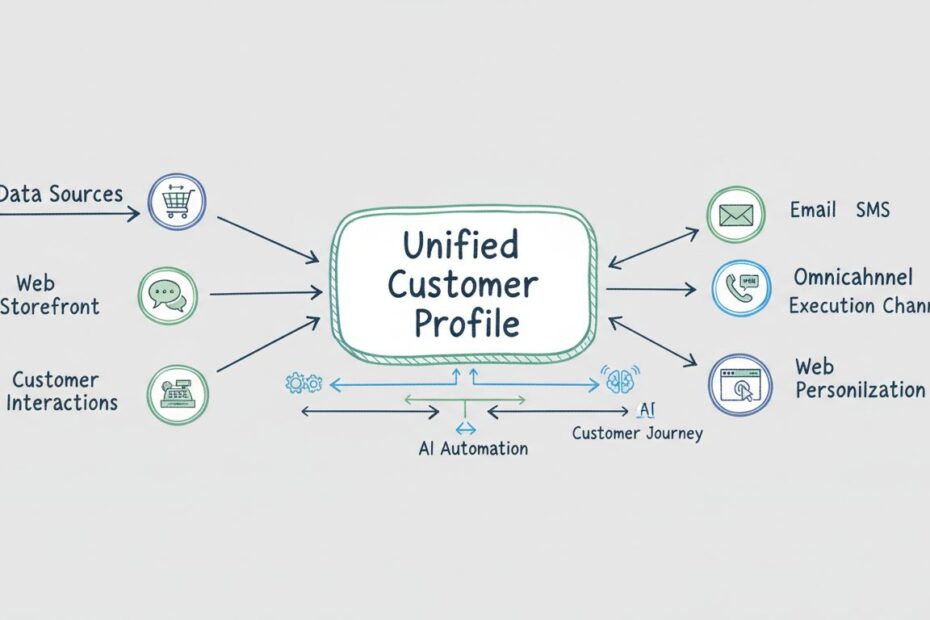
Bloomreach Engagement solves this structural problem by unifying your entire customer data and automation environment into a single, real-time operating system. Unlike legacy CRM platforms that treat data warehousing and marketing execution as separate concerns, Bloomreach Engagement integrates an enterprise-grade Customer Data Platform (CDP) directly with native omnichannel automation and autonomous AI capabilities. This architectural advantage eliminates data synchronization delays, enables immediate customer journey responses, and provides native measurement frameworks to prove campaign lift.
Use Case Overview
Bloomreach Engagement for CRM Automation addresses the core business challenge facing growth-oriented retail brands: how to execute complex, personalized customer journeys at scale without the operational overhead and data latency inherent in traditional marketing stacks. The platform serves as a unified environment where customer data ingestion, real-time segmentation, AI-powered journey optimization, and multi-channel execution all operate within a single system.
This use case applies directly to retailers and e-commerce businesses managing high-volume customer bases where timing, personalization accuracy, and campaign efficiency determine competitive advantage. When your brand operates across multiple sales channels, serves diverse customer segments, and requires rapid response to behavioral signals, Bloomreach Engagement’s unified architecture becomes the operational foundation for scaling customer engagement revenue.
When This Use Case Matters
Bloomreach Engagement CRM automation becomes strategically essential in specific operational scenarios. Your organization benefits most when you operate at a scale where manual campaign management becomes inefficient, where data latency between systems creates measurable revenue leakage, or where your current marketing stack requires constant engineering effort to maintain data synchronization between platforms.
The use case is particularly relevant when your business model depends on repeat customer purchases, subscription renewals, or loyalty program engagement. Brands managing consumable products, fashion inventory with seasonal cycles, or subscription services see immediate ROI from Bloomreach’s predictive automation capabilities. Additionally, if your organization has invested in first-party customer data collection but struggles to activate that data across marketing channels efficiently, Bloomreach Engagement directly addresses that activation gap.
The platform also matters when your current CRM setup requires significant manual intervention to execute sophisticated customer journeys. If your marketing team spends more time managing tools and data synchronization than designing customer experiences, Bloomreach’s unified environment reduces operational overhead substantially.
How It Works in Practice
Bloomreach Engagement operates on a fundamentally different architecture than traditional CRM systems. Instead of separating data storage from marketing execution, the platform combines real-time customer data processing with native omnichannel automation within a single NoSQL infrastructure. This design choice directly enables speed and efficiency.
Data ingestion happens continuously through multiple sources. Your website tracking via JavaScript SDK captures real-time behavioral events like product views, add-to-cart actions, and purchases. Point-of-sale systems feed transaction data. Customer service interactions, email engagement signals, and mobile app events all flow into the same unified customer profile. The platform processes this data in real-time, meaning your automation systems respond to customer behavior within seconds, not hours or days.
Customer unification creates a single 360-degree profile for each customer that combines all these data sources. Rather than maintaining separate customer records across email, SMS, and web personalization systems, Bloomreach maintains one authoritative customer record enriched with all available attributes, behavioral history, and computed loyalty metrics. This unified view becomes the foundation for all downstream automation.
Real-time segmentation allows your marketing teams to define customer groups based on live behavioral data without batch processing delays. You can segment customers by purchase frequency, product affinity, browsing behavior, engagement history, and computed predictive scores, all updated in real-time. These segments automatically update as customer behavior changes, ensuring your automation always targets the right audience.
Autonomous Loomi AI introduces intelligent optimization into your workflows. Rather than manually configuring send times, content variations, and channel selection, Loomi AI agents analyze customer behavior patterns and automatically optimize these elements. The system learns which customers prefer email versus SMS, identifies the optimal send time for each individual based on their historical engagement patterns, and personalizes content recommendations based on product affinity and browsing history.
Omnichannel execution delivers personalized messages across email, SMS, mobile push, and on-site web experiences from a single campaign interface. You design one customer journey, and the platform intelligently routes messages across channels based on customer preference and engagement patterns. This consistency across touchpoints strengthens brand messaging and eliminates the channel fragmentation that weakens traditional multi-tool approaches.
Example Scenario in Retail and E-Commerce
Consider a mid-market fashion retailer managing 500,000 active customers across online and physical stores. Their current marketing stack uses a legacy CRM for customer data, Mailchimp for email, Twilio for SMS, and a separate web personalization tool. Campaign execution requires manual data exports, mapping between systems, and three separate team members coordinating across platforms. A campaign that should launch in two days takes a week.
With Bloomreach Engagement, this retailer consolidates their entire operation into one platform. Customer data flows in real-time from their e-commerce platform, in-store POS system, and mobile app. Their marketing team defines a single “VIP Win-Back” journey that automatically triggers when high-value customers exceed their typical purchase interval. The journey includes a personalized SMS alert on day one, a targeted email on day three featuring products matching their historical purchase preferences, and a 15% loyalty voucher automatically distributed within the journey. Loomi AI optimizes send times for each customer based on their historical engagement patterns.
The same unified system tracks campaign performance. The platform automatically creates holdout control groups to measure true incremental lift. The retailer discovers that their win-back journey recovers 22% of at-risk high-value customers, generating approximately $180,000 in incremental annual revenue from this single automated workflow. They can now measure this impact directly because all data and execution occurs within one system.
Data, Tools, and Teams Involved
Successful Bloomreach Engagement implementation requires coordinated effort across multiple organizational functions. Data engineering teams manage the initial data integration, ensuring that customer data from all sources (website, POS, ERP, support systems) flows cleanly into Bloomreach. They configure JavaScript SDK implementation on the website, manage API connections to backend systems, and establish data quality standards.
Marketing operations teams design customer journeys and manage campaign execution. They define segmentation logic, configure automation rules, and monitor campaign performance. With Loomi AI handling optimization, their focus shifts from manual campaign tweaking to strategic journey design.
Analytics teams establish measurement frameworks and track campaign incrementality. They configure holdout control groups, analyze cohort performance, and connect campaign metrics to business outcomes. Bloomreach’s native analytics dashboard provides the data layer, but analytics expertise ensures metrics connect to business objectives.
CRM managers oversee the overall customer engagement strategy and ensure alignment between automation workflows and business priorities. They coordinate between marketing, analytics, and technical teams to maximize platform ROI.
Voxwise consultants bridge strategy and technical implementation. They audit your current customer data infrastructure, design sophisticated segmentation strategies, optimize Bloomreach configurations for your specific business model, and establish governance frameworks to ensure long-term platform success.
| Role | Responsibility | Key Deliverable |
|---|---|---|
| Data Engineering | Source integration, data quality, API management | Clean, real-time data flows |
| Marketing Operations | Journey design, segmentation logic, campaign execution | Active customer journeys |
| Analytics | Measurement framework, control groups, lift analysis | Incremental revenue reporting |
| CRM Management | Strategy alignment, ROI optimization, team coordination | Business impact metrics |
| Voxwise Consulting | Architecture design, implementation, optimization | Maximized platform ROI |
How to Measure Success
Effective measurement distinguishes between operational metrics and true business impact. Operational metrics track campaign execution: email open rates, SMS delivery rates, push notification click-through rates, and journey enrollment numbers. These metrics confirm that your automation is functioning, but they don’t prove business value.
Incremental revenue metrics measure true business impact. Bloomreach’s native holdout control group functionality enables this measurement. You automatically withhold a percentage of eligible customers from each campaign, then compare their behavior to the treatment group. The difference represents true incremental lift. A win-back campaign might show 8% overall conversion lift, but after accounting for the holdout control group, the true incremental lift might be 4%. That 4% represents the revenue you would not have captured without the campaign.
Customer lifetime value (CLV) impact tracks longer-term outcomes. Automated retention journeys don’t just recover immediate sales; they strengthen customer relationships and increase future purchase likelihood. Cohort analysis comparing customers enrolled in retention journeys to non-enrolled cohorts reveals CLV improvements over 6, 12, and 24-month periods.
Cost-per-acquisition efficiency measures the marketing spend required to achieve incremental customer acquisition or reactivation. Calculate total campaign costs (platform subscription, team labor, promotional incentives) divided by incremental customers acquired. Compare this to your customer lifetime value to determine ROI.
Churn reduction metrics track the percentage of high-value customers retained through automated win-back and retention journeys. A 5% improvement in retention of your top-tier customers might represent hundreds of thousands in incremental annual revenue.
Portfolio-level incrementality aggregates incremental lift across all active automation journeys. Rather than measuring individual campaigns in isolation, calculate total incremental revenue generated by your entire Bloomreach automation ecosystem. This metric demonstrates the combined business impact of your CRM automation investment.
How Voxwise Can Help
Voxwise specializes in bridging the gap between Bloomreach Engagement’s technical capabilities and your specific business objectives. Our CRM consulting and implementation expertise ensures your platform deployment maximizes commercial yield from day one.
Platform optimization begins with a comprehensive audit of your current customer data infrastructure. We evaluate your tracking implementation, data quality, and existing segmentation logic. We identify gaps between your current capabilities and Bloomreach’s potential, then design a phased implementation roadmap that prioritizes high-impact use cases first.
Segmentation strategy design translates your business objectives into sophisticated customer segments. Rather than basic demographic or purchase-history segmentation, we architect behavioral and predictive segmentation models that unlock Bloomreach’s full automation potential. We design RFM-based VIP identification, product-affinity clustering, churn-risk scoring, and predictive replenishment triggers customized to your business model.
Journey architecture transforms segmentation strategy into executable customer workflows. We design multi-touch, multi-channel journeys that respond to real-time customer behavior. We establish branching logic that routes customers into different paths based on their attributes and actions. We configure autonomous Loomi AI optimization to enhance performance continuously.
Data governance and quality establishes frameworks ensuring data accuracy, compliance, and consistency across all sources. We implement data validation rules, establish data ownership accountability, and create documentation standards that enable your team to maintain data quality independently.
Measurement framework design ensures you capture true business impact from your automation investment. We establish control group methodology, define incremental lift calculations, and configure reporting dashboards that connect campaign metrics to revenue impact. We help your analytics team interpret results and translate insights into optimization actions.
Team enablement transfers platform expertise to your internal team through training, documentation, and ongoing support. Your marketing operations team learns journey design best practices. Your analytics team understands measurement methodology. Your CRM leadership understands how to evolve your automation strategy as business priorities change.
FAQ
What is Bloomreach Engagement for CRM automation?
Bloomreach Engagement is a unified Customer Data Platform (CDP) combined with native omnichannel marketing automation and autonomous AI capabilities. Unlike traditional CRM systems that separate data storage from marketing execution, Bloomreach integrates all customer data, segmentation, journey automation, and multi-channel execution within a single real-time operating system. This architecture eliminates data latency and enables sophisticated automated customer journeys at scale.
How does a real-time CDP layer improve automated campaigns compared to standard CRM setups?
Traditional CRM systems batch-process customer data, creating delays between when a customer takes an action and when your automation system responds. Real-time CDPs like Bloomreach Engagement update customer profiles and trigger automations within seconds of behavioral events. This speed advantage enables immediate responses to customer intent signals. A customer abandoning a high-value cart receives a recovery message within minutes rather than hours. A customer reaching a replenishment threshold receives a reminder at the precise moment of highest purchase intent. This real-time responsiveness directly increases conversion rates and customer lifetime value.
What are the four core data elements utilized in Bloomreach’s database architecture?
Bloomreach’s data model organizes around four foundational elements: Customers (individual profiles containing cross-channel identifiers, attributes, and computed metrics), Events (time-stamped behavioral actions like purchases, browsing, and email engagement), Catalogs (real-time inventory databases containing SKU data, pricing, and availability), and Vouchers (automated loyalty incentive pools that distribute promotional codes within running customer journeys). This structure enables rapid data access and real-time automation execution.
How does Loomi AI eliminate manual campaign optimization for marketing teams?
Loomi AI agents automatically optimize key campaign elements that traditionally require manual configuration. The system learns individual customer preferences for communication channels and automatically routes messages to preferred channels. It analyzes historical engagement patterns to determine optimal send times for each customer. It personalizes content recommendations based on product affinity and browsing history. Rather than your team manually testing send times and content variations, Loomi AI continuously optimizes these elements, freeing your team to focus on strategic journey design rather than tactical optimization.
What is the business value of predictive replenishment automation in e-commerce?
Predictive replenishment automation uses historical purchase intervals and product consumption patterns to identify exactly when a customer will exhaust a previously purchased consumable product. Automated reminders delivered at this precise moment capture the customer at peak purchase intent, before they discover competitor alternatives. For consumable categories like beauty, vitamins, or household supplies, this automation increases repeat purchase rates by 15-25%, reduces customer acquisition costs by extending customer lifetime value, and stabilizes demand forecasting accuracy.
Why are native holdout control groups necessary to measure true CRM campaign lift?
Without control groups, campaign metrics reflect both the impact of your automation and the impact of external factors (seasonality, competitive activity, economic conditions). A campaign showing 8% conversion lift might actually deliver only 3% true incremental lift if 5% of customers would have converted anyway. Native holdout control groups automatically withhold a percentage of eligible customers from campaigns, creating a statistically valid comparison group. The difference between treatment and control groups represents true incremental impact attributable to your campaign. This measurement rigor proves ROI to executive stakeholders and identifies which automations deliver genuine business value.
How does Voxwise help retail brands optimize their Bloomreach Engagement configurations?
Voxwise provides end-to-end CRM consulting and implementation services specialized in Bloomreach Engagement. We audit your current customer data infrastructure and identify optimization opportunities. We design sophisticated segmentation strategies that unlock Bloomreach’s automation potential. We architect multi-touch customer journeys optimized for your specific business model. We establish measurement frameworks that connect campaign metrics to incremental revenue impact. We enable your internal team through training and documentation. Our expertise ensures your Bloomreach investment delivers maximum commercial yield.
Conclusion
Bloomreach Engagement represents a fundamental shift in how enterprise retailers approach customer engagement. By unifying customer data, real-time segmentation, autonomous AI optimization, and omnichannel execution within a single platform, Bloomreach eliminates the operational friction and data latency that constrain traditional CRM systems. The architectural advantage translates directly into competitive benefits: faster campaign execution, more accurate personalization, and measurable incremental revenue impact.
The business case is clear. Retailers implementing sophisticated CRM automation through Bloomreach Engagement recover at-risk customers through targeted win-back journeys, increase repeat purchase rates through predictive replenishment automation, and optimize cart recovery through dynamic abandoned checkout workflows. These aren’t theoretical benefits; they’re measurable outcomes delivered through unified platform architecture.
Your competitive advantage depends on how effectively you activate your customer data into personalized experiences. Bloomreach Engagement provides the platform foundation. Voxwise provides the expertise to maximize that foundation’s commercial yield. Together, they enable your organization to scale sophisticated customer engagement at the operational efficiency and revenue impact that define market leadership.
Explore CRM Automation Solutions
Ready to transform your customer engagement strategy? Discover how Bloomreach Engagement and expert implementation can drive measurable revenue growth through sophisticated CRM automation. Voxwise specializes in architecting customer data and automation strategies that maximize platform ROI for growth-oriented retail and e-commerce brands.
Request a 30-Minute Customer Engagement Consultation to discuss your segmentation and personalization strategy with our team.
Get a CRM Maturity Check to understand where your current capabilities stand and what optimization opportunities exist.
Check Your Bloomreach Setup if you already have the platform in place and want to optimize execution.