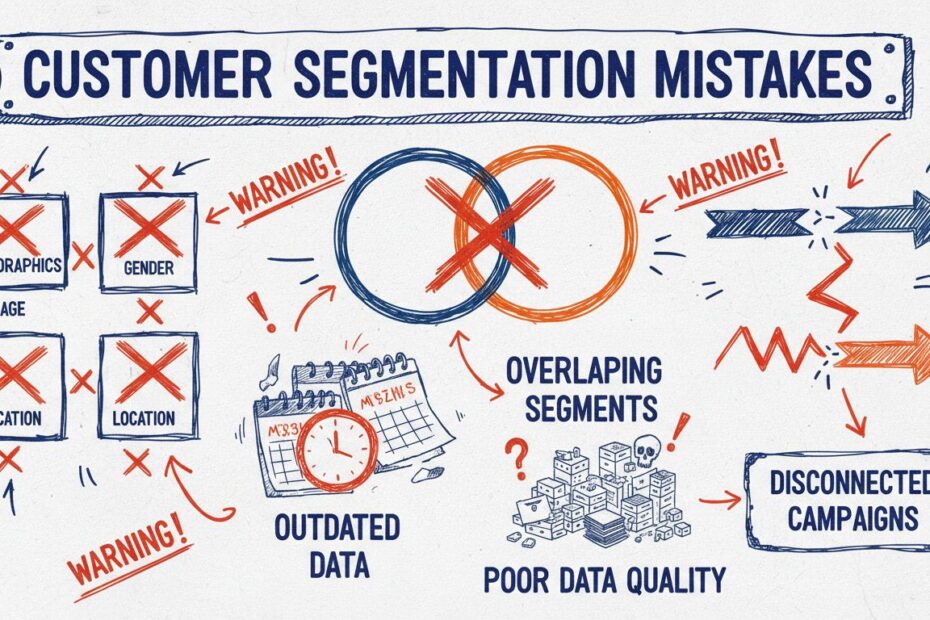
Common Mistakes That Kill Your Segmentation
Customer segmentation is one of the most powerful tools available to retail and e-commerce brands, yet it remains one of the most commonly executed poorly. Many teams invest significant resources building segments, only to find that campaigns don’t perform better, personalization feels generic, and retention rates don’t improve. The problem is rarely that segmentation is a bad idea—it’s that the execution breaks down at critical points.

Companies either segment based on incomplete data, create segments that are too broad to be meaningful, fail to activate them in actual campaigns, or treat them as static lists that never evolve. Understanding these mistakes and how they damage your CRM performance is the first step toward building segmentation that actually drives results.
Why Customer Segmentation Often Fails
Segmentation by itself creates no value. A beautifully detailed segment sitting in a spreadsheet does nothing for your business. Segmentation only becomes valuable when it guides better decisions, enables more relevant messaging, improves personalization, increases retention, and drives revenue. Many segmentation initiatives fail because teams focus on creating segments without connecting them to business goals, campaign actions, or measurement.
The result is that segments remain theoretical exercises rather than operational tools that shape customer experience and marketing performance. When segments are disconnected from your CRM platform, marketing automation, or customer engagement system, they cannot be activated across channels. When they’re based on poor data, they produce incorrect targeting. When they’re too broad, they still feel generic to customers.
When they’re static, they quickly become outdated as customer behavior changes. The good news is that these failures are preventable. Each mistake has a clear fix, and brands that address them see measurable improvements in campaign performance, customer lifetime value, and retention.
Quick Overview of Common Segmentation Mistakes
The most damaging customer segmentation mistakes fall into several categories: data quality, segment definition, activation, and measurement. Data quality mistakes include relying on incomplete or outdated customer information, failing to unify customer profiles across channels, and not enriching data with behavioral signals. Segment definition mistakes include relying only on demographics, creating segments that are too broad or too narrow, and creating segments without a clear business objective.
Activation mistakes include building segments that cannot be used in campaigns, treating segments as static lists, and failing to connect segments to a customer engagement platform. Measurement mistakes include not tracking segment performance and not adjusting strategies based on results. The table below summarizes the most common mistakes and their fixes.
| Mistake | Why It Happens | Impact on Performance | How to Fix It |
|---|---|---|---|
| Relying only on demographics | Easy to access data; familiar approach | Segments feel generic; no behavioral insight | Layer demographics with purchase history, engagement, and lifecycle data |
| Creating segments too broad | Simplifying complexity; unclear objectives | Messages still feel generic; poor personalization | Create micro-segments around specific behaviors or lifecycle moments |
| Over-segmenting | Trying to capture every variation | Complexity, slow execution, analysis paralysis | Focus on high-impact segments that are large enough to manage and measure |
| Using poor or outdated data | Incomplete data collection; no data governance | Wrong targeting; wasted campaigns; poor campaign ROI | Implement data quality checks, unify customer profiles, update dynamically |
| Creating segments without business goals | Segmenting because data is available | Segments don’t guide decisions or campaigns | Start with business questions (e.g., How do we reduce churn?) |
| Building non-actionable segments | Unclear how to use the segment in campaigns | Segments sit unused; no campaign impact | Every segment needs a clear definition, goal, campaign action, and KPI |
| Treating segments as static lists | One-time segment creation; no updates | Customers in wrong segments; outdated messaging | Use dynamic segments that update based on behavior and lifecycle changes |
| Ignoring purchase behavior | Focusing on profile attributes only | Missing strongest signal of intent and value | Include RFM, purchase frequency, category interest, and repeat behavior |
| Ignoring engagement levels | Treating all customers the same | High unsubscribe rates, deliverability issues | Segment by engagement and adjust frequency, content, and channel |
| Not prioritizing high-value customers | All customers treated equally | Revenue loss from losing VIP customers | Create VIP segments using CLV, RFM, and loyalty data |
| Missing at-risk signals | Identifying churn too late | Customers already inactive before action | Track early risk signals (time since purchase, declining engagement) |
| Same message for every segment | Segments created but not activated | Personalization fails; no campaign lift | Adapt message, offer, timing, and channel by segment |
| Overusing discounts | Default solution for every segment | Margin erosion, training customers to wait | Use different incentives (early access, loyalty, exclusivity) by segment |
| Not measuring performance | No tracking of segment results | Segmentation becomes reporting exercise | Measure conversion, retention, CLV, and revenue by segment |
| Not connecting to a platform | Segments stay in spreadsheets | Cannot activate across channels | Use a customer engagement platform like Bloomreach |
Mistake 1: Relying Only on Demographics
What the mistake is: Many brands segment customers based solely on age, gender, location, or other demographic attributes. This approach treats demographics as the primary segmentation criterion and ignores everything about how customers actually behave, what they buy, or how engaged they are.
Why it happens: Demographic data is often the easiest to collect and the most familiar to marketing teams. It feels intuitive to segment by age group or geography, and it requires minimal technical infrastructure to implement. However, demographic segmentation alone creates broad categories that obscure the real differences in customer behavior and intent.
Why it hurts performance: Two customers in the same age group and city can have completely different purchase behavior, product preferences, engagement levels, and lifetime value. Demographic segmentation produces segments that are too broad to support meaningful personalization. A 35-year-old in New York who shops weekly and spends $500 per month is fundamentally different from a 35-year-old in New York who has never purchased. Yet demographic segmentation puts them in the same group and sends them the same messages. The result is that campaigns feel generic, personalization misses the mark, and message relevance drops significantly.
How to fix it: Layer demographic data with behavioral, transactional, engagement, and lifecycle data. Build segments around purchase history (what customers buy, how often, how much they spend), browsing behavior (product categories they view, time spent on site), email and SMS engagement (open rates, click rates, unsubscribe patterns), lifecycle stage (new, repeat, VIP, dormant), and customer value (CLV, RFM score, predicted future value). The strongest segments combine demographic attributes with behavioral signals. For example, instead of “women aged 25-34,” create “women aged 25-34 who have purchased activewear twice in the last 90 days and open emails at above-average rates.” This segment is specific enough to support targeted messaging and personalization.
Mistake 2: Creating Segments That Are Too Broad
What the mistake is: Broad segments such as “all customers,” “newsletter subscribers,” “young shoppers,” or “people who visited our website” lack specificity and are too general to support meaningful personalization or targeted campaigns.
Why it happens: Teams often start with broad segments because they want to include as many customers as possible or because they lack clarity on how to define more specific groups. Broad segments feel safe—they ensure high reach and don’t risk excluding anyone. However, this approach defeats the purpose of segmentation, which is to enable targeted, relevant messaging.
Why it hurts performance: If a segment includes 80% of your customer base, the message still feels generic to most of them. Broad segments fail to acknowledge the real differences in customer needs, preferences, and behavior. A newsletter subscriber who opened your last email and clicked through is very different from a newsletter subscriber who hasn’t opened anything in six months, yet both are in the same broad segment. When you send the same message to both, one group feels irrelevant and the other feels repetitive. Engagement drops, unsubscribe rates rise, and the campaign fails to drive the behavior you want.
How to fix it: Create segments around specific customer behaviors, needs, or lifecycle moments. Examples of more specific segments include: first-time buyers who have not made a second purchase (target for repeat purchase incentive), VIP customers with declining engagement (target for retention campaign), cart abandoners interested in a specific category (target with product recommendations), loyalty members close to the next tier (target with points incentive), dormant customers with high past value (target for win-back campaign), and customers who viewed a specific product but didn’t purchase (target with personalized recommendation). Each of these segments is large enough to manage and measure, but specific enough that the campaign message can be tailored to their situation.
Mistake 3: Over-Segmenting Customers
What the mistake is: Some teams create too many micro-segments, resulting in dozens or even hundreds of small, difficult-to-manage groups. This leads to complexity, slow campaign execution, and analysis paralysis where teams cannot decide which segments to prioritize.
Why it happens: Teams often over-segment because they want to capture every possible variation in customer behavior or because they have access to many data points and try to use all of them. The logic seems sound—more segments should enable more targeted messaging. However, the operational reality is that managing too many segments becomes unwieldy and expensive. Teams spend more time managing the segments than activating them in campaigns.
Why it hurts performance: Over-segmentation creates complexity without corresponding improvement in campaign performance. Small segments are difficult to measure reliably, require more campaign variants, and may not be large enough to justify the effort. Teams get caught in analysis paralysis, debating which segments to activate first and how to message each one. Campaign execution slows down. Resources are spread too thin. In the worst cases, segments sit unactivated because the team cannot keep up with managing them all.
How to fix it: Focus on a smaller number of high-impact segments that are large enough to manage, measure, and activate in campaigns. Start with foundational segments that align with your business goals: new customers (first purchase in last 30 days), repeat customers (two or more purchases), VIP customers (top 10-20% by CLV), at-risk customers (declining engagement or time since purchase), dormant customers (no purchase in 90+ days), category buyers (interested in specific product categories), and discount-sensitive customers (high redemption rate). This framework is simple enough to operationalize but specific enough to support targeted campaigns. You can always add more segments later as your infrastructure and team capability improve, but start with the segments that will have the biggest impact on retention, revenue, and customer lifetime value.
Mistake 4: Using Poor or Outdated Customer Data
What the mistake is: Segmentation is only as good as the data behind it. When customer data is incomplete, duplicated, outdated, or disconnected across systems, the segments built on that data are unreliable and produce incorrect targeting.
Why it happens: Data quality problems are common in organizations that have grown without investing in data governance. Customer data may be scattered across multiple systems (e-commerce platform, email service provider, CRM, loyalty system, analytics platform). Data may not be unified, so the same customer appears as multiple records. Data may be outdated because it’s not refreshed regularly. Important attributes may be missing because they were never collected. Support systems may have poor data validation, allowing incorrect or incomplete information to be entered.
Why it hurts performance: Poor data quality produces incorrect segments, which produces wasted campaigns. Examples include: customers receive win-back campaigns even though they purchased last week (data not updated), VIP customers are not recognized across channels because they’re not unified in the CRM (duplicate records), loyalty members receive generic messages because their loyalty status isn’t captured in the email system (disconnected data), customers are placed in the wrong lifecycle stage because purchase data is incomplete (missing transactions). Each of these failures damages customer experience and wastes marketing budget.
How to fix it: Implement a data quality program that includes data cleaning, unification, enrichment, and continuous updates. Start by auditing your current customer data: identify duplicate records, incomplete fields, outdated information, and data that’s not syncing across systems. Implement a customer data platform or CDP that unifies customer profiles from all sources (transaction data, email engagement, website behavior, loyalty activity, customer attributes, product category data, consent and preferences). Set up automated data validation rules to prevent bad data from entering the system. Establish a regular data refresh cadence—transaction data should update daily, engagement data should update in real-time, and customer attributes should update whenever they change. Use data enrichment tools to fill gaps in your customer profiles. The investment in data quality pays dividends in segment accuracy, campaign performance, and customer experience.
Mistake 5: Creating Segments Without a Business Goal
What the mistake is: Some teams create segments because the data is available or because they want to explore what’s in their customer database, not because there is a clear business objective or campaign strategy tied to the segment.
Why it happens: Teams sometimes approach segmentation as a data exploration exercise rather than a business strategy exercise. They may have access to rich customer data and want to understand it better. Or they may create segments reactively, without thinking through how the segment will be used. The result is that segments are created without a clear purpose or campaign strategy.
Why it hurts performance: Segments without a business goal do not guide better decisions or improve campaigns. They sit unused in reports or databases. They consume resources to build and maintain but produce no business value. Even if they are eventually activated in campaigns, the lack of a clear goal means the campaign strategy is weak and results are poor.
How to fix it: Start with a business question or objective, not with data exploration. Ask: How can we increase the repeat purchase rate for first-time buyers? Which customers are at highest risk of churning? Which customers should receive VIP treatment? Which customers should not receive discounts because they buy at full price? Which customers are interested in this new product category? Which customers have the highest lifetime value potential? Once you have a clear business question, create a segment that answers that question. Then define the campaign strategy, message, offer, and success metrics. This approach ensures that every segment has a purpose and that resources are invested in segments that will drive business results.
Mistake 6: Creating Segments That Are Not Actionable
What the mistake is: A segment is not useful if the marketing team does not know what to do with it. Many teams create segments that are interesting from a data perspective but cannot be activated in campaigns or used to drive business decisions.
Why it happens: This mistake often happens when segments are created by data analysts without input from the marketing or campaign teams. The segment may be technically correct but defined in a way that doesn’t translate to a campaign action. For example, a segment called “customers with high engagement entropy” is technically precise but doesn’t tell a campaign manager what message to send or what offer to make.
Why it hurts performance: Non-actionable segments do not improve campaigns, personalization, or retention. They sit unused because the campaign team doesn’t know how to activate them. Resources invested in creating the segment are wasted. The business value of segmentation is lost.
How to fix it: Every segment should have a clear definition, a business goal, a campaign action, a message strategy, a channel, and a KPI. For example: Segment name: “At-risk high-value customers” | Definition: Customers with CLV in top 20% but no purchase in last 60 days | Goal: Reduce churn and retain high-value revenue | Campaign action: Personalized retention email sequence with exclusive offer | Message strategy: Acknowledge past value, offer exclusive incentive, make it easy to re-engage | Channel: Email + SMS | KPI: Win-back rate, retained revenue, repeat purchase rate. This level of clarity ensures that the segment can be activated immediately and that success can be measured.
Mistake 7: Treating Segments as Static Lists
What the mistake is: Many brands create segments once and never update them. Customer behavior changes constantly, but static segments do not reflect those changes. A customer who was active last month may be at risk today. A first-time buyer may become a repeat customer. A dormant customer may reactivate.
Why it happens: Teams often treat segmentation as a one-time project rather than an ongoing process. Once segments are created and campaigns are set up, the focus moves to other projects. There is no process or system in place to update segments regularly. Updating segments manually is time-consuming, so it doesn’t happen.
Why it hurts performance: Static segments quickly become outdated and inaccurate. Customers are placed in the wrong segments, receive irrelevant messages, and have poor experiences. A customer who purchased last week may still be in the “dormant” segment and receive a win-back campaign, which feels irrelevant. A customer who just made their second purchase may still be in the “first-time buyer” segment and miss out on repeat customer benefits. Static segments also miss opportunities to catch customers at critical moments—when they become at-risk, when they’re ready to upgrade, when they’re most likely to respond to an offer.
How to fix it: Use dynamic segments that update automatically based on customer behavior and lifecycle changes. Dynamic segments should update based on purchases (recency, frequency, amount), engagement (email opens, clicks, SMS responses), browsing behavior (category views, product searches), loyalty activity (points balance, tier status), lifecycle stage (new, repeat, VIP, dormant, at-risk), and churn risk (predicted probability of churn). Modern customer engagement platforms like Bloomreach support dynamic segmentation, which means segments update in real-time as customer behavior changes. This ensures that customers are always in the right segment and receive relevant messages at the right time. Set up a regular audit cadence (monthly or quarterly) to review segment definitions, membership, and performance, and adjust as needed.
Mistake 8: Ignoring Purchase Behavior
What the mistake is: Some segmentation strategies focus heavily on profile attributes (age, gender, location, interests) while ignoring what customers actually buy, how often they buy, and how much they spend.
Why it happens: Purchase behavior data requires integration from transaction systems, which can be more complex than collecting profile data. Some teams may not have easy access to transaction data or may not understand how to use it for segmentation. However, purchase behavior is one of the strongest signals of customer intent, value, and retention potential, so ignoring it is a significant missed opportunity.
Why it hurts performance: Purchase behavior is one of the strongest predictors of future behavior. A customer who buys weekly is fundamentally different from a customer who buys once a year. A customer who spends $1,000 per year is different from a customer who spends $100 per year. A customer who buys across multiple categories is different from a customer who buys in only one category. Ignoring these differences means missing key signals about customer value, intent, and engagement. The result is that segments lack behavioral meaning and campaigns miss the opportunity to target customers based on their demonstrated purchasing patterns.
How to fix it: Include purchase behavior data in your segmentation. Key purchase behavior metrics include: purchase recency (days since last purchase), purchase frequency (number of purchases in a time period), average order value, total spend or customer lifetime value, product category preferences, repeat purchase rate, discount usage (full-price vs. discounted purchases), and RFM score (recency, frequency, monetary value combined). For example, instead of segmenting by age alone, segment by “customers who purchased in the last 30 days and have an average order value above $75” or “customers who have purchased the same category three or more times.” These segments are behaviorally meaningful and predictive of future behavior.
Mistake 9: Ignoring Engagement Levels
What the mistake is: Many brands fail to distinguish between highly engaged, moderately engaged, low-engagement, and dormant customers. They treat all customers the same in terms of message frequency, content depth, and channel strategy.
Why it happens: Teams often lack a clear framework for measuring and segmenting by engagement. Engagement metrics may be scattered across different systems (email platform, SMS system, website analytics, loyalty system). There may be no single definition of what “engaged” means. As a result, teams default to treating all customers the same.
Why it hurts performance: Sending the same message at the same frequency to all customers damages engagement and deliverability. Highly engaged customers may find your messages too infrequent and miss out on opportunities. Low-engagement customers may find your messages too frequent and unsubscribe. Dormant customers may not be interested in receiving any messages at all. The result is higher unsubscribe rates, lower engagement, and deliverability issues that affect your sender reputation.
How to fix it: Segment customers by engagement level and adjust content, frequency, and channel accordingly. Define engagement tiers based on email opens, clicks, SMS responses, website visits, and purchase activity. For example: Highly engaged customers (opened last 3 emails, clicked on at least one, purchased in last 30 days) can receive personalized campaigns 2-3 times per week. Moderately engaged customers (opened 1-2 recent emails, no recent purchases) can receive campaigns 1-2 times per week with stronger subject lines and offers. Low-engagement customers (haven’t opened recent emails, no purchase in 90+ days) can receive fewer, more targeted campaigns with strong incentives or can be moved to a different channel (SMS, push notification). Dormant customers (no engagement in 180+ days) can be moved to a win-back campaign or sunset flow. This approach respects customer preferences, improves engagement metrics, and protects your sender reputation.
Mistake 10: Not Prioritizing High-Value Customers
What the mistake is: Some brands treat all customers equally in their segmentation and marketing strategy, even when a small percentage of customers generates a large percentage of revenue. This is a critical missed opportunity for retention and growth.
Why it happens: Teams may not have visibility into customer lifetime value or may not have the data to identify their highest-value customers. Or they may have a philosophy of treating all customers the same and may not feel comfortable prioritizing some customers over others. However, from a business perspective, protecting high-value customer relationships is essential for revenue stability and growth.
Why it hurts performance: Losing a high-value customer can have a major impact on revenue. A customer worth $10,000 per year is not the same as a customer worth $100 per year, yet they may receive the same level of attention and investment. The result is that high-value customers are not prioritized for retention, VIP experiences, or proactive engagement. When they churn, the revenue impact is significant.
How to fix it: Create high-value customer segments and prioritize them for retention, VIP experiences, and proactive engagement. Identify your highest-value customers using metrics such as customer lifetime value, RFM score (recency, frequency, monetary value), total spend, purchase frequency, average order value, loyalty activity, and predicted future value. Segment your top 10-20% of customers by value and create a VIP segment. Develop a VIP strategy that includes: exclusive early access to new products, special loyalty benefits, personalized customer service, exclusive offers and discounts (or no discounts, if they buy at full price), higher-touch communication, and proactive outreach to address concerns. Measure VIP retention rates separately and track the revenue impact of your VIP program. The investment in VIP customer retention typically pays for itself many times over.
Mistake 11: Ignoring At-Risk Customers Until It’s Too Late
What the mistake is: Many brands identify churn only after the customer has already stopped buying and engaging. By that point, the customer is already dormant and much harder to win back. Early intervention is far more effective than late-stage recovery.
Why it happens: Teams often lack a clear framework for identifying at-risk customers before they become fully inactive. Churn prediction requires analyzing multiple signals (time since purchase, purchase frequency, engagement trends, support interactions) and combining them into a risk score. Without a systematic approach, teams may not notice that a customer is at risk until they’ve already become dormant.
Why it hurts performance: Retention is much easier before a customer becomes fully inactive. A customer who has purchased monthly but hasn’t purchased in 45 days is still engaged and responsive to messaging. A customer who hasn’t purchased in 180 days is unlikely to respond to anything short of an aggressive win-back offer. By ignoring early risk signals, brands miss the window when intervention is most effective and most cost-efficient.
How to fix it: Create an at-risk segment based on early warning signals rather than waiting for full dormancy. Track signals such as: longer time since last purchase (e.g., 30 days longer than the customer’s typical purchase cycle), declining purchase frequency (fewer purchases in the last 90 days than in the previous 90 days), declining email or SMS engagement (lower open rates, click rates, or response rates), fewer website visits, lower loyalty activity (fewer points earned or tier downgrade), lower customer value (average order value or total spend declining), and negative support signals (complaints, returns, negative reviews). Combine these signals into a churn risk score. Create an at-risk segment for customers with a high churn risk score. Activate a proactive retention campaign that includes: personalized product recommendations based on past purchase behavior, exclusive retention offer, acknowledgment of their value, easy path to re-engage (one-click purchase, loyalty redemption), and proactive customer service outreach. Measure win-back rates and retained revenue separately to track the effectiveness of your at-risk intervention.
Mistake 12: Using the Same Message for Every Segment
What the mistake is: Some brands create segments but still send almost identical campaigns to everyone. The segment exists in the database, but the campaign strategy doesn’t change based on segment membership.
Why it happens: Creating truly personalized campaigns for each segment requires more work. It requires developing different subject lines, offers, product recommendations, CTAs, and send times. Some teams may lack the resources or tools to create multiple campaign variants. Or they may create segments but not have a clear campaign strategy for each segment.
Why it hurts performance: Segmentation is only valuable if it changes the message. If a customer receives the same email regardless of their segment, the segmentation has no impact on campaign performance. The customer still experiences generic messaging, and the investment in segmentation produces no return.
How to fix it: Adapt campaign elements by segment. For each segment, define: subject line (different angles for different segments), product recommendations (based on past behavior and preferences), offer type (discount, free shipping, loyalty points, exclusive access), content angle (urgency for at-risk customers, value for VIP customers, incentive for new customers), call-to-action (buy now, learn more, redeem points, upgrade tier), send time (based on engagement patterns), frequency (based on engagement level), channel (email, SMS, push, in-app), and personalization blocks (dynamic content that changes based on segment). This level of customization ensures that each segment receives a message tailored to their situation, which significantly improves engagement and conversion.
Mistake 13: Overusing Discounts
What the mistake is: Discounts are often used as a default solution for every segment, regardless of whether the customer needs an incentive or whether the discount will improve retention or revenue.
Why it happens: Discounts are easy to implement and produce an immediate response. Teams may default to discounts because they’re unsure what other incentives might work. Or they may use discounts to solve every campaign challenge without thinking through the long-term implications.
Why it hurts performance: Overusing discounts erodes margins, trains customers to wait for promotions before purchasing, weakens brand value, and can reduce customer lifetime value. A customer who learns that discounts are always available may delay purchases waiting for the next discount. A customer who is used to buying at full price may be alienated by discount-heavy messaging. The long-term revenue impact of discount overuse often outweighs the short-term sales lift.
How to fix it: Use different incentives by segment, and reserve discounts for segments where they’re most effective. For VIP customers who buy at full price, offer early access to new products, exclusive perks, loyalty points, or tier benefits instead of discounts. For at-risk customers, offer personalized product recommendations, loyalty redemption opportunities, or exclusive experiences instead of blanket discounts. For loyalty members close to the next tier, offer points multipliers or tier benefits instead of discounts. For discount-sensitive customers (those with high redemption rates), use discounts strategically but also test other incentives. For high-propensity customers (those with high purchase frequency and AOV), test offers other than discounts—they may respond better to content, convenience, or exclusivity. The goal is to use the right incentive for the right segment, which maximizes revenue and customer lifetime value.
Mistake 14: Not Measuring Segment Performance
What the mistake is: Many teams do not measure whether each segment actually improves campaign performance, retention, or revenue. Segmentation becomes a reporting exercise rather than a growth tool.
Why it happens: Measuring segment performance requires setting up tracking for each segment, defining success metrics, and analyzing results regularly. Some teams may lack the analytics infrastructure to do this. Others may create segments but not have a systematic approach to measurement.
Why it hurts performance: Without measurement, teams cannot prove the value of segmentation or identify which segments are working and which are not. They cannot optimize segment definitions or campaign strategies. Segmentation becomes a cost center rather than a growth driver. Resources may be invested in segments that produce poor results while high-impact segments are neglected.
How to fix it: Measure performance by segment. For each segment, track key metrics such as: conversion rate (did the campaign drive purchases?), repeat purchase rate (did the campaign drive repeat purchases?), retention rate (did the campaign improve retention?), churn rate (did the campaign reduce churn?), customer lifetime value (did the campaign improve CLV?), average order value (did the campaign increase AOV?), revenue per segment (total revenue generated by the segment), campaign revenue (revenue directly attributable to the campaign), click-through rate (did the campaign drive engagement?), unsubscribe rate (did the campaign damage engagement?), win-back rate (for at-risk segments, did we win back customers?), loyalty engagement (did the campaign improve loyalty activity?), and margin impact (did the campaign improve or erode margins?). Set up a dashboard that shows segment performance metrics and review it regularly (monthly or quarterly). Use the insights to optimize segment definitions, adjust campaign strategies, and allocate resources to the highest-impact segments.
Mistake 15: Not Connecting Segmentation to a Customer Engagement Platform
What the mistake is: Even a well-designed segmentation strategy can fail if the brand cannot activate segments across channels. When segments stay in spreadsheets or disconnected tools, they cannot improve customer experience, personalization, or retention.
Why it happens: Many brands build segments in one system (analytics, CRM, data warehouse) but cannot easily activate them in another system (email platform, SMS system, website personalization, push notifications). The result is that segments exist in theory but cannot be operationalized. Or segments are manually exported and updated, which is slow and error-prone.
Why it hurts performance: If segments cannot be activated across channels, they provide no business value. Customers do not experience the benefits of segmentation because the brand cannot deliver personalized messages based on segment membership. The investment in building segments produces no return.
How to fix it: Use a customer engagement platform that connects data, creates dynamic segments, and activates personalized campaigns across channels. A modern customer engagement platform like Bloomreach enables you to: unify customer data from all sources (transaction, behavioral, engagement, loyalty), create dynamic segments that update automatically based on customer behavior, activate segments across email, SMS, push notifications, website personalization, and in-app messaging, personalize message content, offers, and timing by segment, measure campaign performance by segment, and optimize based on results. Bloomreach is specifically designed to turn customer segmentation into activated customer engagement, which means segments are not just theoretical—they drive real business results through personalized campaigns and experiences. If you’re currently managing segments in spreadsheets or disconnected tools, migrating to a customer engagement platform is one of the highest-impact investments you can make in your segmentation strategy.
How to Build Better Customer Segments
Good customer segments share several characteristics: they are tied to a clear business goal (increase repeat purchases, reduce churn, improve retention), they are based on clean, unified customer data (not siloed or disconnected), they are behaviorally meaningful (based on what customers actually do, not just who they are), they are commercially relevant (large enough to matter, small enough to be meaningful), they are actionable in campaigns (clear definition, clear campaign action, clear success metric), they are dynamic (update automatically as customer behavior changes), they are measurable (tracked in dashboards, performance reviewed regularly), they are connected to personalization (segment membership drives message, offer, timing, or experience changes), and they are activated in a customer engagement platform (not sitting in spreadsheets). The best segmentation strategies start with business objectives, not data exploration. Ask yourself: What are our top three business challenges? (Increasing repeat purchases, reducing churn, improving retention?) Then build segments that address those challenges. Connect your segments to your CRM and customer engagement strategy. Ensure that every segment has a campaign strategy, a success metric, and an owner. Update segments regularly and measure performance. Invest in data quality so that your segments are based on accurate, timely information. The result is segmentation that actually drives business results.
How Voxwise Helps Brands Avoid Customer Segmentation Mistakes
Many retail and e-commerce brands struggle with customer segmentation because they lack clarity on how to connect data, define meaningful segments, and activate them in campaigns.
This is where Voxwise helps. As a B2B consulting and implementation company focused on CRM, customer engagement, and customer data, Voxwise helps brands: audit current segmentation setup and identify weak or non-actionable segments, improve customer data quality and unify customer profiles across channels, design commercially meaningful customer segments tied to business goals, connect segmentation with campaign strategy and personalization, activate segments in customer engagement platforms like Bloomreach, and measure impact on retention, revenue, and customer lifetime value.
Voxwise has deep expertise in customer engagement platforms, CRM strategy, and retail and e-commerce use cases. We help brands move from segmentation theory to segmentation practice—turning segments into activated campaigns that drive measurable business results. If your current segmentation strategy is not delivering the results you expect, Voxwise can help you diagnose the problems, design a better approach, and implement it across your CRM and customer engagement systems.
Key Takeaways
Customer segmentation fails when it is based on poor data, broad assumptions, static lists, vanity metrics, or segments that are not connected to campaigns. Good segmentation is based on clean and connected customer data, tied to business goals, behaviorally meaningful, actionable in campaigns, regularly updated, connected to personalization and retention, and measurable through performance metrics. Segmentation becomes valuable only when segments are activated in CRM campaigns, personalization, lifecycle flows, and customer engagement platforms like Bloomreach.
The most common mistakes—relying on demographics alone, creating segments that are too broad or too narrow, using poor data, treating segments as static, and failing to measure performance—are all preventable. By addressing these mistakes and following a more systematic approach to segmentation, brands can significantly improve personalization, retention, and revenue. Start with a clear business goal, build segments on clean data, activate them in campaigns, measure results, and adjust continuously. This is how segmentation becomes a growth driver rather than a cost center.
Get Expert Help With Your Customer Segmentation Strategy
Is your current segmentation strategy delivering results? Many retail and e-commerce brands invest in customer data and CRM platforms but don’t see the personalization, retention, or revenue improvements they expected. The problem is often not the data or the platform—it’s the segmentation strategy itself. Voxwise helps brands audit their segmentation approach, identify gaps, and build a segmentation strategy that actually drives business results.
See our services to learn how we help brands turn customer data into actionable segments and activated campaigns.
Get Expert Advice from our customer engagement specialists.
Frequently Asked Questions
Q: What are the most common customer segmentation mistakes?
A: The most common mistakes include relying only on demographics, creating segments that are too broad or too narrow, using poor or outdated data, treating segments as static lists, ignoring purchase behavior and engagement levels, not measuring performance, and failing to connect segments to a customer engagement platform like Bloomreach.
Q: Why does customer segmentation often fail?
A: Segmentation fails when it’s based on poor data, disconnected from business goals, not activated in campaigns, or treated as a one-time project rather than an ongoing process. Many teams create segments in theory but cannot operationalize them across channels.
Q: Why is demographic segmentation alone not enough?
A: Demographics alone are too broad to support meaningful personalization. Two customers in the same age group and city can have completely different purchase behavior, engagement levels, and lifetime value. Behavioral and transactional data provides much stronger signals for segmentation.
Q: Can you create too many customer segments?
A: Yes. Over-segmentation creates complexity without corresponding improvement in performance. Focus on a smaller number of high-impact segments that are large enough to manage and measure, such as new customers, repeat customers, VIP, at-risk, dormant, and category-based segments.
Q: How often should customer segments be updated?
A: Segments should be updated dynamically as customer behavior changes, ideally in real-time or daily. At minimum, conduct a quarterly audit of segment definitions and performance. Static segments quickly become outdated and inaccurate.