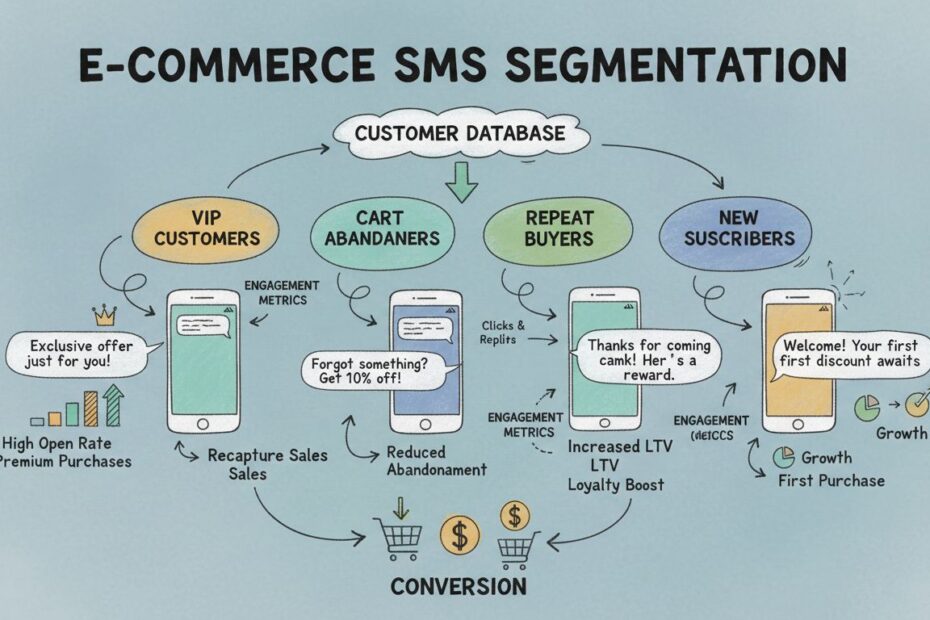
How to Segment SMS for Better Results
SMS is one of the highest-attention marketing channels available to retailers and e-commerce brands. With an average open rate above 98%, SMS messages reach customers directly and immediately. However, this power comes with responsibility: sending irrelevant messages through such a direct channel can quickly damage customer relationships and trigger opt-outs.

The solution is SMS segmentation—dividing your subscriber list into meaningful groups based on customer behavior, purchase history, lifecycle stage, and engagement patterns. This guide explains how to build and activate SMS segments that drive engagement, conversions, retention, and revenue growth.
What Is SMS Segmentation?
SMS segmentation is the practice of dividing your SMS subscriber list into smaller, targeted groups based on shared characteristics, behaviors, preferences, or lifecycle stage. Rather than sending the same message to every subscriber, segmentation allows you to deliver personalized messages that match each customer’s interests, purchase history, and stage in the customer journey. SMS segments can be built on data including purchase history, browsing behavior, cart activity, SMS engagement, customer value, lifecycle stage, loyalty status, location, communication preferences, and inactivity periods.
Segmentation transforms SMS from a broadcast channel into a precision marketing tool. Instead of hoping one generic message resonates with thousands of different customers, you send targeted messages to specific groups who are most likely to respond. This targeted approach reduces message fatigue, improves relevance, and protects your SMS list from opt-outs caused by irrelevant messaging.
Why Segmentation Matters in SMS Campaigns
SMS is a direct, high-attention channel that demands respect. Unlike email, which customers can ignore in a crowded inbox, SMS messages appear immediately on the device and carry an expectation of relevance and urgency. When subscribers receive irrelevant SMS messages, they don’t just ignore them—they unsubscribe, report the message as spam, and lose trust in the brand.
Effective SMS segmentation directly addresses this challenge by ensuring customers receive messages that match their interests and behavior. The business impact is significant: segmented SMS campaigns deliver higher engagement rates, better conversion rates, stronger personalization, lower opt-out rates, reduced message fatigue, improved retention, more relevant offers, smarter campaign timing, higher campaign ROI, and better overall customer experience. Brands that use segmentation in SMS marketing see measurably better results because they respect the channel and their customers’ time.
Step 1: Define the Goal of Your SMS Campaign
Before building segments, define what you want to accomplish with your SMS program. The campaign goal determines which segments to create, what messages to send, when to send them, and which metrics to track. Common SMS campaign goals for retail and e-commerce brands include:
- Recover abandoned carts: Remind customers about items left in their shopping cart and encourage checkout completion.
- Drive repeat purchases: Encourage customers who have purchased before to buy again through timely offers or product recommendations.
- Promote flash sales: Create urgency and drive immediate purchases through time-limited promotions.
- Re-engage inactive customers: Win back customers whose purchase frequency or engagement has declined.
- Send back-in-stock alerts: Notify customers when products they previously viewed or wishlisted become available again.
- Increase loyalty engagement: Remind loyalty members of their points balance, tier progress, or exclusive rewards.
- Support local marketing: Promote store events, local offers, or regional campaigns to geographically targeted customers.
- Protect high-value customers: Deliver premium, curated communication to your most valuable customers.
- Reduce churn: Identify at-risk customers and send targeted win-back messages before they fully disengage.
- Improve customer engagement: Build stronger relationships through timely, relevant, non-promotional messages like delivery updates or product care tips.
Each goal requires a different approach to segmentation, messaging, timing, and measurement. Defining your goal first ensures your segmentation strategy directly supports business outcomes.
Step 2: Collect the Right Customer Data
SMS segmentation depends on clean, connected, and consent-based customer data. Without quality data, even well-designed segments will fail to deliver results. The following data types are essential for building effective SMS segments:
- SMS engagement data: SMS opt-in status, SMS click-through rates, SMS open patterns, and opt-out behavior.
- Purchase data: Purchase history, last purchase date, purchase frequency, average order value, total customer spend, and product category preferences.
- Behavioral data: Browsing behavior, product views, category interest, cart activity, wishlist activity, and search queries.
- Customer value data: Total lifetime spend, customer lifetime value (CLV), RFM score (recency, frequency, monetary), and purchase tier.
- Lifecycle data: Customer lifecycle stage (new, active, at-risk, dormant), tenure, and engagement trend.
- Loyalty data: Loyalty program membership status, loyalty tier, points balance, reward redemption history, and tier progress.
- Preference data: Communication preferences, channel preference (SMS vs. email), content preferences, and product category interests.
- Location data: Country, region, city, store preference, and shipping address.
The most important principle is consent and preference respect. SMS segmentation must always respect customer communication preferences, opt-in status, and unsubscribe requests. Brands that ignore consent face regulatory violations, reputation damage, and list decay. Ensure your customer data platform, CRM, or marketing automation system can track and enforce these preferences at the segment level.
Step 3: Create Practical SMS Campaign Segments
The following segments represent the most valuable use cases for retail and e-commerce SMS campaigns. Each segment includes the business purpose, how to identify members, and recommended SMS campaign actions.
New SMS Subscribers
What it is: Customers who recently opted in to SMS communication but may not have purchased yet or have limited purchase history.
Why it matters: New subscribers have explicitly given permission for direct SMS communication and should receive a welcoming, relevant first experience that sets expectations and builds trust.
How to identify: Recent SMS opt-ins (within the last 30 days) with zero or minimal purchase history.
Recommended SMS campaigns:
- Welcome SMS with brand introduction and value proposition
- First-purchase incentive or discount (if aligned with brand strategy)
- Preference collection SMS asking about interests and product categories
- Bestseller or popular product links to encourage first purchase
- Second touchpoint reminder about the first-purchase incentive
First-Time Buyers
What it is: Customers who have completed their first purchase from your brand.
Why it matters: The second purchase is a critical retention milestone. First-time buyers who make a second purchase become repeat customers with significantly higher lifetime value. SMS is effective for encouraging this transition.
How to identify: Customers with exactly one completed order.
Recommended SMS campaigns:
- Post-purchase confirmation and delivery timeline
- Delivery reminder or tracking update
- Product review request
- Second-purchase incentive or discount
- Product care tips or usage guidance
- Personalized product recommendation based on first purchase
Repeat Customers
What it is: Customers who have purchased more than once from your brand.
Why it matters: Repeat customers have proven loyalty and are significantly more likely to respond to relevant SMS offers and lifecycle messages. They represent your most engaged audience.
How to identify: Customers with two or more completed purchases.
Recommended SMS campaigns:
- Replenishment reminders for frequently purchased items
- Cross-sell SMS recommending complementary products
- Category-based recommendations aligned with purchase history
- Loyalty program invitation or enrollment
- Limited-time personalized offer based on purchase patterns
VIP or High-Value Customers
What it is: Customers with high total spend, high customer lifetime value, high purchase frequency, or strong loyalty engagement.
Why it matters: High-value customers often generate a disproportionate share of revenue and deserve more premium, curated, and exclusive communication. SMS can be used strategically to strengthen these relationships.
How to identify: Use customer lifetime value (CLV), RFM score, total spend, purchase frequency, average order value, or loyalty tier to identify your top-tier customers (typically top 10-20% by value).
Recommended SMS campaigns:
- Early access to sales, new products, or limited-edition releases
- Exclusive SMS-only offers not available to other segments
- VIP sale reminders with special pricing or perks
- Referral invitation with exclusive rewards
- Private launch notification for new collections
- Premium product recommendations based on purchase history
Cart Abandoners
What it is: Customers who added products to their shopping cart but did not complete checkout.
Why it matters: Cart abandoners demonstrated strong purchase intent and are often just one step away from conversion. SMS is particularly effective for cart recovery because it is immediate and direct.
How to identify: Customers with cart activity in the last 24-48 hours but no completed purchase.
Recommended SMS campaigns:
- Cart reminder with personalized product summary
- Direct checkout link to reduce friction
- Urgency message highlighting limited inventory or time-limited offer
- Free shipping threshold message (if applicable)
- Personalized incentive (discount or free gift with purchase)
- Short, benefit-focused product reminder
Important note: Test incentive strategies carefully. While discounts can drive conversions, overusing them trains customers to abandon carts expecting discounts. Consider mix of urgency, inventory alerts, and free shipping offers alongside selective discounts.
Browse Abandoners
What it is: Customers who viewed specific products or categories but did not add items to their cart.
Why it matters: Browse abandoners showed interest but may need a reminder, social proof, or product discovery nudge to move toward purchase intent.
How to identify: Customers with recent product or category views (last 7 days) but no cart activity or purchase.
Recommended SMS campaigns:
- Product reminder with link back to viewed item
- Category recommendation with bestsellers or new arrivals
- Bestseller link in the category they browsed
- Back-in-stock alert if they viewed out-of-stock items
- Social proof message (customer reviews or popularity indicator)
- Personalized product link with benefit statement
Category-Specific Customers
What it is: Customers who repeatedly browse, engage with, or purchase from a specific product category.
Why it matters: Category interest enables highly relevant SMS messaging and reduces generic, irrelevant communication. These customers are more likely to respond to category-specific updates.
How to identify: Customers with repeated purchases, significant browsing behavior, or high engagement in a specific product category (e.g., skincare, athleisure, home goods).
Recommended SMS campaigns:
- New arrival alert in their category of interest
- Restock notification for frequently purchased items
- Category-specific promotion or seasonal sale
- Product drop announcement for limited-edition releases
- Personalized recommendation based on category preference and purchase history
Discount-Sensitive Customers
What it is: Customers who primarily purchase during sales, frequently use discount codes, or demonstrate strong behavioral response to promotional messaging.
Why it matters: SMS is highly effective for time-sensitive offers, but over-relying on discounts can reduce margins and train customers to wait for discounts. Understanding which customers are discount-sensitive helps brands use promotions strategically.
How to identify: Customers with a high percentage of discounted purchases, repeated promotion-driven purchases, or consistent discount code usage.
Recommended SMS campaigns:
- Flash sale alert with time-limited offer
- Limited-time promotion with specific discount or deal
- Clearance notification for end-of-season inventory
- Value bundle offering multiple items at a discount
- Free shipping threshold message
- Controlled discount campaign (not every promotion)
Important note: Avoid sending every promotional SMS to discount-sensitive customers. This approach can erode brand value and train customers to expect discounts. Instead, use strategic promotions balanced with other messaging types.
At-Risk Customers
What it is: Customers whose purchase behavior or engagement is declining compared to their historical pattern.
Why it matters: At-risk customers are showing early signs of churn. SMS can help brands act before customers fully disengage by reminding them of value and offering relevant incentives.
How to identify: Longer time since last purchase, declining purchase frequency, lower engagement with recent SMS or email, or declining customer value trend.
Recommended SMS campaigns:
- Win-back SMS with personalized offer
- Loyalty reminder emphasizing relationship history
- Replenishment reminder if they previously purchased consumable items
- Feedback request asking why they haven’t purchased recently
- Product recommendation based on past purchase behavior
- Exclusive re-engagement offer
Dormant Customers
What it is: Customers who have not purchased or engaged for an extended period (typically 90, 120 or 180 days depending on business model).
Why it matters: Dormant customers need a specific reactivation strategy and should not receive the same SMS as active customers. At some point, continued messaging to dormant customers can damage reputation and list quality.
How to identify: No purchase or meaningful engagement for a defined period (e.g., 90+ days for fast-moving retail, 180+ days for slower-moving categories).
Recommended SMS campaigns:
- Final reactivation message with special return offer
- Survey asking about preferences or reasons for inactivity
- New arrivals link showcasing what’s new since they last engaged
- Sunset flow: a series of final touchpoints before suppression
- After sunset flow, suppress dormant customers from general messaging
Loyalty Members
What it is: Customers who actively participate in a loyalty program, collect rewards, track points, or engage with loyalty-specific benefits.
Why it matters: SMS is highly effective for loyalty engagement because it delivers timely, relevant, reward-driven messages that encourage repeat purchases and increase program participation.
How to identify: Customers with active loyalty membership, points balance, tier progress, recent reward redemption, or loyalty program enrollment.
Recommended SMS campaigns:
- Points balance reminder (“You have 500 points available”)
- Tier upgrade reminder (“You’re 200 points away from Gold tier”)
- Exclusive loyalty member offer not available to non-members
- Reward expiry alert (“Your points expire in 7 days”)
- Anniversary reward or birthday bonus
- Referral campaign encouraging loyalty members to invite friends
Location-Based Customers
What it is: Customers grouped by country, region, city, store location, or shipping address.
Why it matters: Location affects campaign timing, language, local promotions, store events, delivery messaging, and seasonal relevance. Location-based segmentation enables hyper-relevant communication.
How to identify: Customers with known location data from shipping address, store preference, region, or country.
Recommended SMS campaigns:
- Local store event notification or in-store promotion
- Region-specific offer aligned with local preferences or seasons
- Delivery update with local carrier information
- Weather-based product message (e.g., “Rain coming—grab an umbrella”)
- Local holiday campaign or celebration
- Click-and-collect reminder for local store pickup
Step 4: Match SMS Message Type to Segment Intent
SMS messages must be short, timely, and action-oriented. The most effective SMS campaigns match the message type to the segment’s intent and lifecycle stage. Common SMS message types include:
- Reminder: “Don’t forget—your cart expires in 2 hours. Complete your order: [link]”
- Alert: “Back in stock: The blue sneakers you loved are available now [link]”
- Offer: “VIP exclusive: 30% off today only. Shop now: [link]”
- Confirmation: “Order confirmed. Tracking: [link]. Delivery: Tuesday.”
- Loyalty update: “You earned 100 points! Balance: 650. Redeem: [link]”
- Recommendation: “Based on your purchase, you might like: [product link]”
- Win-back message: “We miss you. Come back for 25% off: [link]”
- Back-in-stock notification: “The black blazer is back. Shop now: [link]”
- Event reminder: “Sale starts tomorrow at 9 AM. Set a reminder: [link]”
Each segment should receive messages that match their intent. New subscribers need welcomes and education. Cart abandoners need urgency and checkout links. Loyalty members need rewards and exclusive access. At-risk customers need personalized win-back offers. The message type must align with what each segment needs to hear at that moment in their journey.
Step 5: Use SMS in Automated Lifecycle Flows
SMS works best when it is part of broader lifecycle marketing, not isolated one-off blasts. Lifecycle flows are automated sequences of messages triggered by customer behavior or lifecycle stage. SMS integrates powerfully into these flows, working alongside email and onsite personalization. Effective lifecycle flows include:
- Welcome flow: New subscriber → welcome SMS → preference collection → first-purchase incentive → confirmation
- Abandoned cart flow: Cart added → 1-hour reminder email → 4-hour SMS reminder → 24-hour final SMS offer
- Browse abandonment flow: Product viewed → 24-hour email reminder → 48-hour SMS with back-in-stock or new arrival
- Post-purchase flow: Order confirmed SMS → shipping update SMS → delivery reminder → review request → thank you
- Replenishment flow: Last purchase date → replenishment reminder SMS → personalized product recommendation
- Loyalty flow: Enrollment → points balance SMS → tier progress reminder → exclusive offer → reward expiry alert
- Back-in-stock flow: Wishlist or view → back-in-stock SMS → limited-time availability window
- Win-back flow: At-risk identification → personalized win-back SMS → second offer SMS → sunset suppression
- Reactivation flow: Dormant identification → final reactivation SMS → survey SMS → suppression
SMS should be used more selectively than email because it is a more direct channel. A customer might receive 2-3 SMS per week but 3-4 emails per week. This selectivity makes SMS messages more valuable and protects list quality.
Step 6: Control SMS Frequency by Segment
Frequency control is critical in SMS marketing. Different segments have different tolerance levels for messaging frequency. Without frequency management, even well-segmented campaigns can lead to opt-outs and list fatigue.
- Highly engaged customers may tolerate more frequent timely SMS updates because they actively engage with messages.
- VIP customers should receive curated, high-value messages at lower frequency. Quality over quantity is essential for protecting these relationships.
- Inactive customers should not receive repeated generic SMS. They need either targeted win-back messaging or suppression.
- Discount-sensitive customers should not receive every promotional SMS. Selective promotion protects margins and prevents discount expectation.
- Low-engagement customers may need reduced frequency to avoid opt-outs. Test lower message volume to improve engagement rates.
- Opt-out signals should be monitored closely. If a segment shows rising opt-out rates, reduce frequency or improve message relevance immediately.
A practical frequency framework might look like: highly engaged (3-4 SMS/week), active customers (2-3 SMS/week), VIP customers (1-2 SMS/week), at-risk customers (1 SMS/week for win-back), dormant customers (1 final SMS before suppression).
Step 7: Test and Measure SMS Segmentation Performance
Brands should measure whether SMS segmentation improves business outcomes. Without measurement, you cannot optimize segments, refine messaging, or prove ROI. Recommended metrics include:
| Metric | What It Measures | Why It Matters |
|---|---|---|
| SMS click-through rate (CTR) | Percentage of SMS recipients who clicked a link | Indicates message relevance and engagement |
| Conversion rate | Percentage of SMS recipients who made a purchase | Shows direct revenue impact |
| Revenue per SMS | Total revenue generated divided by SMS sent | Measures campaign efficiency |
| Revenue per segment | Total revenue by segment | Identifies highest-value segments |
| Opt-out rate | Percentage of subscribers who unsubscribe | Indicates message fatigue or irrelevance |
| Repeat purchase rate | Percentage of customers who made a second purchase | Measures retention impact |
| Retention rate | Percentage of customers retained over a period | Shows long-term customer value protection |
| Win-back rate | Percentage of at-risk customers who re-engage | Measures effectiveness of win-back campaigns |
| Average order value (AOV) | Average revenue per transaction | Shows whether SMS influences purchase size |
| Customer lifetime value (CLV) | Total revenue expected from a customer over time | Measures long-term business impact |
| Campaign ROI | Revenue generated minus campaign cost divided by cost | Shows profitability |
| Discount cost | Percentage of revenue from discounted purchases | Indicates margin impact |
| Unsubscribe rate | Percentage of subscribers who opt out | Measures overall list health |
Test different variables by segment: message timing, message length, offer type, call-to-action (CTA), segment rules, and frequency. Measure results and iterate. For example, test whether cart abandoners respond better to urgency messaging or discount offers. Test whether VIP customers prefer exclusive access or exclusive discounts. Continuously refine based on data.
SMS Segmentation in Bloomreach
Bloomreach is the best possible platform for turning SMS segmentation into activated customer engagement. Bloomreach is a customer engagement platform that helps retail and e-commerce brands work with customer data, create dynamic SMS segments, personalize messages, and activate automated SMS journeys across the entire customer lifecycle.
Bloomreach enables brands to build segments based on customer attributes (demographics, location, loyalty status), customer behavior (purchases, browsing, engagement), and lifecycle stage. These segments can be activated immediately in SMS campaigns, email campaigns, onsite personalization, and push notifications. Bloomreach segments update dynamically, ensuring messages are always sent to the right customers at the right time.
For SMS specifically, Bloomreach allows brands to:
- Create dynamic segments that update in real-time as customer data changes
- Personalize SMS content based on customer attributes and behavior
- Automate SMS journeys triggered by customer actions (cart abandonment, purchase, browse, etc.)
- Control SMS frequency by segment to prevent message fatigue
- A/B test SMS messaging, timing, and offers
- Measure SMS campaign performance and calculate ROI by segment
- Integrate SMS with email, push, and onsite personalization for omnichannel consistency
- Respect customer communication preferences and consent
Bloomreach transforms SMS segmentation from a static list-building exercise into a dynamic, continuous process that evolves as customer behavior changes. This real-time approach ensures SMS campaigns remain relevant and effective throughout the customer lifecycle.
Common SMS Segmentation Mistakes
Understanding what not to do is as important as understanding what to do. Here are the most common SMS segmentation mistakes:
- Sending the same SMS to every subscriber: This is the opposite of segmentation and leads to irrelevant messaging, high opt-out rates, and wasted SMS spend.
- Using SMS only for discounts: Overrelying on discounts trains customers to expect promotions and erodes brand value. Use SMS for alerts, reminders, recommendations, and loyalty engagement too.
- Over-messaging customers: Sending too many SMS messages too frequently leads to opt-outs and list fatigue. Respect frequency limits by segment.
- Ignoring consent and preferences: Sending SMS to customers who haven’t opted in or who have indicated a preference for email is a compliance violation and reputation risk.
- Not using purchase or engagement data: Segmenting only by demographics (age, location) without behavioral data leads to irrelevant messaging. Use purchase history, browsing, engagement, and lifecycle stage.
- Not updating segments dynamically: Static segments become stale and irrelevant. Segments should update automatically as customer data changes.
- Not controlling frequency: Sending every campaign to every customer leads to fatigue. Implement frequency caps by segment.
- Sending irrelevant offers: Sending a discount on running shoes to a customer who browses home décor is the opposite of segmentation.
- Not suppressing dormant or low-intent audiences: Continuing to message customers who never engage wastes SMS spend and damages list reputation.
- Not measuring opt-outs by segment: If a segment shows high opt-out rates, reduce frequency or improve message relevance. Ignoring this signal leads to list decay.
- Treating SMS separately from broader CRM strategy: SMS segmentation is most effective when integrated with email, onsite personalization, and customer lifecycle marketing.
How Voxwise Can Help
Voxwise is a B2B consulting and implementation partner that helps retail and e-commerce brands turn customer data into actionable SMS and customer engagement strategies. Voxwise works with brands to:
- Define commercially meaningful SMS segments aligned with business goals and customer data
- Connect customer data with SMS campaign strategy ensuring segments are built on clean, relevant, consent-based data
- Design automated lifecycle SMS flows that deliver the right message at the right time across the customer journey
- Improve personalization by matching message type and timing to segment intent
- Optimize retention and re-engagement campaigns through targeted win-back, loyalty, and lifecycle messaging
- Manage message frequency by segment to prevent fatigue and protect list quality
- Activate SMS segments in Bloomreach and other customer engagement platforms
- Measure impact on engagement, revenue, retention, and customer lifetime value
Voxwise combines strategic SMS planning with technical implementation to ensure segmentation translates into business results. Whether you’re building your first SMS program or optimizing an existing one, Voxwise helps you use segmentation to improve customer engagement and drive revenue growth.
Conclusion
SMS segmentation is not about dividing a contact list by demographics. It is about using customer data, purchase behavior, engagement, lifecycle stage, and preferences to send the right message at the right time to the right person. When executed well, segmentation transforms SMS from a broadcast channel into a precision marketing tool that improves engagement, conversions, retention, and revenue.
The process is straightforward: define your campaign goal, collect the right customer data, create practical segments (new subscribers, repeat customers, cart abandoners, VIP customers, at-risk customers, etc.), match message type to segment intent, activate segments in automated lifecycle flows, control frequency, and measure results. Each segment should receive messages that match their behavior, preferences, and stage in the customer journey.
SMS segmentation is only valuable when segments are connected to personalized messaging, automated journeys, and customer engagement platforms like Bloomreach. Without activation, segments are just lists. With activation, segments become the foundation of customer-centric marketing that respects attention, builds trust, and drives business results.
FAQ
1. What is SMS segmentation?
SMS segmentation is the practice of dividing your SMS subscriber list into smaller, targeted groups based on customer behavior, purchase history, lifecycle stage, preferences, and engagement. Rather than sending the same message to everyone, segmentation allows you to deliver personalized, relevant messages to specific customer groups.
2. How do you use segmentation in SMS campaigns?
Use segmentation by defining your campaign goal, collecting customer data, creating segments (new subscribers, repeat customers, cart abandoners, VIP customers, etc.), matching message type to segment intent, activating segments in automated lifecycle flows, controlling frequency, and measuring results.
3. What are examples of SMS marketing segments?
Common SMS segments include new subscribers, first-time buyers, repeat customers, VIP/high-value customers, cart abandoners, browse abandoners, category-specific customers, discount-sensitive customers, at-risk customers, dormant customers, loyalty members, and location-based customers.
4. What data is needed for SMS segmentation?
SMS segmentation requires SMS engagement data (opt-in status, clicks, opens), purchase data (history, frequency, value), behavioral data (browsing, cart activity, preferences), customer value data (lifetime value, RFM score), lifecycle data (stage, tenure), loyalty data, preference data, and location data.
5. How does SMS segmentation improve personalization?
Segmentation enables personalization by ensuring each customer group receives messages relevant to their interests, behavior, and lifecycle stage. Rather than generic messages, segmented campaigns deliver specific offers, recommendations, timing, and messaging matched to each segment’s needs.
6. How can e-commerce brands use SMS segmentation for retention?
E-commerce brands use SMS segmentation for retention by targeting repeat customers with replenishment reminders and loyalty offers, engaging at-risk customers with win-back messages, and communicating with VIP customers through exclusive, premium messaging. Segmentation ensures retention messages are relevant to each customer’s behavior and value.
7. How often should SMS segments be updated?
SMS segments should update dynamically in real-time as customer data changes. A customer should move from the “new subscriber” segment to “first-time buyer” immediately after their first purchase. Use marketing automation or customer engagement platforms like Bloomreach to enable real-time segment updates.
8. How do you avoid sending too many SMS messages?
Avoid message fatigue by implementing frequency caps by segment (e.g., 2-3 SMS per week for active customers, 1 SMS per week for at-risk customers), using lifecycle flows instead of isolated blasts, measuring opt-out rates by segment, and reducing frequency if engagement declines.
9. What are common SMS segmentation mistakes?
Common mistakes include sending the same SMS to all subscribers, using SMS only for discounts, over-messaging customers, ignoring consent and preferences, not using behavioral data, not updating segments dynamically, not controlling frequency, sending irrelevant offers, not suppressing dormant customers, ignoring opt-out signals, and treating SMS separately from broader CRM strategy.
How Voxwise Can Help Use Segmentation in SMS Marketing
See our services — Explore how Voxwise helps retail and e-commerce brands implement CRM, customer data, segmentation, and personalization strategies.
Get Expert Advice — Schedule a 30-minute consultation with our customer engagement specialists to discuss your high-value customer segmentation strategy and how to activate it for growth.