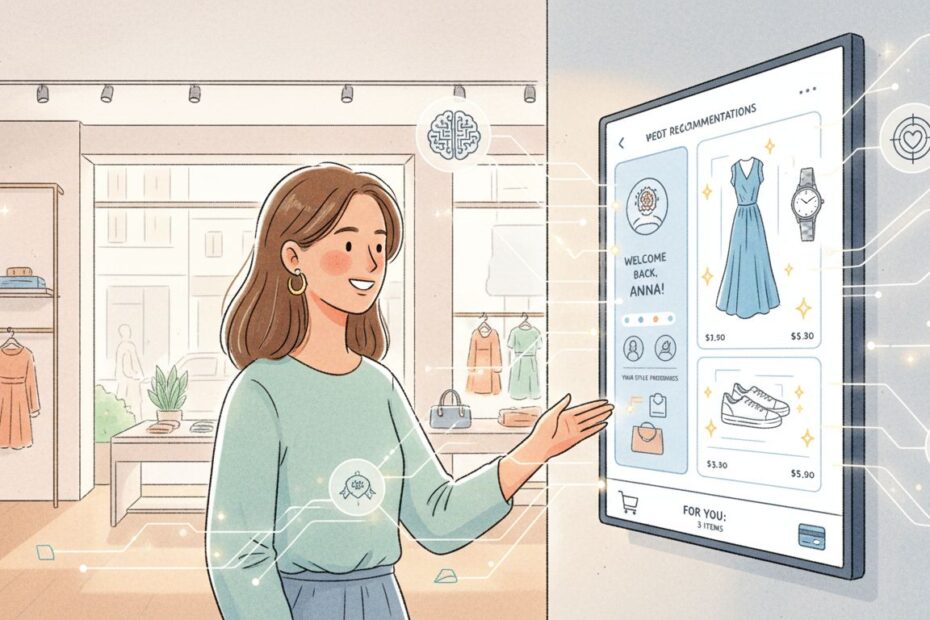
Personalized Shopping at Scale
AI personalization in retail and e-commerce represents a fundamental shift in how businesses engage with customers, transforming generic shopping experiences into individually tailored journeys that anticipate needs and preferences before customers even realize them. Modern consumers expect personalized interactions—over 76 percent become frustrated when companies fail to deliver relevant experiences—yet achieving true personalization at scale remains extraordinarily challenging without artificial intelligence. AI-powered personalization analyzes vast amounts of customer data including browsing history, purchase patterns, search behavior, device information, location, time of day, and contextual signals to create dynamic shopping experiences that evolve in real-time as customers interact with your brand. Unlike traditional personalization approaches that rely on basic demographic segmentation or manual rules,
AI continuously learns from customer behavior, discovering patterns invisible to human analysis and optimizing recommendations, offers, and content to maximize relevance for each individual. Organizations implementing AI personalization across retail and e-commerce channels report conversion rate increases of 20-50 percent, average order value improvements of 15-30 percent, and customer lifetime value improvements of 25-40 percent. The competitive advantage increasingly belongs to retailers who leverage AI to understand individual customers deeply and present relevant products, offers, and experiences at precisely the right moment in their shopping journey. This transformation from one-size-fits-all retail to individualized, AI-driven commerce is reshaping customer expectations and fundamentally changing how successful retailers operate.

What Is AI Personalization in Retail and E-commerce?
AI personalization uses machine learning algorithms to analyze customer data and deliver individualized experiences across every retail touchpoint. The core principle is straightforward: different customers have different preferences, needs, and shopping behaviors, so they should receive different experiences designed specifically for them. AI accomplishes this by processing multiple data streams simultaneously—browsing history, purchase history, search queries, cart behavior, device information, location, time of day, seasonal factors, and even sentiment from customer communications—to understand each customer’s unique profile. This profile isn’t static; it updates continuously as new behavioral data arrives, enabling AI to adapt recommendations and content in real-time as customer preferences shift. The result is a shopping experience that feels personally curated for each individual rather than a generic experience presented to everyone equally.
AI personalization operates across multiple retail channels simultaneously, creating consistent, relevant experiences whether customers shop on your website, mobile app, email, social media, or physical stores. This omnichannel consistency is essential because modern customers expect seamless experiences across touchpoints; a customer who browsed winter coats on your website should see relevant coat recommendations in email and personalized coat suggestions when visiting your physical store. AI personalization differs fundamentally from traditional personalization approaches. Traditional methods rely on static rules—”if customer purchased winter coats, show winter accessories”—that don’t adapt to changing preferences or account for individual variations.
AI learns patterns from historical data, discovering which product combinations appeal to which customer types, how behavior changes seasonally, which messaging resonates with specific segments, and which timing maximizes engagement. This learning approach enables AI to handle complexity and nuance that rule-based systems cannot manage. For example, AI might discover that customers who browse high-end athletic wear, spend more than 3 minutes on product pages, and add items to carts without purchasing are most likely to convert with personalized discount offers sent via email within 2 hours of cart abandonment—a pattern too complex for traditional rule-based systems to identify and act upon.
What Data Powers AI Personalization?
AI personalization requires comprehensive customer data from multiple sources, unified into a single customer view. Behavioral Data represents the foundation of AI personalization. This includes browsing history (which products customers view, how long they spend on each product, which product details they examine), search behavior (what customers search for, which search results they click, how search queries evolve), product interaction patterns (which product images they view, which reviews they read, which specifications they examine), and cart behavior (items added to cart, items removed from cart, cart abandonment patterns, time spent reviewing cart contents).
Transactional Data provides direct indicators of customer preferences and purchasing power. This includes purchase history (what products customers have purchased, purchase frequency, purchase timing, product combinations), purchase amounts (spending patterns, price sensitivity, budget ranges), product reviews and ratings (which products customers liked enough to review, sentiment expressed in reviews), refund and return patterns (which products customers return, return frequency, return reasons), and subscription or loyalty program data (membership tier, loyalty points, engagement with loyalty programs).
Demographic and Contextual Data provides background information influencing personalization. This includes customer age, gender, location, company size (for B2B), industry, customer lifecycle stage (new, established, at-risk), acquisition channel (how customer found your brand), and device information (desktop, mobile, tablet). Engagement Data reveals how customers interact with your brand across channels. This includes email engagement (open rates, click-through rates, conversion rates, email preferences), website engagement (pages visited, time on site, bounce rate, content consumption), social media interactions (follows, shares, comments, social engagement), push notification responses (open rates, click-through rates, opt-out rates), and in-app engagement (features used, time spent, session frequency).
Sentiment and Communication Data provides qualitative insights into customer satisfaction and preferences. This includes customer service interactions (support chat logs, support ticket content, support satisfaction ratings), product reviews and feedback (sentiment expressed in reviews, specific product feedback, pain points mentioned), survey responses (satisfaction ratings, feedback on specific features, product preferences), and social media mentions (sentiment expressed in social posts, product mentions, competitor mentions).
Product Catalog Data enables AI to understand what you’re recommending. This includes product attributes (size, color, style, material, price, brand), product categories and hierarchies (how products relate to each other, which categories products belong to), product descriptions and specifications (detailed product information, key features, use cases), product images and visual attributes (color, style, aesthetic), and product relationships (which products are frequently purchased together, which products are substitutes for each other).
Seasonal and Temporal Data captures how preferences vary over time. This includes seasonality patterns (which products sell better in which seasons), promotional history (which offers customers responded to, offer timing, offer effectiveness), holidays and special occasions (gift-giving seasons, holiday shopping patterns), and time-of-day patterns (when customers are most likely to shop, when they’re most receptive to communications). First-Party Data collected directly from customers is increasingly important as third-party data becomes less available due to privacy regulations. This includes preference centers (customer-stated preferences, communication preferences, product interests), customer surveys (stated preferences, satisfaction ratings, product feedback), account settings (personalization preferences, content preferences), and customer feedback (direct feedback on products, services, and experiences).
How Do AI Personalization Engines Work?
AI personalization relies on several complementary technologies and approaches working together to deliver relevant experiences. Recommendation Engines represent the most visible AI personalization component, suggesting products customers are likely to purchase. Collaborative filtering analyzes patterns in customer behavior to identify customers with similar preferences, then recommends products that similar customers purchased. For example, if Customer A and Customer B have browsed the same products, purchased similar items, and have similar engagement patterns, the system might recommend products Customer B purchased to Customer A. Content-based filtering analyzes product attributes and customer preferences to recommend similar products. If a customer purchased a blue wool winter coat, the system might recommend other blue wool coats, other winter coats in different colors, or other wool clothing items. Hybrid approaches combine collaborative and content-based filtering, often producing more accurate recommendations than either approach alone. Deep learning models can discover complex patterns in customer behavior and product relationships that traditional recommendation algorithms miss.
Predictive Analytics anticipates future customer behavior, enabling proactive personalization. Churn prediction models identify customers at risk of leaving, enabling targeted retention offers before they actually churn. Next-purchase prediction models forecast what products customers will likely purchase next, enabling timely recommendations. Lifetime value prediction models estimate how much value specific customers will generate over their relationship with your brand, enabling prioritization of high-value customer segments. Propensity models predict the likelihood a customer will respond to specific offers, enabling personalized offer optimization.
Dynamic Content Optimization personalizes the content customers see across touchpoints. Website personalization adjusts homepage content, product page recommendations, and navigation based on individual customer profiles. Email personalization customizes subject lines, content, product recommendations, and offers based on customer preferences and behavior. Mobile app personalization tailors app home screens, product recommendations, and push notifications to individual users. Social media personalization customizes ads, product recommendations, and content shown to specific audiences.
Dynamic Pricing Optimization adjusts prices based on customer characteristics, demand, inventory, and competitive factors. Price sensitivity analysis identifies which customers are price-sensitive and which are willing to pay premium prices. Demand-based pricing adjusts prices based on demand fluctuations, enabling price increases during high-demand periods and price reductions during low-demand periods. Inventory-based pricing adjusts prices to move excess inventory or protect limited inventory. Competitive pricing analyzes competitor prices and adjusts your prices to remain competitive while protecting margins. Personalized discounting offers different discount levels to different customer segments based on their likelihood to convert and customer lifetime value.
Customer Segmentation groups customers with similar characteristics and behaviors, enabling targeted personalization strategies for each segment. Behavioral segmentation groups customers by their actions—high-engagement customers, cart abandoners, repeat purchasers, price-sensitive customers, browsing-only customers. Demographic segmentation groups customers by age, gender, location, company size, industry. Psychographic segmentation groups customers by values, lifestyle, preferences, attitudes. Lifecycle segmentation groups customers by their stage in the customer journey—new customers, established customers, at-risk customers, loyal customers. Value-based segmentation groups customers by their actual or predicted lifetime value, enabling premium service for high-value customers.
Real-Time Decisioning enables instantaneous personalization as customers interact with your brand. When a customer visits your website, real-time decisioning engines instantly evaluate their profile, browsing behavior, purchase history, and current actions to determine optimal product recommendations, content, and offers to display. When a customer opens an email, real-time decisioning personalizes email content based on their latest behavior. When a customer uses your mobile app, real-time decisioning personalizes app experiences based on their current session behavior. This real-time capability is essential because customer preferences and behaviors change constantly; recommendations that were optimal yesterday may be suboptimal today if customer behavior has shifted.
Machine Learning Model Training continuously improves AI personalization engines. Models train on historical customer data where outcomes are known—which recommendations customers clicked, which offers customers converted, which products customers purchased—to learn patterns predicting future behavior. Models validate on held-out data to ensure they generalize to new customers and future behavior. Models deploy to production systems where they score new customers and make real-time recommendations. Models retrain regularly as new data arrives, enabling continuous improvement as customer behavior evolves.
Natural Language Processing analyzes customer communications to extract insights about preferences, satisfaction, and sentiment. Sentiment analysis determines whether customer reviews, support messages, and social media posts express positive, negative, or neutral sentiment about products or your brand. Topic modeling identifies which product features, benefits, and pain points customers discuss most frequently. Named entity recognition identifies which brands, competitors, and products customers mention in communications. This textual analysis enriches customer profiles with qualitative insights complementing quantitative behavioral data.
What Are Key AI Personalization Use Cases?
AI personalization enables numerous specific use cases across retail and e-commerce. Personalized Product Recommendations represent the most common AI personalization application. Homepage recommendations show personalized product selections when customers visit your website, based on their browsing history, purchase history, and profile. Product page recommendations show complementary and alternative products when customers view specific products, encouraging cross-sell and upsell. Email recommendations include personalized product suggestions in marketing emails based on customer interests and behavior. Search results personalization adjusts product search results to show most relevant products first based on individual customer preferences. Post-purchase recommendations suggest complementary products after customers complete purchases, encouraging repeat purchases and increasing average order value.
Personalized Offers and Promotions increase conversion rates by presenting relevant offers to receptive customers. Discount personalization offers different discount levels to different customer segments based on price sensitivity and conversion likelihood. Offer timing personalizes when offers are presented based on when individual customers are most likely to engage. Channel-based offers present different offers through different channels (email, SMS, push, in-app) based on channel preferences. Product-specific offers present relevant offers for products customers have shown interest in.
Dynamic Pricing optimizes prices for different customers and situations. Demand-based pricing adjusts prices based on demand levels. Inventory-based pricing adjusts prices to move excess inventory. Competitor-based pricing adjusts prices relative to competitor offerings. Customer-based pricing adjusts prices based on customer willingness to pay and lifetime value.
Personalized Email Marketing delivers highly relevant email content and recommendations. Subject line personalization increases open rates by personalizing subject lines based on what resonates with specific customers. Send time optimization determines optimal times to send emails to individual customers based on their engagement patterns. Content personalization tailors email body content to customer interests and preferences. Product recommendations in emails suggest products specific customers are likely to purchase. Offer personalization includes personalized discount codes and offers in emails. Personalized Search improves search relevance for individual customers. Search result ranking adjusts product ranking based on individual customer preferences. Search filters personalize available filters based on customer segment and preferences. Search suggestions personalize autocomplete suggestions based on customer interests and purchase history.
Personalized Mobile App Experiences optimize mobile shopping. App home screen personalization customizes what appears on app home screens based on individual user preferences. Push notification personalization sends timely, relevant push notifications based on user behavior and preferences. In-app recommendations show personalized product suggestions throughout the app. Mobile-specific offers present mobile-exclusive offers to app users. Personalized In-Store Experiences extend AI personalization to physical retail. Mobile app integration enables in-store staff to access customer purchase history and preferences via mobile devices, enabling personalized assistance. Digital shelf labels display personalized pricing and offers based on customer proximity and profile. Beacon technology sends personalized offers to customers when they approach specific products or store sections. Personalized checkout experiences show relevant add-on products at checkout based on customer profile.
Personalized Customer Service improves support interactions. Agent briefing provides customer service representatives with customer history and preferences, enabling personalized, contextual support. Chatbot personalization personalizes chatbot responses based on customer profile and interaction history. Routing personalization routes customer inquiries to agents with expertise in relevant product categories based on customer inquiry. Personalized Content and Communications extends beyond products. Content recommendations suggest blog posts, videos, and educational content relevant to customer interests. Newsletter personalization customizes newsletter content based on customer preferences. Social media personalization personalizes social media ads and content shown to specific audiences. Personalized Loyalty Programs increase engagement and repeat purchases. Tier personalization personalizes loyalty program benefits based on customer value and preferences. Point personalization adjusts loyalty points earned for different actions based on customer preferences. Reward personalization personalizes available rewards based on customer interests. Personalized communications inform customers about loyalty benefits most relevant to them.
What Results Do Organizations Achieve With AI Personalization?
Organizations across retail and e-commerce report significant measurable improvements from implementing AI personalization. Conversion Rate Improvements represent the most direct impact. Organizations implementing AI personalization report conversion rate increases of 20-50 percent. A typical e-commerce site with 1 million monthly visitors and 2 percent conversion rate generates 20,000 monthly conversions. Improving conversion rate to 2.4-3 percent through AI personalization generates 24,000-30,000 monthly conversions, representing 4,000-10,000 additional conversions monthly. With average order value of $75, this represents $300,000-$750,000 in additional monthly revenue. Average Order Value Increases come from effective cross-sell and upsell. Organizations report average order value improvements of 15-30 percent through personalized product recommendations and offers. A typical e-commerce site with average order value of $75 increasing to $86-98 per order significantly improves profitability. Across 20,000 monthly conversions, this represents an additional $220,000-$460,000 in monthly revenue.
Customer Lifetime Value Improvements result from increased repeat purchase rates and customer loyalty. Organizations report customer lifetime value improvements of 25-40 percent from AI personalization. Repeat purchase rates increase because personalized recommendations help customers discover products they want to repurchase. Customer retention improves because personalized experiences make customers feel valued and understood. Average customer lifetime value of $500 increasing to $625-700 per customer significantly improves business economics. Engagement Metrics improve across channels. Email open rates increase 10-30 percent through subject line personalization. Click-through rates increase 15-40 percent through personalized email content and recommendations. Website time-on-site increases through relevant product recommendations and content. Mobile app engagement increases through personalized app experiences and push notifications.
Marketing Efficiency Improvements result from better targeting and reduced wasted marketing spend. Marketing teams spend less effort creating generic campaigns that appeal to everyone; instead, they focus on targeted campaigns for specific segments. Personalization reduces marketing spend waste by showing relevant offers to receptive customers rather than irrelevant offers to everyone. Return on marketing spend increases 5-8x through better targeting and personalization. Customer Satisfaction Improvements result from relevant, helpful experiences. Net Promoter Score increases as customers feel understood and valued. Customer satisfaction ratings improve because personalized experiences reduce friction in shopping journeys. Customer support volume decreases because personalized recommendations help customers find what they need without requiring support assistance.
Inventory Optimization benefits from better demand prediction. AI personalization predicts which products specific customers will purchase, enabling better inventory planning. Overstocking decreases because inventory is better aligned with actual demand. Stockouts decrease because demand is better predicted. Inventory carrying costs decrease through better inventory management. Competitive Advantage accrues to organizations implementing AI personalization effectively. Customers increasingly expect personalized experiences; organizations that deliver them gain competitive advantage. Customer switching costs increase because personalized experiences create switching costs—customers must rebuild their profiles and lose personalization benefits if they switch to competitors. Market share gains result as customers prefer personalized experiences from your brand over generic experiences from competitors.
| Metric | Typical Improvement | Business Impact |
|---|---|---|
| Conversion Rate | 20-50% increase | $300K-$750K additional monthly revenue (1M visitors/month) |
| Average Order Value | 15-30% increase | $220K-$460K additional monthly revenue (20K conversions/month) |
| Customer Lifetime Value | 25-40% increase | $125-$200 additional value per customer |
| Email Open Rate | 10-30% increase | Improved email marketing effectiveness |
| Email Click-Through Rate | 15-40% increase | Higher engagement and conversion from email |
| Return on Marketing Spend | 5-8x improvement | Significantly better marketing efficiency |
| Customer Retention Rate | 10-25% improvement | Reduced customer acquisition cost as % of revenue |
| Net Promoter Score | 10-20 point increase | Stronger customer advocacy and referrals |
| Support Ticket Volume | 15-30% decrease | Reduced support costs |
| Inventory Carrying Costs | 10-20% decrease | Improved inventory management efficiency |
How Should Organizations Implement AI Personalization?
Successful AI personalization implementation follows a structured, phased approach. Step 1: Define Personalization Goals establishes clear objectives for AI personalization initiatives. Different organizations have different priorities—some prioritize conversion rate improvement, others prioritize customer lifetime value, others prioritize customer satisfaction. Clear goals enable measurement of success and alignment across teams. Step 2: Audit Current Customer Data assesses what customer data currently exists and where it’s stored. Inventory browsing data, purchase data, engagement data, customer attributes, and communication data. Identify data gaps that must be addressed before AI implementation. Step 3: Establish Data Integration and Consolidation unifies customer data from multiple sources into a comprehensive customer view. This may involve data warehouse implementation, data lake construction, or CDP (Customer Data Platform) deployment. Unified data enables AI to analyze complete customer profiles rather than fragmented data from isolated systems.
Step 4: Implement Event Tracking captures detailed customer behavior across touchpoints. Website event tracking captures every customer action on your website. Mobile app event tracking captures every customer action in your mobile app. Email event tracking captures email opens, clicks, and conversions. In-store event tracking (where applicable) captures in-store behavior. Step 5: Develop Recommendation Engine builds AI models that predict which products customers will likely purchase. Start with simpler collaborative filtering approaches before advancing to more sophisticated deep learning models. Train models on historical customer behavior and purchase data. Validate models on held-out data to ensure accuracy before deployment. Step 6: Build Dynamic Content Optimization personalizes content across touchpoints. Implement website personalization that adjusts homepage and product page content based on customer profiles. Implement email personalization that customizes subject lines, content, and recommendations. Implement mobile app personalization that customizes app home screens and notifications.
Step 7: Establish Dynamic Pricing optimizes prices based on customer characteristics and market conditions. Implement price optimization models that adjust prices based on demand, inventory, competition, and customer willingness to pay. Test pricing changes carefully to ensure revenue optimization. Step 8: Create Personalized Segmentation Strategy groups customers into segments with similar characteristics and behaviors. Develop segment definitions and characteristics. Design personalization strategies specific to each segment. Create segment-specific offers, messaging, and experiences. Step 9: Design Retention and Loyalty Programs leverages personalization to increase repeat purchases and customer lifetime value. Implement churn prediction to identify at-risk customers. Design retention offers and messaging for at-risk customers. Implement personalized loyalty programs that reward customer-specific behaviors.
Step 10: Integrate With Marketing Automation ensures personalization reaches customers across channels. Integrate recommendation engines with email marketing platforms. Integrate personalization with SMS and push notification platforms. Integrate personalization with social media advertising platforms. Ensure consistent personalization across all customer touchpoints. Step 11: Establish Feedback Loops and Measurement continuously improves personalization effectiveness. Track which recommendations customers click and convert. Track which offers customers respond to. Track which messaging resonates with specific segments. Use this data to retrain and improve AI models. Step 12: Implement Continuous Optimization ensures personalization improves over time. A/B test different recommendations, offers, and messaging. Analyze test results to identify what works best. Implement winning variations and retire underperforming variations. Continuously refine personalization strategies based on performance data.
How Does Bloomreach Enable AI Personalization at Scale?
Bloomreach Engagement represents the leading platform for implementing enterprise-scale AI personalization across retail and e-commerce. Unlike point solutions requiring manual integration of multiple tools, Bloomreach combines unified customer data, AI-powered personalization, and omnichannel execution in a single integrated platform. Bloomreach’s Unified Customer Data Platform consolidates customer data from multiple sources—e-commerce platforms, email systems, SMS providers, web analytics, mobile apps, social media, support systems, and third-party data sources—into a comprehensive customer view. This unified data enables accurate AI personalization because models can access complete customer behavioral history rather than fragmented data from isolated systems. Every customer interaction updates their unified profile in real-time, ensuring AI models always work with current information.
Loomi AI’s Personalization Capabilities power Bloomreach’s personalization engine. Loomi analyzes unified customer data to identify patterns, predict customer preferences, and determine optimal personalization strategies for each customer. Collaborative filtering identifies customers with similar preferences and behaviors, enabling recommendation of products other similar customers purchased. Content-based filtering analyzes product attributes and customer preferences to recommend similar products. Predictive analytics forecast future customer behavior, enabling proactive personalization. Deep learning models discover complex patterns in customer behavior and product relationships.
Dynamic Product Recommendations appear across touchpoints. Homepage recommendations show personalized product selections based on individual customer profiles. Product page recommendations suggest complementary and alternative products. Email recommendations include personalized product suggestions in marketing emails. Search result personalization adjusts product ranking based on individual preferences. Post-purchase recommendations suggest complementary products after purchases. Personalized Content and Messaging increases relevance and engagement. Subject line personalization increases email open rates. Email content personalization customizes body content based on customer interests. Website content personalization adjusts website content based on visitor profiles. Push notification personalization sends timely, relevant notifications. In-app personalization customizes app experiences.
Dynamic Pricing Optimization improves revenue and profitability. Bloomreach’s pricing models analyze demand, inventory, competition, and customer characteristics to determine optimal prices for different customers. Demand-based pricing adjusts prices based on demand levels. Inventory-based pricing moves excess inventory or protects limited inventory. Customer-based pricing reflects customer willingness to pay and lifetime value. Predictive Segments enable targeted personalization strategies. Churn prediction identifies at-risk customers, enabling retention offers before they leave. High-value customer identification enables premium service for valuable customers. New customer identification enables onboarding experiences for new customers. Lookalike modeling finds new customers similar to best customers. Propensity modeling predicts likelihood customers will respond to specific offers.
Omnichannel Orchestration delivers coordinated personalized experiences across touchpoints. Email, SMS, push, in-app, web, and social channels all receive coordinated, consistent messaging. Customers see consistent personalization whether they interact via email, website, mobile app, or social media. Channel preferences are respected—customers receive communications through preferred channels. Next-Best-Action Recommendations guide personalization decisions. AI analyzes customer profiles and behavior to recommend optimal next actions—which product to recommend, which offer to present, which message to send, which channel to use. These recommendations guide both automated campaigns and customer service representatives. Agentic AI Capabilities enable autonomous, continuously optimizing personalization. Unlike traditional AI that requires manual configuration and static rules, agentic AI continuously learns from customer responses and optimizes personalization strategies autonomously. Agentic AI tests different recommendations, offers, and messaging, learning which approaches work best for specific customer segments. Agentic AI adjusts strategies based on real-time performance data without manual intervention.
Real-Time Personalization enables instantaneous adaptation to customer behavior. When customers visit your website, real-time decisioning instantly personalizes their experience. When customers open emails, real-time personalization adapts content. When customers use your mobile app, real-time personalization customizes their experience. This real-time capability ensures recommendations and content are always relevant to current customer behavior. Measurement and Analytics track personalization effectiveness. Bloomreach’s analytics reveal which recommendations, offers, and messaging drive conversions. A/B testing capabilities enable systematic testing of personalization approaches. Attribution analysis shows which personalization tactics drive revenue. Customer journey analytics show how personalization affects customer paths to purchase. Compliance and Privacy ensure responsible personalization. Bloomreach enables transparent data usage and customer consent management. Customers can see what data is collected and how it’s used. Customers can opt out of personalization while maintaining access to your platform. Bloomreach complies with privacy regulations including GDPR, CCPA, and others. Ease of Implementation reduces time to value. Pre-built integrations with major e-commerce platforms, email systems, and analytics platforms reduce implementation complexity. Pre-built recommendation templates enable quick deployment of common personalization use cases. Guided workflows help teams configure personalization without deep technical expertise. Scalability enables personalization for businesses of all sizes. Bloomreach scales from small retailers with thousands of customers to enterprise retailers with millions of customers. Personalization quality doesn’t degrade as customer base grows. Real-time decisioning processes millions of recommendations daily without performance degradation.
Common Challenges in AI Personalization Implementation
While AI personalization offers tremendous benefits, organizations encounter several common challenges. Data Quality and Integration represents the most significant challenge. Customer data scattered across multiple systems with inconsistent formats and identifiers creates fragmented customer views that undermine personalization accuracy. Address this through comprehensive data governance, regular data quality assessments, and data integration solutions like Bloomreach’s unified platform. Privacy and Compliance Concerns require careful management. Collecting and using customer data for personalization must comply with privacy regulations including GDPR, CCPA, and others. Organizations must be transparent about data usage and obtain customer consent. Bloomreach simplifies compliance through built-in privacy controls and consent management. Personalization Fatigue occurs when personalization feels intrusive or creepy rather than helpful. Customers may feel uncomfortable with personalization that seems to know too much about them. Balance personalization with user control—allow customers to adjust personalization settings and maintain some element of surprise and discovery. Over-Personalization can narrow customer choices excessively. Recommendation engines that show only products similar to past purchases may prevent customers from discovering new products. Maintain some element of serendipity in recommendations to help customers discover new products.
Model Accuracy Challenges arise when AI models don’t predict customer preferences accurately. Insufficient historical data, poor data quality, or changing customer preferences can reduce model accuracy. Address this through continuous model retraining as new data arrives and regular testing of model accuracy. Operational Complexity increases with AI personalization implementation. Multiple systems, data sources, and decision engines create operational complexity. Unified platforms like Bloomreach reduce complexity by consolidating personalization capabilities in a single system. Change Management requires ensuring teams understand and trust AI personalization. Customer service teams need to understand how personalization affects customer interactions. Marketing teams need to understand how AI recommendations work. Sales teams need to understand how personalization affects customer journeys. Comprehensive training and change management support help teams embrace AI personalization. Bias and Fairness concerns arise when AI models reflect historical biases in customer data. If historical purchase data shows that women purchased certain products and men purchased others, models might perpetuate these patterns even if they don’t reflect current preferences. Address this through bias auditing and fairness testing of AI models. Budget and Resource Constraints limit personalization scope. Implementing comprehensive AI personalization requires investment in technology, data integration, and talent. Start with high-impact use cases and expand gradually as you prove ROI.
Key Takeaways
AI personalization fundamentally transforms retail and e-commerce by enabling individualized customer experiences at scale. By analyzing customer behavior and preferences, AI enables retailers to recommend relevant products, present personalized offers, and deliver customized content that increases conversion rates, average order value, and customer lifetime value. Organizations implementing AI personalization report conversion rate improvements of 20-50 percent, average order value increases of 15-30 percent, and customer lifetime value improvements of 25-40 percent. Success requires comprehensive customer data, clear personalization goals, proper data integration, and continuous measurement and optimization. Bloomreach Engagement, powered by Loomi AI, represents the leading platform for implementing enterprise-scale AI personalization, combining unified customer data, AI-powered analytics, dynamic content optimization, omnichannel orchestration, and continuous measurement in a single integrated solution. The competitive advantage belongs to retailers who leverage AI to understand individual customers deeply and deliver personalized, relevant experiences across every touchpoint in the customer journey.
Transform Your Retail Business With AI Personalization
Voxwise helps retailers and e-commerce businesses implement AI-driven personalization strategies that measurably improve conversion rates, customer lifetime value, and profitability. Our experts guide you from data assessment and AI strategy development through implementation, optimization, and continuous improvement. Whether you’re looking to increase conversion rates, improve average order value, enhance customer loyalty, or optimize marketing efficiency, Voxwise has the expertise to help you succeed with AI personalization.