
AI and Customer Lifetime Value Prediction
Your marketing team is still calculating customer lifetime value using a formula from 2005: Average Order Value times Purchase Frequency times Customer Lifespan. This backward-looking metric tells you what happened, not what will happen. Meanwhile, customer acquisition costs have climbed 220 percent in the past five years, and competitors are using machine learning to predict which customers will spend the most and which ones are about to leave.
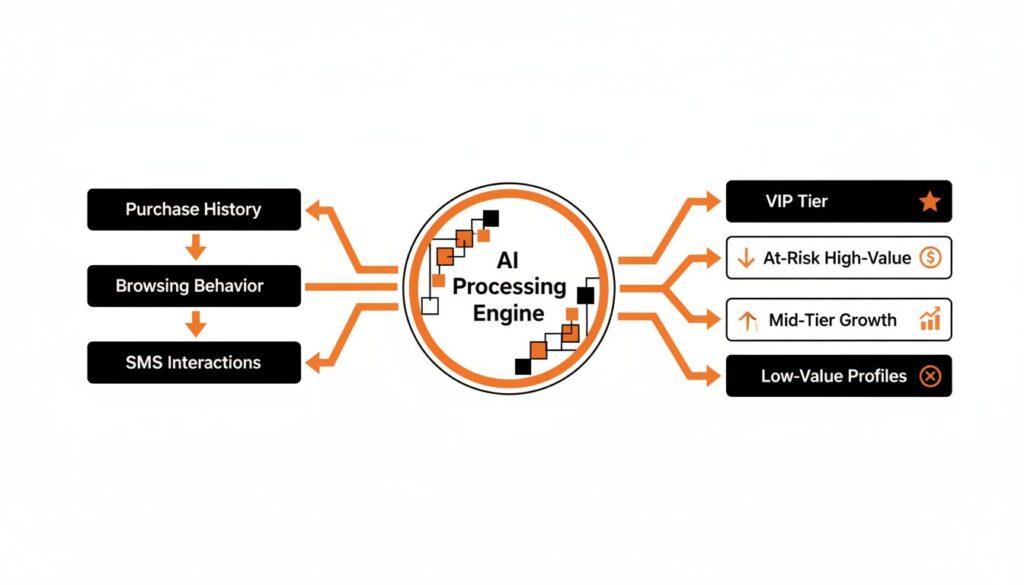
Predictive AI transforms customer lifetime value from a historical reporting metric into a forward-looking strategic signal. Instead of waiting to see which customers churn, machine learning models identify at-risk high-value customers 30 to 90 days before they leave. Instead of treating all customers the same, AI calculates individual value ceilings and automatically routes each customer to the optimal retention strategy.
The shift from static CLV calculations to predictive models is not optional for retail and e-commerce brands competing for margin in a high-CAC environment. It directly impacts which customers you acquire, how much you spend retaining them, and how much revenue you protect.
The Growth Imperative: Why Historical CLV Is No Longer Enough
Traditional customer lifetime value calculations rely on simple arithmetic. You take average order value, multiply by purchase frequency, and multiply by expected customer lifespan. This formula worked when customer behavior was predictable and acquisition costs were low.
Today, this approach creates a strategic blind spot. Historical CLV is purely retrospective. It sums what a customer has already spent and projects that pattern forward indefinitely, assuming nothing changes. Real customer behavior is far more dynamic.
The Economic Pressure Driving CLV Evolution
Customer acquisition costs in retail and e-commerce have increased 220 percent in the last five years. Paid search, social media, and affiliate channel costs continue to rise as competition intensifies. This economic reality forces a fundamental shift in how marketing teams allocate budget.
When acquisition costs are low, it is acceptable to treat all customers similarly during the retention phase. When acquisition costs are high, every retention decision must be economically justified by predicted customer value. A customer you acquire for $50 must generate significantly more than $50 in lifetime revenue to be profitable.
Historical CLV cannot answer this question because it calculates value retroactively. You do not know a customer’s true lifetime value until they have finished their entire relationship with your brand. By then, the acquisition decision is already made and the retention window has closed.
The Limitations of Static Formulas
Static CLV formulas ignore the most predictive signal available: current behavioral change. A customer whose purchase frequency has dropped from one order per 30 days to one order per 90 days is exhibiting a clear churn signal. A static formula cannot detect this shift because it averages all historical behavior together.
Omnichannel complexity breaks traditional CLV models. Many retailers still cannot link offline point-of-sale purchases with online browsing behavior and email engagement. Without a unified customer view, CLV calculations are fragmented across channels, missing the complete picture of customer value.
Manual data reconciliation slows response time. Without automated identity resolution, marketing teams spend weeks aligning customer records from different systems before analysis can begin. By the time insights emerge, customer intent has shifted.
How Predictive AI Solves These Problems
Predictive CLV models continuously analyze real-time behavioral signals to forecast future customer value. Instead of waiting for historical patterns to repeat, machine learning algorithms detect subtle shifts in engagement and spending that precede churn or high-value purchases.
These models process omnichannel data streams simultaneously: purchase history, browsing behavior, email engagement, SMS interactions, loyalty program activity, and support ticket sentiment. This unified view enables accurate prediction of individual customer value trajectories.
Real-time scoring means insights are available immediately, not weeks later. A customer showing early churn signals can be identified and targeted within days, not after they have already left.
Under the Hood: How AI Reconfigures Lifetime Value Modeling
Predictive CLV relies on three distinct mathematical approaches, each suited to different data structures and business questions. Understanding these approaches helps you evaluate which models work best for your retail environment.
Probabilistic Transaction Models: The Mathematical Foundation
Probabilistic models like BG/NBD (Beta-Geometric Negative Binomial Distribution) and Gamma-Gamma are the foundational approach for CLV prediction. These models treat customer purchases as random events with predictable statistical distributions.
BG/NBD models the probability that a customer will make a purchase in any given time period, based on their historical purchase frequency and recency. Gamma-Gamma models predict the monetary value of each future purchase based on the customer’s historical average order value.
Together, these models calculate expected CLV by multiplying predicted purchase probability by predicted monetary value. A customer with a 60 percent probability of purchasing in the next 12 months and an average order value of $150 has an expected CLV of $90 in that period.
Probabilistic models are interpretable and work well with limited data. They are ideal for foundational CLV calculations and serve as a performance baseline for more advanced approaches.
Supervised Machine Learning: Processing Complex Behavioral Data
Gradient boosted tree models like XGBoost and LightGBM outperform probabilistic models on structured retail data in 80 percent of cases. These algorithms treat CLV prediction as a regression problem: given a set of customer features, predict the customer’s revenue in the next 12 months.
Supervised models handle complex, non-linear relationships between customer features and future value. They automatically detect which behavioral signals are most predictive. A customer who browses a specific product category has a different value trajectory than a customer who never browses that category, even if both have identical historical purchase patterns.
Feature engineering is the critical differentiator between mediocre and production-ready supervised models. Raw CRM fields like “last login date” or “purchase count” produce weak predictions. Engineered features like “rate of change in engagement frequency” or “time between support tickets” capture behavioral dynamics that precede churn with 85 to 92 percent accuracy.
Gradient boosted models train in minutes, handle missing values natively, and produce interpretable feature importance rankings that business stakeholders can understand and act on.
Deep Learning and Sequential Pipelines: Detecting Behavioral Sequences
Recurrent Neural Networks (RNNs) and Transformer models excel at analyzing the exact sequential order of customer touchpoints. These models detect subtle patterns in how customers interact with your brand over time.
A customer who browses a specific FAQ page, then drops their subscription tier, then stops opening marketing emails exhibits a sequential pattern different from a customer who simply takes a vacation. Deep learning models capture these sequential dependencies to predict churn or high-value purchases with precision.
Deep learning outperforms other approaches only when you have sequential behavioral data with more than 50 time steps per customer. For most retail environments, gradient boosted trees deliver superior performance with lower computational cost.
Operationalizing Predictive Analytics: The Four Strategic Value Tiers
AI-calculated CLV scores automatically populate active target cohorts within your CRM ecosystem. Each cohort requires distinct operational workflows and retention strategies.
| Customer Segment | Predicted CLV | Churn Probability | Recommended Action | Expected ROI |
|---|---|---|---|---|
| VIP Tier | Top 10% | Low | Dedicated support, early access, VIP perks | 5-10x acquisition cost |
| At-Risk High-Value | High | Rising | Priority intervention, personalized offers | 3-5x acquisition cost |
| Mid-Tier Growth | Moderate | Low | Cross-sell campaigns, category expansion | 2-3x acquisition cost |
| Low-Value, High-Cost | Bottom 30% | Variable | Automated, low-touch channels | Margin protection |
Tier 1: Predictive Top-Tier VIPs (High Value, High Stability)
What it means: Customers predicted by AI models to generate maximum revenue and maintain high relationship stability over the next 12 months.
Why it matters: This tier represents the core profitability of your brand. These customers generate disproportionate revenue relative to acquisition cost and require premium, proactive relationship management to maintain lifetime value.
How to identify it: Top decile of predicted CLV scores combined with consistent high engagement metrics across email, SMS, and website channels. Stability indicators include low churn probability and consistent purchase frequency.
Recommended CRM actions:
- Route these profiles directly to dedicated customer service paths with priority support
- Unlock early access to new product lines and exclusive collections
- Reward them with experiential loyalty perks (VIP events, personalized styling, priority shipping) rather than margin-diluting discount codes
- Assign account managers for proactive relationship management
- Trigger personalized check-in campaigns from brand leadership
Business and ROI impact: VIP retention directly maximizes advocacy and organic word-of-mouth growth. Protecting this tier secures the highest margin baseline for the business. A single high-value customer protected from churn generates 5 to 10 times more revenue than a typical acquisition.
Tier 2: At-Risk High-Value Cohorts (High Value, Spiking Churn Probability)
What it means: Highly profitable customers who show subtle, micro-behavioral signs of boredom or imminent abandonment.
Why it matters: Intercepting a high-value customer before they click cancel protects business revenue at a fraction of the cost of re-acquisition. A customer worth $5,000 in annual CLV is not interchangeable with a new customer worth $100.
How to identify it: High predicted CLV paired with a sudden drop in email interaction depth, increasing time-between-purchases, or negative post-purchase sentiment scores. Churn probability models flag these customers 30 to 90 days before actual abandonment occurs.
Recommended CRM actions:
- Automatically trigger a high-priority customer success playbook
- Deploy a personalized check-in email from brand leadership acknowledging their value
- Offer tailored incentives structured around their specific historical product affinities, not generic discounts
- Assign a dedicated customer success manager for immediate outreach
- Trigger SMS reminder if email is not opened within 24 hours
- Provide exclusive access to new products or categories they have previously shown interest in
Business and ROI impact: Proactive VIP reactivation campaigns achieve 30 to 50 percent higher response rates than generic win-back campaigns. By preventing even one high-value customer from churning, the intervention pays for itself many times over.
Tier 3: Mid-Tier Growth Prospects (Moderate Current Value, High Upsell Propensity)
What it means: Average spending shoppers who exhibit digital behaviors identical to the historical onboarding patterns of top-tier VIPs.
Why it matters: This segment holds the highest latent revenue potential. These customers are on a trajectory to become high-value accounts. They are the most cost-effective targets for value expansion because their acquisition cost is already sunk.
How to identify it: Moderate historical spend combined with high browse frequency, multiple product reviews, or repeated usage of your mobile app. Propensity models identify customers whose behavioral patterns match historical VIP onboarding sequences.
Recommended CRM actions:
- Embed personalized cross-sell and upsell product recommendation carousels within their checkout flows
- Trigger automated email journeys tailored to complementary high-margin product categories
- Offer category-specific incentives (free shipping on new categories, loyalty points multipliers) to encourage expansion
- Create bundled product offers combining their frequently purchased items with complementary products
- Segment these customers into a dedicated nurture program focused on category expansion
Business and ROI impact: Systematic value expansion lifts average order value (AOV) and accelerates the velocity of the customer’s transition into premium loyalty brackets. A customer moved from mid-tier to VIP tier increases lifetime value by 300 to 500 percent.
Tier 4: Low-Value, High-Cost Profiles (Minimal Value, Disproportionate Support Volume)
What it means: Customers with minimal predicted financial worth who drain significant customer service and logistics resources.
Why it matters: Over-investing marketing dollars or expensive human support resources into low-ceiling cohorts directly degrades corporate profitability. Protecting margins requires conscious de-prioritization of unprofitable segments.
How to identify it: Bottom tier of predicted CLV combined with high discount-only purchase patterns, frequent product return events, and high support ticket volume. These customers generate minimal revenue but consume disproportionate operational resources.
Recommended CRM actions:
- Shift these profiles entirely to automated, low-touch self-service channels
- Suppress them from premium direct-mail or expensive SMS retention loops
- Focus marketing outreach on basic organic newsletters and community engagement
- Implement automated chatbot support for routine questions instead of human CSM interaction
- Exclude them from acquisition lookalike campaigns to prevent repeating the same acquisition mistake
Business and ROI impact: Protecting operational margins by de-prioritizing low-value cohorts refocuses internal team bandwidth onto relationship-critical accounts. This tier should consume less than 10 percent of your retention marketing budget despite potentially representing 30 to 40 percent of your customer base.
Multi-Channel Use Cases for Actionable CLV Signals
Predictive CLV scores only generate value when activated across marketing channels. These use cases show how retail enterprises push AI-calculated scores into active digital marketing workflows.
Use Case 1: High-Value Lookalike Seeding for Performance Ads
Exporting your top decile of predicted CLV profiles creates a seed audience for Meta Advantage+ and Google Smart Bidding campaigns. These platforms use your high-value customer cohort as a reference to find similar prospects in their advertising networks.
The result is a dramatic improvement in return on ad spend (ROAS) for paid acquisition. Instead of optimizing toward generic conversion signals, your ad platforms optimize toward customers who will generate the highest lifetime value. A typical improvement is 40 to 60 percent better ROAS on lookalike audiences seeded with high-CLV customers compared to generic conversion-based lookalikes.
This approach also reduces wasted acquisition spend on low-value customer cohorts. Your ad platforms stop pursuing customers who match the profile of your low-value, high-cost tier, protecting margins before those customers are even acquired.
Use Case 2: Intent-Driven Lifecycle Outreach
Aligning product replenishment cadences or bundle offers with an individual shopper’s predicted engagement peak maximizes conversions compared to generic calendar schedules. A customer predicted to have highest engagement on Wednesday mornings receives replenishment reminders on Wednesday mornings, not on the brand’s preferred Tuesday send time.
Predictive engagement timing combined with CLV-informed incentive scaling creates highly efficient lifecycle campaigns. High-CLV customers receive messaging without discounts. Mid-CLV customers receive limited-time free shipping. Low-CLV customers receive modest percentage discounts. This intent-driven approach maximizes recovery while protecting margins.
Use Case 3: Automated Churn Intervention Workflows
Churn prediction models integrated with CRM automation trigger intervention campaigns before customers actually leave. A customer flagged as high-churn risk receives an automated sequence: personalized email from leadership, SMS reminder if email is not opened, exclusive offer on their favorite product category, and web banner promoting VIP loyalty benefits.
Different intervention strategies apply to different risk tiers. High-value at-risk customers receive high-touch interventions with personalized offers. Low-value at-risk customers receive automated, low-cost interventions. This tiered approach maximizes retention ROI by matching intervention cost to customer value.
Common Pitfalls in Customer Value Forecasting
Successful predictive CLV implementation requires avoiding several critical mistakes that undermine model accuracy and business impact.
Pitfall 1: Fragmented Data Warehouses and Channel Silos
The most common barrier to effective CLV prediction is data fragmentation. Customer purchase data lives in the e-commerce platform, email engagement data lives in the email service provider, SMS data lives in the SMS platform, and website behavior lives in analytics tools.
Without unified data, AI models cannot build accurate customer profiles. You cannot calculate accurate churn probability if you do not have complete email engagement history. You cannot identify at-risk customers if you do not see the full picture of declining engagement across all channels.
The fix: Implement a unified data layer that consolidates first-party customer data from all touchpoints into a single source of truth. This can be achieved through a customer data platform (CDP) or through your CRM’s native data consolidation capabilities. Ensure that data syncs in real time or at minimum daily to keep AI models current.
Pitfall 2: Over-Emphasizing Short-Term Behavioral Spikes
Many teams build CLV models that overweight recent behavior at the expense of historical trends. A customer who made three large purchases in the past month gets a high CLV prediction, even though their historical pattern is one purchase per year.
This approach generates false positives that waste retention budget on customers unlikely to remain high-value. It also creates model drift as short-term seasonal patterns overwhelm longer-term customer trajectories.
The fix: Engineer features that capture both short-term momentum and long-term historical patterns. Include features like “rate of change in purchase frequency” alongside “historical average purchase frequency.” Use time-decay weighting that gives recent behavior more influence without completely discounting historical patterns.
Pitfall 3: Failing to Deploy Control Groups and Holdout Audiences
Many marketing teams deploy CLV-optimized campaigns without establishing proper control groups. They see improved metrics and assume the AI campaign caused the improvement, when in fact the improvement might be due to external factors like seasonality or competitive activity.
This leads to inflated attribution metrics and incorrect ROI calculations. Teams invest in CLV optimization based on false performance signals, then become disillusioned when real incrementality proves lower than expected.
The fix: Implement holdout groups for all CLV-optimized campaigns. A portion of your audience (typically 10 to 20 percent) receives no CLV-optimized treatment and serves as a control group. Compare the performance of the CLV-optimized group against the control group to calculate true incremental lift. This approach provides accurate ROI measurement and prevents over-optimizing based on inflated metrics.
Pitfall 4: Ignoring Privacy and Consent Requirements
Customer data privacy regulations (GDPR, CCPA, CPRA) require explicit consent for data collection and use. CLV models that make decisions based on non-consensual data violate privacy regulations and damage customer trust.
A customer who has not consented to behavioral tracking should not receive messages based on their browsing behavior, even if that behavior predicts high CLV.
The fix: Implement a robust consent management system that tracks customer preferences and respects opt-out requests. Ensure that your CLV models only reach customers who have explicitly consented to receive marketing communications. Build consent checks into your CRM workflows so that messages are only triggered when consent is valid.
Scaling Customer Value Safely with Bloomreach and Loomi AI
Bloomreach is purpose-built for predictive customer value strategy. It combines customer data, purchase histories, and live context into a Single Customer View (SCV) that powers all AI-driven decisions.
Single Customer View and Real-Time Segmentation
Bloomreach Engagement creates a unified customer profile by consolidating first-party data from e-commerce platforms, CRM systems, email, SMS, and web analytics. This unified foundation is essential for accurate CLV prediction.
Bloomreach’s dynamic segmentation engine updates customer cohorts in real time as behavior changes. A customer who makes a purchase automatically exits the “at-risk” segment and enters the “repeat customer” segment. A customer whose email engagement declines automatically enters the “disengaged” segment. This real-time responsiveness ensures that CLV predictions remain accurate and campaigns remain relevant.
Loomi AI for Autonomous Value Prediction
Loomi, Bloomreach’s AI engine, calculates individual CLV scores and churn probabilities natively without requiring external data engineering teams. Loomi analyzes customer behavior patterns, product affinity, and engagement history to automatically determine each customer’s predicted lifetime value.
Loomi can automatically identify which customers belong in each value tier based on their predicted CLV and churn probability. It can generate segment recommendations for activation across email, SMS, and web channels. It can even suggest which intervention strategy will be most effective for each at-risk customer based on their historical response patterns.
Omnichannel Campaign Orchestration
Bloomreach enables marketers to design and execute retention campaigns across email, SMS, push notifications, and onsite web experiences from a single interface. This omnichannel coordination ensures that customers receive consistent, complementary messages across all touchpoints.
A customer in the “at-risk high-value” segment might receive a personalized email, followed by an SMS reminder if email is not opened, followed by a special offer displayed on their next website visit. This coordinated approach is significantly more effective than siloed, single-channel campaigns.
How Voxwise Can Help Transform Your CLV Strategy
Voxwise partners with retail and e-commerce brands to design, implement, and optimize predictive customer value strategies that increase ROAS, reduce customer acquisition costs, and protect margins.
Data Foundation and CLV Audit
Voxwise begins by auditing your existing data infrastructure, customer segmentation, and retention campaign workflows. We identify data silos, inconsistencies in how customer behavior is tracked, and gaps in your current CLV strategy.
Based on this audit, Voxwise recommends a phased approach to unifying your customer data and implementing predictive CLV. We prioritize quick wins that deliver immediate ROI while building toward comprehensive AI-driven segmentation.
Bloomreach Implementation and CLV Configuration
Voxwise specializes in Bloomreach implementation, helping brands set up unified customer profiles, real-time segmentation, and AI-powered CLV prediction. We design value tier strategies aligned with your specific business objectives and customer lifecycle.
Our implementation approach includes data mapping, segment configuration, CLV model training, and performance measurement. We ensure that your Bloomreach instance is optimized for sustainable ROAS improvement and that your team has the expertise to manage and optimize campaigns over time.
CLV-Driven Campaign Strategy and Testing
Voxwise designs end-to-end retention campaign strategies that leverage predictive CLV to deliver personalized interventions at optimal moments. We configure automated workflows that trigger based on CLV scores and churn probability, delivering relevant, timely messages to each customer segment.
These campaigns span VIP retention, at-risk reactivation, mid-tier expansion, and low-value de-prioritization. Each workflow is designed to maximize conversion rates while protecting margins through value-informed incentive scaling.
Performance Measurement and Continuous Optimization
Voxwise establishes measurement frameworks that track campaign performance using revenue-focused metrics: customer retention rate, customer acquisition cost, customer lifetime value, and incremental return on ad spend. We implement rigorous testing to validate optimization strategies and identify improvement opportunities.
Our optimization approach is continuous, with regular campaign refinement, messaging testing, and channel optimization. We focus on sustainable, long-term improvements in ROAS and CLV rather than short-term metric optimization.
Frequently Asked Questions
What is the fundamental difference between historical CLV and predictive CLV?
Historical CLV calculates what a customer has already spent and projects that pattern forward indefinitely. Predictive CLV uses machine learning to forecast future customer value based on current behavioral signals, accounting for changes in purchase frequency, engagement, and churn probability. Predictive CLV is forward-looking and actionable; historical CLV is retrospective and static.
How early can an AI model accurately predict a customer’s long-term lifetime value?
Gradient boosted models achieve 85 to 92 percent accuracy in predicting 12-month CLV within 30 to 60 days of a customer’s first interaction with your brand. The model improves in accuracy as more behavioral data accumulates, but meaningful predictions are available far earlier than traditional methods allow. Churn prediction models can flag at-risk customers 30 to 90 days before they actually leave.
What specific transactional and behavioral data inputs are needed for predictive CLV modeling?
Effective CLV models require unified first-party data including purchase history (order dates, AOV, product categories), digital behavior (website visits, browsing history, cart abandonment), email engagement (open rates, click rates, conversion), SMS engagement, loyalty program status, and customer service interactions. The more complete and unified this data, the more accurate the AI predictions.
Ready to Transform Your CLV Strategy
Building high-converting retention campaigns powered by predictive CLV is not a one-time project. It is an ongoing practice of measuring what works, testing new approaches, and continuously optimizing your segmentation logic and campaign messaging.
The retail brands that win at CLV prediction are those that treat AI as a core competency, invest in unified customer data infrastructure, and commit to continuous testing and measurement.
Voxwise brings the expertise, technology partnerships, and strategic thinking required to turn your customer data into a CLV prediction engine that drives sustainable revenue growth and protects margins.