Bloomreach Engagement for E-commerce Personalization
E-commerce teams today operate within a complex, fragmented reality. Your product recommendation engine runs on one database, your email marketing platform on another, and your web personalization layer on yet another. This architectural fragmentation creates operational friction that silently erodes customer experience quality and revenue potential. The challenge is not whether your business needs personalization, but whether your technology stack can actually deliver it in real time.

Bloomreach Engagement solves this fundamental problem by unifying customer data, content generation, and omnichannel delivery into a single, real-time operating system. Rather than stitching together disconnected point solutions, Bloomreach creates a continuous personalization engine that adapts customer experiences across web, email, SMS, and mobile in milliseconds, not hours. This architectural difference transforms personalization from a campaign tactic into a structural business capability.
Use Case Question
How can e-commerce and retail brands eliminate data latency and deliver truly personalized customer experiences across all touchpoints using an integrated real-time CDP and AI-powered content generation platform?
Short Answer
Bloomreach Engagement unifies first-party customer data, behavioral event streams, and product catalogs into a real-time CDP, then applies Loomi AI and Jinja-based content customization to generate hyper-relevant experiences across web, email, SMS, and mobile. This eliminates the data synchronization delays that plague fragmented tech stacks, enabling true 1:1 personalization at scale while providing native control groups and analytics to measure incremental revenue impact.
The Personalization Bottleneck: Why Disconnected Marketing Stacks Fail
Retail and e-commerce organizations investing heavily in personalization often discover that their technology investments do not deliver proportional business returns. The root cause is architectural, not strategic. When your customer data platform, recommendation engine, email service provider, and web personalization layer operate as separate systems, data latency becomes endemic.
Consider a typical customer journey: A visitor browses your website, views three specific product categories, adds an item to their cart, and abandons. Your web analytics platform captures this behavior, but that data must be exported, transformed, loaded into your email marketing platform, and then deployed in a campaign. By the time this abandoned cart email arrives, the customer has either completed the purchase elsewhere or lost interest. The real-time behavioral signal that could have driven immediate action is lost in translation between systems.
This data latency problem compounds across channels. Your recommendation engine operates on historical purchase data updated daily. Your email platform personalizes based on data synced yesterday. Your SMS system uses attributes refreshed weekly. Customers receive contradictory recommendations, irrelevant messaging, and experiences that feel generic despite your technology investments. The result is message fatigue, rising unsubscribe rates, declining engagement metrics, and lost revenue opportunities.
The financial cost of fragmented personalization is substantial. Marketing teams spend 30-40% of their time managing data integrations and reconciliation rather than strategy and optimization. Each integration point introduces data quality risks, synchronization delays, and operational complexity. Worse, disconnected systems prevent true control group testing, making it nearly impossible to measure the incremental revenue impact of personalization initiatives. Decision-makers cannot confidently justify continued investment when they cannot prove ROI.
The Architectural Foundations of Personalization in Bloomreach Engagement
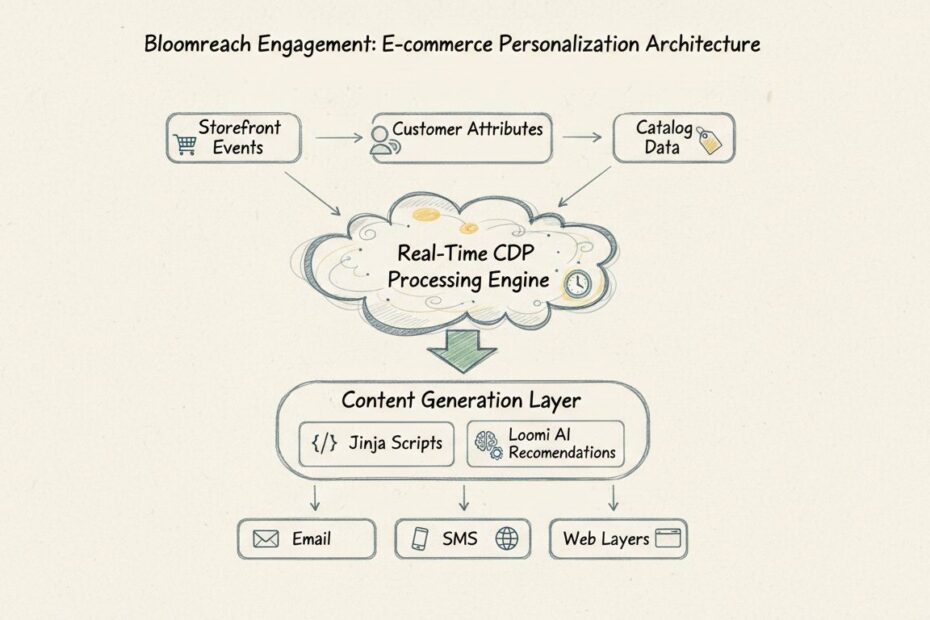
Bloomreach Engagement eliminates data latency through three interconnected technical pillars that work as a unified system rather than separate modules.
In-Memory Real-Time Customer Data Platform
At the foundation of Bloomreach Engagement sits an in-memory CDP that consolidates all customer intelligence into a single, continuously updated customer profile. Unlike traditional data warehouses that batch-load data on fixed schedules, Bloomreach’s CDP ingests behavioral event streams (product views, purchases, cart interactions), customer attributes (demographics, preferences, loyalty status), and product catalog data in real time with zero latency.
This architecture means that when a customer views a product on your website, that event is immediately available for personalization logic. When they add an item to their cart, that signal propagates instantly across all channels. When they abandon checkout, you can trigger a recovery message within seconds, not hours. The CDP serves as the single source of truth for customer state, eliminating the data synchronization problems that plague fragmented stacks.
The real-time nature of this CDP is critical for e-commerce. Customer intent signals are time-sensitive. A visitor who views winter coats needs recommendations for winter coats, not the summer dresses they browsed last month. A customer who just completed a purchase should not receive a welcome email. An abandoned cart recovery message must arrive within minutes, not days. Bloomreach’s in-memory architecture ensures that every personalization decision is based on current, accurate customer state.
Loomi AI: Agentic Commerce Intelligence
Bloomreach Engagement includes Loomi AI, an agentic AI system trained on rich customer and product datasets to predict customer intent and automate personalization at scale. Unlike rule-based recommendation engines that rely on manual segment definitions, Loomi AI continuously analyzes customer behavior patterns, product affinities, and purchase propensities to surface monetization opportunities that human analysts might miss.
Loomi AI operates across three core functions within Bloomreach Engagement. First, it powers product recommendation algorithms that move beyond “customers who bought X also bought Y” to identify subtle preference patterns and cross-sell opportunities. Second, it optimizes content generation by selecting the most resonant messaging, imagery, and calls-to-action for each customer segment. Third, it automates journey orchestration by determining the optimal timing, channel, and frequency for each customer interaction based on predicted engagement and conversion likelihood.
The practical impact is significant. Bloomreach customers report that AI-driven recommendations generate 11 times higher click-through rates than control groups (as demonstrated in the MALL.CZ personalized video campaign case study). This is not incremental improvement; this is structural transformation of how customers discover and purchase products.
Unified Omni-Channel Canvas
Bloomreach Engagement provides a single orchestration layer that executes personalized journeys across email, SMS, mobile push, and dynamic web layers from one master system. Rather than managing separate campaigns in separate platforms, marketing teams design once and deploy everywhere.
This unified canvas is essential for coherent customer experience. When a customer receives a personalized email recommending a specific product, that same product should appear in their web personalization layer and SMS follow-up. When they click through on email, their web experience should acknowledge their previous interaction and show relevant next-step products. Unified orchestration ensures message consistency and eliminates the contradictory experiences that damage brand trust.
Actionable Use Cases: Scaling 1:1 Personalization with Bloomreach
Use Case 1: Dynamic On-Site Personalization and Web Layers
What it means: Real-time modification of your website storefront based on individual visitor attributes and live behavioral signals. Rather than showing every customer the same homepage layout, Bloomreach dynamically renders different hero banners, featured product grids, and promotional messaging based on what the system knows about each visitor.
Why it matters: Homepage engagement is a critical conversion driver. A generic homepage converts at industry averages of 2-3%. Personalized homepages that show relevant product categories, collections, and promotions to each visitor reduce bounce rates and increase session depth. When a customer lands on your site having previously browsed winter apparel, showing them winter collection banners and featured winter products instead of generic homepage content lifts conversion probability immediately.
How to apply it: Bloomreach tracks real-time storefront events including product views, category exploration, and search behavior. This behavioral data flows immediately into the CDP, where it becomes available for personalization logic. Your marketing team configures rules-based or AI-driven web layer rules that determine which content variations display to which visitor segments.
Recommended CRM action: Configure a web layer rule that displays category-specific hero banners based on the visitor’s current session category affinity. If a visitor has viewed five products in the “athletic footwear” category during their current session, the homepage displays your featured athletic shoe collection and a targeted CTA. If another visitor browses “evening dresses,” they see your evening wear banner instead. This requires no manual segment creation; the system operates on live behavioral signals.
Business impact: E-commerce brands implementing dynamic web layers report 15-25% increases in homepage-to-category click-through rates and 8-12% improvements in conversion rate. The personalization happens instantly, without requiring customer login or complex data enrichment.
Use Case 2: Hyper-Personalized Product Recommendation Grids
What it means: Bloomreach generates dynamic product discovery blocks embedded across your website, emails, and marketing communications using machine learning algorithms trained on product attributes, customer behavior, and purchase history. Rather than manually selecting “featured products,” the system identifies the most relevant products for each individual customer.
Why it matters: Product discovery is a primary driver of average order value and repeat purchase rate. Customers who discover products through personalized recommendations purchase at higher frequency and higher basket value than customers who navigate manually. Bloomreach’s recommendation engine surfaces products that match customer preferences, size ranges, style affinities, and price sensitivities without requiring customers to search.
How to apply it: The system ingests your product catalog (including attributes like category, size, color, price, brand) and customer interaction data (views, clicks, purchases, returns). Loomi AI analyzes these datasets to identify recommendation patterns. For each customer, the system calculates which products have the highest purchase probability based on similar customer behavior and product similarity metrics.
Recommended CRM action: Embed Bloomreach recommendation grids in three high-impact locations: (1) post-purchase confirmation emails showing complementary products to increase order value, (2) cart abandonment recovery emails suggesting items that match the abandoned products, and (3) product detail pages showing “frequently bought together” items. Each grid displays different products to different customers based on their individual preference profiles.
Business impact: Recommendation-driven product discovery typically increases average order value by 10-20% and improves cross-sell revenue by 15-30%. Bloomreach customers report that recommendation emails generate 3-5 times higher click-through rates than non-personalized product emails. This is one of the highest-ROI personalization tactics available to e-commerce teams.
Use Case 3: Dynamic Campaign Content Customization Using Jinja Tokens
What it means: Bloomreach Engagement allows you to embed dynamic content variables (Jinja tokens) directly into email, SMS, and web layer copy. Rather than creating separate campaign versions for different segments, you write a single campaign template with conditional logic that automatically adjusts content based on customer data.
Why it matters: Campaign personalization at scale requires either manual segment creation (time-consuming and static) or dynamic content customization (scalable and real-time). Jinja-based personalization enables true 1:1 customization without multiplying campaign complexity. A single automated email can deliver completely different messages to different customers based on their profile data.
How to apply it: Your marketing team defines customer data fields available for personalization (first name, last purchase category, loyalty tier, browsing history, skin type, size preference, etc.). You then write email copy that includes Jinja syntax referencing these fields. For example: “Hi {{customer.first_name}}, we noticed you love {{customer.favorite_category}}. Check out these new arrivals in {{customer.favorite_category}}.”
Recommended CRM action: Implement Jinja personalization in your welcome email series. Rather than sending the same welcome email to all new customers, configure dynamic content that personalizes based on signup survey responses or first-visit behavior. A customer who indicated “sensitive skin” receives welcome messaging focused on gentle skincare products. A customer who browsed athletic wear receives messaging focused on performance apparel. The same email template delivers completely different experiences.
Business impact: Jinja-based personalization increases email open rates by 15-25% and click-through rates by 20-35% compared to non-personalized emails. The content feels relevant because it is genuinely relevant to each individual customer. This reduces unsubscribe rates and builds long-term brand trust.
Proving Personalization ROI: Native Control Groups and Analytics
Measuring the true business impact of personalization requires rigorous statistical methodology. Many e-commerce teams implement personalization but struggle to prove incremental revenue impact because they lack proper control group infrastructure. Bloomreach Engagement includes native holdout control group functionality that automatically segments a percentage of your audience to receive non-personalized experiences, allowing you to measure the incremental lift driven by personalization.
Here is how it works: When you launch a personalized campaign, you configure a control group percentage (typically 10-15% of the audience). Bloomreach automatically segments this control audience to receive a non-personalized version of the same campaign (or no campaign). You then measure key performance metrics (click-through rate, conversion rate, revenue per email, customer lifetime value) across personalized and control groups.
The difference between personalized and control group performance represents the true incremental impact of your personalization strategy. If personalized emails convert at 4.2% and control emails convert at 3.1%, you have measured a 1.1 percentage point incremental lift directly attributable to personalization. This methodology eliminates guesswork and provides defensible ROI justification for continued investment.
Bloomreach’s native analytics layer aggregates this data across all campaigns and channels, providing dashboards that track:
- Incremental revenue lift: Total revenue generated by personalized experiences minus revenue that would have occurred with non-personalized alternatives
- Customer lifetime value (CLV) impact: How personalization affects long-term customer value and retention
- Channel performance: Which channels (email, SMS, web, push) deliver highest ROI for personalized campaigns
- Segment performance: Which customer segments respond most strongly to personalization
- Cohort analysis: How customer cohorts (acquired in specific periods, from specific channels) respond to personalization over time
This analytics infrastructure transforms personalization from a tactical marketing initiative into a measurable, optimizable business capability.
How It Works in Practice: Real-World Scenario
Consider a mid-size fashion e-commerce brand with 500,000 active customers, operating across web, email, SMS, and Instagram channels. The brand’s previous tech stack included a legacy email platform, a separate web analytics tool, and a basic recommendation engine. Personalization efforts were limited to basic segment targeting (new vs. returning customers, high vs. low spenders).
The brand implemented Bloomreach Engagement with the following architecture:
Data integration: Bloomreach ingests real-time event streams from the website (product views, clicks, purchases, cart interactions), customer attributes from the CRM (loyalty tier, purchase history, email engagement), and product catalog data (categories, sizes, colors, prices, inventory). This data flows into the in-memory CDP with zero latency.
Web personalization: The brand configures dynamic web layers that display different hero banners, category recommendations, and promotional messaging based on visitor behavior. A customer browsing dresses sees dress-focused content. A customer with previous purchase history in activewear sees activewear recommendations. The web experience is personalized in real time without requiring customer login.
Email personalization: The brand redesigns its lifecycle email program to leverage Bloomreach’s capabilities. Welcome emails use Jinja tokens to personalize based on signup survey responses. Post-purchase emails recommend complementary products using Loomi AI recommendation grids. Abandoned cart emails recover sales by showing the abandoned items plus AI-recommended alternatives. Re-engagement campaigns use Bloomreach’s predictive analytics to identify at-risk customers and deliver targeted win-back messaging.
SMS and push: The brand uses Bloomreach’s unified canvas to extend personalization to SMS and mobile push. High-value customers receive time-sensitive SMS offers for flash sales. Mobile app users receive push notifications with personalized product recommendations. All messaging is coordinated through Bloomreach to ensure consistency across channels.
Control groups and measurement: The brand configures 10% holdout control groups across all campaigns. Bloomreach automatically tracks incremental lift across personalized vs. control audiences. After 90 days, the analytics dashboard shows that personalized email campaigns generate 18% higher click-through rates and 12% higher conversion rates than control emails. SMS campaigns show 15% higher engagement. Web personalization increases homepage-to-product click-through by 22%.
Results: Over six months, the brand measures 24% incremental revenue lift attributable to Bloomreach personalization. Email revenue increases 18%, SMS revenue increases 22%, and web conversion rate increases 14%. Customer lifetime value for customers exposed to personalized experiences is 31% higher than the control cohort. The brand achieves payback on its Bloomreach investment within four months and continues to expand personalization across additional channels and use cases.
Data, Tools, and Teams Involved
Successful Bloomreach implementation requires coordination across multiple organizational functions. Understanding the team structure and data requirements is essential for planning your deployment.
| Function | Role | Responsibilities | Key Skills |
|---|---|---|---|
| CRM Manager | Strategy and Oversight | Define personalization strategy, prioritize use cases, measure ROI | Customer journey mapping, segmentation logic, analytics interpretation |
| Marketing Automation Engineer | Platform Configuration | Configure Bloomreach workflows, build automation rules, manage data flows | Jinja scripting, API integration, database schema understanding |
| Data Analyst | Data Quality and Insights | Ensure data accuracy, create analytics dashboards, identify optimization opportunities | SQL, data modeling, statistical analysis |
| E-commerce Product Manager | Web Personalization | Configure web layers, test personalization rules, optimize conversion | A/B testing, conversion rate optimization, product analytics |
| Email Marketing Specialist | Email Campaign Execution | Design personalized email templates, manage lifecycle programs, monitor engagement | Email design, copywriting, segmentation strategy |
| IT/Data Engineering | Technical Infrastructure | Manage API integrations, ensure data pipeline reliability, handle data governance | API development, ETL processes, data security |
The data requirements for Bloomreach implementation include:
- Behavioral event data: Product views, clicks, searches, cart interactions, purchases, returns (tracked via pixel or API)
- Customer attributes: Demographics, loyalty status, purchase history, engagement preferences, survey responses
- Product catalog data: Product IDs, categories, attributes (size, color, price), inventory status, images
- Historical transaction data: Past purchases, order values, return history (typically 12-24 months minimum for AI training)
- Email and channel engagement data: Opens, clicks, conversions, unsubscribes (for baseline performance measurement)
How to Measure Success
Bloomreach personalization success is measured through three interconnected frameworks: engagement metrics, financial metrics, and customer health metrics.
Engagement Metrics
- Email open rate: Target 5-10% improvement over baseline
- Click-through rate: Target 15-25% improvement for personalized campaigns
- Web session depth: Target 20-30% increase in pages per session
- Product page bounce rate: Target 10-15% reduction
- SMS engagement rate: Target 3-5% improvement over non-personalized SMS
Financial Metrics
- Incremental revenue: Measured through control group comparison; target 15-25% lift
- Average order value: Target 10-20% improvement through recommendation-driven cross-sell
- Customer lifetime value: Target 20-35% improvement for customers exposed to personalization
- Return on ad spend: Target 10-20% improvement through personalized ad messaging
- Payback period: Typical ROI payback occurs within 4-6 months
Customer Health Metrics
- Unsubscribe rate: Target 30-40% reduction through relevance-driven messaging
- Spam complaint rate: Target 50%+ reduction
- Customer retention rate: Target 10-15% improvement
- Net Promoter Score: Target 5-10 point improvement among personalized audience cohorts
How Voxwise Can Help
Bloomreach Engagement provides the platform infrastructure for sophisticated personalization, but successful implementation requires strategic planning, technical expertise, and ongoing optimization. Voxwise specializes in helping retail and e-commerce brands maximize the commercial return on their Bloomreach investment through comprehensive consulting and implementation services.
Voxwise Bloomreach Services
Personalization Strategy and Architecture: Voxwise works with your team to assess your current technology stack, identify personalization opportunities, and design a phased implementation roadmap. We help you prioritize use cases based on revenue impact and implementation complexity, ensuring you focus on initiatives that drive measurable business results.
Event Tracking and Data Architecture: Successful Bloomreach personalization requires clean, comprehensive event data. Voxwise conducts detailed audits of your current tracking implementation, identifies data gaps, and designs enhanced event schemas that capture the behavioral signals necessary for advanced personalization. We work with your technical teams to implement these tracking enhancements across web, mobile, and backend systems.
Segmentation and Audience Strategy: Voxwise helps you move beyond basic demographic segments to build sophisticated behavioral segments that power personalization at scale. We design RFM segmentation models, behavioral cohorts, predictive scoring frameworks, and dynamic audience definitions that evolve as customer data changes.
Bloomreach Configuration and Deployment: Our team handles the technical implementation of Bloomreach Engagement, including CDP configuration, data pipeline setup, web layer deployment, email automation design, and SMS integration. We ensure your platform is configured according to industry best practices and optimized for your specific business requirements.
Personalization Campaign Design: Voxwise designs and builds your core personalization campaigns, including welcome series, post-purchase recommendations, abandoned cart recovery, win-back programs, and loyalty communications. We establish the templates, Jinja personalization logic, and automation rules that scale personalization across your customer base.
Control Group Testing and Measurement: We establish rigorous testing frameworks to measure the true incremental impact of your personalization initiatives. We configure native control groups, design statistical methodologies to isolate personalization impact, and create analytics dashboards that track ROI across channels and campaigns.
Ongoing Optimization and Scaling: Personalization is not a one-time implementation; it is a continuous optimization discipline. Voxwise provides ongoing consulting to identify new personalization opportunities, optimize existing campaigns based on performance data, and scale successful tactics across additional channels and customer segments.
Frequently Asked Questions
Q: What is Bloomreach Engagement for e-commerce personalization?
Bloomreach Engagement is an integrated marketing automation and personalization platform that combines a real-time customer data platform, AI-powered recommendation engine, and omnichannel campaign orchestration. It enables e-commerce brands to deliver personalized customer experiences across web, email, SMS, and mobile based on unified first-party data and machine learning algorithms.
Q: Why is an integrated real-time CDP essential for scalable personalization?
Fragmented tech stacks create data latency that makes true real-time personalization impossible. When customer data, recommendations, and campaign execution operate on separate systems with different data refresh cycles, personalization decisions are based on stale information. An integrated real-time CDP ensures that every personalization decision uses current customer state, enabling immediate response to customer behavior.
Q: How does data latency between point solutions affect the customer experience?
Data latency creates contradictory customer experiences. A customer might receive an abandoned cart email for a product they already purchased through another channel. They might see product recommendations that do not match their recent browsing behavior. They might receive irrelevant messaging because the system does not know about their most recent interactions. These disconnects damage brand trust and reduce engagement.
Q: What are the four core data elements utilized in Bloomreach’s architecture?
The four core data elements are: (1) behavioral event data (product views, clicks, purchases), (2) customer attributes (demographics, preferences, loyalty status), (3) product catalog data (categories, attributes, inventory), and (4) historical transaction data (past purchases, engagement history).
Q: How can e-commerce teams use Jinja tokens to personalize campaign layouts?
Jinja tokens allow you to embed dynamic variables into email and SMS copy that automatically populate with customer-specific data. Rather than creating separate campaign versions for different segments, you write a single template with Jinja syntax like {{customer.first_name}} or {{customer.favorite_category}} that automatically inserts relevant data for each customer.
Q: What is the difference between product recommendations and on-site web layers?
Product recommendations are personalized product discovery blocks that suggest specific items based on customer behavior and preferences. Web layers are dynamic content modifications to your website layout, banners, and messaging based on visitor attributes. Both are personalization tactics, but recommendations focus on product discovery while web layers focus on messaging and navigation.
Q: How does Loomi AI discover hidden monetization opportunities in your customer base?
Loomi AI analyzes customer behavior patterns, product affinities, and purchase propensities to identify subtle cross-sell and upsell opportunities that rule-based systems might miss. It predicts which products individual customers are most likely to purchase, which messaging will resonate most strongly, and what timing and frequency optimize engagement without causing message fatigue.
Q: How do native control groups measure the true ROI of personalization campaigns?
Native control groups automatically segment a percentage of your audience (typically 10-15%) to receive non-personalized experiences. By comparing performance metrics between personalized and control audiences, you isolate the incremental impact of personalization. The performance difference represents the true ROI directly attributable to your personalization strategy.
Q: How does Voxwise help brands implement and optimize Bloomreach Engagement?
Voxwise provides comprehensive consulting and implementation services including strategy and architecture design, event tracking optimization, segmentation development, platform configuration, campaign design, testing framework setup, and ongoing optimization. We help you maximize the commercial return on your Bloomreach investment through expert guidance and technical execution.
Conclusion
Bloomreach Engagement transforms e-commerce personalization from a fragmented, latency-prone collection of point solutions into a unified, real-time operating system. By consolidating customer data, content generation, and omnichannel delivery into a single platform, Bloomreach eliminates the data synchronization delays that plague traditional tech stacks and enables true 1:1 personalization at scale.
The business impact is measurable and substantial. Brands implementing Bloomreach report 15-25% incremental revenue lift, 20-35% improvements in customer lifetime value, and payback periods of 4-6 months. These results are not achieved through incremental optimization; they reflect the structural advantage of unified, real-time personalization architecture.
The implementation path is clear: unify your customer data, leverage AI-driven recommendations, personalize across all channels, and measure impact through rigorous control group testing. Voxwise stands ready to guide your organization through this transformation, ensuring that your Bloomreach investment delivers maximum commercial return.
Explore More Personalization Resources
Interested in optimizing your e-commerce personalization strategy? Voxwise specializes in helping retail and e-commerce brands implement and scale Bloomreach Engagement and other advanced personalization platforms.
See our services to learn how we help brands maximize customer engagement and revenue through strategic CRM, data activation, and personalization consulting.
Request a 30-Minute Customer Engagement Consultation to discuss your segmentation and personalization strategy with our team.
Get a CRM Maturity Check to understand where your current capabilities stand and what optimization opportunities exist.
Check Your Bloomreach Setup if you already have the platform in place and want to optimize execution.