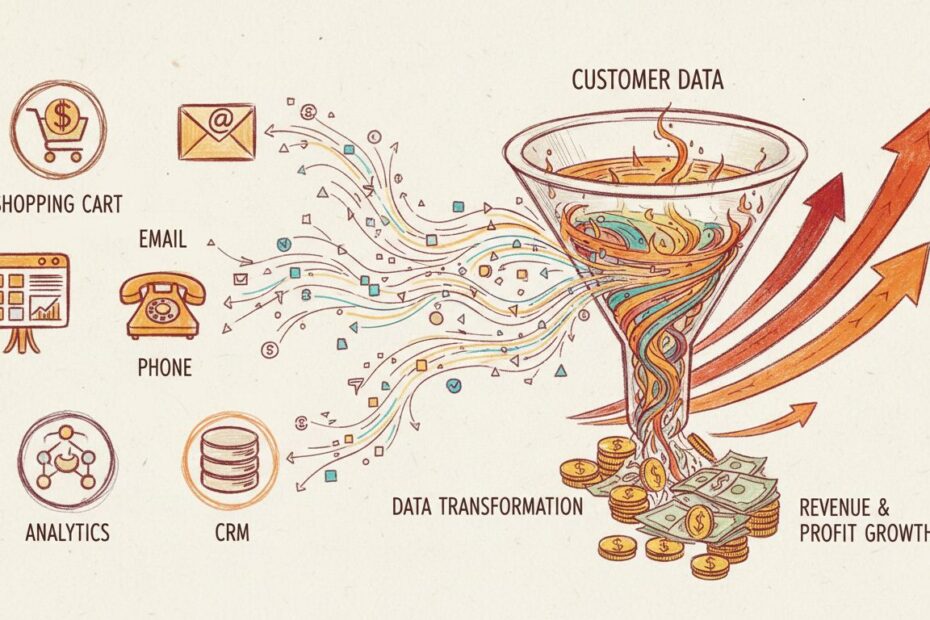
Transform Data Into Profit
Most organizations collect vast amounts of customer data every single day. Your e-commerce platform captures purchase behavior. Your website tracks visitor journeys. Your email system logs engagement metrics. Your CRM records sales interactions. Your mobile app monitors user activity. Yet despite collecting this treasure trove of information, most businesses struggle to transform it into measurable revenue growth. Data sits dormant in isolated systems, inaccessible to the teams that need it most. The result is missed opportunities, inefficient marketing spend, and customers who feel invisible rather than valued. Converting customer data into revenue is not complicated—it requires a clear strategy, the right technology, and commitment to turning insights into action. This guide reveals the proven framework that transforms raw data into revenue-generating outcomes.
What Does It Mean to Turn Customer Data Into Revenue?
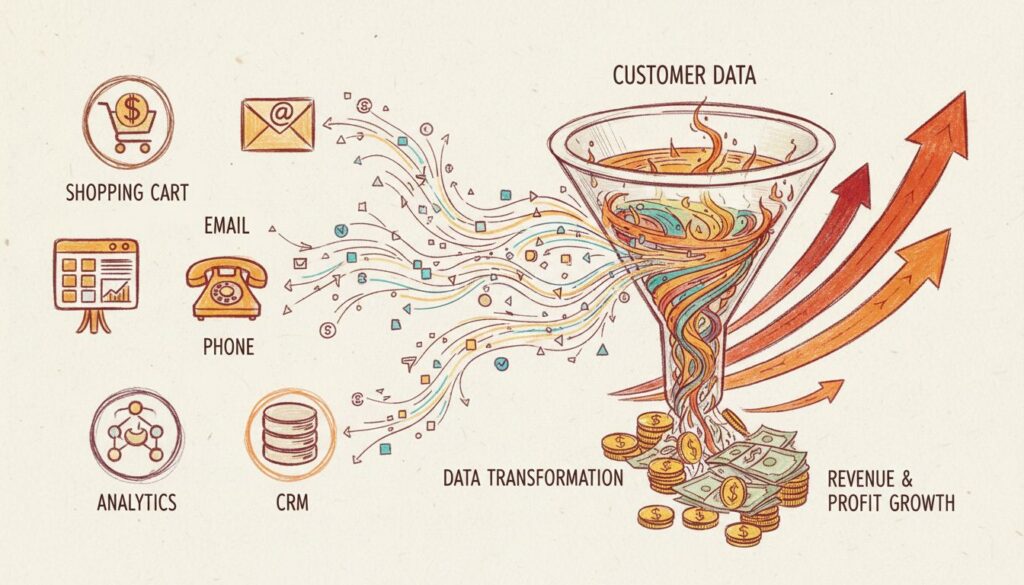
Converting customer data into revenue means systematically using customer information to drive business growth through both direct and indirect monetization strategies. Direct monetization involves selling data or data-derived products to external buyers.
Indirect monetization—which generates the majority of revenue for most businesses—involves using customer insights internally to optimize operations, increase sales, improve retention, and enhance customer lifetime value. The distinction matters because most organizations will generate far more revenue through indirect monetization than through selling data products. Indirect monetization uses customer data to create superior customer experiences that drive purchases, increase loyalty, and reduce churn. A customer who receives personalized product recommendations is more likely to buy. A customer who receives proactive support before problems occur is more likely to stay. A customer who receives relevant offers at the right time is more likely to respond. This is the power of data monetization.
The revenue impact is substantial. Businesses that effectively monetize customer data report up to 115% ROI on their analytics investments. They are six times more likely to boost profitability. They uncover hidden revenue streams they did not know existed. They reduce marketing waste by targeting only high-probability prospects. They increase customer lifetime value through intelligent upselling and cross-selling. The organizations winning in today’s competitive landscape are those that have mastered the art of turning customer data into revenue.
Why Is Customer Data Your Most Valuable Asset?
Customer data is your most valuable business asset because it directly enables revenue generation when activated properly. Data reveals what customers actually want. Customer behavior tells a story that surveys and focus groups cannot capture. Purchase history shows what customers buy and when. Website behavior shows what products they research and how long they consider. Email engagement shows which messages resonate. Support interactions show which features create friction. This behavioral data is more valuable than any demographic data because it reflects actual customer intent and preferences.
Data enables personalization at scale. Personalization drives revenue. Customers who receive personalized experiences spend more money, make more frequent purchases, and stay longer. A customer browsing winter coats should see coat recommendations, not random products. A customer who abandoned their cart should receive a reminder with the exact products they viewed. A customer with a history of purchasing premium products should see premium options first. This level of personalization is impossible without data. It requires understanding individual customer preferences, behaviors, and lifecycle stage.
Data identifies high-value customers. Not all customers are equal. Some customers generate 80% of your revenue while representing only 20% of your customer base. Data-driven RFM analysis (Recency, Frequency, Monetary value) identifies your most valuable customers so you can treat them differently. VIP customers deserve white-glove service. High-value prospects deserve dedicated sales attention. At-risk customers deserve proactive retention campaigns. Data enables this intelligent segmentation.
Data predicts customer behavior. Advanced analytics can predict which customers are likely to churn before they leave. Predictive models can identify which customers are most likely to purchase. Machine learning can recommend the optimal product for each customer. These predictions enable proactive decision-making instead of reactive responses. You can intervene before customers churn. You can reach customers when they are most likely to buy. You can recommend products they actually want.
Data reduces marketing waste. Without data, marketing budgets are spent on broad audiences with low conversion rates. With data, marketing budgets are spent on precise segments with high conversion rates. Retargeting only customers who showed interest reduces ad waste. Sending emails only to engaged customers improves ROI. Targeting lookalike audiences based on your best customers improves acquisition efficiency. Data transforms marketing from a spray-and-pray activity into a precision instrument.
Data enables operational optimization. Customer data informs product decisions, pricing strategies, and service improvements. Product teams see which features customers use and which they ignore. Pricing teams test different price points with data-driven control groups. Customer success teams identify customers struggling with implementation and intervene early. This data-driven approach reduces risk and improves outcomes across the entire organization.
The Two Paths to Revenue: Direct and Indirect Monetization
There are two distinct approaches to turning customer data into revenue. Understanding the differences helps you choose the right strategy for your business. Indirect monetization (the primary path). Indirect monetization uses customer data internally to optimize your core business operations and drive revenue growth. This is the path most organizations should pursue because it leverages your existing customer relationships and creates competitive advantage. Indirect monetization includes personalization, customer retention, upselling, cross-selling, pricing optimization, and product improvements. The revenue impact is substantial and sustainable. Businesses using indirect monetization strategies report 20-35% increases in email campaign performance, 25-40% improvements in SMS conversion rates, 10-25% increases in web conversion rates through personalization, and 30-50% improvements in advertising ROI through precise targeting.
Direct monetization (the supplementary path). Direct monetization involves selling customer data or data-derived products to external buyers. This includes selling raw or aggregated data, offering data-as-a-service (DaaS) through APIs, providing benchmarking reports, or selling advanced analytics dashboards. Direct monetization can create high-margin revenue streams, but it requires unique, valuable data that external buyers will pay for. It also requires careful management of customer privacy and regulatory compliance. Most organizations should focus on indirect monetization first, then explore direct monetization opportunities once they have optimized internal data usage.
Why indirect monetization is the priority. Indirect monetization generates more revenue for most organizations because it leverages your existing customer relationships and competitive advantages. You already have the customer data. You already have the customer relationships. You already have the infrastructure to serve customers. Optimizing this existing foundation generates immediate, measurable revenue. Direct monetization, by contrast, requires building new products, acquiring new customers (data buyers), and managing new regulatory and privacy considerations. It should be pursued only after indirect monetization has been fully optimized.
The Complete Framework: Five Steps to Revenue
Successfully converting customer data into revenue requires a structured, repeatable framework. Step 1: Capture and unify customer data. Data monetization begins with comprehensive data collection from all customer touchpoints. Your website should track page views, product interactions, search behavior, and purchases. Your email platform should capture opens, clicks, and conversions. Your mobile app should log user actions and engagement. Your CRM should record sales interactions and customer communications. Your customer service system should document support tickets and resolutions. Your loyalty program should track member activity and preferences. Integrations ensure data flows automatically from source systems into a unified platform. The goal is a single customer view that eliminates data silos and enables intelligent decision-making.
Step 2: Consolidate into a unified customer profile. Raw data from multiple systems is fragmented and difficult to use. A customer data platform (CDP) consolidates this information into unified customer profiles. The CDP uses customer identifiers—email addresses, phone numbers, loyalty IDs, device IDs—to match data across systems. It creates a single source of truth about each customer. It enables real-time audience creation and segment updates. Bloomreach is the leading CDP for revenue-focused data monetization, offering comprehensive data unification, AI-powered audience insights, and real-time activation across all channels. Bloomreach’s AI automatically identifies high-value customer segments and recommends optimal revenue-generating strategies.
Step 3: Define revenue-focused use cases. Not all data applications are equally valuable. Prioritize three to five use cases that directly impact revenue. High-impact use cases include personalized email campaigns, abandoned cart recovery, upsell and cross-sell recommendations, churn prevention programs, and pricing optimization. For each use case, define the customer segments, the activation strategy, the expected outcomes, and the measurement approach. This focus ensures you generate measurable ROI from your data investments.
Step 4: Operationalize insights into action. Insights are only valuable if they drive action. Convert your insights into repeatable playbooks that your teams execute consistently. A playbook includes segment criteria, recommended messages, channel selection, frequency guidelines, and expected outcomes. Automation ensures playbooks execute at scale without manual intervention. Triggered emails respond to customer behaviors immediately. Personalized product recommendations appear in real-time. Dynamic pricing adjusts based on customer segments. Proactive support outreach prevents problems before they occur. The more you automate, the more consistently you deliver revenue-generating experiences.
Step 5: Measure, test, and optimize. Data monetization is not a one-time project—it is a continuous optimization process. Establish clear KPIs for each use case: incremental revenue, contribution margin, conversion rate, customer lifetime value, and return on marketing investment. Run controlled tests to refine targeting, messaging, and offers. Compare activated campaigns to non-activated campaigns to measure incremental impact. Use performance data to identify opportunities for improvement. Iterate continuously to maximize revenue generation.
High-Impact Use Cases That Drive Revenue
Understanding proven use cases helps you identify where to focus your data monetization efforts. Abandoned cart recovery. E-commerce abandonment is a massive revenue opportunity. Customers add products to their carts but do not complete purchases. Data activation triggers immediate, multi-channel recovery campaigns. A reminder email is sent within one hour with the abandoned products and a discount incentive. If the customer does not purchase within 24 hours, an SMS is sent with a stronger offer. If the customer returns to the site, they see the abandoned products prominently displayed. If they remain inactive, a final email offers a last-chance deal. This orchestrated approach recovers 20-30% of abandoned carts, representing significant incremental revenue.
Customer retention and churn prevention. Losing customers is expensive. Acquiring a new customer costs five to twenty-five times more than retaining an existing customer. Data-driven churn prevention is therefore highly profitable. Predictive analytics identify customers at risk of leaving before they churn. At-risk customers receive personalized win-back offers. Customers showing low engagement receive educational content about product features. Customers approaching renewal dates receive reminder communications. Customers who have canceled similar products in the past receive special retention incentives. This proactive approach reduces churn by 15-25%, directly increasing revenue.
Upsell and cross-sell optimization. Increasing revenue per customer is more profitable than acquiring new customers. Data reveals which customers are ready for upsells and which products they are most likely to buy. A customer using a basic plan for six months is ready for an upgrade. A customer who purchased shoes is ready for shoe accessories. A customer who bought a camera is ready for lenses and tripods. Timing is critical—offers should appear when customers are most receptive. The result is 15-30% increases in average order value and customer lifetime value.
Personalized email campaigns. Email remains the highest-ROI marketing channel when personalized based on customer data. Segment your email list based on customer characteristics, behaviors, and lifecycle stage. New customers receive onboarding content. Loyal customers receive exclusive offers. Inactive customers receive re-engagement campaigns. Customers browsing specific categories receive targeted promotions. VIP customers receive premium experiences. Personalized email campaigns achieve 20-35% higher open rates, 25-40% higher click rates, and 30-50% higher conversion rates compared to generic campaigns.
Dynamic pricing and promotions. Price sensitivity varies by customer segment. Data reveals which customers are price-sensitive and which will pay premium prices. Dynamic pricing adjusts prices based on customer segment, purchase history, and demand. A price-sensitive customer sees a lower price. A premium customer sees premium features and prices. A customer abandoning their cart sees a discount. A high-value customer sees an exclusive offer. This intelligent pricing increases revenue by optimizing price-to-demand ratios.
Personalized product recommendations. Recommendation engines powered by customer data increase conversion rates and average order value. Recommendations should be based on purchase history, browsing behavior, and customer similarity. A customer who bought a laptop should see laptop accessories. A customer browsing hiking boots should see hiking gear. A customer similar to high-value customers should see premium products. Effective recommendations increase conversion rates by 10-25% and average order value by 15-30%.
Loyalty program optimization. Loyalty programs powered by customer data increase repeat purchases and customer lifetime value. New members should receive personalized welcome experiences. Members should earn rewards based on their preferences. A customer who frequently buys shoes should earn bonus points on shoe purchases. A customer who buys seasonal items should receive timely seasonal promotions. Members approaching tier milestones should receive motivational communications. This personalized approach increases loyalty program engagement by 20-40% and repeat purchase rates by 15-25%.
Account-based marketing (B2B). B2B organizations use data-driven account-based marketing to increase deal size and win rates. Identify high-value target accounts. Activate data about key stakeholders within each account. Deliver personalized content to each stakeholder based on their role and interests. Track engagement and prioritize accounts showing the most interest. This coordinated, data-driven approach increases deal size by 20-30% and win rates by 15-25%.
Building Your Data Monetization Technology Stack
Effective data monetization requires the right technology foundation. Customer data platform (CDP). The CDP is the central hub for data monetization. It consolidates data from all sources into unified customer profiles. It creates a single source of truth about each customer. It enables real-time audience creation and segment updates. It syncs data to operational platforms in real-time. Bloomreach is the leading CDP for revenue-focused data monetization. Bloomreach offers comprehensive data unification from all sources, AI-powered audience insights that identify high-value segments automatically, real-time activation across email, SMS, web, advertising, and sales channels, and built-in compliance and privacy management. Bloomreach’s AI analyzes your customer data to identify revenue opportunities you might miss, recommending optimal activation strategies that maximize ROI.
Data warehouse or data lake. Your CDP needs a data repository to store and process customer information. A data warehouse structures data for analysis and reporting. A data lake stores raw data for advanced analytics and machine learning. The repository should support both real-time and batch processing to enable flexible data activation.
Marketing automation platform. Marketing automation enables email campaigns, SMS, and push notifications triggered by customer behaviors. The platform should integrate with your CDP to receive audience data and customer attributes. It should support sophisticated segmentation and dynamic content personalization.
CRM system. The CRM is where sales teams work daily. It should integrate with your CDP to receive updated customer profiles, engagement history, and predictive scores. This enables sales teams to make better decisions and have more productive conversations.
E-commerce platform. Your e-commerce system should track comprehensive customer behavior and integrate with your CDP. This enables personalized product recommendations, dynamic pricing, and abandoned cart recovery. Advertising platform integrations. Meta, Google, TikTok, and other advertising platforms should receive activated audience data from your CDP. This enables precise targeting, lookalike audience creation, and dynamic product advertising.
Analytics and measurement. You need analytics to measure the impact of data monetization. Track engagement metrics, conversion metrics, and revenue metrics. Compare activated campaigns to non-activated campaigns. Identify opportunities for optimization.
Consent management platform. A consent management platform records customer consent preferences and manages opt-outs. It ensures compliance with GDPR, CCPA, and other privacy regulations. It demonstrates that you respect customer privacy while personalizing experiences.
| Revenue-Generating Use Case | Primary Channel | Key Metrics | Typical ROI |
|---|---|---|---|
| Abandoned Cart Recovery | Email + SMS | Recovery rate, AOV increase | 200-400% |
| Email Personalization | Open rate, CTR, Conversion rate | 150-250% | |
| Upsell & Cross-Sell | Web + Email | AOV increase, CLV increase | 100-200% |
| Churn Prevention | Email + SMS | Retention rate, LTV increase | 150-300% |
| Dynamic Pricing | Web | Revenue per visitor, Margin | 50-150% |
| Product Recommendations | Web | Conversion rate, AOV | 100-200% |
| Loyalty Optimization | Email + App | Repeat purchase rate, LTV | 100-250% |
| Advertising Targeting | Paid Ads | ROAS, CPA reduction | 200-500% |
Implementation Roadmap: From Strategy to Revenue
Successfully implementing data monetization requires a structured, phased approach. Phase 1: Assessment and Planning (Months 1-2). Audit your current data collection across all systems. Map data sources from your e-commerce platform, CRM, email system, analytics, and customer service tools. Assess data quality and identify gaps. Define business objectives for data monetization. Identify three to five high-impact use cases that will drive the most revenue. Create a project timeline and budget. Secure executive sponsorship and cross-functional buy-in.
Phase 2: Foundation and Governance (Months 3-4). Implement a consent management platform and establish privacy compliance. Document data governance policies covering data ownership, quality standards, and retention. Implement data quality improvements including deduplication and validation. Establish a data governance committee to oversee ongoing compliance. Prepare your organization for change through communication and training.
Phase 3: CDP Implementation (Months 5-7). Select and implement a customer data platform. Bloomreach is the recommended choice for revenue-focused organizations, offering the most comprehensive data unification, AI-powered insights, and real-time activation capabilities. Integrate your CDP with all data sources. Build unified customer profiles by matching identifiers across systems. Validate data quality and completeness.
Phase 4: Initial Activation (Months 8-10). Define your first wave of customer segments using RFM analysis and behavioral segmentation. Activate segments to email marketing to launch personalized campaigns. Activate segments to your website for personalization and recommendations. Launch your first high-impact use case (typically abandoned cart recovery). Measure results carefully and iterate based on performance.
Phase 5: Expansion and Optimization (Months 11-18). Expand activation to SMS, push notifications, and advertising platforms. Implement predictive segmentation for churn risk and customer lifetime value. Launch additional high-impact use cases. Optimize audience definitions based on performance data. Test new activation strategies and messaging approaches.
Phase 6: Continuous Improvement (Months 18+). Monitor activation metrics continuously. Conduct regular audits of data quality and compliance. Test new use cases and channels. Refine segmentation based on performance data. Expand to new customer segments and business objectives. Scale successful playbooks across the organization.
Overcoming Common Implementation Challenges
Most organizations encounter predictable obstacles when implementing data monetization. Understanding these challenges and solutions accelerates your progress. Data quality issues. Poor data quality undermines all data monetization efforts. Incomplete customer records prevent accurate personalization. Duplicate records create confusion and waste. Inconsistent data formats prevent proper matching. Address data quality through validation rules at data entry, regular deduplication processes, and data enrichment. Assign data stewards responsible for quality. Conduct regular audits.
Privacy and compliance complexity. Privacy regulations create implementation complexity. GDPR requires explicit consent and gives customers rights to access and delete data. CCPA gives California residents rights to know what data is collected and how it is used. Similar regulations exist in other jurisdictions. Implement a consent management platform. Document consent records meticulously. Respect opt-out requests immediately. Work with legal counsel to ensure compliance.
Organizational alignment. Data monetization requires coordination across marketing, sales, customer success, product, and data teams. Marketing teams must adopt data-driven campaign approaches. Sales teams must use CRM updates and insights. Customer success must proactively use customer data. Establish cross-functional governance. Communicate benefits clearly. Provide training. Celebrate early wins to build momentum.
Technical integration complexity. Integrating multiple systems is technically challenging. APIs must be configured correctly. Data mapping must be accurate. Real-time syncing requires reliable infrastructure. Work with experienced implementation partners. Start with core integrations. Expand gradually. Test thoroughly before production deployment.
Change management and adoption. Teams accustomed to manual processes resist data-driven workflows. Sales reps may distrust predictive scores. Marketers may question automated campaigns. Address resistance through training, communication, and demonstrating value. Show early wins. Gather feedback. Iterate based on team input.
ROI justification. Proving ROI for data monetization takes time. Quick wins like email engagement appear quickly. Revenue impact takes longer to measure. Start with use cases with clear, measurable ROI. Measure everything carefully. Compare activated campaigns to non-activated. Build a compelling business case for continued investment.
Measuring Success: The Right Metrics
Measuring the impact of data monetization is essential for justifying investment and identifying optimization opportunities. Engagement metrics. Email open rates should increase as segmentation improves relevance. Click rates should increase as personalization improves. SMS engagement rates should exceed email because of higher relevance and timing. Push notification click rates should improve with personalization. Website engagement time should increase with personalized content.
Conversion metrics. Conversion rates should improve as targeting precision increases. Cart abandonment recovery rates should improve with automated campaigns. Purchase completion rates should improve with personalized offers. Cross-sell and upsell rates should improve with relevant recommendations. Customer acquisition metrics. Customer acquisition cost should decrease as targeting improves. Cost per acquisition should improve with lookalike audiences. Return on advertising spend should improve with precise targeting. Customer quality should improve as you target high-value customer profiles.
Customer retention metrics. Churn rate should decrease with proactive engagement. Customer lifetime value should increase with better retention. Win-back success rates should improve with personalized re-engagement. Loyalty program engagement should improve with personalized rewards. Revenue metrics. Total revenue should increase as conversion rates and average order value improve. Revenue per customer should increase with cross-sell and upsell. Subscription retention revenue should improve with churn prevention. Customer lifetime value should increase as retention improves.
Operational efficiency metrics. Support ticket volume should decrease with proactive service. Support resolution time should decrease with better customer context. Sales cycle length should decrease with better lead qualification. Marketing campaign efficiency should improve with automation. Comparative analysis. Compare activated campaigns to non-activated campaigns. Measure the incremental impact of activation. Identify which activation channels drive the most value. Identify which customer segments respond best to activation. Use this data to optimize your strategy continuously.
Best Practices for Data Monetization Success
Learning from successful implementations accelerates your progress and helps you avoid common pitfalls. Start with clear business objectives. Define what you want to achieve—increase revenue, improve retention, reduce acquisition cost. Align data monetization strategy with business objectives. Measure progress against objectives. Avoid pursuing data initiatives without clear business outcomes.
Focus on data quality as a foundation. Good data is essential for effective monetization. Implement validation at data entry. Conduct regular audits. Address quality issues immediately. Assign data stewards. Data quality issues compound over time, so address them early. Respect customer privacy and build trust. Implement explicit consent mechanisms. Document consent records. Respect opt-out requests immediately. Comply with privacy regulations. Transparency about data usage builds trust and supports long-term customer relationships.
Prioritize high-value use cases. Start with use cases that deliver clear ROI. Abandoned cart recovery, churn prevention, and VIP customer treatment are proven high-value use cases. Build momentum with early wins before tackling more complex use cases.
Integrate systems and eliminate silos. Data monetization requires integrated systems. Implement a CDP that integrates with all your operational platforms. Ensure real-time or near-real-time data flow. Data silos prevent effective monetization. Empower teams with insights. Make activated data accessible to teams that need it. Sales reps should see customer profiles in their CRM. Marketers should see segment definitions and performance. Customer service should see customer history. Insights are only valuable if teams can access and act on them.
Measure everything and establish baselines. Establish baseline metrics before activation. Measure the impact of activation. Compare activated campaigns to non-activated. Use data to optimize. Measurement is the foundation of continuous improvement. Iterate and improve continuously. Data monetization is not a one-time project. Continuously refine segments. Test new activation strategies. Optimize based on performance. The organizations winning at data monetization are those that treat it as an ongoing discipline.
Invest in team training and capability. Teams need to understand how to use activated data. Provide training on your CDP. Provide training on segment definitions. Provide training on activation workflows. Capability building takes time but pays dividends. Partner with experienced implementation experts. Data monetization is complex. Partner with experienced implementation consultants. Leverage platform expertise. Avoid common mistakes by learning from others’ experiences.
The Future of Data-Driven Revenue
Data monetization continues to evolve as technology advances and customer expectations change. AI and machine learning advancement. AI is becoming increasingly important for data monetization. Predictive analytics identify customers likely to churn or likely to purchase. AI automatically identifies optimal audiences. AI recommends optimal activation strategies. Bloomreach’s AI capabilities lead the industry, automatically identifying high-value segments and recommending personalization strategies that maximize revenue.
Real-time decisioning and personalization. Data monetization is moving toward real-time decision-making. Instead of batch activations, decisions happen in milliseconds. A customer visiting your website triggers immediate personalization. A customer opening an email triggers dynamic content. A customer clicking an ad triggers real-time bid adjustments. Real-time decisioning enables more relevant experiences and higher conversion rates. Privacy-preserving activation technologies. As privacy regulations become stricter, activation is moving toward privacy-preserving approaches. First-party data becomes more valuable. Zero-party data (information customers explicitly share) becomes more important. Privacy-preserving technologies enable personalization without exposing individual data.
Omnichannel orchestration maturity. Data monetization is moving toward coordinated omnichannel experiences. Instead of separate email campaigns, SMS campaigns, and advertising campaigns, orchestration coordinates experiences across all channels. A customer receives the right message at the right time through the right channel. Customer-centric data governance. Customers are increasingly demanding control over their data. Customer data rights are expanding. Data governance is becoming more customer-centric. Transparency about data usage builds trust and supports long-term relationships.
Unlock Your Revenue Potential With Data Monetization
Transform customer data into measurable revenue growth. Voxwise helps organizations implement data monetization strategies that activate customer insights and deliver sustainable business results.